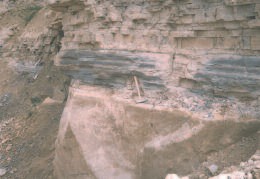
Marl Slate Formation
The Marl Slate, well known since the works of Sedgwick and Hutton in the 19th century as the equivalent of the Kupferschiefer (Copper Shale) of Germany, is the first widespread deposit of the Zechstein Sea. Because of its distinctive and abundant fauna and flora and its unusual content of metallic elements, the formation has been studied in great detail. It was deposited in Lower Permian Times, about 240 million years ago.
The Marl Slate Formation in Great Britain
The Marl Slate can be traced throughout the entire length of the marine Permian outcrop in North-East England. It stretches from north Nottinghamshire, through central and east Yorkshire, County Durham and into the North Sea.
The Marl Slate provides a unique glimpse of the natural history in and around the margins of the Zechstein Sea some 240 million years ago. The unusual lithology and faunal content of the
The Marl Slate Formation in County Durham
The
The well-established name Marl Slate was applied to the formation in the 19th century, although in strict geological terms the rock is neither a marl, nor a slate. The Marl Slate in places includes rounded sand grains and minerals such as sphalerite, galena and chalcopyrite. It has been suggested that some of the fish remains from the south Durham outcrop may be associated with syngenetic mineralisation.
The Marl Slate is present beneath the Magnesian Limestone throughout County Durham. It is thickest, locally exceeding 3.6 metres around Ferryhill and Quarrington Hill, but thins in places to less than 1 metre.
Influence on the landscape and biodiversity
Owing to its limited thickness and outcrop the
Economic use
The Marl Slate in County Durham is nowhere of economic interest.
Wider significance
The Marl Slate is well known for its fauna of fossil fish. It has also yielded important fossil reptiles and plants. Permian fossil fish faunas are very limited in number and distribution world wide. Relatively well-preserved and locally numerous examples from the Kupferschiefer of Germany attracted attention early in the 19th century. Those in the Marl Slate of County Durham were discovered at about the same time and were described a little later. In the past well-preserved specimens were collected from localities such as the Ferryhill Gap and from quarries along the escarpment and there are internationally important collections of the fossils in numerous museums. The quarries south of Middridge have been the source of the best-preserved Permian plants found in England. The railway cutting north of Ferryhill is the type locality of the plant Mixoneura huttoniana (King) (see Fossils and Palaeontology).
Selected references
Hirst and Dunham, 1963; Hutton, 1831; Magraw, 1963; Pattison, 1986; Sedgwick, 1829; Smith, 1970, 1971, 1981, 1994, 1995; Smith and Francis, 1967; Smith et al. 1974; Smith et al. 1986.