Alkaline minor intrusive rocks
I. Parsons
Introduction
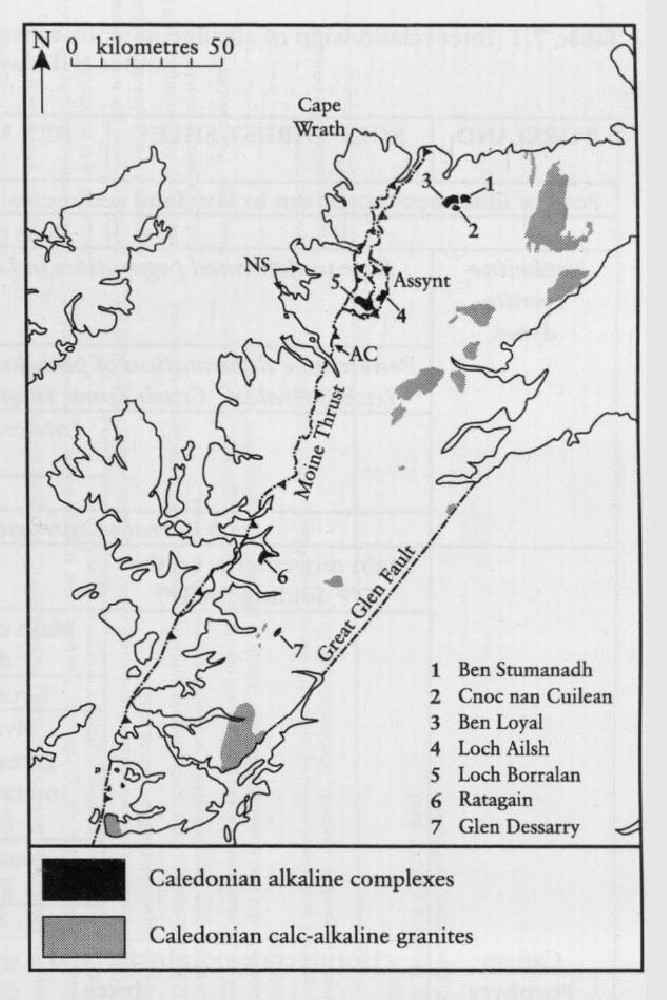
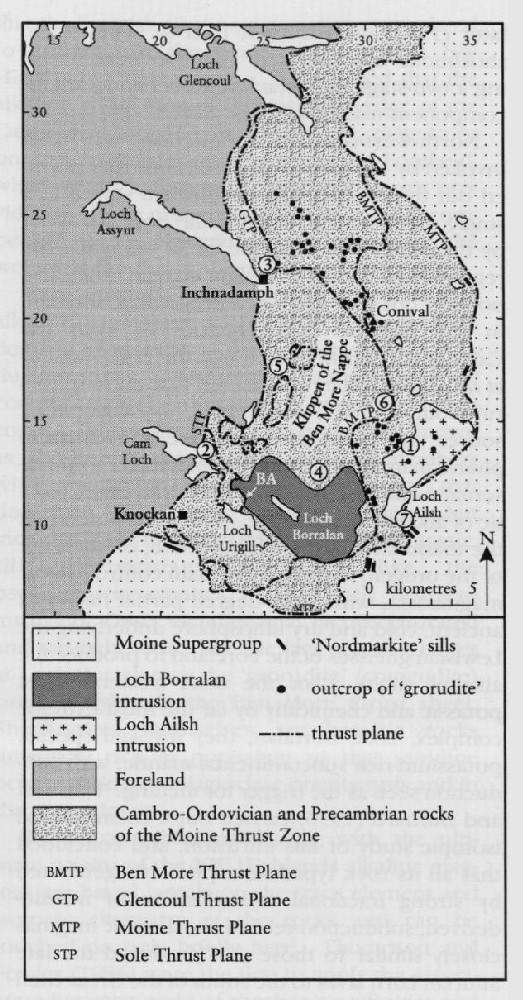
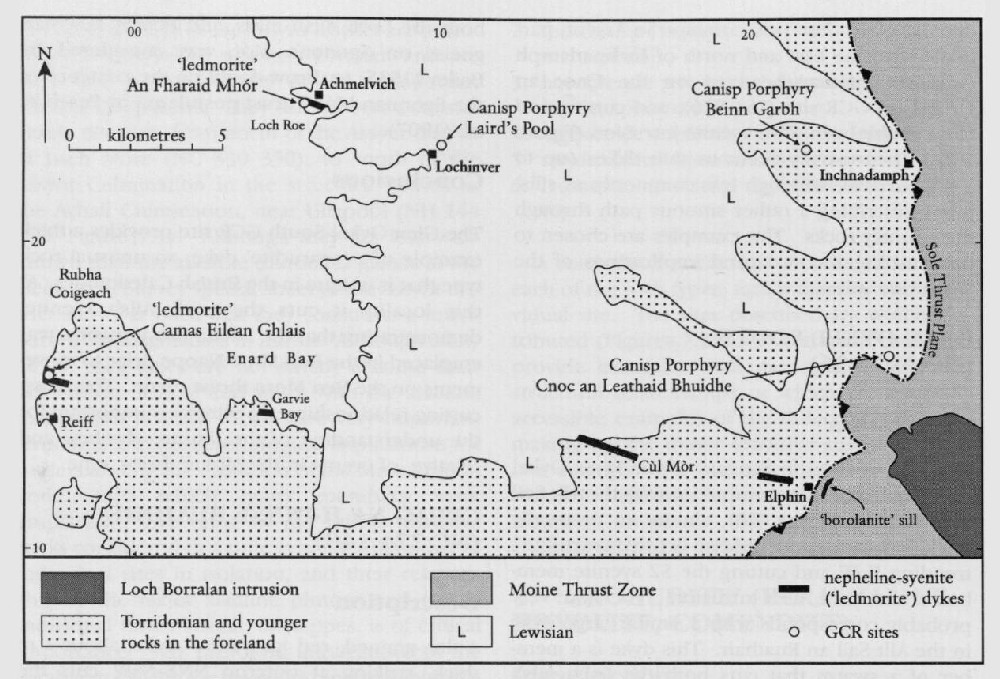
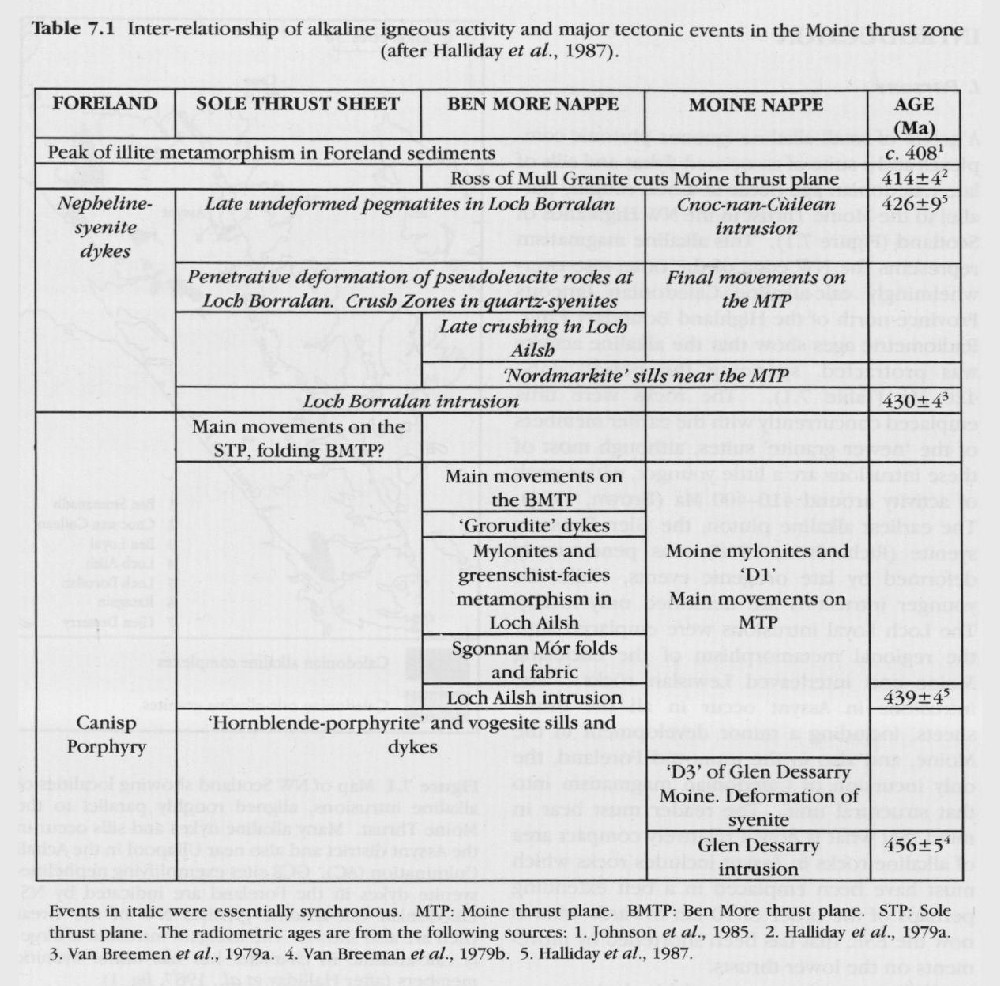
The extensive suite of dykes and sills of alkaline and related rocks in the Assynt district are petrologically unusual in a British context, and are important representatives of the Caledonian alkaline magmatism. They extend over a considerable distance, from north of the Assynt district at Loch More [NC 330 350], to south of the Assynt Culmination in the structure known as the Achall Culmination, near Ullapool [NH 144 953], (Figure 7.1). Although they are less well-known than the alkaline plutons, a glance at the Geological Survey special sheet of the Assynt district shows at once that they constitute a major part of the magmatism in Assynt. Although many of the rock types are not strictly alkaline their association in time and space with the alkaline magmatism is clear. They have very important structural and geochronological implications for understanding the evolution of the Moine thrust zone, into which many members were emplaced. The value of the minor intrusive rocks considered as a suite is greater than that of individual sites in isolation, and their relationship to the major alkaline plutons and to the individual thrust sheets, or nappes, is of critical importance. The profound implications of the alkaline rocks for the magmatic and tectonic evolution of the NW Highlands are discussed in the introduction to this chapter, and the age relationships are summarized in (Table 7.1). The distribution of some of the minor intrusive rock types is shown on (Figure 7.2). The reader is reminded that we are dealing with a region of very considerable crustal shortening, perhaps in excess of 100 km normal to the thrust belt if the Moine Thrust itself is included (Elliott and Johnson, 1980), and that the region involved in the alkaline magmatism must have extended from the unmoved Foreland (where nepheline-syenite dykes are found on the Atlantic coast) to a point many tens of kilometres to what is now the ESE.
The petrography, chemistry and distribution of the dykes and sills was described by Sabine (1953) who also recognized the importance of the suite as structural markers. He recognized six main petrographical types of minor intrusive rock, together with some localized varieties. The sites are grouped below according to the six rock types using the varietal and local rock names adopted by Sabine (1953), with the more usual modern equivalents given where appropriate. The different types are as follows.
- 'grorudite' (peralkaline rhyolite, comendite)
- The Canisp Porphyry (porphyritic quartz-microsyenite)
- 'hornblende porphyrite' (hornblende microdiorite, spessartite)
- vogesite (hornblende-rich lamprophyre)
- 'nordmarkite' (quartz-microsyenite)
- ledmorite' (melanite nepheline-microsyenite)
A common introduction is provided here for each of the rock types, rather than for each individual site. The sites described are widely distributed (Figure 7.2), (Figure 7.13) and were chosen to provide examples with particularly significant structural relationships or which are relatively accessible examples of the different rock types making up the minor intrusive suite. There is one example of a probable diatreme (called a 'volcanic vent' by the early Geological Survey mappers) in Assynt. This is associated with a vogesite sill and is included in that section.
References