Chapter 5 Cambrian rocks of England
A.W.A. Rushton
Introduction
In England, Cambrian rocks mainly occur in association with Precambrian volcanic rocks in small inliers in the Welsh Borderlands and the English Midlands.
The Welsh Borderland
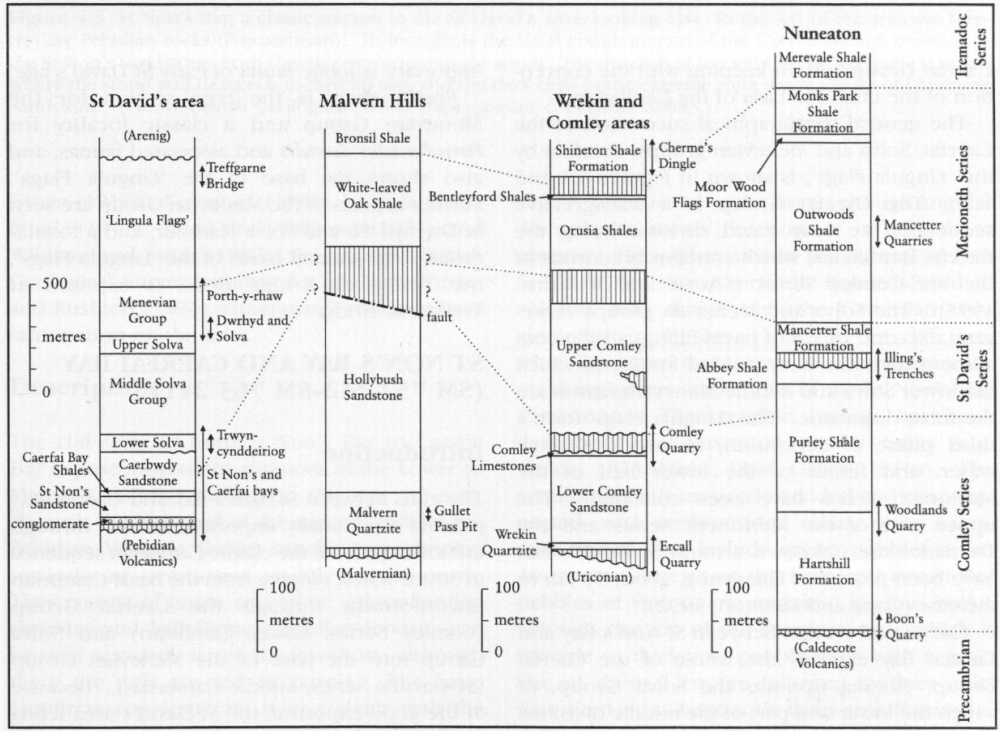
Inliers of Cambrian and Precambrian rocks are brought up along the Church Stretton Lineament and the Malvern Line (Brasier et al., 1992b), the principal outcrops being in the Comley and Wrekin areas of south Shropshire and the Malvern Hills of Worcestershire and Herefordshire. In these areas the successions are mainly of quartzitic and glauconitic sandstones of the Comley and St David's series, overlain by thin black mudstones of the Merioneth, and in all areas there are significant breaks in deposition. The sediments accumulated in shallow water in areas close to active fault-complexes. Apart from the basal strata, most of the succession in the Comley and Wrekin areas is very badly exposed, and practically all the details of the stratigraphy had to be elucidated by trenching (Cobbold, 1927; Cobbold and Pocock, 1934). The accepted succession (summarized by Rushton, 1974) is given in outline in
The Wrekin Quartzite and basal lower Comley Sandstone are exposed in the Ercall Quarry, where both radiometric age-dating and bio-stratigraphy contribute to the relatively good dating of the early Cambrian transgression. The approximately correlative Malvern Quartzite is exposed in the Gullet Pass Pit, where it is fossiliferous. The interesting contacts between the top of the lower Comley Sandstone, the Comley Limestones and the base of the upper Comley Sandstone are present in the Comley Quarry site and the associated 'Excavation No. 2', but none of the overlying divisions is well-enough exposed to have been selected for the GCR site series.
English Midlands
In contrast to the Welsh Borderland, the Cambrian of the English Midlands has substantial sandstone formations only in the lower parts of the Lower Cambrian, as seen in the Nuneaton Inlier of Warwickshire and in the Charnwood Forest area. The Lickey Quartzite, south-west of Birmingham, was formerly referred to the Cambrian but is now regarded as Ordovician (Old et al., 1991). At Nuneaton the sandstones of the Hartshill Formation are overlain by thick mudstone divisions of the
There are few good natural exposures, but the Hartshill Formation was studied when well-exposed in several working quarries (Brasier et al., 1978). The base of the succession is seen at Boon's Quarry, and the upper part, from the