Malvern Hills: localities in The Malverns Complex
Introduction
The
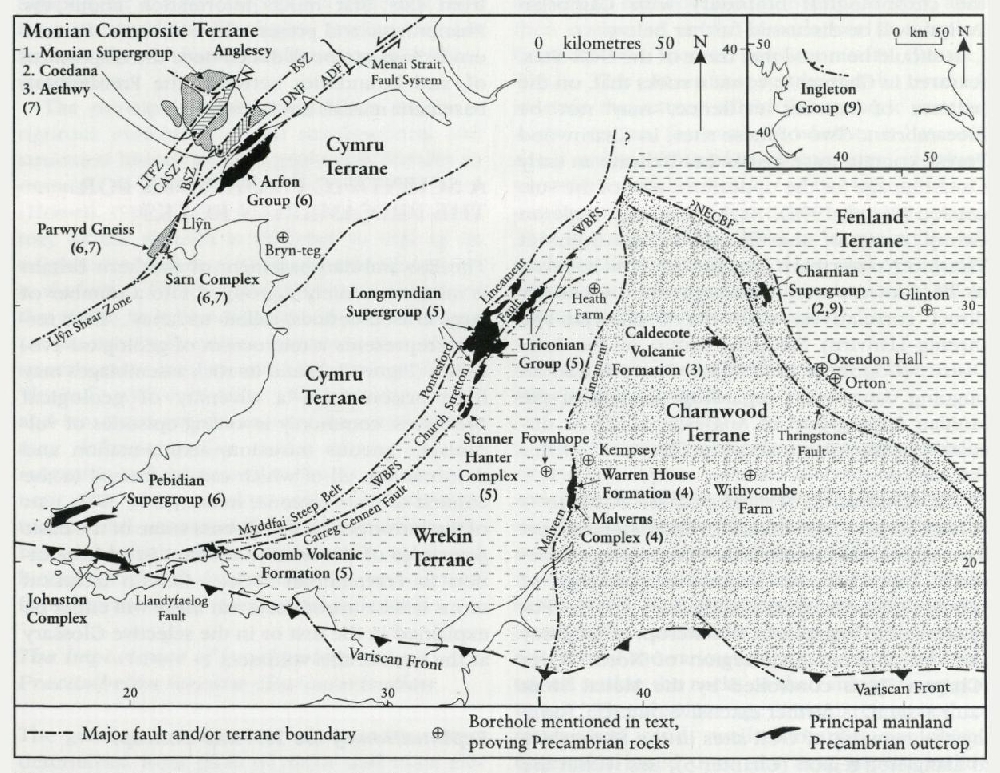
Geochemical analysis provides the most appropriate tool to determine the origins and intrusive settings of the rocks, by comparing stable elements that survived the multi-episode tectonothermal history with their occurrence in igneous rocks formed in modern environments. Geochemical studies are described in Lambert and Holland (1971), Dearnley (1990) and Barclay et al. (1997). They show that the
In many exposures a penetrative foliation is present, locally giving the plutonic protolith a schistose or superficially gneissose appearance. Phyllonitic and mylonitic rocks are also present, associated with ductile shear zones, but the intensity of deformation in the northern Malvern Hills is, in general, less than farther south (Worssam et al., 1989). Mafic and ultramafic rocks are present in minor amounts. Granite occupies the north-western and southern slopes of Worcestershire Beacon, exhibiting a complex relationship to the diorite host (Bullard, 1975, 1989). It is also present in smaller intrusive bodies and sheets elsewhere. Discordant pegmatites post-date most of the ductile deformation, as do mafic bodies on the eastern slopes of North Hill and Worcestershire Beacon. Thin sheets of microdiorite are also discordant to the ductile foliation of the complex.
The most detailed petrography of the complex is that of Lambert and Holland (1971). Diorites and tonalites form about 75 per cent of the outcrop, typically comprising green hornblende and tabular plagioclase (andesine). Relict igneous textures showing interlocking and ophitic feldspar laths and plates, zoned plagioclase feldspars and pseudomorphs after olivine are found in a few specimens of the more mafic diorites (Dearnley, 1990). Accessory minerals include sphene (titanite), apatite and zircon. With increasing grade of deformation and metamorphism, epidote and chlorite replace hornblende, and oligoclase is progressively sericitized, ultimately producing the rock type referred to as epidiorite by Blyth and Lambert (1970) and Lambert and Holland (1971). The range of dioritic rocks is most easily demonstrated in the North Hill quarries
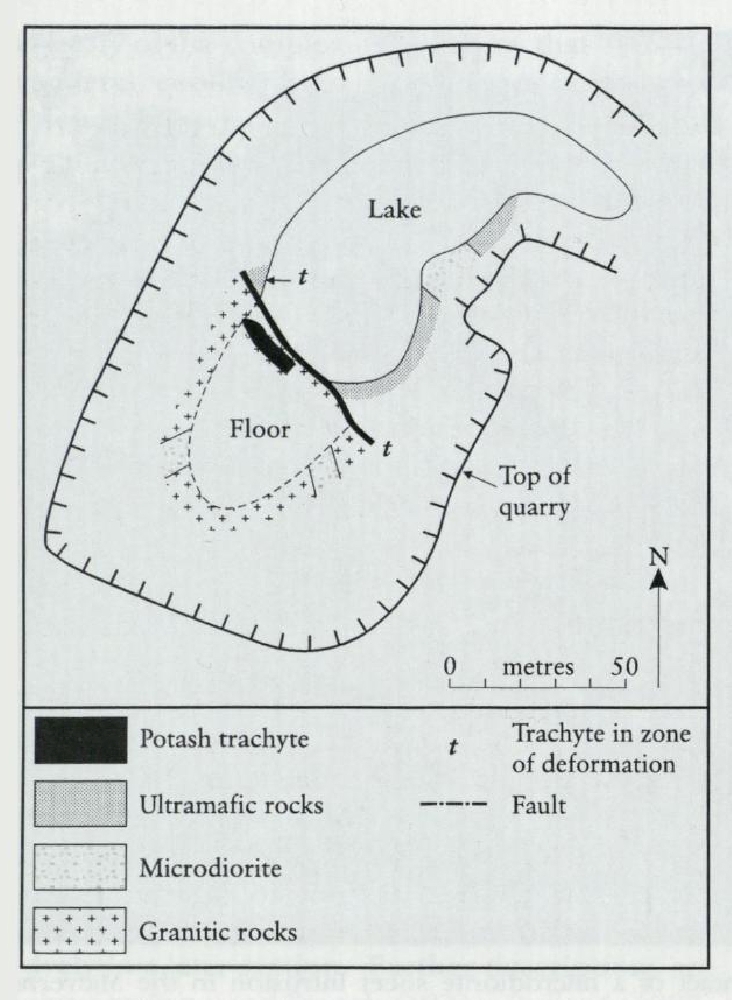
Pegmatites are abundant throughout the complex, ranging from diffuse streaks in diorite to sharply discordant, dyke-like bodies. Potassic (microcline-quartz), sodic (albite-quartz) and granitic varieties have been recognized (Lambert and Holland, 1971). Muscovite is the principal accessory, together with minor amounts of biotite, secondary chlorite and epidote. Emplacement of granitic and pegmatitic bodies into the complex resulted in modification by hybridization and metasomatism. Blyth and Lambert (1970) have documented extensive hybridization between diorites and felsic melts. Metasomatism, involving the elements Na, Ca, K, Mg, Fe and Ti, is most clearly demonstrable in the ultramafic protoliths, such as the biotite amphibolites. A small, alkaline, potash-rich intrusive body of trachytic composition is present in Earnslaw Quarry.
The history of intrusion and deformation of the complex that was proposed by Bullard (1975) followed Brammall and Dowie (1936) in advocating the presence of two distinct phases of granite emplacement. In Bullard's scheme, an initial phase of diorite, tonalite and granite intrusion was closely followed by ductile shearing whilst these rocks were still hot. The emplacement of ultramafic rocks and dolerites next occurred, succeeded by further shearing to produce well-foliated and mylonitic rocks in the south. Acid intrusions, including pegmatites, aplites, granites and felsites were subsequently emplaced, followed by the microdiorite sheets. Variscan thrusting along the western margin of the complex was a major feature of the Phanerozoic deformation of this region. The fabrics produced by the two major shearing events mainly cut across the northerly alignment of the Malverns ridge
Isotopic age dating of the
The low initial 87Sr/86Sr ratio (0.705) of these rocks apparently precludes a prolonged crustal history (Barclay et al., 1997). TDM (model) data obtained by Murphy et al. (1999) suggest, however, that magma generation in the
The Rb-Sr and U-Pb dates indicate that the
Strachan et al. (1996) have published age determinations relevant to the recryztallisation history of the complex. They show that 40Ar–39Ar mineral cooling ages determined from hornblende in metadiorite intrusions constrains the timing of upper greenschist to low amphibolite facies thermal reactivation of the complex to between 649 and 652 Ma; this gives a maximum age for the shearing. Hornblende from a diorite that is net-veined by late pegmatites, which in turn crosscut the mylonitic shear fabrics, yields an age of 610 Ma. This is interpreted to date static thermal rejuvenation associated with pegmatite intrusion and it constrains the minimum age of the shearing. A plateau age of about 597 Ma recorded from muscovite in a greisen vein in granite dates the hydrothermal alteration of the complex.
Locality descriptions
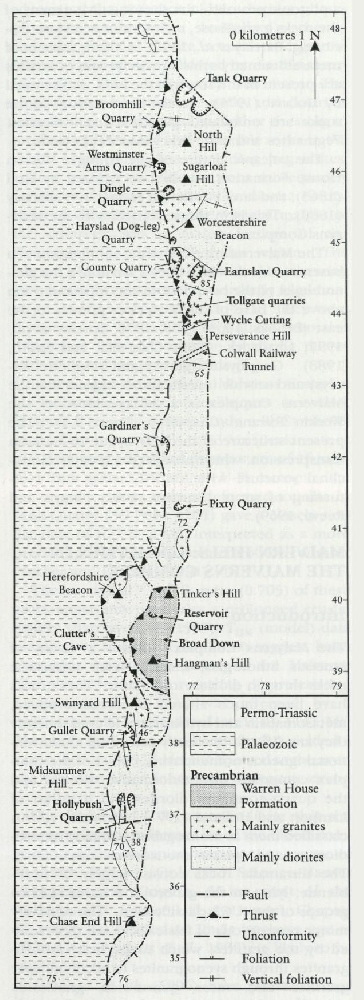
There are numerous large quarries in the Malverns
Tank (North Hill) Quarry
Also known as North Malvern or Pyx Quarry, this exposes mainly hybrid pink and green diorites with some granites. It is one of the most spectacular of the Malvern quarries, forming a notch in the north-eastern slope of North Hill. Originally much deeper, with its walls rising 80 m above the quarry floor, it has been partly infilled with domestic waste.
The rocks are foliated granites and diorites, with an abundance of shear zones in which the igneous protolith is retrogressively metamorphosed to amphibolite and biotite schist. The most prominent foliation is approximately vertical and strikes north-west. Epidote and haematite are common in joints and veins and there are numerous pinkish red, almost flat-lying very coarse-grained pegmatite and fine-grained aplitic veins. The meta-igneous rocks are intruded by microdiorite dykes, one of which was chemically analysed and found to belong to the younger Precambrian magmatic episode mentioned earlier in the introduction to the
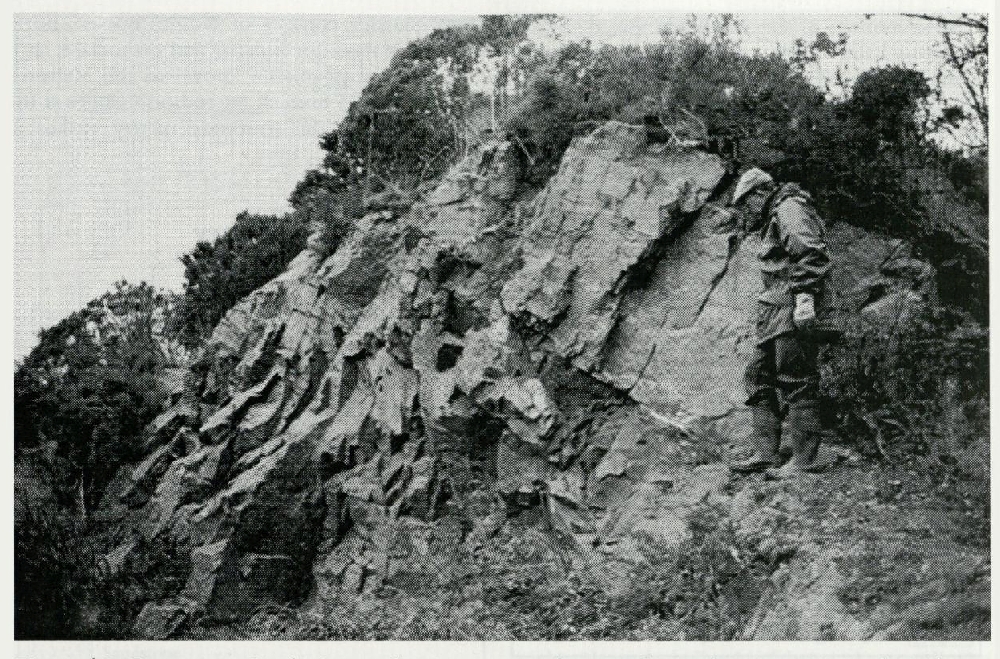
A geology trail at the entrance to the quarry illustrates representative lithologies. Most of the faces are inaccessible and dangerous. Exposures are found along the lower wall of the northwestern face, but at the time of writing, rampant growth of Buddleia bushes has made them inaccessible at all but a few points. A metal ladder down the west slope of the quarry infill gives access to the most westerly of the lowermost exposures. Descending the metal steps, one is confronted by a steeply dipping, NW-trending shear surface in a protolith of broadly dioritic composition. To the south, lineations on the surface plunge moderately to the south; to the north slickensides plunge to the north, indicating a complex history of movement. Halfway between the steps and the north-western end of the quarry, the epidote-veined, feldspathized and hybridized diorite host is intruded by a steeply inclined, NW-trending granite sheet. This has a diffuse, locally banded contact with the diorite on its south side, but a sharp, intrusive contact on its north side, suggesting multiple intrusion. Coarser pegmatite is also apparently intruded into the sheared diorite. Late, flat-lying, 0.15 m-thick pegmatite veins cross-cut all the lithologies. Farther to the north, the diorite is cut by a late (? Variscan) fault zone up to 0.3 m wide, filled with breccia and calcite, and dipping 40° to the NNW.
Dingle Quarry
Dingle Quarry provides a safe, easily accessible locality at which to examine age relationships between some of the
Earnslaw Quarry
Earnslaw Quarry
Thorpe (1971) gave a detailed description of the trachyte. It is a fine-grained, dull grey rock with scattered spots and veins of carbonate. It is composed of a mass of monoclinic potassium feldspar laths showing Carlsbad twinning and alteration to white micaceous minerals. The laths show trachytic alignment around hexagonal, rectangular and anhedral carbonate (mainly) pseudomorphs; chlorite, iron-titanium oxides, a colourless fibrous mineral (possibly chlorite) and quartz also occur. The hexagonal form of some of the crystals may suggest the former presence of nepheline, although the elongation seen in some outlines is consistent with an amphibole. The chilled margin of the intrusion comprises an extremely fine-grained, cryptocrystalline feldspathic base with some angular quartz and microcline xenocrysts and autobrecciated trachyte fragments. Pegmatite-like carbonate pockets occur in the centre of the intrusion and in the highly deformed margin of the granite, which is extensively veined with carbonate.
In the south-eastern corner of the quarry, a microdiorite sheet at least 7 m thick intrudes coarse-grained, pink and green granite. The contact strikes at 150° and dips 60 to 70° to the north-east.
Lower Tollgate Quarry
This is the most northerly of the Tollgate quarries and comprises two sub-quarries
Upper Tollgate Quarry
This quarry (also named Upper Wyche Quarry) is the most southerly of the Tollgate quarries. It exposes mainly pink, massive, foliated microcline granite. The granite is locally mylonitized, with E–W elongation of quartz and biotite. A prominent (? Variscan) shear plane dips about 45° south in the main face and there are prominent steep, east-dipping joints. Small amounts of garnet are recorded and a microdiorite dyke is present in the eastern wall (Lambert and Holland, 1971, pp. 229, 230; Penn and French, 1971, pp. 29, 30).
Wyche Cutting
The Wyche cutting on the B4218
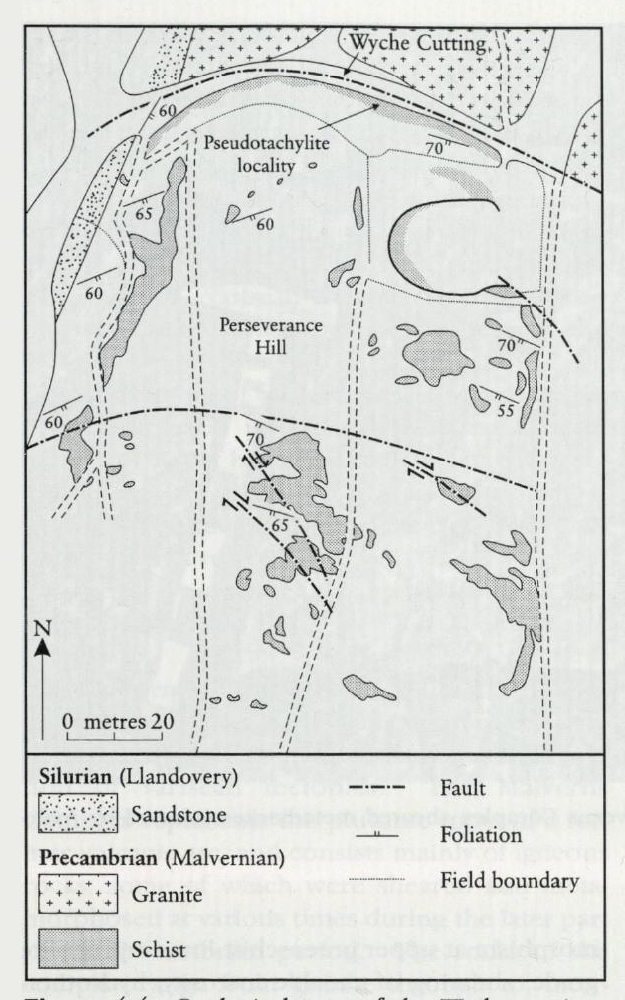
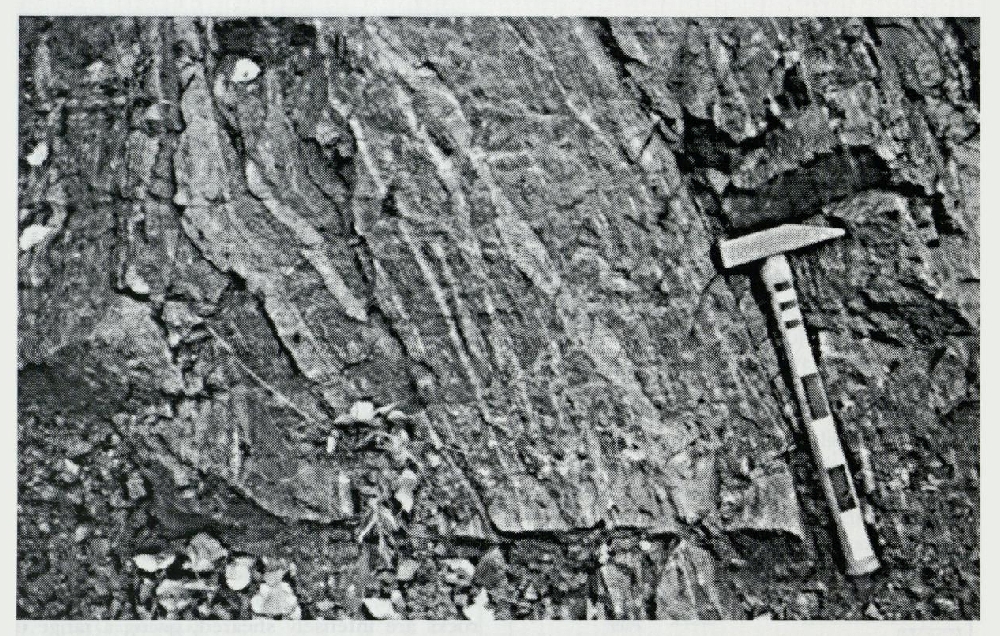
Behind the public toilets at the western end of the cutting, mylonitized granite shows heterogeneous strain effects in which high-strain zones with more intense mylonitic foliation separate boudins of less deformed granite and pegmatite. The mylonites have a low-angle to steeply south-dipping foliation and sub-horizontal lineation on the foliation surfaces. Eastwards, the strike swings to E–W and the dip steepens, reaching vertical in the centre of the cutting. Farther east, the strike swings to ESE with lessening dip. The foliation around this arcuate strike dips towards a point on the northern slope of Perseverance Hill, south of the cutting. The structure was attributed by Brammall (1940) to NNW-directed thrusting, resulting in the schistose diorites being deformed against the buttress of the more competent granite block, and the shear fabrics confirm this interpretation. The granite is also locally sheared, particularly along a gully occupied by a highly sheared dolerite dyke (Penn and French, 1971).
The pseudotachylite occurs in dark veins within intensely sheared, heterogeneous rocks, including tonalite relicts and more competent granite, on the south-eastern side of the cutting
Gullet Quarry
Although many of the faces in this large quarry are inaccessible, there are some accessible sections in the
The quarry was worked on three levels, the lowest now being flooded. On entering the quarry on the second level, a ramp on the northeastern side leading down to the water affords good exposures of the lithologies present. On the south side of the ramp, immediately underneath the car park, chloritic sheared rocks are exposed. On the north side of the ramp, pink granitic veins and sheets intrude the host greenish grey, fine-grained dioritic rocks
The massive, mafic rocks in this quarry were termed epidiorites by Lambert and Holland (1971). They possess a distinct metamorphic texture and consist of about 50 per cent green hornblende, with partly sericitized oligoclase, subsidiary chlorite, epidote, quartz and opaque oxide. It has been suggested that some of these well-foliated rocks are of metasedimentary origin (Bullard, 1989).
Interpretation
The
Thorpe (1987) concluded that the features shown by the pseudotachylite veins the Wyche Cutting are consistent with frictional melting in an episode of high strain during stick-slip or seismic fault motion at relatively shallow depth (possibly less than 4–5 km). This resulted in the rapid injection of the melt into the surrounding mylonitic granite, followed by devitrification and/or hydrothermal alteration and further deformation. Variscan transgression produced the major faulted monoclinal structure of the Malvern Hills that is seen today.
The trachyte of possible Caledonian age in Earnslaw Quarry is unusual in being alkaline (with 13% K20), but geochemical data (Thorpe, 1971; Barclay et al., 1997) indicate that it formed by melting of biotite-rich
Conclusions
The Malvern Hills form one of the largest and best-exposed outcrops of Precambrian rocks in England, and provide a spectacular demonstration of Variscan tectonics. The
Several of the quarries may be highlighted as having unique features, adding to their scientific and educational importance. Dingle Quarry provides a safe, easily accessible, 'hands-on' locality at which to examine the age relationships between some of the igneous components of