Tables
| Former names of units | Current names |
| Middle and Upper Chalk (only Middle Chalk was ever present here) | |
| Middle Chalk (Inoceramus labiatus Zone) | |
| Cenomanian Limestone (Beds A–C) | |
| Bed C of Cenomanian Limestone of authors | Pinnacles Member with Haven Cliff |
| Hardground at top | |
| (Bed B) | Little Beach Member with Humble Point |
| Hardground at top | |
| Grizzle and Wilmington Sand (Bed A2) | Hooken Member (Wilmington Sand facies) |
| Basement Bed (Bed Al) | Basement Bed (inferred Pounds Pool Member equivalent) |
| Lower Cretaceous | |
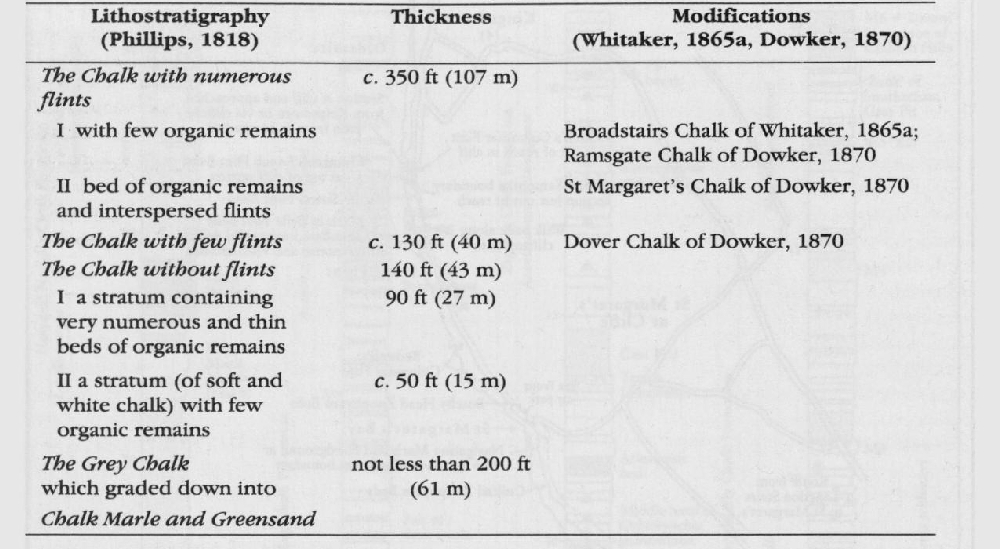
| Lithostratigraphy (Phillips, 1818) | Thickness | Modifications (Whitaker, 1865a, Dowker, 1870) |
| The Chalk with numerous flints | c. 350 ft (107 m) | |
| I with few organic remains | Broadstairs Chalk of Whitaker, 1865a; | |
| Ramsgate Chalk of Dowker, 1870 | ||
| II bed of organic remains and interspersed flints | St Margaret's Chalk of Dowker, 1870 | |
| The Chalk with few flints | c. 130 ft (40 m) | Dover Chalk of Dowker, 1870 |
| The Chalk without flints | 140 ft (43 m) | |
| I a stratum containing very numerous and thin beds of organic remains | 90 ft (27 m) | |
| II a stratum (of soft and white chalk) with few organic remains | c. 50 ft (15 m) | |
| The Grey Chalk | not less than 200 ft | |
| which graded down into | (61 m) | |
| Chalk Marle and Greensand |
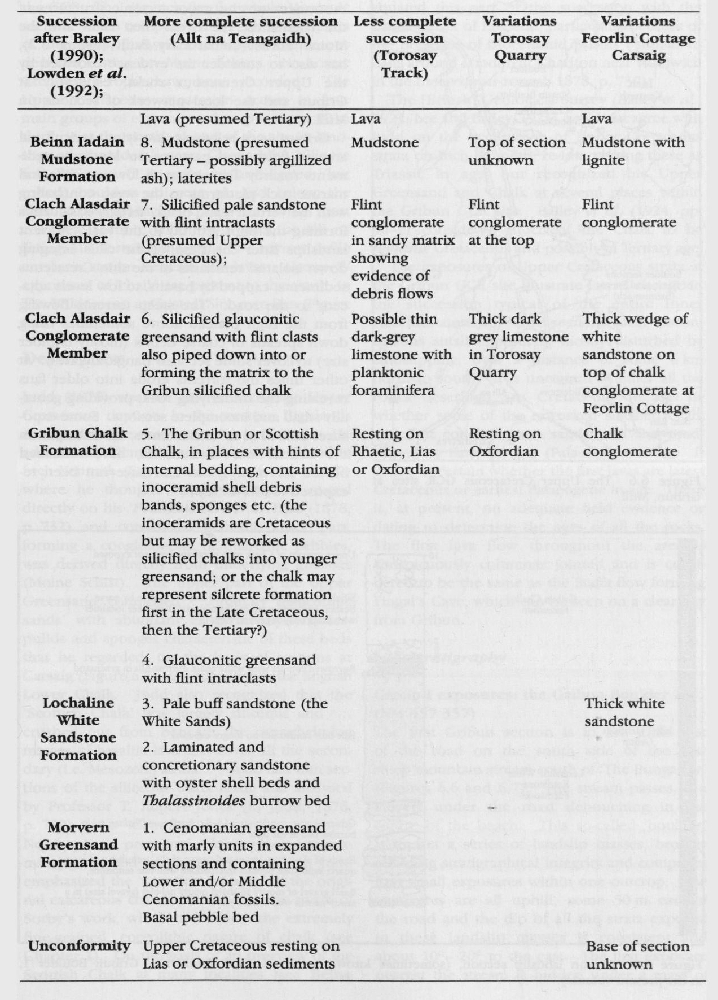
| Succession after Braley (1990); Lowden et al. (1992); | More complete succession (Allt na Teangaidh) | Less complete succession (Torosay Track) | Variations Torosay Quarry | Variations Feorlin Cottage Carsaig |
| Lava (presumed Tertiary) | Lava | Lava | ||
| 8. Mudstone (presumed Tertiary – possibly argillized ash); laterites | Mudstone | Top of section unknown | Mudstone with lignite | |
| 7. Silicified pale sandstone with flint intraclasts (presumed Upper Cretaceous); | Flint conglomerate in sandy matrix showing evidence of debris flows | Flint conglomerate at the top | Flint conglomerate | |
| 6. Silicified glauconitic greensand with flint clasts also piped down into or forming the matrix to the Gribun silicified chalk | Possible thin dark-grey limestone with planktonic foraminifera | Thick dark grey limestone in Torosay Quarry | Thick wedge of white sandstone on top of chalk conglomerate at Feorlin Cottage | |
| 5. The Gribun or Scottish Chalk, in places with hints of internal bedding, containing inoceramid shell debris bands, sponges etc. (the inoceramids are Cretaceous but may be reworked as silicified chalks into younger greensand; or the chalk may represent silcrete formation first in the Late Cretaceous, then the Tertiary?) | Resting on Rhaetic, Lias or Oxfordian | Resting on Oxfordian | Chalk conglomerate | |
| 4. Glauconitic greensand with flint intraclasts | ||||
| 3. Pale buff sandstone (the White Sands) | Thick white sandstone | |||
| 2. Laminated and concretionary sandstone with oyster shell beds and Thalassinoides burrow bed | ||||
| 1. Cenomanian greensand with manly units in expanded sections and containing Lower and/or Middle Cenomanian fossils. Basal pebble bed | ||||
| Unconformity | Upper Cretaceous resting on Lias or Oxfordian sediments | Base of section unknown |