Ditchley Road Quarry, Oxfordshire
R.J. Wyatt
Introduction
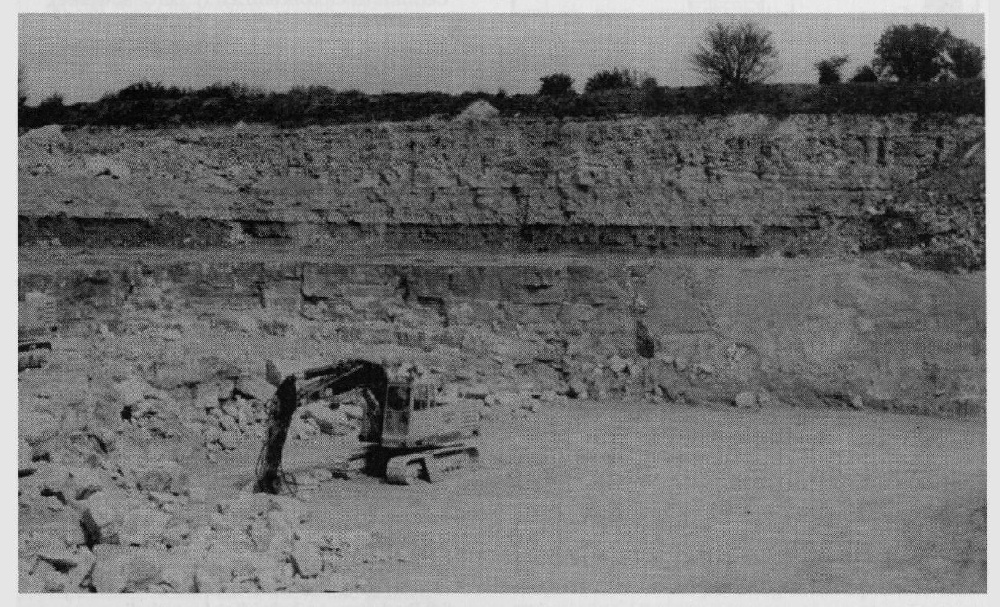
Ditchley Road Quarry, also known as 'Town Quarry', at Charlbury, Oxfordshire, exhibits a fine section ranging from the
Description
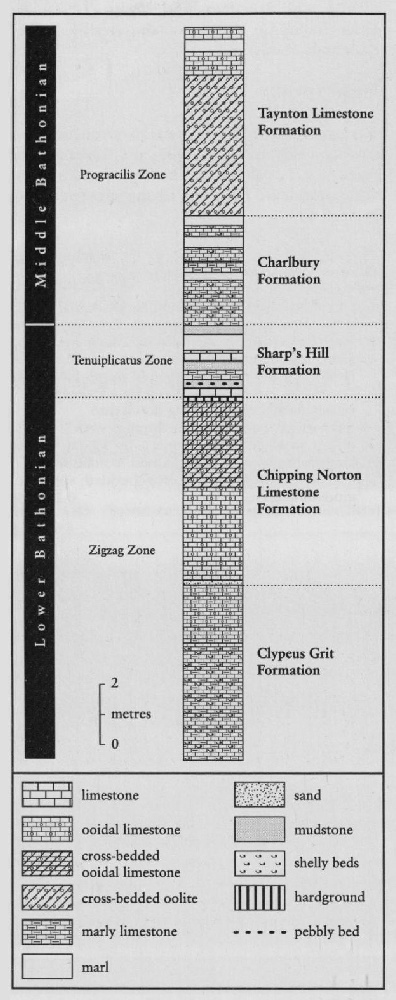
The greater part of the section given below is based on Horton et al. (1987) and Boneham and Wyatt (1993). Details of the
| Thickness (m) | |
| Taynton Limestone Formation | |
| 0.35 | |
| 9: Limestone, grey, fine grained, finely ooidal, flaggy-weathering; locally only sparsely ooidal | 0.40 |
| 8: Marl, brown, finely shell-detrital, thinly bedded, forming prominent bed; small lenses and lenti-cles of fine-grained limestone in upper half | 0.40 |
| 7: Limestone, creamy-grey, fine grained, compact, rubbly weathering; passing down into increasingly ooidal and shell-fragmental rubbly weathering limestone | 0.40 |
| 6: Limestone, fawn, coarse grained, ooidal, shell-fragmental, locally gently cross-bedded; sporadic mudstone clasts | 0.25–0.30 |
| 5: Limestone, buff, weathering to cream, fine-to medium-grained, sparsely ooidal; thinly bedded, locally gently cross-bedded, fissile calcarenite; sporadic, thin, impersistent, laminated, darker-buff marl seams | 0.08–0.15 |
| 4: Oolite, pale-cream, medium- to coarse-grained, shell-fragmental, sparry, with prominent planar cross-bedding; impersistent thin seams of thinly bedded, fissile calcarenite; scattered larger shell-fragments including Praeexogyra hebridica (Forbes); also unbroken shells of small immature bivalves; planar top, undulating base | 0.05–1.00 |
| 3: Limestone, cream, fine-grained, very thinly bedded, fissile calcarenite; locally absent | 0–0.08 |
| 2: Oolite, similar to above but creamy-white and with less prominent cross-bedding but with individual beds showing internal cross-bedding structure | 1.40 |
| 1: Oolite, pale-cream, medium- to coarse-grained, shell-fragmental, sparry, thick-bedded, with large-scale trough cross-bedding; fawn, very hard, 'raggy' in basal 0.15 m, with large shell-fragments including Isognomon; sharp planar base | 1.45 |
| Charlbury Formation | |
| 11: Marl, buff, laminated; clay partings with carbonaceous plant-debris; lenticular beds of shell-detrital, sparry limestone | 0.20–0.32 |
| 10: Limestone, buff, very marly, shell-fragmental, bivalve fauna including Camptonectes, Ceratomya cf. concentrica (J. de C. Sowerby), Eocallista antiopa (Thevenin), Mactromya, Modiolus imbricatus J. Sowerby, Pachymya (Arcomya), Pinna, Pleuromya? and Protocardia cf. stricklandi (Morris and Lycett); also the gastropod Ampullospira stricklandi (Morris and Lycett) and the echinoid Nucleolites woodwardi (Wright) | 0.45 |
| 9: Marl, brown, finely shell-detrital | 0.25 |
| 8: Limestone, brown, ooidal, shell-fragmental, hard, sparry; partings at top and base with many Isognomon shells | 0.30 |
| 7: Limestone, buff, very marly, thinly bedded, fine calcarenite | 0.30 |
| 6: Limestone, fawn, ooidal, shell-detrital, hard, sparry | 0.15–0.30 |
| 5: Marl, brown, with lenses of hard, ooidal, shell-fragmental sparry limestone | 0.23–0.30 |
| 4: Limestone, brown, shell-detrital, slightly marly, banded, hard, with scattered oyster shells; Camptonectes and Antiquicyprina loweana (Morris and Lycett) | 0.18–0.30 |
| 3: Limestone, buff, very marly, Shelly, shell-fragmental, ooidal with abundant Praeexogyra hebridica (Forbes) and other bivalves including Camptonectes (C.) auritus (Schlotheim), Isognomon, Modiolus, Plagiostoma and Pleuromya?; also Kallirhynchia cf. bella S.S.Buckman; an hebridica lumachelle up to 0.15 m-thick locally in middle | 0.55–0.80 |
| 2: Limestone, brown, shell-fragmental, slightly ooidal, hard, sparry; coarsely shell-fragmental at base | 0.16–0.20 |
| 1: Limestone, buff, very marly, shell-fragmental, very shelly, soft, with many bivalves including Camptonectes and Isognomon, and rhynchonellids including Epithyris 'maxillata'of authors, Kallirhynchia bella and K. cf. decora S.S. Buckman; sharp base | 0.15–0.40 |
| 8: Clay, mainly dark bluish-grey with sporadic Placunopsis; crudely layered oyster-shell debris at base | 0.25–0.32 |
| 7: Clay, black, peaty, with abundant white, decalcified, oyster-shell fragments | 0.02–0.03 |
| 6: Marl, brown, shelly, unevenly bedded; abundant Praeexogyra hebridica and Epithyris oxonica Arkell; sporadic Modiolus | 0.55 |
| 5: Limestone, bluish-grey, weathering greenish-buff; shell-fragmental, with crudely bedded oyster-shell debris; oyster-encrusted planar upper surface; thin layer of fibrous gypsum at base | 0.30–0.35 |
| 4: Clay, dark bluish-grey to black, with many carbonaceous plant-fragments, partings of quartz sand and a few streaks of yellowish marly 'race'; abundant Placunopsis in lower part | 0.18–0.40 |
| 3: Limestone, greenish-buff, marly, sandy, shell-fragmental; many bivalves including Placunopsis | 0.20–0.42 |
| 2: Clay, dark-grey, weathering rusty-brown, with lenticles of quartz sand; locally a shell sand or clay with Placunopsis; micritic limestone conglomerate at uneven base | 0.15–0.33 |
| 1: Limestone, pale-fawn, sparsely ooidal, micritic; hard and porcellanous at top; passing down into pale-grey marly, more ooidal limestone with scattered quartz grains and small gastropods (Bathonella?); carbonaceous plant-debris near uneven base | 0.10–0.40 |
| 3: Limestone, cream to white, fine- to medium-grained, shell-fragmental, ooidal; small-scale cross-stratification and rippled surfaces; hard, brownish and recrystallized at top | 3.00 |
| 2: Limestone, pale-cream, fine grained, sandy, finely ooidal; thickly bedded and compact | 3.10 |
| 1: Sand, orange-brown, marly, with impersistent limestone ribs; shell debris and shells | 0.10–0.15 |
| Clypeus Grit Formation | |
| 7: Clay with Stiphrothyris globata (of authors) | 0.05–0.15 |
| 6: Limestone, cream, marly, ooidal, sparsely pisolitic | 1.80 |
| 5: Limestone, pale-orange to cream, soft, marly, shell-fragmental | 0–0.10 |
| 4: Limestone, yellowish-cream, marly, ooidal, shell-fragmental; many brachiopods and bivalves | 0.50–0.75 |
| 3: Limestone, creamy-fawn, marly, fine grained, sparsely ooidal; many brachiopods, bivalves, some gastropods; two thin beds of sand | 2.13 |
| 2: Limestone, pale-brown and buff, soft, very marly, shell-fragmental, sparsely ooidal | 0.90 |
| 1: Limestone, brown, hard, marly, sparsely ooidal, shell-fragmental | seen to 0.25 |
Boreholes drilled in the floor of the quarry proved a further 5.8 m of the Clypeus Grit Formation, indicating a total thickness of 11.7 m for the formation.
Interpretation
The succession in Ditchley Road Quarry records a period in which depositional environments varied between shallow-water, unrestricted, carbonate shelf-sea; marine, quiet-water, protected, carbonate lagoon; and brackish-water, near-shore, sub-littoral mudflat.
At the base of the succession, the micritic matrix of the Clypeus Grit Formation suggests a generally low-energy environment in which the deposition of carbonate mud was dominant. It is inferred that the matrix-supported ooids and pisoids were washed into the depositional area from nearby sources during higher-energy events. A stable substrate encouraged the development of a large and varied, sessile and motile bivalve–brachiopod fauna, as well as species of shallow-burrowing echinoids.
The ooidal limestones of the overlying
The
The strata of the Charlbury Formation have formerly been included with the
The succeeding
The section at Ditchley Road Quarry has yielded no fossils of special biostratigraphical significance. However, the stratigraphy of a comparable nearby succession at Stonesfield (Boneham and Wyatt, 1993; see GCR site report, this volume) allows it to be dated satisfactorily. The
Conclusions
Ditchley Road Quarry currently reveals a varied lithological succession ranging from the Lower Bathonian