Foss Cross, Gloucestershire
M.G. Sumbler
Introduction
The quarry at the Foss Cross GCR site exposes strata in the middle part of the
Description
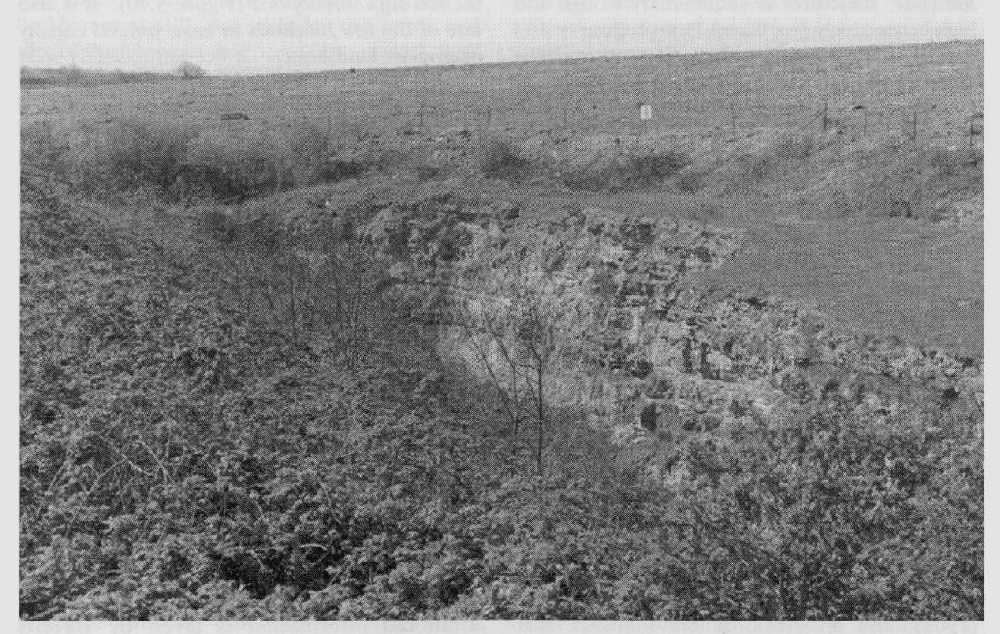
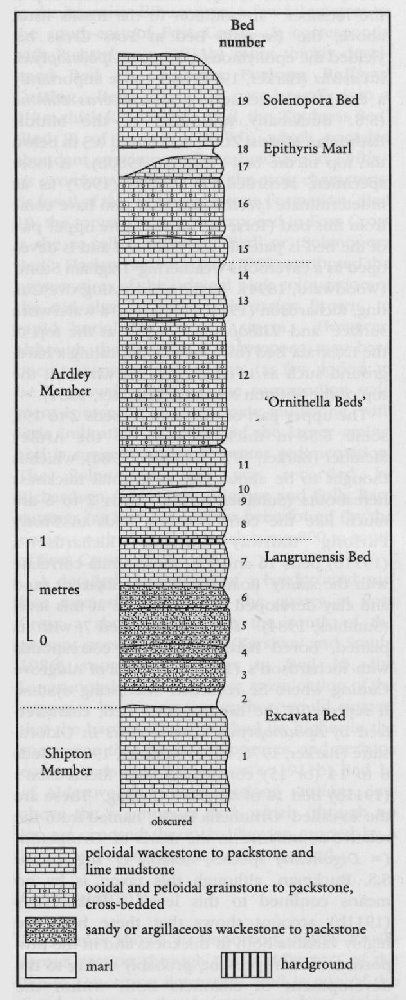
Although most of the quarry at Foss Cross is now infilled by tipping, the face constituting the GCR site is preserved in the centre of the tipped area (
| Thickness (m) | |
| 19: Solenopora Bed: Limestone, white to buff, rubbly, wackestone with scattered yellow peloids more abundant towards base; occasional large bivalves and pink/white-banded algal masses; Solenopora jurassica Brown, ramose coral fragments, bryozoan fragments, Avonothyris?, Digonella digonoides S.S. Buckman, Epithyris oxonica Arkell, Kallirhynchia sp., Plagiostoma subcardiiformis (Greppin), Stiphrothyris capillata Arkell | 0.95 |
| 18: Marl, fawn with occasional bivalves; Kallirhynchia sp., Epithyris oxonica Arkell, Lopha sp., Plagiostoma subcardiiformis (Greppin) | 0.08 |
| 17: Limestone ('Dagham Stone'); brown, recrystallized wackestone with scattered peloids, becoming softer and marly towards base; uneven top | 0.22 |
| 16: Limestone, white to buff, well-sorted, cross-bedded, ooidal grainstone, flaggy weathering with harder recrystallized shell concentrations in basal 0.3 m | 0.60 |
| 15: Limestone, white to brown, hard, recrystallized wackestone, with abundant large yellow peloids; forming prominent bed in the face | 0.25 |
| 14: Marl, pale-grey and buff banded, with abundant peloids and shell fragments; sporadic oysters, brachiopods and limestone concretions; Chomatoseris sp., Kallirhynchia spp. including forms comparable with S.S. Buckman's dromio, obtusa and oxoniensis, Digonella digonoides S.S. Buckman, Epithyris oxonica Arkell, Stiphrothyris cf. capillata Arkell, Anisocardia sp., Camptonectes (Camptonectes) laminatus (J. Sowerby), C. (Radulopecten) vagans (J. de C. Sowerby), Ceratomya striata (J. Sowerby), Corbula hulliana Morris, Limatula sp., Liostrea cf. undosa (Phillips), Lopha gregarea (J. Sowerby), Pholadomya lirata (J. Sowerby), Plagiostoma sp., Pleuromya?, Tancredia?; nerineid gastropod | 0.25 |
| 13: Limestone, white to brown, wackestone with scattered peloids becoming more abundant in parts, and grading to packstone or grainstone; sporadic pods with abundant bivalves and gastropods; highly burrowed top with marl-filled burrows; Epithyris sp., Clypeus sp., ostreid fragments, Plagiostoma subcardiiformis (Greppin), Eunerinea eudesii? (Morris and Lycett), Fibuloptyxis cf. witchelli (Cox and Arkell), Globularia sp. | 0.30 |
| 12: Limestone, buff, soft, poorly sorted, peloidal and ooidal packstone to grainstone; cross-bedded in parts; several thin partings of grey marl, including one at base | 1.30 |
| 11: Limestone, buff, poorly sorted, peloidal packstone; locally a poorly developed 'Dagham Stone' | 0.40 |
| 10: Marl, buff | 0.05 |
| 9: Limestone, brown, hard, wackestone with scattered peloids | 0.15 |
| 8: Limestone, buff and white mottled wackestone with scattered peloids; persistent marl parting for 0.01 m at base | 0.33 |
| 7: Limestone, upper part a hard, recrystallized burrowed Dagham Stone' with sharp, bored hardground top surface cutting across fossils; passing down into softer, grey, lime mudstone; Chomatoseris sp., corals, echinoid fragments, Camptonectes sp., Cosa gervillia crassicosta (Morris and Lycett), Falcimytilus sublaevis (J. de C. Sowerby), Inoperna sp., Liostrea cf. undosa (Phillips), Liostrea sp., Lopha sp., Lucina bellona d'Orbigny, Isognomon (Mytiloperna) bathonicus (Morris and Lycett), Modiolus imbricatus J. Sowerby, Pholadomya lirata (J. Sowerby), Plagiostoma cardiiformis J. Sowerby, P. subcardiiformis (Greppin), Pleuromya sp., Protocardia sp., Pteroperna sp., Quenstedtia sp., Trigonia sp., nerineid and nerinellid gastropods including Aphanoptyxis?, Bactroptyxis implicata (d'Orbigny), Eunerinea arduennensis (Buvignier), E. eudesii (Morris and Lycett) and Fibuloptyxis witchelli (Cox and Arkell) | 0.48 |
| 6: Limestone, grey to brown, soft, crumbly, slightly bituminous, peloidal wackestone; locally marly at base | 0.20 |
| 5: Limestone, grey, hard, splintery, peloidal and shell-fragmental, slightly sandy wackestone to packstone; prominent bed in face | 0.37 |
| 4: Limestone, greyish-brown, argillaceous, bituminous, soft and crumbly, with rippled laminae of clay | 0.15 |
| 3: Limestone, peloidal and shell-fragmental, sandy wackestone to packstone, with grainstone patches; locally fairly hard and recrystallized | 0.33 |
| 2: Marl, grey to white banded, sandy and ooidal | 0.17 |
| Shipton Member | |
| 1: Limestone, white and cream with buff mottles, massive to rubbly; very sparsely peloidal wackestone with abundant fossils, mainly bivalves and corals; intensively bioturbated; topmost 0.3 m to 0.5 m hard and recrystallized, and upper 0.2 m a good Dagham Stone' with soft marl-filled burrows; Chomatoseris porpites (Wm Smith), Montlivaltia sp., thecosmiliid coral, Anisocardia?, Camptonectes sp., Isocyprina sp., Lucina bellona d'Orbigny, Pleuromya?, Protocardia stricklandi (Morris and Lycett), Pterocardia pesbovis (d'Archiac), Trigonia?, Eunerinea sp., Fibuloptyxis witchelli (Cox and Arkell), Globularia cf. formosa (Morris and Lycett), trochid and other gastropod fragments; lower part now obscured | max. seen 1.90 |
Interpretation
The basal 1.9 m of the section (Bed 1) are assigned to the
The upper part of the section (beds 2 to 19), some 6.58 m thick, belongs to the
The cross-bedded, flaggy-weathering oolite of Bed 16 is the typical lithology of the middle and upper parts of the
A detailed description of a hardground surface formerly exposed in the quarry at Foss Cross a short distance to the south of the present preserved section (Kershaw and Smith, 1986) supposedly relates to Bed 15, the Langrunensis Bed. However, examination of the exposure by the present author would suggest that the hardground described lay higher in the succession than present exposures, and perhaps corresponds with Richardson's (1911b) Bed 11 of Aldgrove and Stony Furlong cuttings, just above the Solenopora Bed, which (though no longer exposed there) is likewise capped by a bored and oyster-encrusted hardground.
Conclusions
Foss Cross shows an important, highly fossiliferous section through the middle part of the