Gutterford Burn, East Lothian and Midlothian
Derek J. Siveter
Introduction
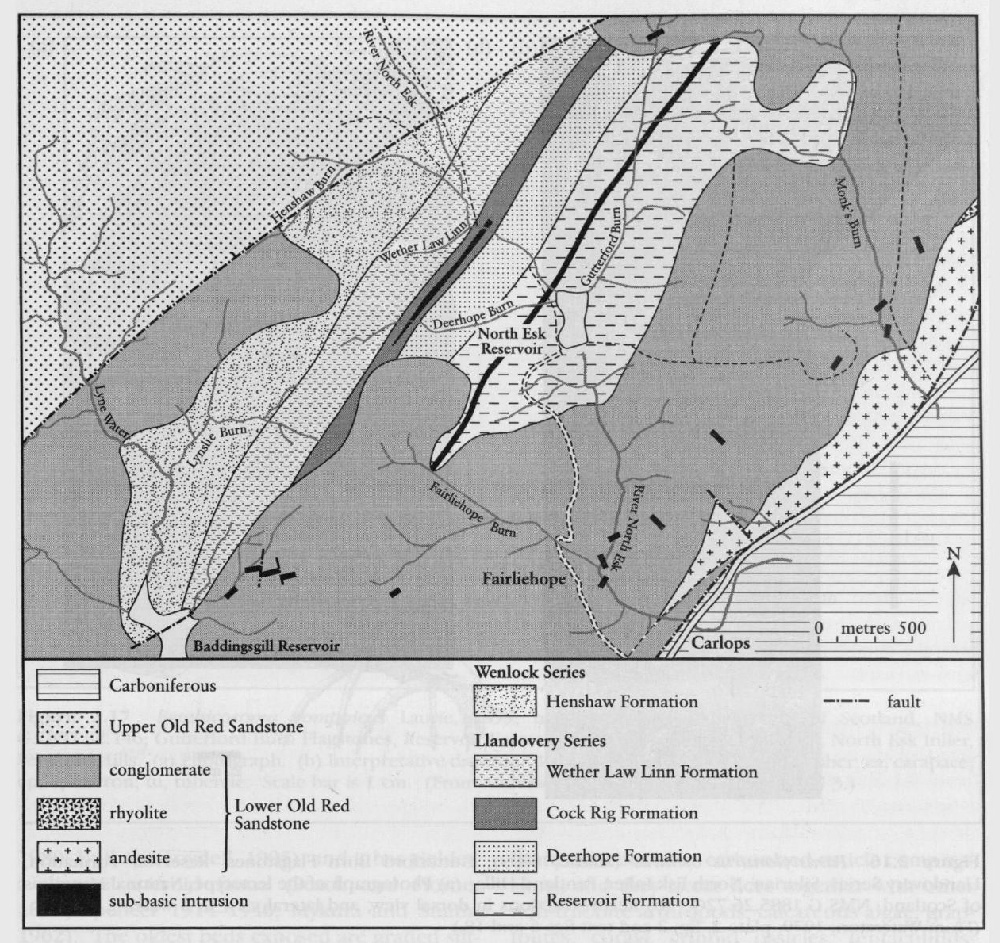
This Midland Valley of Scotland site lies within the North Esk Inlier, the largest of three Silurian inliers in the Pentland Hills, some 25 km southwest of Edinburgh (see
Notes on the geology of the Pentland Hills, by Maclaren, were published as early as 1839. Subsequently, in the third quarter of the nineteenth century, Howell and Geikie (1861), Haswell (1865), Brown and Henderson (1867) and Henderson and Brown (1870) all contributed towards an understanding of the geological succession of the area, and the papers of the last two of these authors included publication of the first detailed geological map. Since then there have been numerous works on various aspects of the geology and palaeontology of the Pentland Hills. Amongst the more notable of these are comments in the benchmark work on the Silurian geology of Scotland by Peach and Horne (1899); the work of Lamont (1947a, 1947b, 1952) who determined much of the sequence here to be Llandovery in age and the youngest rocks to be Wenlock; remapping by Mykura and Smith (1962), and by Tipper (1976) who also established most of the modern lithostratigraphy for the Silurian of North Esk; palaeoecological work by Tipper (1975) and Robertson (1999); and the palaeoenvironmental interpretations of Robertson (1989, 1999) and Clarkson et al. (2001). The Silurian succession and fossils of the area have also featured in various field guides, such as those of Mykura (1986), Robertson (1983, 1986), and Clarkson and Taylor (1989), and historical overviews, for example that of Clarkson (2000).
Gutterford Burn has been known as an outstanding locality for fossil arthropods since Henderson and Hardie made excavations there in the 1890s, the abundant material from which was described and discussed at that time by Laurie (1892, 1893, 1899). A diverse eurypterid fauna dominates the non-trilobite arthropod fauna from this locality, of which the stylonuroids are perhaps the most notable, but it also contains one of the earliest scorpions, a xiphosuran chelicerate, a phyllocarid crustacean species, and arthropod material of uncertain affinity (Peach and Horne, 1899; Petrunkevitch, 1949; Lamont, 1955; Waterson, 1962, 1964, 1979; Plotnick, 1999; Anderson and Moore, 2004; Tetlie, 2006b). In July 2003 new excavations and collections were made at the site (Anderson, 2003; Anderson and Moore, 2004). The detailed results of this re-investigation of the Gutterford Burn Eurypterid Bed are contained in a paper by Anderson et al. (2007) that was in press at the time of writing, but it has not been possible to incorporate these into the present site report, nor the information contained in the field guide by Clarkson et al. (2007), nor, in the main, the conclusions from a new study of one of the eurypterids from here (Tetlie et al., 2007).
In addition to its importance for the study of early arthropods, Gutterford Burn has significance for Silurian (Llandovery Series) geology in general within the Pentland Hills and thus the north-eastern part of the Midland Valley, and has been included in a GCR volume on Silurian stratigraphy (Aldridge et al., 2000). In addition to the fossil arthropod importance of this site, the area is also independently selected for the GCR for the Palaeozoic Palaeobotany, Carboniferous–Permian Igneous Rocks, Carboniferous–Permian Fish/Amphibia and Westphalian selection categories (Cleal and Thomas, 1995, 1996; Dineley and Metcalf, 1999, Stephenson et al., 2003).
Description
The Silurian strata of the North Esk Inlier dip steeply to vertically, they have a strike of 030–040°, and they young to the WNW
Gutterford Burn itself trends roughly north to south and runs into the north-east corner of North Esk Reservoir. The strata of the GCR site lie entirely within the
| Thickness (m) | |
| (iv) grey to olive mudstones with laminae of siltstone and thin beds of flaggy sandstone near the base | 200 + |
| (iii) flaggy buff or dark grey grits interbedded with grey mudstones ( |
120 |
| (ii) mudstones and silty mudstones with laminae of siltstone and rare beds of flaggy greywacke (Gutterford Burn Mudstones) | 125 |
| (i) fine-grained grits and siltstones in units up to 20 m thick, alternating with units of interlaminated mudstone and siltstone | 50 + |
Overall, the
The eurypterids are concentrated within the Eurypterid Bed, which occurs near the top of the
The asteroid fauna occurs in two horizons in transitional strata between the Gutterford Burn flagstones and the overlying, mainly argillaceous beds. Trilobites, brachiopods and graptolites are also known from these transitional beds.
Interpretation
Palaeoenvironmental analysis initially indicated that the Reservoir through to Cock Rig formations were essentially deposited as part of a submarine fan system (Robertson, 1989), though this interpretation is now thought to be at best equivocal, and that more probably this part of the sequence represents in general basin-fill or distal storm deposits of shallow-water origin, with the
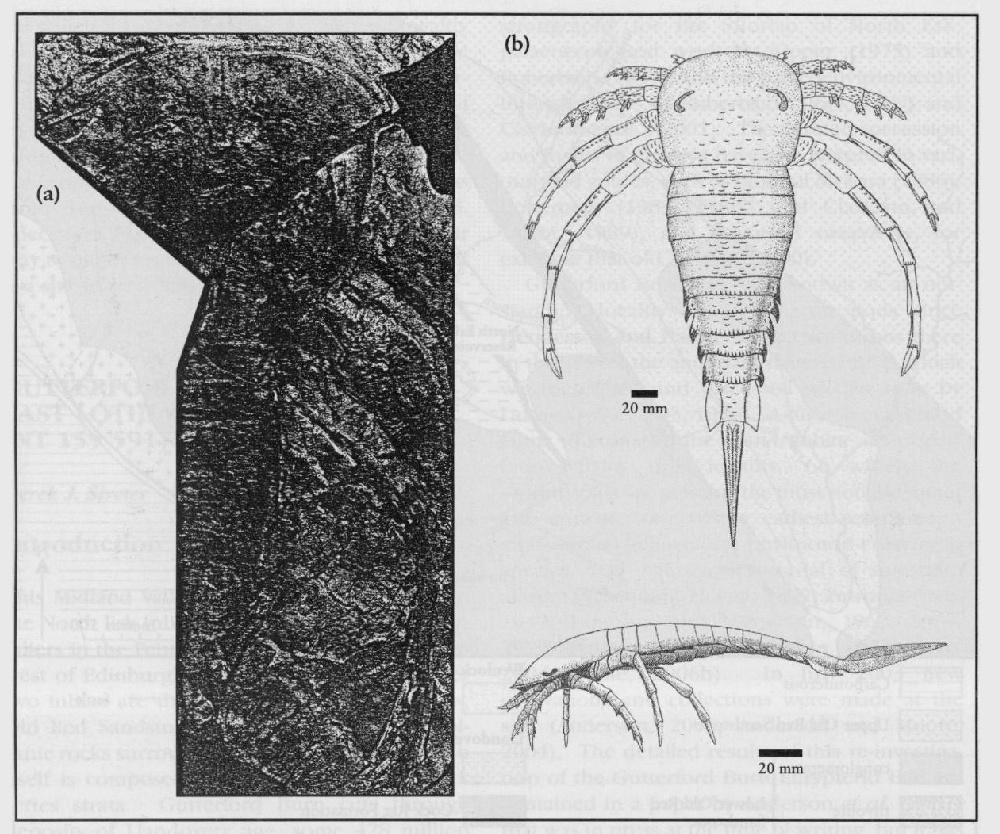
Within the context of chelicerate studies Scottish Siluro–Devonian localities have become renowned for yielding a diversity of stylonuroid eurypterids, and foremost among these sites is Gutterford Burn. Stylonuroids are characterized by their long fifth and sixth prosomal appendages, narrow abdomen, and long and styliform telson (Waterston, 1979), the form of their prosomal legs being considered a diagnostic character uniting the group in one overview of eurypterid classification (Tollerton, 1989).
They are claimed to have been able to walk on their long, stilt-like legs, and some species have even been suggested as capable of doing so on the shore, though undoubtedly most were aquatic (see Størmer, 1934; Waterston, 1979; Selden, 1984).
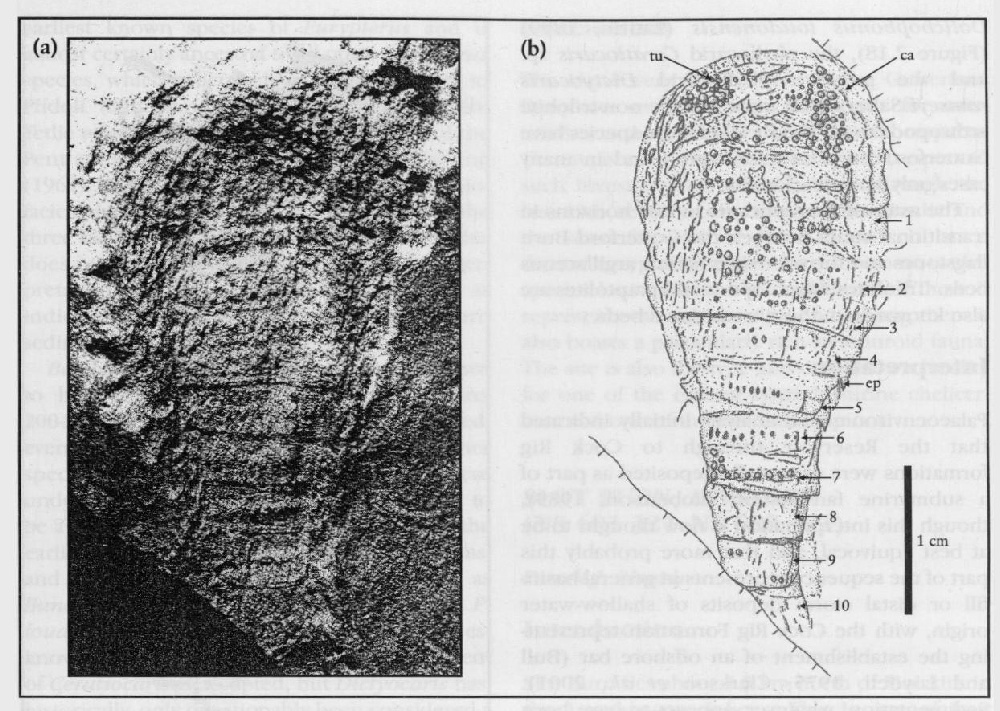
With the re-assignment of Eurypterus cyclophthalmus to Kiaeropterus, E. minor is now the earliest known species of Eurypterus and is almost certainly ancestral to all other Eurypterus species, which collectively span the Wenlock to Přídolí (Silurian) time interval (Tetlie, 2006b; Tetlie et al., 2007). The eurypterid fauna of the Pentlands was placed by Kjellesvig-Waering (1961) in his Hughmilleridae–Stylonuridae biofacies phase, purportedly the least marine of the three biofacies identified by him. However this does not appear to be consistent with the interpretation of the environment of deposition, as indicated above, for the Gutterford Burn sediments.
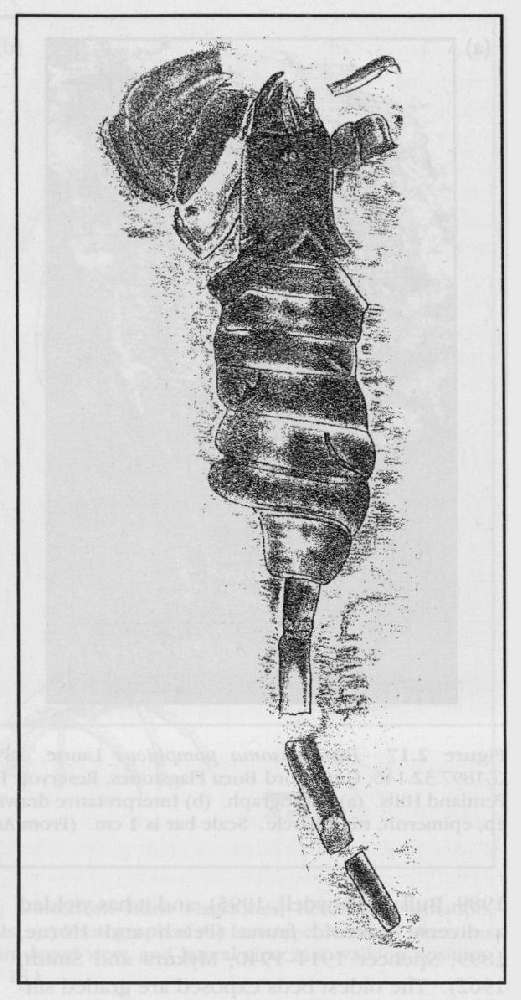
Bembicosoma pomphicus was recently shown to be a xiphosuran (Anderson and Moore, 2004), as Laurie (1899) originally suspected, even though he described it together with other species from the Pentland Hills that were undoubtedly eurypterids. It is now believed to be a 'synziphosurine', thus making it one of the earliest of this loose grouping of xiphosurans, and has been placed in the same family as Bunodes, Limuloides and Pasternakevia. P. loudonensis, similarly, is one of the earliest known scorpions. The phyllocarid assignment of Ceratiocaris is accepted, but Dictyocaris has, historically, only questionably been considered a phyllocarid and it remains essentially of unknown affinity.
In general the invertebrate fauna of the Reservoir and Deerhope formations appears to be biogeographically discrete, as it is largely distinct from that found in the Girvan area to the west, and from elsewhere in Britain. The younger
Gutterford Burn has particularly close arthropod network links with the other eurypterid rich Siluro-Devonian Midland Valley sites of Slot Burn, Dunside, and Turin Hill. It contains, however, an especially rich stylonuroid fauna unmatched elsewhere. Ties are also present with the Ludlow through to Přídolí series Anglo-Welsh arthropod sites of Church Hill, the Whitcliffe, Ludford Lane and Ludford Corner, Tin Mill Race, Perton Lane, and Bradnor Hill. All of these have important eurypterid faunas but stylonuroids are almost entirely absent from them.
Conclusions
The Llandovery Series rocks of the Gutterford Burn site are extremely important for non-trilobite arthropod research in several respects. The site is a key historical locality with respect to such investigations, made famous through the late 19th century collecting of John Hardie and the scientific work of John Laurie. It has a diverse eurypterid fauna — there are some twelve species known from here and for all of these it represents the type locality, and among them it also boasts a particularly rich stylonuroid fauna. The site is also the type and only known locality for one of the earliest synziphosurine chelicerates and one of the earliest scorpions.