Porth Ceiriad
Highlights
This locality with its periglacial sediments above and below glacial till may show that this part of Llŷn was glaciated by confluent Irish Sea and Welsh ice during the Late Devensian, but lay in a periglacial area beyond the western limit of a later advance of Welsh ice.
Introduction
Porth Ceiriad is an important coastal exposure which shows that the St Tudwal's Peninsula may have been a zone of transition between Irish Sea and Welsh ice masses during the Late Pleistocene. The sections were first noted by Ramsay (1881) and have since featured in studies by Jehu (1909), Saunders (1967, 1968a, 1968b, 1968c, 1973) and Whittow and Ball (1970).
Description
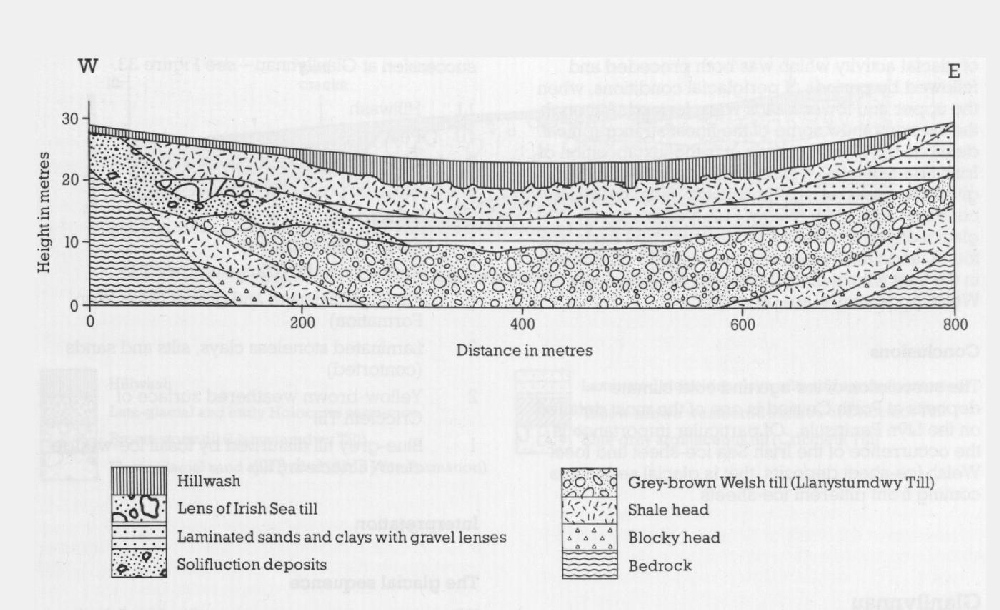
The sections at Porth Ceiriad extend laterally for about 700m, and they reach a maximum height of 30m. Whittow and Ball (1970) recorded the following generalised sequence, shown in
6 Hillwash
5 False-bedded shale head (cryoturbated)
4 Solifluction deposits
3 Grey-brown non-calcareous Welsh till
2 Fine shale head
1 Blocky head
Bed 4 contains a large lens of calcareous Irish Sea till, reworked Welsh till from bed 3 and beds of laminated clays and sands with gravel lenses.
Interpretation
Although Ramsay (1881) described the head deposits at Porth Ceiriad as an angular breccia of post-Tertiary age resting on slaty strata, Jehu (1909) was the first to describe the sections in detail. He noted that many of the boulders and pebbles in the till were of Welsh origin although other farther-travelled, probably Irish Sea, erratics were also recorded. He regarded the till at Porth Ceiriad as representing the Upper Boulder Clay of his tripartite succession, representing the most recent of two glacial advances in Llŷn.
The sections at Porth Ceiriad were next studied by Saunders (1967, 1968a, 1968b, 1968c, 1973). Using pebble lithology and till fabric measurements, he ascertained that the till at Porth Ceiriad (bed 3) had been deposited by Welsh ice moving from northeast to south-west. This suggested that when the Welsh till was deposited at Porth Ceiriad, the area to the west was probably free from Irish Sea ice, which otherwise would have caused a major southward deflection of the Welsh ice-sheet. The Welsh till was therefore considered younger than the main Irish Sea till (Trevor
These correlations were not, however, accepted by Whittow and Ball (1970) who suggested that the Welsh till at Porth Ceiriad belonged to the first of the recognised glacial advances in Llŷn and could therefore be correlated with the lower of the Welsh tills on the south Llcal coast, at Criccieth (Morannedd) and Glanllynnau (the Criccieth
Porth Ceiriad is particularly important for showing evidence for the interactions and movements of the Irish Sea and Welsh ice-sheets in south-west Llŷn during the Late Devensian.
Saunders originally presented lithological and fabric data to correlate the Welsh till at Porth Ceiriad with the upper of two tills found farther east along the south Llŷn coast, the Llanystumdwy
The absence of an upper till at Porth Ceiriad that could be correlated with the Welsh Llanystumdwy
The stratigraphic record at Porth Ceiriad is difficult to interpret although it would appear that the sequence contains evidence for at least one phase of glacial activity which was both preceded and followed by periods of periglacial conditions, when the upper and lower heads were formed. Although the sections show some of the finest stratigraphical detail on the Llŷn Peninsula, it is the juxtaposition of Irish Sea and local Welsh glacial sediments which gives the site special significance. Such evidence contrasts with Porth Neigwl to the west where glacial deposits mainly from the Irish Sea Basin are found, and Glanllynnau and Morannedd (Criccieth) in the east where glacial deposits of exclusively Welsh provenance are recorded.
Conclusions
The succession of ice age and cold climate deposits at Porth Ceiriad is one of the most detailed on the Llŷn Peninsula. Of particular importance is the occurrence of the Irish Sea ice-sheet and local Welsh ice-sheet deposits, that is glacial sediments coming from different ice-sheets.