Headon Hill (Alum Bay–Totland), Isle of Wight
Highlights
Headon Hill has produced a good fauna of Late Eocene reptiles, and it is especially important for the specimens of lizards and snakes. These include several specimens of the glass lizard Ophisaurus, the first record in Britain, as well as three species of snakes.
Introduction
The Late Eocene (Priabonian)
The
Description
A generalized section of the
| Thickness (m) | |
| Clays and marls seen | to 6.6 |
| Limestones | 2.8 |
| Lignite (Lignite Bed) | 0.7 |
| Limestones | 2.7 |
| 0.8 | |
| Blue-green clays and sands | 2.0 |
| Limnaea Limestone | 0.2 |
| Blue, green and brown sandy clays (Venus Bed) | c. 4.4 |
| Sands, clays and lignites (Neritina Bed) | 2.5 |
| Limnaea limestone (How Ledge Limestone) | c. 2.0 |
| Marls, clays, sands and lignites | 4.6 |
| Limnaea limestone | 0.4 |
| Green clays and pale sands | 4.4 |
| Limnaea limestone | 0.8 |
| Blue and green clays | 1.0 |
| Limnaea limestone | 0.25 |
| Green sandy clays | 0.7 |
| Green clays | seen 1.1 |
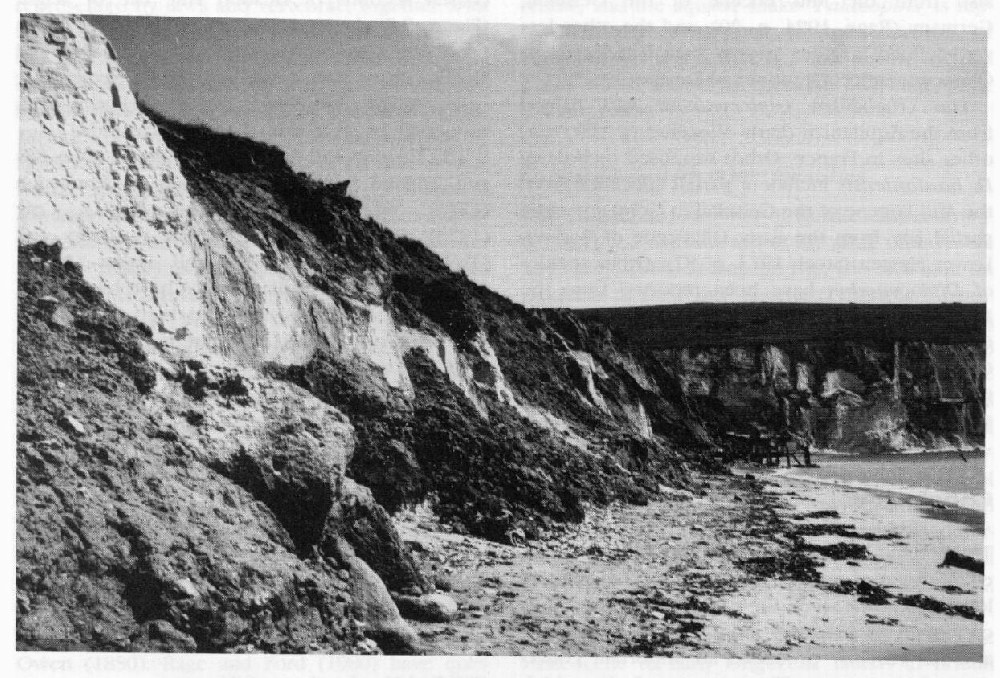
Cray (1973, p. 24) mentions fragments of turtle bones and, more rarely, broken mammalian remains from a limestone immediately below the Lignite Bed, a horizon outcropping about a third of the way up the vertical cliff formed by the limestone on the south-west seaward face of Headon Hill. The limestone (which may also overlie the Lignite Bed in places) is very variable lithologically, and several subdivisions were recognized. The reptile-bearing lithology is a soft, impure, orange-coloured, marly limestone, rich in the shells of Galba sp. However, reptile debris, including dermal scutes of turtles ('Emys' sp.) and teeth of the crocodilian Diplocynodon, also occurs sporadically throughout the Lignite Bed and appears to come from all the lithologies, being represented both in friable lignite and in the shell marls (Cray, 1973, p. 25).
In the early 1970s large collections of reptiles (particularly squamates) and amphibians were obtained by Mr R.L.E. Ford from units in the
Fauna
The main collections of fossil reptiles from Headon Hill are curated in the BMNH as well as the Museum National d'Histoire Naturelle (MNHN) Paris and the Stuttgarter Museum für Paläontologie (Ford collection). The collections include many mammal and amphibian taxa, as well as reptiles. Amphibians include palaeobatrachid and discoglossid frogs (
Testudines: Cryptodira:
Emydidae
'Emys' sp.
Archosauria: Crocodylia: Neosuchia:
Eusuchia
Diplocynodon sp.
Crocodilus sp.
Lepidosauria: Squamata:
Sarnia
Scincomorph indet.
Necrosaurus sp.
Ophisaurus sp.
Glyptosaurine indet.
Lepidosauria: Squamata: Serpentes
Paleryx rhombifer Owen, 1850
Vectophis wardi Rage and Ford, 1980 Type specimen: MNHN CGB 27
cf. Dunnophis
Interpretation
The
The turtle 'Emys' is represented by numerous thin unornamented scutes and appendicular bones. This genus may almost certainly be attributed to the well-known Eocene genus Ocadia, of which two forms have been noted from the
The lizards from Headon Hill include members of the Necrosauridae (Necrosaurus), Scincomorpha and Anguidae (glyptosaurine, Ophisaurus), all of which are known from the Hordle Cliff section (see above). The faunal list from the HH2 horizon at Headon Hill is smaller than that from the
The Scincomorpha are represented by several remains of dentary bones, but these are not entirely diagnostic. The dentaries possess a narrow meckelian groove that is shallow and restricted to the lower surface of the dentary anteriorly. The cylindrical teeth show pleurodont implantation, and (viewed laterally) are high relative to the average height of the dentary.
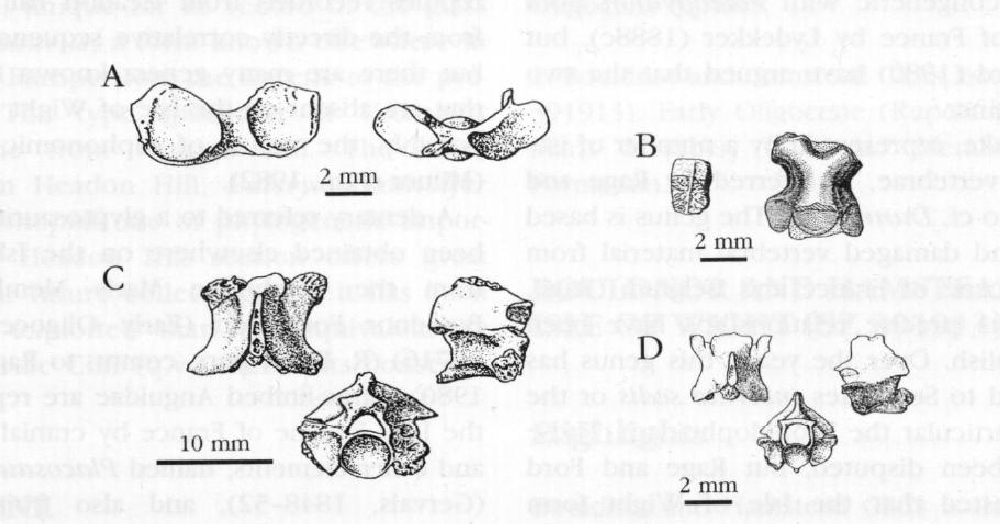
Ophisaurus (the glass lizard) is the most abundant lizard present, being represented by numerous distinctive remains of osteoscutes (or osteoderms) and a few isolated dorsal vertebra (Meszoely and Ford, 1976; Rage and Ford, 1980;
The anguine subfamily Glyptosaurinae is represented by two partly fragmented dorsal vertebrae and a caudal vertebra. These are larger than those of Ophisaurus and may be distinguished by the slightly concave ventral surface of the centra (a feature characteristic of limbed Anguidae). The necrosaurid Necrosaurus is represented by a single elongate posterior caudal vertebra, showing no fused haemapophyses, but two articular facets for the chevron and a groove on the ventral surface.
Of the snakes, the boid Paleryx rhombifer (
A small snake, represented by a number of isolated dorsal vertebrae, is referred by Rage and Ford (1980) to cf. Dunnophis. The genus is based on limited and damaged vertebral material from the Early Eocene of France and Belgium (Rage, 1984), and its precise relationships have been hard to establish. Over the years, this genus has been assigned to Serpentes incertae sedis or the Boidae (in particular the Tropidopheidae). These views have been disputed, but Rage and Ford (1980) suggested that the Isle of Wight form might provide a good morphological connection between 'typical' Dunnophis and the Boidae.
Vectophis wardi is a frequent element in the fauna, being represented by five vertebrae from Totland Bay and by about 60 vertebrae on Headon Hill (
Comparison with other localities
Geographically and stratigraphically, the nearest comparable units to the
A dentary referred to a glyptosaurine lizard has been obtained elsewhere on the Isle of Wight, from the
The discovery of the anguid Ophisaurus from the Isle of Wight, extends the range of this genus from the Mid and Late Eocene of central Europe, to the British Isles. The genus is still extant and is confined to the eastern section of continental Europe.
Necrosaurus is known from the Late Eocene of France (Necrosaurus cayluxi Filhol, 1873) and from the Mid Eocene of Germany and latest Eocene and Early Oligocene of France (N. eucarinatus Kuhn, 1940). The genus is also known from the Paleocene of France and from the Early Oligocene of Belgium (Estes, 1983).
The snake Dunnophis is reported from the Early Eocene of France and Belgium, the Mid and Late Eocene of North America, the Late Eocene of France and the Early Oligocene of Belgium (Rage, 1984). As noted above, the closely related
Conclusions
Headon Hill is an important reptile site of Late Eocene age, unique for its record of the glass lizard Ophisaurus, a form known elsewhere in continental Europe from the Eocene to the present day. The type specimen of Vectophis wardi came from Headon Hill. The other snakes from Headon Hill, Paleryx rhombifer and cf. Dunnophis are of phylogenetic importance. The Headon Hill section offers great potential for future collecting, and it has been much less exploited than the equivalent-age units at Hordle Cliff (q.v.), hence its conservation value.