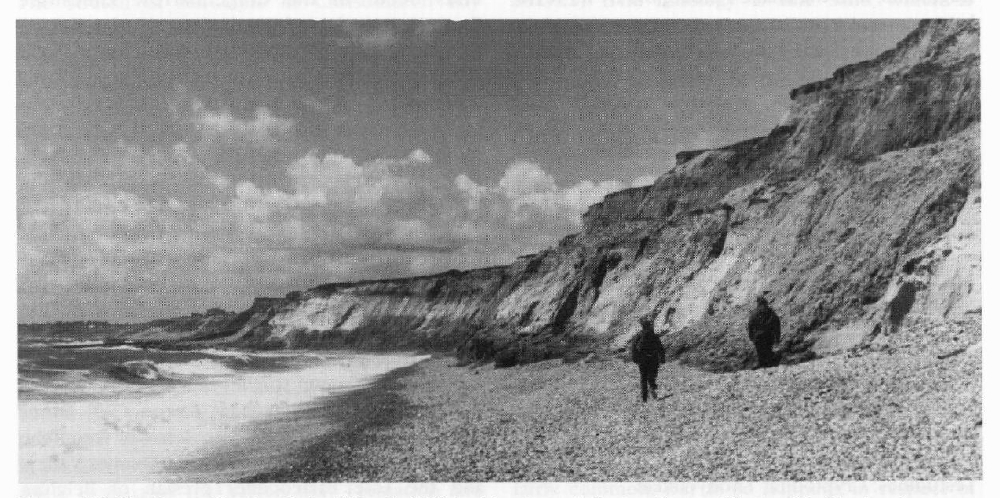
Hordle Cliff, Hampshire
Highlights
Hordle Cliff has produced one of the richest assemblages of fossil reptiles and mammals from the Late Eocene in the world. The reptiles include nearly 40 species of turtles, crocodilians, lizards and snakes, and the specimens include the original named material of 15 species. New specimens come to light all the time.
Introduction
The Late Eocene (Priabonian)
The first vertebrate remains reported from the sections of Hordle (or Hordwell) Cliff were described from the extensive collections of Searles Wood and Barbara, Marchioness of Hastings which had been assembled during the late 1840s. These remains, including numerous specimens of mammals, fishes and reptiles (crocodilians, turtles, snakes, lizards), were initially reported by Wood (1844) and Charlesworth (1845). Wood (1846) listed and figured further material from Hordle Cliff, and Hastings (1852, 1853) reported the results of six years' further collecting, listing important finds of mammals, fishes, reptiles and birds. Subsequently, in 1855, the Hastings collection was acquired by the British Museum (Natural History).
The Hordle crocodilians were discussed further by Owen (1848), Pomel (1853), Meyer (1857), Huxley (1859e) and Lydekker (1882b, 1889h). The abundant turtles from Hordle Cliff were described by Owen and Bell (1849), Seeley (1876e), Baur (1889), Lydekker (1889b) and Hooley (1905), and the snake and lizard material was described by Owen (1850), Hastings (1852), Lydekker (1888a, 1888c), Hoffstetter (1942), Sullivan (1979), Rage and Ford (1980), Estes (1983) and Rage (1984).
A recent collection of small tetrapods from Hordle Cliff made between 1976 and 1981, containing numerous new specimens, has greatly expanded the faunal list. The specimens were obtained by Mr Roy Gardner of Fareham from the
Description
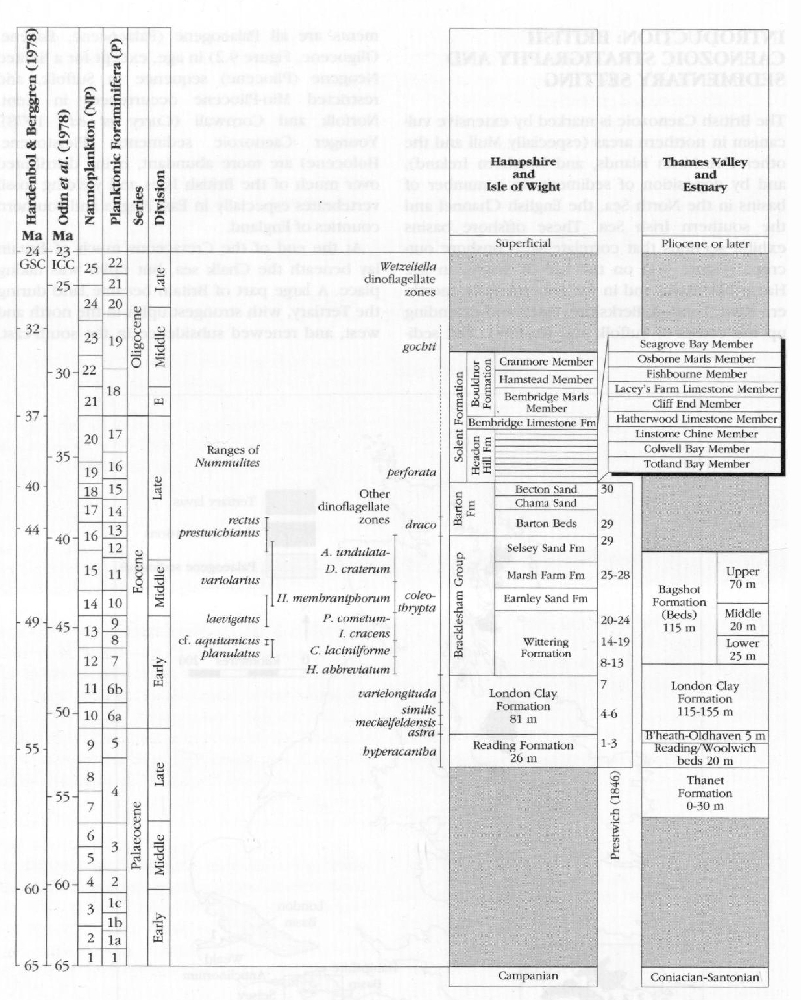
The stratigraphy of the Early Palaeogene rocks at Hordle Cliff has been described by Gardner et al. (1888) and Cray (1973). The following section is abridged from Cray (1973, p. 11). All the beds dip gently south-east at about 2.5°.
| Thickness (m) | |
| ('Lower Headon Beds') | |
| Marl | seen 0.5 |
| Rodent Bed: Limnaea Marl with overlying dark clay (=Rodent Bed Marl) | 0.25 |
| Unio Beds: grey clays with sandy layers | 3.5 |
| Green clays | 2.5 |
| Chara Bed: dark clays | 1.4 |
| Blue and green clays | 2.7 |
| Limnaea Limestone | 0.4 |
| 13 Ironstone Bed | 1.2 |
| 12 Crocodile Bed: sands | 2.0 |
| 11 Rolled-Bone Bed: sand with abraded bones | 0.3 |
| 10 Clay and sands | 1.4 |
| 9 (pars) Leaf Bed: carbonaceous clay | 1.0 |
| 9 (pars) |
3.5 |
| 8 Ironstone bed | 0.4 |
| 7 Clays | 1.1 |
| 6 Lignites | seen 1.4 |
The
As has been established by Cray (1973) and Milner et al. (1982), among others, the Hordle reptiles were all found in the
The Rodent Bed (Hastings Bed 1), consisting predominantly of grey clays and marls, is limited in lateral extent, outcropping just to the east of Hordle House, and extending eastwards for some 275 m before wedging out. To the west the beds are absent, having been removed by recent erosion. The highest horizon of the Rodent Bed consists of clays, tinted pink and heavily altered by percolation from the overlying Plateau Gravel. These clays are underlain by a thin, dark, clayey sand which in turn rests on a comminuted shell bed, the Limnaea Marl.
Hastings (1852, p. 194) recorded an extensive vertebrate fauna from the Rodent Bed. The finds may be bracketed with the dark clayey marl on the basis of Hastings' detailed description of the host sediment and mention of the underlying Limnaea Marl. In her brief description of the fauna, Hastings (1852) recorded "This band contains much debris, generally very compressed and fragile. You find here small rodent jaws, portions of carapace and a plastron of Emys, many teeth and bone fragments of crocodiles, some snake vertebrae, and rarely the teeth and bones of mammals' [translation]. Gardner et al. (1888, p. 596) also mention the occurrence of a large fauna from the dark clayey sand, listing 'serpents' vertebrae, rodents' teeth, etc.', but Tawney and Keeping (1883, p. 567), in their detailed stratigraphic account of Hordle Cliff, list only 'serpents' vertebrae' from the Limnaea Marl, without mention of the more abundant remains from the beds above.
Cray (1973, pp. 10–12) described the occurrence and preservation of the vertebrates: 'occasional rodent teeth and turtle fragments were recovered from the upper levels of the Limnaea marl, and the overlying dark sandy clay has yielded a moderate quantity of small-sized vertebrate debris… This material is always of very small size and evidently represents a current-sorted accumulation; all the large Headon Beds species are absent. All the specimens are fragmentary and… some of the material is water worn'.
The upper part of the Crocodile Bed is made up of fine, soft, white sands, but the lower layers are composed of more indurated sediments which are brownish in colour. The outcrop lies to the west of Hordle House, where the beds seem to rise from the base of the cliffs, and continue westwards until just west of Long Mead End. Hastings (1852, p. 198) noted crocodilians and the freshwater turtles Trionyx and 'Emys' from the Crocodile Bed. Diplocynodon hantoniensis, collected by Wood in 1843 and described by Taylor in 1844, also appears to have come from this bed, in which the remains 'were embedded in the fine siliceous sand of which the freshwater deposit at Hordwell is chiefly composed'.
Hastings observed (1852, p. 197) that abundant shells invariably accompanied the vertebrate remains and recorded that the most richly fossiliferous level lay about 3 ft (c. 1 m) from the top of the bed, and that the middle of the outcrop, a little to the west of Hordle House was the most productive locality. Most material from the Crocodile Bed, however, appears to have been derived from isolated lenses rich in vertebrate remains, and such an origin is explicit in the earliest account by Hastings (1848, p. 63): 'the vertebrae and other bones of the Crocodile and Paloplotherium were found at intervals of from four inches to three feet apart to the westward of the heads… I must not omit likewise to state, that close to this crocodile's head (the whole group comprising a space of about six feet long by ten inches only in thickness, and following each other nearly in a straight line) were found the nearly entire shell of a fossil Trionyx… and the jaw, vertebrae, and scales of a fish of the order Lepidosteus'.
The
The specimens collected recently by Mr Gardner also derive from the
Other horizons which have yielded reptile remains include the Rolled-Bone Bed. In 1852 (p. 199), Hastings reported finds of turtles and crocodilians from it. However, most of the specimens are generally highly abraded and cannot be identified precisely.
The Thin Shell Bed above the Lower Ironstone Band has yielded one of the largest collections of reptiles from Hordle. This bed occurs immediately above the ironstone band (numbered 8 in Tawney and Keepings' section), which is usually considered to mark the base of the
Fauna
The Hastings Collection is curated in the BMNH, and other material is held in CAMSM, OUM and YORMS. Repository numbers are only given for type specimens, but an estimate of the total numbers of each species preserved in these major collections is appended.
| Numbers | |
| Testudines: Cryptodira: | |
| Cheloniidae | |
| Argillochelys sp | 1 |
| Chelone sp. | 1 |
| Testudines: Cryptodira: | |
| Dermatemydidae | |
| Trachyaspis hantoniensis Lydekker, 1889 Type specimen: BMNH R1443 | 1 |
| Testudines: Cryptodira: | |
| Carettochelyidae | |
| Anosteira anglica Lydekker, 1889 Type specimen: BMNH 33198 y,x | 1 |
| Testudines: Cryptodira: | |
| Trionychidae | |
| Aulacochelys (Trionyx) circumsulcata (Owen, 1849) Type specimen: BMNH 30404 | 2 |
| Geoemyda (Nicoria) headonensis (Hooley, 1905) Type specimen: BMNH R1542 | 2 |
| Geoemyda sp. | 1 |
| Trionyx barbarae Owen, 1849 Type specimen BMNH 30409 | 2 |
| Trionyx bowerbanki Lydekker, 1889 | 1 |
| Trionyx henrici Owen, 1849 Type specimen: BMNH 30406–7 | 11 |
| Trionyx incrassatus Owen, 1849 Type specimen: BMNH R1433 | 5 |
| Trionyx planus Owen, 1849 Type specimen: BMNH 30410,a | 2 |
| Trionyx rivosus Owen, 1849 Type specimen BMNH 30405 | 1 |
| Trionyx sp. | 9+ |
| Testudines: Cryptodira: | |
| Emydidae | |
| Ocadia crassa (Owen, 1849) Type specimen: CAMSM C20923 | 6+ |
| Ocadia oweni (Lydekker, 1889) Type specimen: BMNH 36811 | 3 |
| Ocadia sp. | 1 |
| Turtle indet. | 100+ |
| Archosauria: Crocodylia: Neosuchia: | |
| Eusuchia: Alligatoridae | |
| Crocodilus' sp. | 18 |
| Diplocynodon hantoniensis (Wood, 1844) Type specimen: CAMSM ?unnumb. | c. 55 |
| Diplocynodon sp. | c. 30 |
| Lepidosauria: Squamata: | |
| Sauria Gekkonid | |
| Necrosaurus sp. | 5+ |
| Ophisaurus sp. | 50+ |
| Anguine | 5+ |
| Glyptosaurinae incertae sedis | 3 |
| Plesiolacerta lydekkeri Hoffstetter, 1942 Type specimen: BMNH 32840a | 2 |
| Lacertid | 5+ |
| Cordylid | 50+ |
| Squamata: Amphisbaenia: | |
| Amphisbaenidae | |
| Blanus sp.? | 5+ |
| Lepidosauria: Squamata: Serpentes | |
| Eoanilius cf. E. europae | 1 |
| Paleryx rhombifer Owen, 1850 Type specimen: BMNH 25259 | 8 |
| Paleryx sp. | 3 |
| Cadurcoboa sp. | 1 |
| Palaeophis | 1 |
| Calamagras sp. | 50+ |
| Platyspondylia sp. | 1 |
| cf. Dunnophis | 5+ |
| Vectophis wardi Rage and Ford, 1980 | 5+ |
Interpretation
Plint (1984) has interpreted the Hordle succession as representing a coastal environment, including littoral marine, barrier island shoreface, storm washover, and barrier flat, brackish lagoon, distributary channel and floodplain lake environments. The sequence indicates reducing salinity through time, and a transition towards river-dominated sedimentation in shallow flood-plain lakes. Hooker (1992, p. 500) interprets the Hordle
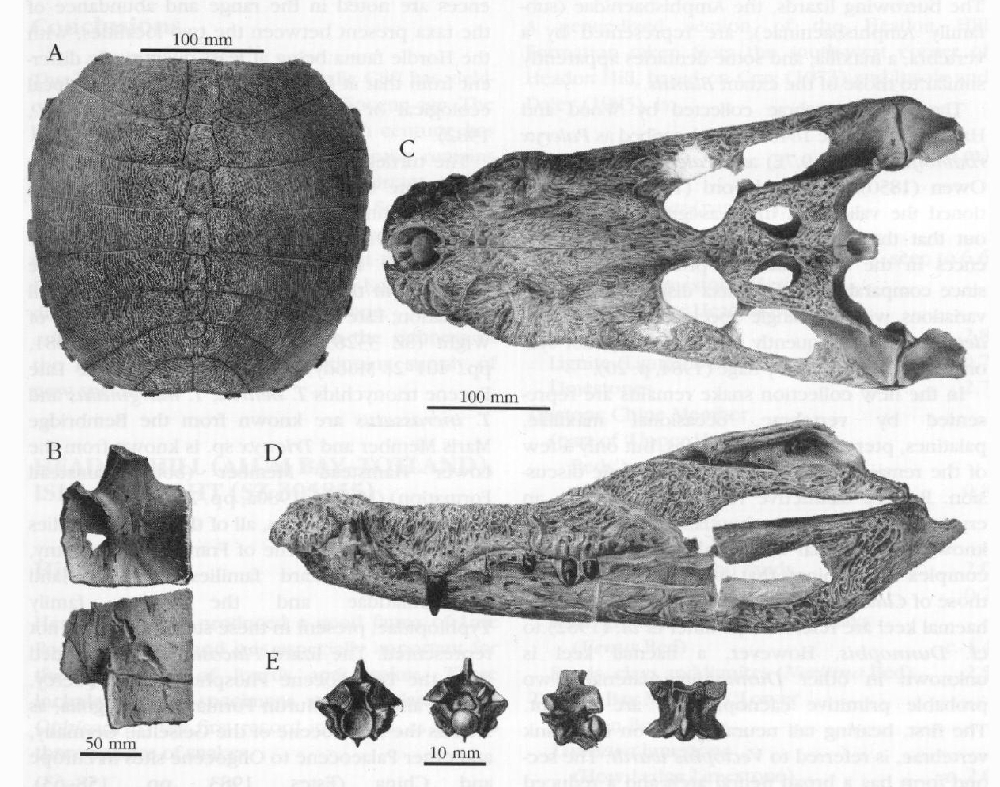
Other turtles from Hordle belong to largely marine groups, typical of most British Tertiary sites (see Sheppey report). Argillochelys was a moderate-sized cheloniid with an estimated total length of 200 mm. Trachyaspis hantoniensis, a dermatemydid, is based on limited carapace remains showing a distinctive ornament (Lydekker, 1889h, p. 54). Anosteira anglica, established by Lydekker (1889h, p. 54) on the basis of carapace remains, is a carettochelyid. Misynarski (1976, p. 73) was uncertain of the systematic position of the species, while Moody (1980a) assigned it to Allaeochelys. Ocadia crassa Owen, 1849 (
The first recorded Hordle reptile was a crocodilian, apparently derived from the Crocodile Bed, and named Alligator hantoniensis by Wood (1844). The specimen, consisted of 'A great portion of the head… having nearly all the upper range of teeth (42 in number) remaining, along with the humerus, dermal scutae and other parts of the skeleton'. Pomel (1853, p. 383) correctly referred this species to the genus Diplocynodon on the basis of sharing with the French D. ratelii an expansion of the third lower tooth, which was nearly as much enlarged as the fourth. Meyer represented by jaws and vertebrae, together with a few cranial and appendicular bones, and were the first lizards recognized from Hordle. The remains were originally referred to the supposed iguanid 'Iguana europeana' by Lydekker (1888a, 1888c), but were reidentified as lacertid by Hoffstetter (1942), who designated one of the Hordle specimens the holotype of Plesiolacerta lydekkeri (Estes, 1983, p. 103). The other material, including vertebrae, was identified by Lydekker (1888a, 1888c) as belonging to the large limbed anguid Placosaurus. Sullivan (1979), however, argued that P. rugosus, the type species of Placosaurus, is indeterminate, but Estes (1983, p. 158) accepts the validity of the genus. Milner et al. (1982) refer Placosaurus to the anguid subfamily Glyptosaurinae incertae sedis. A large cordylid is represented by jaws and vertebrae. The burrowing lizards, the Amphisbaenidae (subfamily Amphisbaeninae), are represented by a vertebra, a maxilla, and some dentaries apparently similar to those of the extant Blanus.
The snake vertebrae collected by Wood and Hastings in the late 1840s were described as Paleryx rhombifer (
In the new collection snake remains are represented by vertebrae, occasional maxillae, palatines, pterygoids and dentaries, but only a few of the remains are suitable for taxonomic discussion. Besides distinctive remains of Paleryx, an erycine is the most abundant form present, known from caudal and trunk vertebrae with a complex morphology that most closely resemble those of Calamagras. Vertebrae bearing a distinct haemal keel are referred by Milner et al. (1982) to cf. Dunnophis. However, a haemal keel is unknown in other Dunnophis material. Two probable primitive caenophidians are present. The first, bearing tall neural spines on the trunk vertebrae, is referred to Vectophis wardi. The second form has a broad neural arch and a reduced neural spine. This may represent a new taxon, since no other comparable material is known. An aniliid is represented by an isolated dorsal vertebra. Several boids can be distinguished from the structure of their middle and posterior trunk vertebrae, and the aquatic snake 'Palaeophis' is represented by somewhat limited remains of vertebrae, although this is a late record of this genus which should be checked (J.-C. Rage, pers. comm., 1993).
Comparison with other localities
The
The turtles are known from several other Late Palaeocene to Early Oligocene faunas in Britain and in continental Europe (Moody, 1974, 1980a). The fresh-water Trionyx and ?Ocadia and the crocodilian Diplocynodon hantoniensis are known from the
Among the squamates, all of the Hordle families are found in the Eocene of France and Germany, and only the lizard families Agamidae and Helodermatidae and the snake family Typhlopidae, present in these successions, are not represented. The lizard Placosaurus is recorded from the Late Eocene Phosphorites du Quercy, France and Shara Murun Formation, Mongolia, as well as the Mid Eocene of the Geiseltal, Germany, and other Palaeocene to Oligocene sites in Europe and China (Estes, 1983, pp. 158–63). Plesiolacerta is known also from the Late Palaeocene of Dormaal, Belgium, the Late Eocene Phosphorites du Quercy, France and possibly from the Late Palaeocene of Germany (Estes, 1983, pp. 103–4). The snake Paleryx is known also from the Mid Eocene of the Geiseltal, Germany (Rage, 1984, p. 20), and the other less well-defined taxa are known from Palaeocene to Oligocene units in continental Europe.
The crocodilian Diplocynodon was named from the Aquitanian (Early Miocene) of Allier and other sites in France. Other supposed records of D. hantoniensis include a partial specimen from the Mid Eocene of the Geiseltal in Germany and a partial jaw from the Early Oligocene of Borken, Lower Hessen (Steel, 1973, p. 82). Other species of Diplocynodon have been reported from the Mid Eocene of France, Messel and the Geiseltal, Germany, Spain and Wyoming, USA, the Oligocene of France, the Miocene of Austria and the Mid Pliocene of Bulgaria, among others (Steel, 1973, pp. 81–4).
Conclusions
The
The conservation value lies in the richness of the reptile fauna and the continuing supply of new specimens.