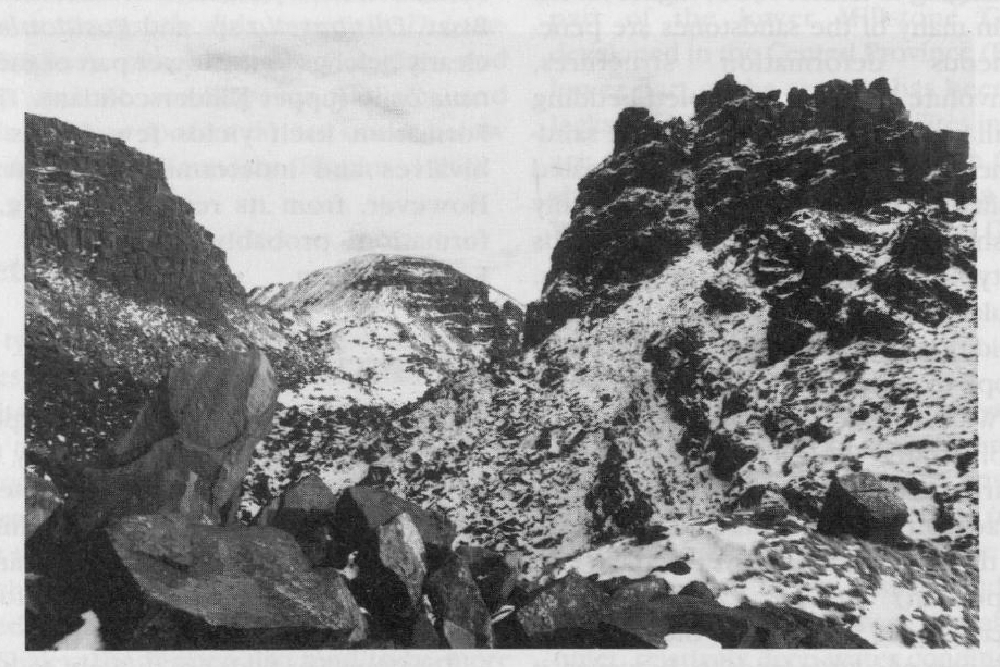
Alport Castles
Highlights
Alport Castles is the best exposure of Shale Grits, as developed in the southern part of the Pennine Basin.
Introduction
A landslip scar
Description
About 120 m of strata are exposed here, 115 m of which belong to the
The sandstones are of two types, which Walker (1966a) referred to as Facies A and Facies C. The main difference is bed thickness, the former being 60 cm thick, the latter anything from 60 cm to 3m thick. Also, Facies C can sometimes be in the form of large channels, although small-scale channelling also occurs in Facies A. Alport Castles is particularly good for showing sedimentary structures in these sandstones units, including sole structures, graded bedding and parallel lamination. Ripple lamination is also sometimes visible, confined to the top part of a sandstone bed. Both sandstone types have been interpreted as turbidites, Facies A being the distal deposits and Facies C the proximal deposits (Walker, 1966a).
The Facies A sandstones dominate the lower half of the
An unusual lithology present in the upper
The top 15 m seen at Alport Castles are mudstones and a broad sandstone-filled channel, belonging to the Grindslow Shales. They compare closely with the more complete sequence visible at Blackden Brook.
Interpretation
This is by far the best exposure of
Conclusions
Alport Castles is one of the most important exposures of rocks of the Shale Grits, which are about 315 million years old. The site has particularly well developed structures in the rocks that show that they were formed by turbidity currents. These currents were generated when seismic movement disturbed sediment in a shallow marine setting (in this case on the front of a river delta), which then rolled down along the sea-bottom into deeper water where the sediment was re-deposited. Alport Castles is one of the best Late Palaeozoic (250–410 million years old) examples of such deposits in north-western Europe.