Wern Ddu
Highlights
Wern Ddu shows the only continuous sequence from the lower Langsettian to upper Bolsovian in the eastern part of the South Wales Coalfield. It is also the only extant site in the coalfield from which palynomorphs have been obtained, and which thus allows an approximate identification of palynological zones.
Introduction
This is a disused claypit 1.5 km south-east of Caerphilly, Mid-Glamorgan, Wales
Description
Lithostratigraphy
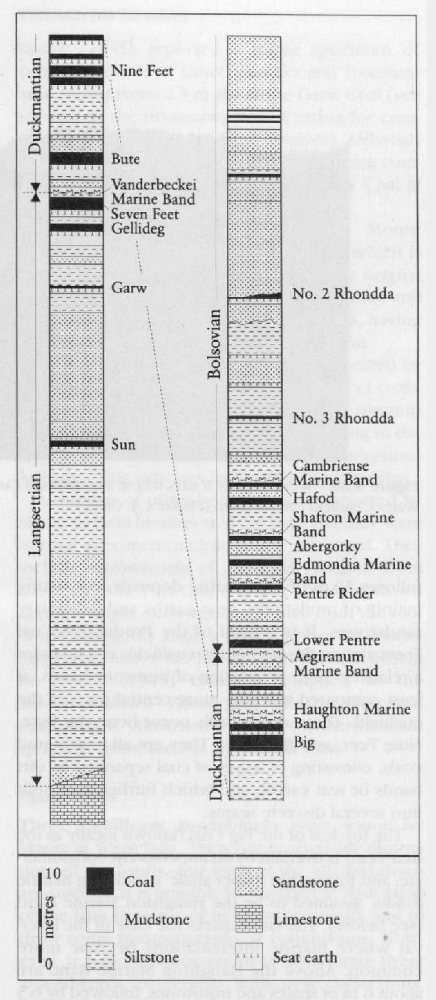
The sequence exposed here in the 1940s and described by Moore (1945) was 185 m thick. Although Moore provided a detailed stratigraphical log (summarized in
| Moore | Squirrell and Downing |
| Big Rock Vein | No. 2 Rhondda Coal |
| Bodwr Fach Coal | No. 3 Rhondda Coal |
| Bodwr Fawr Coal | Hafod Coal |
| Limog Fach Coal | Abergorky Coal |
| Limog Fawr Coal | Pentre Rider Coal |
| Pentre Coal | |
| Yard Coal | Lower Pentre Coal |
| Big Vein Group | Big Coal |
| Black Vein | Nine Feet Coal |
| Fork Vein | Bute Coal |
| Brass Vein | Seven Feet Coal |
| Hard Vein | Five Feet-Gellideg Coal |
At the base of the sequence are flaggy sandstones which seem to represent the upper part of the Farewell Rock Formation. This is overlain by a 7 cm thick coal, which is probably the Garw Coal (Squirrell and Downing, 1969). The roof of this coal consists of shales containing fish fragments, and is thus similar to the roof of the Garw Coal as seen at Brynmawr
The succeeding 6 m are shales, mudstones and clayband ironstones. Similar deposits, albeit rather thicker, occur in most of the South Wales Coalfield at this level (for instance, the interval between the Cnapiog and Grey coals at Cwm Gwrelych–Nant Llyn Fach), and seem to represent an interval of lacustrine conditions that prefaced the onset of more typically fluvio-deltaic conditions represented by the Productive Coal Formation.
More typical Productive Coal Formation deposits start with the Five Feet–Gellideg Coal. In more central parts of the basin, the Five Feet and Gellideg coals can be individually recognized, and in some places the Five Feet further splits to form a group of closely spaced seams (e.g. near Pontypridd — Woodland and Evans, 1964). At Wern Ddu, however, they have coalesced to form a 75 cm thick coal with thin dirt bands.
About 3 m above this is another compound coal with thin dirt partings called the Seven Feet Coal. The local name, Brass Vein, reflects the high pyrite content of both the coal and the partings. A little way to the west, the partings become thicker, and three discrete seams become recognizable, known as the Seven Feet, Yard and Amman Rider coals (or the Seven Feet Group).
This in turn is overlain by 3 m of shales containing marine fossils, which is thought to be the
The top leaf of the Big Coal (known locally as the Red Vein) is overlain by an impersistent conglomerate, and then a thin 'paper shale' containing marine fossils, assumed to be the
There follows 6 m of unfossiliferous, non-marine shales with ironstones, overlying which are about 3 m of sandy shales and seat earths. Moore (1945) interpreted this emergent interval as the probable position of the 'Yard Seam' (a local name for the
Overlying the Pentre Rider are 9 m of sandstones and some shales and seat earths. One 30 cm thick shale in this interval has a bright red colour, perhaps reflecting a slight lowering of the water-table, and offering a foretaste of the reddening of the strata seen in the Pennant Formation of the east crop (Downing and Squirrell, 1965). The next coal is generally referred to as the Abergorky Coal and, as elsewhere in the coalfield, is overlain by black, 'papery' shales of the Shafton (or Lower Cwm Gorse) Marine Band.
Above the
In the central part of the coalfield, the
The roof of the Gilfach Coal is a 12–15 m thick sandstone, which in this part of the coalfield marks the base of the Pennant Formation. A total of 25 m of Pennant Formation was reported here by Moore (1945), consisting mainly of coarse sandstones and conglomerates, although there was also a 40 cm thick coal and its seat earth — the No. 2 Rhondda Coal. Squirrell and Downing (1969) identify the conglomerate and sandstone which overlie the No. 2 Rhondda Coal and which marks the top of the sequence exposed at Wern Ddu, as the Saron Sandstone.
Biostratigraphy
Marine bands
As already stated, six mudstone or shale bands in the Wern Ddu sequence have been identified as marine bands. They yield assemblages of only very limited diversity, restricted mainly to inarticulate brachiopods, Dunbarella and 'Productus'. However, they are thought to be the Vanderbeckei, Haughton, Aegiranum, Edmondia, Shafton and Cambriense marine bands, based on their position relative to widespread coals and sandstones in the section.
A seventh mudstone, immediately overlying the Garw Coal near the base of the sequence, was reported by Moore (1945) to yield fish fragments. It is uncertain whether it is a marine band, but it is interesting to note the presence of an identical bed above the Garw Coal at Brynmawr
Non-marine bivalves
Moore (1945) reported a single specimen of 'Naiadites flexuosa' (auct., non Dix and Trueman) from an ironstone 2.3 m above the Garw Coal (see account of the Brynmawr
From the Five Feet–Gellideg Coal, Moore reported Anthraconauta minima auct., which is now normally referred to as Curvirimula belgica (Hind) following proposals made by Trueman and Weir (1960). This is a long ranging species, having been reported from the Viséan to Bolsovian.
More diagnostic assemblages were reported by Moore from between the Bute and Nine Feet coals. They included Anthraconaia williamsoni (Brown) and A. robertsoni (Brown), and thus belong to the A. modiolaris Zone, probably the A. phrygiana Subzone. This indicates the middle Duckmantian.
A number of other horizons were reported by Moore to yield bivalves at Wern Ddu, but they were isolated specimens and/or poorly preserved. They include Anthracosia cf. acutella (Wright) from above the Nine Feet Coal (? Lower Similis-Pulchra Zone), a single Anthracosia sp. shell from the roof of the Abergorky Coal, a poorly preserved assemblage from above the Hafod Coal which Trueman in Moore (1945) claimed belonged to the Similis-Pulchra Zone, and poorly preserved examples of 'Anthracomya'sp. (?Anthraconaia sp.) from above the No. 3 Rhondda Coal.
Plant fossils
Three significant assemblages were found by Moore at Wem Ddu. There are no available illustrations of the fossils, and some of the identifications are suspect. It is possible to interpret at least parts of the lists in terms of modem taxonomy and to draw some biostratigraphical conclusions. However, it will be necessary to re-investigate these assemblages, preferably with new collections, before their full biostratigraphical significance can be established.
The lowest includes 'Neuropteris grangeri' (probably N. beterophylla Brongniart), N. obliqua (Brongniart) Zeiller, Renaultia gracilis (Brongniart) Zeiller, Sphenophyllum cuneifolium Sternberg, Annularia radiata (Brongniart) Sternberg and Asterophyllites charaeformis (Sternberg) Unger. Although containing a range of taxa, the assemblage is not particularly diagnostic, indicating only a position somewhere between the upper Lepidophloios hoeninghausii Zone to upper L. rugosa Zone (upper Langsettian to upper Duckmantian).
The second assemblage was found in shales 5 m below the Nine Feet Coal. It includes 'Neuropteris gigantea'(probably Paripteris pseudogigantea (Potonié) Gothan), 'N. heterophylla' (probably Laveineopteris loshii (Brongniart) Cleal et al.) N. cf. obliqua, Alethopteris decurrens (Artis) Zeiller, Lonchopteris rugosa Brongniart, Mariopteris muricata (Brongniart) Zeiller, Bertrandia avoldensis (Stur) Danzé, Sphenophyllum cuneifolium and Annularia radiata. Such an assemblage probably belongs to the L. rugosa (or possibly lowest P. linguaefolia) Zone, indicating the Duckmantian Stage. Determining the true identity of Moore's N. cf. obliqua would provide a more accurate biostratigraphical control on the assemblage, particularly if it could be fitted into the phylogenetic model outlined by Josten (1962).
About 8 m above the Abergorky Coal, Moore found Laveineopteris tenuifolia (Sternberg) Cleal et al., Paripteris pseudogigantea, Macroneuropteris scheuchzeri (Hoffmann) Cleal et al., Eusphenopteris obtusiloba (Brongniart) Novik, Renaultia chaerophylloides (Brongniart) Zeiller, R. rotundifolia (Andrä) Zeiller and Sphenophyllum majus (Bronn) Bronn. This almost certainly belongs to the P. linguaefolia Zone, indicating the Bolsovian or uppermost Duckmantian.
Palynology
The palynology of this site was described by Sullivan (1962). Other than an unpublished thesis by Williams (1956), the results of which were summarized by Butterworth and Millott (1960), this is the only account of Upper Carboniferous palynomorphs from the South Wales Coalfield. Sullivan's work was also important in that he demonstrated that the non-marine shales yielded assemblages of similar composition to the coals; previous studies on Upper Carboniferous palynology had been based only on the coals, and there had been some debate as to whether the shales would yield similar palynomorphs. This is not the place to provide a detailed biostratigraphical analysis of Sullivan's study; there appear to be differences in the taxonomy used in his paper compared with later biostratigraphical reviews, such as by Smith and Butterworth (1967) and Owens (1984). The following is thus a brief resume of his conclusions.
That part of the section below the Seven Feet Coal was included in the Cirratriradites aligerens Zone of Butterworth and Millott (1960) (the Radiizonates aligerens Zone of Smith and Butterworth, 1967). This is a well defined zone in the upper Langsettian of much of western Europe (Owens, 1984).
Smith and Butterworth (1967) assigned the very topmost Langsettian of South Wales to the Schulzospora rara Zone, but Sullivan found no evidence of it at Wern Ddu. His next highest assemblages, other than those from the
Assemblages from just above the
The Hafod Coal was reported to yield the first rare occurrences of Torispora securis Balme, and was taken by Sullivan to mark the base of the zone of that name. This is a major palynological event, which can be identified throughout much of Europe (Owens, 1984). However, the exact level can vary between basins: in South Wales it occurs at about the middle Bolsovian, whereas in the Lorraine (France) and Donetz (Ukraine) it is near the base of the Bolsovian. This in part explains the discrepancies between the zonation of Smith and Butterworth (1967), in which the base of the T. securis Zone is placed at the
Interpretation
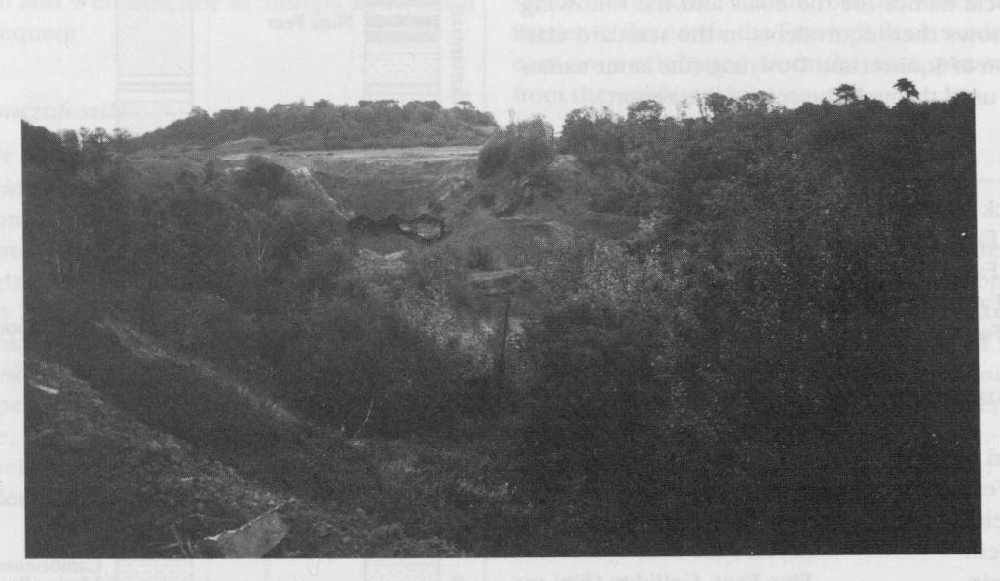
This is the only site in the eastern part of the South Wales basin to show a continuous sequence from the lower Langsettian to the upper Bolsovian. Moore (1945) and Squirrell and Downing (1969) describe similar strata from a number of other places in this part of the coalfield, but they either show only small parts of the sequence, or were underground workings. Although exposure at Wern Ddu is now poor, there is still the potential to open up a continuous sequence through the Productive Coal Formation here. When combined with Brynmawr Road-Cutting and Coed-y-Darren, it will be possible to examine most of the Coal Measures in the eastern part of the basin.
The Productive Coal Formation is significantly condensed compared with sequences to the west. For instance, at Wern Ddu the Duckmantian is only 75 m thick, whereas near Pontypridd it is 180 m (Woodland and Evans, 1964) and near Ammanford it is 235 m (Archer, 1968). Also, significantly more of the sequence consists of seat earths, and the coals are compound seams which further west split into a number of separate seams. This all combines to indicate significantly lower rates of subsidence in this part of the coalfield, which is symptomatic of its position near the margins of the depositional basin.
Another feature of the Wern Ddu sequence is that the Pennant Formation facies occurs significantly higher than in the central part of the coalfield. The junction between this and the underlying Productive Coal Formation is gradational here, with some sandstones occurring just above the Pentre Coal. However, the lowest really massive and conglomeratic sandstones typical of the Pennant appear between the No. 3 and No. 2 Rhondda coals. In contrast, in the middle part of the north crop, such as at Cwm Gwrelych–Nant Llyn Fach, the Pennant Formation appears immediately above the
Biostratigraphically, Wern Ddu is important because it is one of the few places in South Wales to have yielded palynological evidence. South Wales provides good biostratigraphical evidence for the other groups, such as plant macrofossils, non-marine bivalves and marine fossils. However, the rank of the coals is normally too high for the preservation of palynomorphs (Smith and Butterworth, 1967); only in the eastern part of the coalfield, such as at Wern Ddu, is the rank sufficiently low for them to be preserved. There is a problem in relating the evidence from these marginal areas to the main part of the coalfield, as the sequence is condensed and detailed comparisons of the coals are difficult. Sullivan's (1962) discovery that the non-marine mudstones here yielded essentially similar palynomorphs to the coals offers a potential solution to this problem; palynomorphs in shales are less vulnerable to the destructive effects of coalification, and thus might still be preserved in the more central parts of the coalfield. However, although 30 years have now lapsed since Sullivan's discovery, there have been no reported attempts to investigate the palynomorphs from shales in the main part of the coalfield, and thus to provide a more detailed palynostratigraphical analysis of the South Wales sequence.
Conclusions
Wern Ddu shows the only continuous sequence of rocks ranging in age from the early Langsettian to late Bolsovian (300–315 million years old) in the eastern part of the South Wales Coalfield. It is also the only site in the coalfield from where the fossilized remains of plant pollen and spores can still be obtained, which is important for establishing correlations of the strata with sequences in other parts of Europe. This is also helped by a range of other types of fossils, including the remains of various marine and non-marine animals.