Headon Hill, Isle of Wight
Highlights
This is the best exposure of the
Introduction
This section of the review deals with the succession in Headon Hill
Amongst those who made early studies of the section were Webster (1814, 1816), Forbes (1853) and Keeping and Tawney (1881), whose stratigraphical successions were reproduced in Bristow et al. (1889) and White (1921).
For many years, little was published on the section, but over the last three decades or so there has been a considerable rebirth of interest. An extensive stratigraphical and palaeoenvironmental study was undertaken by Edwards (1967) whilst other descriptions are given in Stinton (1971a), Insole (1972), Daley and Edwards (1972) and Daley and Insole (1984) and the comprehensive recent review by Daley (1999, pp. 40–45). The macroinvertebrate faunas of the
Relatively little has been published on the sedimentology, although some descriptions and interpretations occur in the theses of Edwards (1967) and Insole (1972).
This site was also independently selected for its fossil plant, reptiles and mammal content, a more detailed account of which can be found elsewhere in the GCR series (Mesozoic to Tertiary Palaeobotany of Great Britain (Cleal and Thomas, in prep.); Fossil Reptiles of Great Britain (Benton and Spencer, 1995); Fossil Mammals and Birds of Great Britain (Benton et al., in prep)).
Description
To the north of Alum Bay Chine, the Becton Sand crops out above the foreshore. In contrast with the older strata to the south, the formation has a gentle northerly dip. The junction with the Barton Clay is faulted-out.
Further northwards as far as Totland
Lithological succession
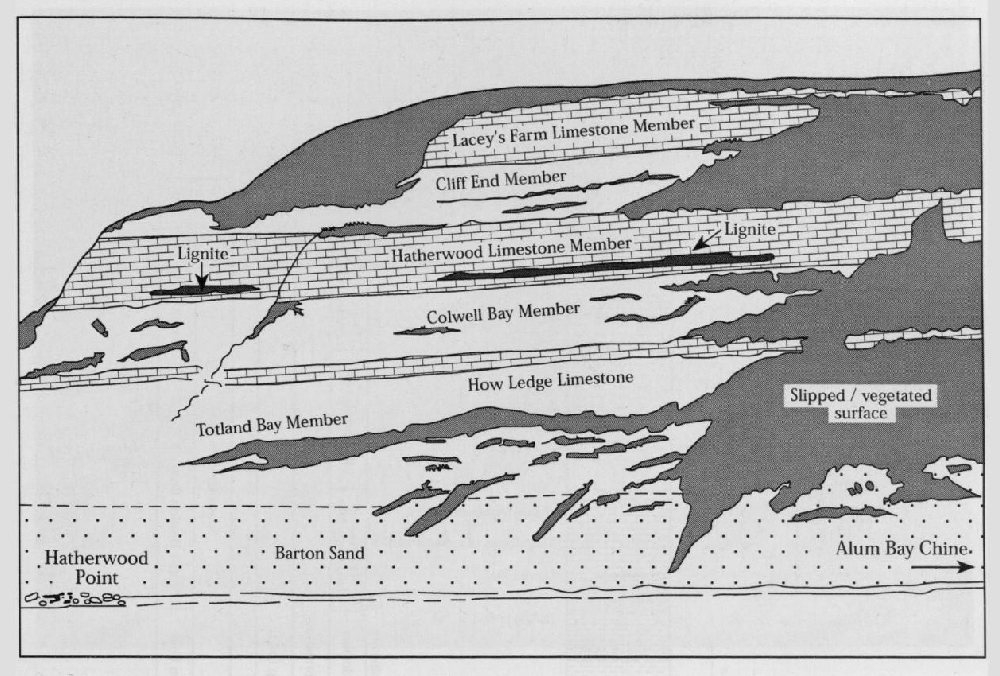
The succession in Headon Hill is almost 100 m thick, of which some 63 m comprise the
Stratigraphy
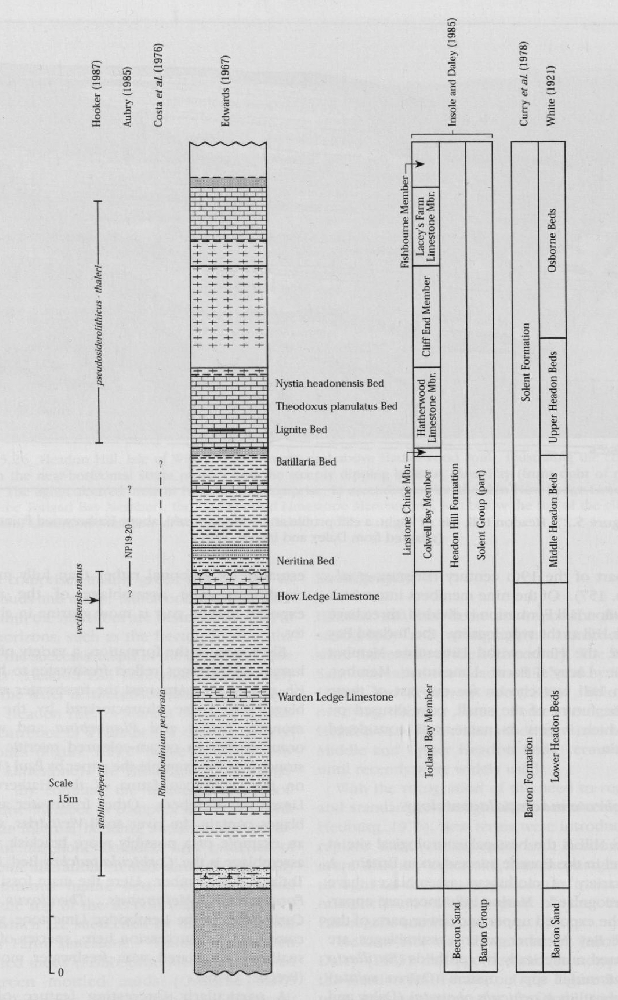
Headon Hill has been an important site for stratigraphy and stratigraphical nomenclature since the middle of the 19th century. The Barton Sand was called the Headon Hill Sand by Forbes (1856) and Bristow et al. (1889). Below his overlying Osborne Series, Forbes recognized a Headon Series which he subdivided into Lower, Middle and Upper Headon Beds, terms which until recently were widely used.
With the recognition of the need to regulate and standardize stratigraphical terminology (cf. Hedburg, 1976), new terms were introduced to replace these earlier ones and Headon Hill, more than any other site, has encouraged new thought on the stratigraphical subdivisions and nomenclature of this part of the English Palaeogene succession.
Headon Hill was designated by Insole and Daley (1985) the type section (stratotype) for the
Invertebrate macropalaeontology
Headon Hill is the best palaeontological site at this level in the Eocene succession in Britain. A wide variety of molluscan assemblages have been recognized. Marine influences are apparent in the exposed upper and lower parts of the
Elsewhere in the formation, a variety of molluscan assemblages reflect freshwater to brackish conditions. Amongst the freshwater assemblages are those characterized by the pulmonates Galba and Planorbina and which occur mainly in cream-coloured micritic limestones (see for example the paper by Paul (1989) on the molluscan fauna of the
A particularly interesting feature of the Theodoxus shells is that they retain much of their original pigmentation and portray a variety of colour patterns, the nature and significance of which have been investigated by Hill (1986) and, in a broader study of colour pattern preservation in the fossil record, by Hollingworth and Barker (1991).
Microfauna
Headon Hill is an important locality for microfaunal research. It was one of the two main sections studied by Keen (1977) in his work on the environmental significance of ostracods, which resulted in the recognition of salinity controlled, and hence salinity diagnostic, assemblages. The foraminiferal fauna was studied in some detail by Murray and Wright (1974). They considered that faunas from the
Vertebrate remains
The importance of Headon Hill from the point of view of vertebrate remains cannot be in doubt. Amongst those found in the
Higher up the sequence, at the junction of the
Flora
Headon Hill is not particularly well-endowed with plant fossils, except for Charophytes. Six species were found in cream-coloured marls 1 m above the base of the
Sedimentology
The section has considerable potential for sedimentological work on paralic brackish to freshwater environments, which mainly comprise those characterized by fine- to medium-grained elastics, but also include freshwater, limestone-producing lakes. Despite the study by Edwards (1967), virtually no modern work on the sedimentology or its environmental implications has been published.
The section contains some of the best repre sentatives of freshwater limestones in the British stratigraphical column. These include the How Ledge Limestone and the Warden Ledge Limestone from the
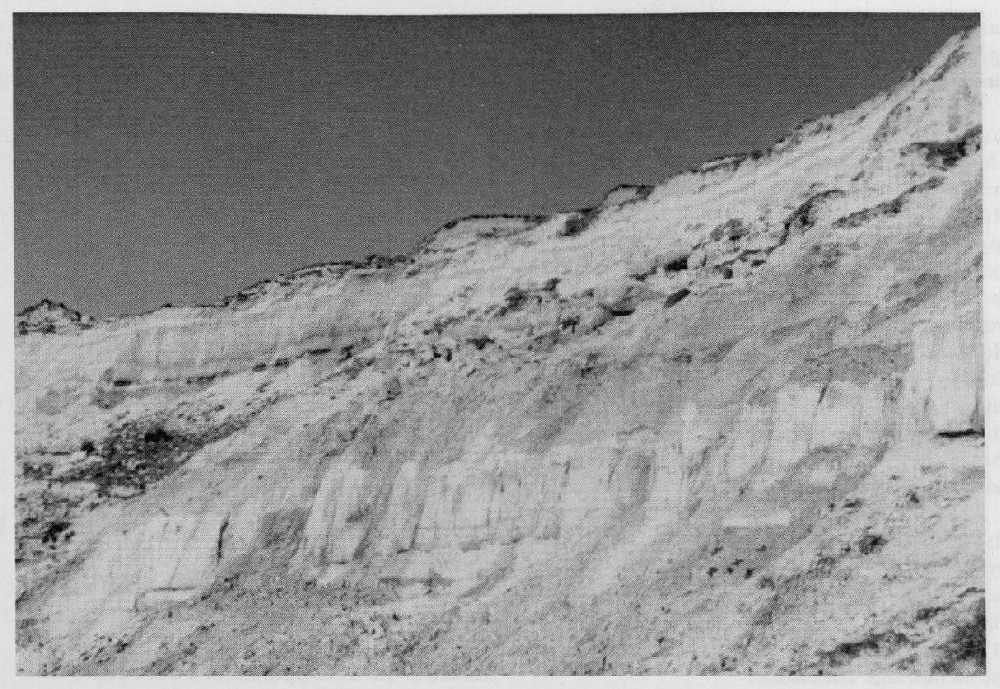
The best example is the 7–8 m thick
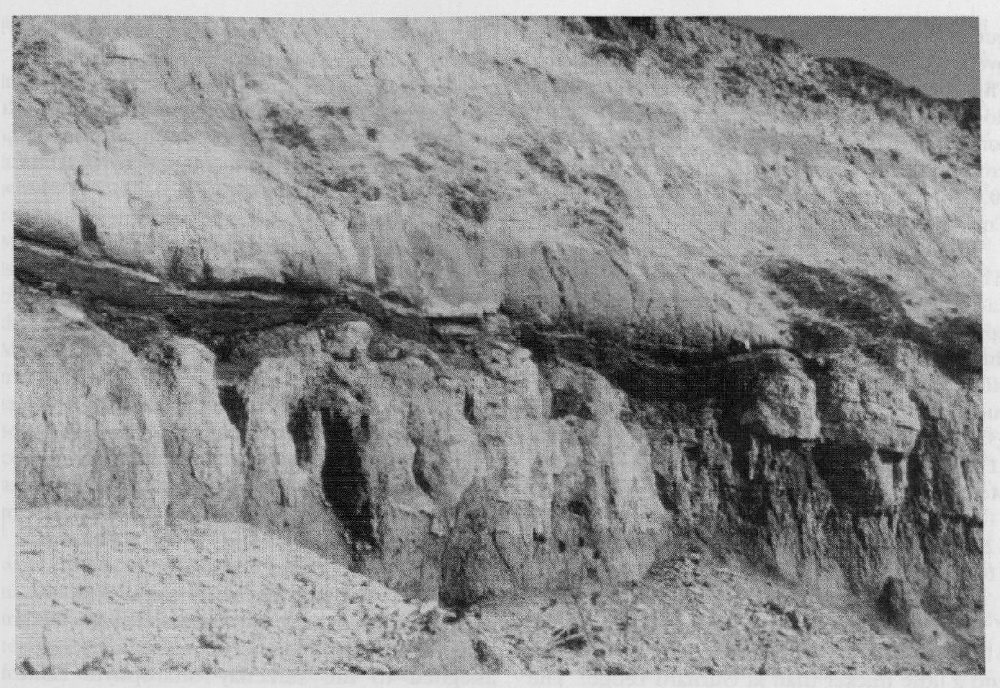
The near-horizontal nature of this member provides a rare opportunity to study lateral changes in a freshwater limestone. A significant feature is the development of a destructive lateral surface within the member. At Hatherwood Point, where it descends well below the centre of the member, lignites fill the hollows in its very irregular profile
Fossil soils are well-developed in parts of the Headon Hill section. Halfway up the
The highest limestone scar above Hatherwood Point is formed by the Lacey's Farm Limestone Member (the Osborne (Beds) Limestone of Edwards (1967) or 'thick concretionary limestone' of White (1921, p. 111)). It comprises hard or soft limestones or calcareous sandstones passing down into very calcareous marls. The limestones are often nodular or rubbly; marked internal surfaces occur, whilst some levels comprise banded limestones or 'crusts'. The top of the member comprises a distinct surface, overlain in places by pebbles or concretions of limestone. The unit as a whole appears to provide a classic example of calcrete profile development.
Clay mineralogy
Little mineralogical work has been undertaken on the section. It was, however, sampled by Gilkes (1968, 1978) who recorded that, as in all the post-'Bracklesham Beds' sediments on the Island, illite dominates the clay mineralogy suite. He attributed this to either the reworking of older Palaeogene sediments adjacent to the basin of deposition and/or derivation from illites neoformed in the widespread calcareous lakes which existed at this time (cf. Porrenga, 1968; Millot, 1970).
Interpretation and evaluation
The unique sequence exposed in Headon Hill differs in certain respects from other contemporary successions in the Isle of Wight and on the mainland. All the stratigraphical units present occur at other localities, but some are particularly well-exposed here, sometimes with facies significantly different from their occurrences elsewhere. The site, therefore, has a critical contribution to make to our understanding of the depositional environments and Palaeogene palaeogeography.
Comparison with other localities
At the base of the succession, the Becton Sand is 27 m in thickness, compared with about 55 m at Whitecliff Bay and 22 m at the type locality (Barton Cliffs). The
By contrast, the
The
The
Stratigraphical significance
Stratigraphically, the Headon Hill section has been important since the 19th century, although some early workers, such as Webster (1814, 1816), failed to fully understand its relationship to other localities. For Forbes (1853, 1856), it was the type section for his Headon Series and, later, Lower, Middle and Upper Headon Beds. Since it is now the type section for the
Dating the succession
It has not proved an easy section to date since the predominantly non-marine or marginally marine facies markedly limit the availability of zone fossils. Costa and Downie (1976) do not refer to Wetzeliella being identified specifically from Headon Hill, but by analogy with localities such as Whitecliff Bay, the lower part of the succession may be assigned to the W. perforata zone. It may include strata of W. gochtii age, but since the environments represented above the
Both in terms of dinoflagellates and nannoplankton, the assignment of late Eocene age to the section seems appropriate. Some have dissented from this view. Bosma (1974) suggested that, on the basis of mammalian studies, much of the succession should be assigned to a new 'Headonian Stage', straddling the Eocene/Oligocene boundary and for which Headon Hill would be the type site. Feist-Castel (1977) also considered that both the Eocene and Oligocene are represented here, the Lower Headon Beds (the
Palaeontology
Despite the lack of zone fossils and a scarcity of plant macrofossils, the site is richly endowed palaeontologically. Together, a variety of low-diversity assemblages of molluscs, ostracods and sometimes forams indicate environments of varying salinity from freshwater to almost fully marine conditions. The generally very good molluscan preservation provides excellent opportunities for detailed research, both taxonomic and palaeoecological. An investigation of the freshwater molluscs has now been published (Paul, 1989), but considerable opportunity exists for research on such brackish water fossils as the Cerithiidae (Potamides, Batillaria, etc.), which occur in profusion at certain levels.
The presence of coloured Theodoxus shells has led to research into a relatively unusual aspect of palaeontology. Colour preservation is rare in the fossil record. What makes this site unique is that such large numbers of variably pigmented shells occur, thereby facilitating a detailed study of both the organic chemistry of pigment preservation and the palaeoecological significance of the colour patterns.
Palaeosalinity
In the Headon Hill section, Keen (1977) was able to recognize five of his six, predominantly salinity-related, ostracod assemblages. Only his fully marine Hazelina Assemblage (found elsewhere in the Brockenhurst Bed) is missing. His recognition that even in the
Keen (1977) and Murray and Wright (1974) were apparently at variance over the interpretation of the Hatherwood Limestone. Keen's work indicated a freshwater derivation whilst the latter authors (p. 36, fig. 15), having identified forams of marine aspect, suggested a lagoonal, intertidal origin. The molluscan faunas can be used to explain this apparent discrepancy, in that whilst such genera as Galba indicate freshwater, Melanoides and Theodoxus are more ambiguous salinity-wise and the hydrobiids represent saline influences. What needs to be remembered is that the carbonate lakes such as that producing the Hatherwood Limestone occurred in a paralic context, where separation from marine or semi-marine influences was from time to time incomplete, allowing the introduction of more saline elements by posthumous transportation or the periodic establishment of more salinity-tolerant communities when suitable conditions were maintained over a longer period. It is worth noting that a similar assemblage of forams to those in the Hatherwood Limestone was found in the predominantly freshwater Bembridge Limestone of Whitecliff Bay.
Palaeogeography and depositional environments
Whilst much palaeoenvironmental analysis of the site has been based on its fossils, the sedimentary features are also valuable for interpretation. It is unfortunate that little of a sedimentological nature has been published, although con siderable data may be found in the unpublished thesis of Edwards (1967). Essentially, deposition took place in a predominantly low-energy paralic embayment in which salinity fluctuated, perhaps in part as a result of eustatic changes. The
Some of the most revealing (and sometimes perplexing) palaeogeographical research arises from multidisciplinary studies and for the Headon Hill section this is well exemplified by the work of Hooker et al. (1995). In a study of the Bembridge Limestone, they found that such an approach can leave unresolved contradictions. In this case, whilst clear mammalian and land snail evidence suggests the proximity of open woodland to forested areas at the time when the Bembridge Limestone was being deposited, there is no other indication of the presence of trees, including a lack of any pollen evidence for woodland or forest, or indeed any flowering plant pollen.
Palaeopedology
By far the most interesting unit sedimentologically, and particularly so from a palaeopedological point of view, is the Hatherwood Limestone. Within it, Edwards (pers. comm., 1990) recognized features comparable with Quaternary–Recent calcretes from the north-western Mediterranean region but also identified a number of palaeokarst surfaces and the sapping of hardpans which had produced potholes and collapse breccias. Such features may be interpreted to suggest an alternation of drier and wetter climatic conditions, a possibility supported by recently published research on the mammalian fauna (Hooker, 1992).
Considerable scope exists for palaeopedological research on the sequence succeeding the Hatherwood Limestone. The Lacey's Farm Limestone appears to have been affected by calcretization, but has not yet been the subject of detailed study. Gley soil development may be reflected in the colour-mottled, variegated muds elsewhere in the succession and these also require investigation.
Conclusions
Headon Hill is a classic site, studied by geologists since early in the 19th century, and was a key locality where early workers such as Forbes first interpreted the local stratigraphy. Nowadays, it is the type section for the
Palaeontologically, it is no less significant. Although not important biostratigraphically, it contains a wide variety of macrofossil and microfossil assemblages of palaeoenvironmental significance. Molluscs, foraminifera and ostracods have indicated the former presence of a wide variety of freshwater to nearly fully marine environments in a low-energy paralic (coastal) embayment. Amongst the vertebrate fossils found are primates and other mammals.
The section offers excellent opportunities for the study of a wide variety of freshwater and brackish water sediments. The freshwater limestones have attracted particular attention, and of these, the Hatherwood Limestone is the thickest and most interesting. Fossil soils (palaeosols), indicating emergent episodes, are well developed at a number of horizons. From the presence of calcretes, the former periodic existence of climatic drier conditions can be inferred, rather than the continual humid tropical or subtropical climates previously considered characteristic of the local Palaeogene from palaeontological (mainly palaeobotanical) evidence.