Herne Bay (Bishopstone Cliffs) Kent
Highlights
Stratigraphically, Herne Bay is the most important Palaeogene site in the London Basin and is one of the two type sections for the internationally important Thanetian Stage and for the Thanet Sand Formation. Evidence from this site has contributed to a realization that, locally, the base of the
Introduction
This site
In a brief summary of research on the section, Ward (1978) cited the classic early work of Prestwich (1850, 1852, 1854a) followed by that of Whitaker (1866, 1872). Both authors provided faunal lists. Prestwich (1852) included a diagrammatical cliff section, as did Whitaker in the Geological Survey Memoir of 1872. As Ward (1978) pointed out, a later account by Gardner (1883) is hard to follow and his sections are more difficult to interpret.
Twentieth century accounts include those of Dewey et al. (1925), Cooper (1934) and that in the Geologists' Association Guide to the area (Pitcher et al., 1958, 1967). Recent descriptions include that by Ward (1978) on the pre-'London Clay' strata and King (1981) on the 'London Clay'. A brief general account appears in Holmes (1981) which, as the Memoir for the local 1:50 000 geological sheet (Faversham), portrays the site in a broader regional Palaeogene context, whilst also providing important lists of references.
Because of its geological importance, Herne Bay has been the venue for a number of field meetings of the Geologists' Association (Dowker, 1864; Whitaker and Dowker, 1885; Leighton, 1894; Whitaker, 1912; Brown, 1936; Stinton, 1965b; Gamble, 1968; Hutchinson, 1968) and the Tertiary Research Group (e.g. Rundle, 1970a). No doubt, the increasing development of coastal defence works for over two decades explains a diminution of such meetings in more recent years.
Palaeontologically, the site has attracted interest since the 19th century. For the 'London Clay', Cooper (1977) summarized previous collecting and provided comprehensive fossil lists. Ward (1978) included similarly comprehensive lists for the 'Lower London Tertiary' (Palaeocene) strata present. Amongst papers making particular reference to the molluscan faunas, are that by Cooper (1934), various papers by Wrigley (including Wrigley, 1949) and King (1981), whilst the vertebrates, particularly fishes, were dealt with by Gurr (1963), Ward (1975, 1978) and Gamble (1979). In addition, various workers have investigated the micropalaeontological remains. Haynes (1956–1958) studied the foraminifera, whilst subsequent attempts to date the section involved research on the dinoflagellates (Costa and Downie, 1976) and calcareous nannoplankton (Martini, 1971; Hamilton and Hojjatzadeh, 1982; Aubry, 1986; Siesser et al., 1987). Non-palaeontological, chronostratigraphical work on the section was included in a wider magnetostratigraphical investigation by Townsend and Hailwood (1985), whose findings were elsewhere integrated with a study of the nannoplankton biostratigraphy (Aubry et al., 1986).
Relatively few workers have studied the section from a detailed lithostratigraphical and sed imentary facies viewpoint and have done so only as part of broader regional studies (Hester, 1965; King, 1981; Ellison, 1983). Mineralogical work on the section has included a detailed study of glauconite and the problems associated with its use in age determination (Fitch et al., 1978a; Curry et al., 1978), provenance studies using heavy minerals (Blondeau and Pomerol, 1962, 1968; Weir and Catt, 1969; Morton, 1982a) and work investigating the possibility of contemporaneous volcanism (Knox, 1983).
Description
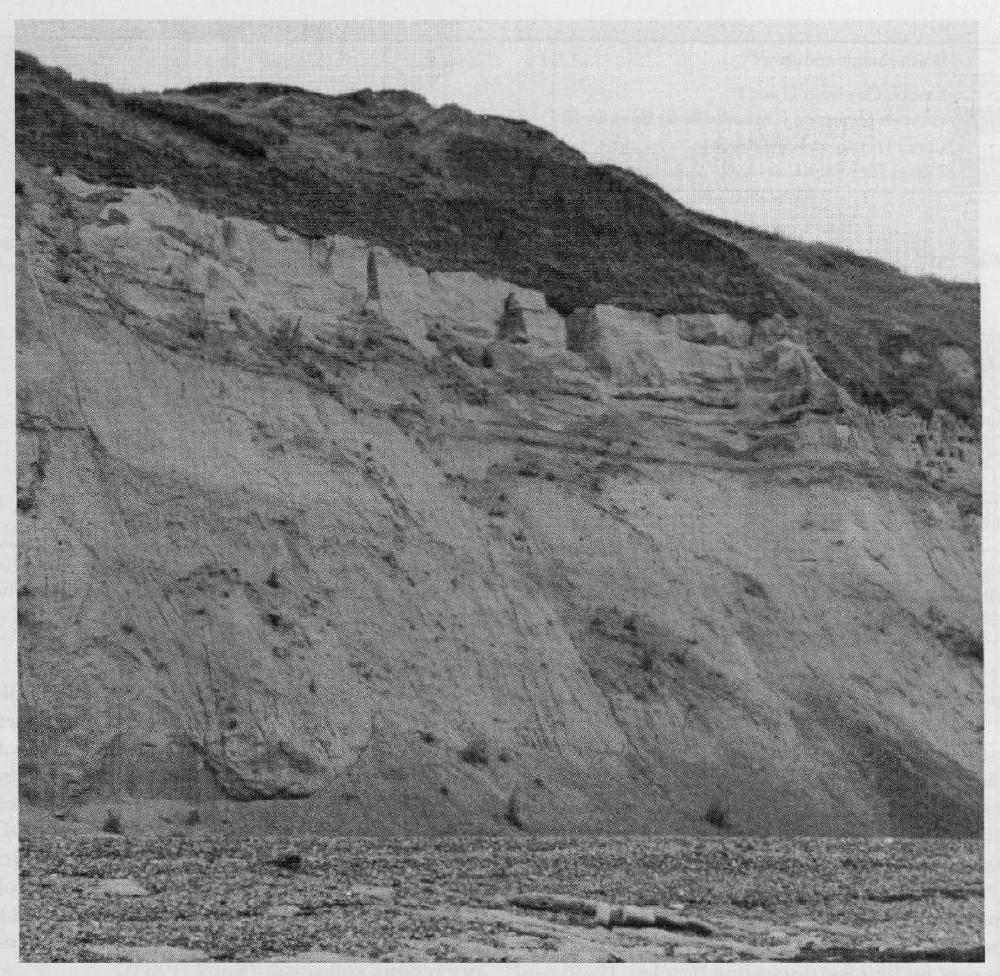
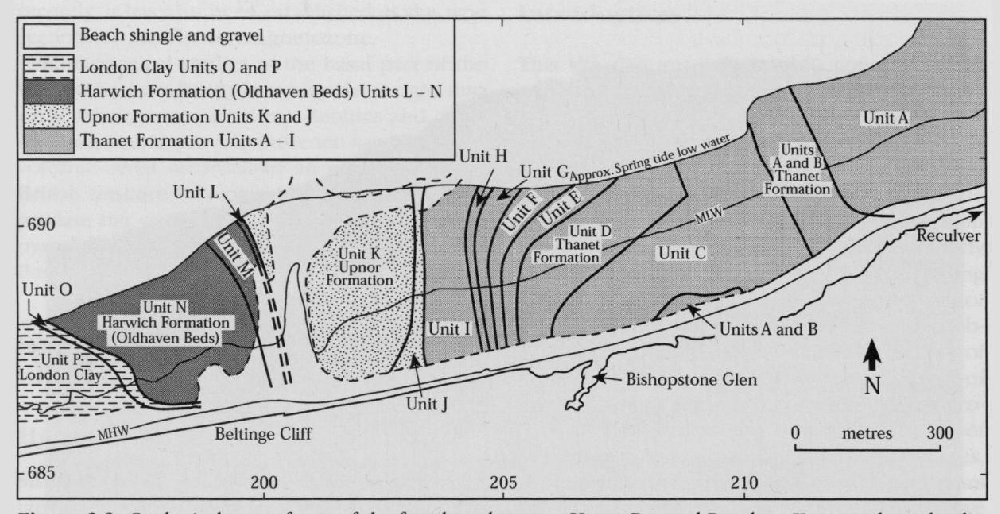
The section between the town of Herne Bay and Reculver to the east
Following the development of coastal defence works, the foreshore exposures (best seen at low-water, equinoctial spring tides) have become an increasing important aspect of the site. Parts of the cliff section are now poorly exposed. For example, King (1981) refers to cliff exposures of 'London Clay' at this site as perhaps, at 35 m, the thickest preservation of the formation in Kent and yet states that little is now visible.
Lithological succession
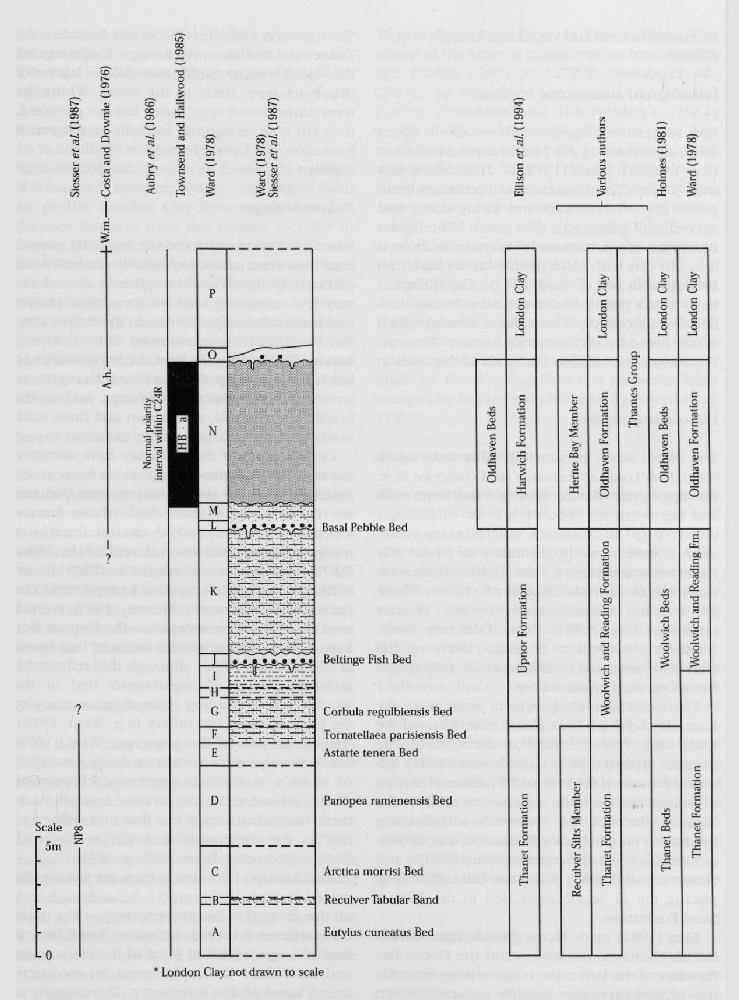
The succession
Lithostratigraphy
The oldest strata present were formerly called the 'Lower London Tertiaries' and comprise here the upper part of the Thanet Sand Formation and the overlying 'Woolwich Beds' of Ellison's (1983, p. 312) Woolwich and
There has been disagreement over where the boundary between the
King (1981) made Herne Bay the type section for his Oldhaven Formation and the Herne
Palaeontology
Since the 19th century, the site has been considered important palaeontologically. Its fossils are particularly significant since this is one of the very few remaining sections to provide insight into earliest Palaeogene times in the British area. Ward's (1978) comprehensive list of 'Lower London Tertiary' fossils from the site includes 34 bivalves, 26 gastropods, together with representatives of other invertebrate groups, such as the brachiopod Lingula, a bryozoan and three echinoids, and also a large number of fishes.
Certain parts of the sequence have attracted the attention of palaeontologists for many years. Amongst these are the Arctica morrisi Bed and the Corbula regulbiensis Bed whose faunas, together with those of some newly defined biostratigraphical units, were described by Ward (1978). The Woolwich Beds (as used by Holmes, 1981, but see later discussion) have proved to be particularly important. Hester (1965) considered that 'no other sections in the Bottom Bed have yielded such a prolific fauna as that found at Bishopstone Glen', although this reflects his inclusion of the C. regulbiensis Bed in the Woolwich and
The 'London Clay' fossils from the site are discussed by King (1981, pp. 54–56) although little of the formation is now exposed. The most comprehensive record, including fossil lists, is that of Cooper (1977). Most of the macrofauna and macroflora are represented by specimens found loose on the foreshore. The majority of the recorded 'London Clay' molluscs probably came from King's (1981) 'Division B', which a little above its base shows a rapid increase in diversity and abundance of foraminifera representing the so-called 'planktonic datum' (cf. that described by Wright (1972) from the Hampshire Basin).
Macrofora
Plant macrofossils have been found at a number of horizons (Chandler, 1961b). Bearing in mind the prolific London Clay flora mainly found at Sheppey but also from this locality (see list in Cooper, 1977), it is the plants from the Thanet Sand Formation that provide a particular local interest. According to Chandler (1961b, p. 17), only two genera have been recognized: Pinus (two species) and the fern Osmundites. However, Ward (pers. comm.) has pointed out that Picea (larch) occurs in both the Astarte tenera Bed and the Beltinge Fish Bed, and that the former also contains a rich seed flora.
Insect remains
An unusual aspect of the fauna is the occurrence of rare pyritized insects from the 'London Clay', most readily obtained from pyritic debris on the foreshore. Rundle (1970a, p. 8) obtained a limited fauna of taxa almost identical to that of the '
Chronostratigraphy
With the section at Pegwell Bay, Herne Bay has been designated the co-stratotype for the Thanetian Stage (Pomerol, 1982).
In the search for a reliable chronostratigraphical scheme based on microfossils, the Herne Bay section has not been neglected. Three zones based on the dinoflagellate Wetzeliella have been recognized: the W. (Apectodinium) hyperacantha Zone (the top of which lies in the basal few metres of the 'London Clay' here), the W. meckelfeldensis Zone (5–18 m above the base) and the overlying W varielongituda Zone (Costa and Downie, 1976).
Unlike Pegwell Bay, where indigenous nannofossils are uncommon, rich and moderately well-preserved nannofossil assemblages have been found at all but the uppermost levels of the Thanet Sand Formation in Herne Bay. The whole of the latter is considered to have an NP8 age (Aubry, 1986, pp. 277–8; Siesser et al., 1987), as suggested previously by Martini (1971). Hamilton and Hojjatzadeh's (1982) report of Discoaster multiradiatus, a nannofossil defining the base of NP9, being found in the uppermost part of the
Age-diagnostic microfossils are absent from the Oldhaven Beds here, but since this unit is both underlain and overlain by beds of the W. (Apectodinium)hyperacantha Zone, it is clearly of this age (Knox et al., 1983). A more recent study of the dinoflagellate cyst sequence biostratigraphy has been undertaken by Powell et al. (1996).
Magnetostratigraphy
The importance of the section for magnetostratigraphical work was stressed by Townsend and Hailwood (1985, p. 969). The Thanet and Woolwich Formations and the 'London Clay' were deposited during a period of reverse polarity. However, for the Oldhaven Beds, the situation is a little more complicated. Up to the lower part of Unit M of Ward (1978)
Glauconite dating
The presence of glauconite in the succession in Herne Bay has allowed various researchers to date the Thanet Sand Formation radiometrically (Odin et al., 1969, 1978; Fitch et al., 1978a, b; Odin and Curry, 1985). Ages determined (in millions of years) include: 68.1 ± 4 (Odin et al., 1969; Thanet Beds, 2 m below the Woolwich Bottom Bed); 53.1 ± 3.3 and 56.0 ± 3.2 (Odin et al., 1978; Thanet Beds, Corbula Bed and 'near top' respectively); 56.8 ± 0.6 and 60.2 ± 2.7 (Fitch et al., 1978a; 5 m below top of Reculver Sands and 2 m above base of Oldhaven Beds respectively). In a later paper, Fitch et al. (1978b) suggested an age range of 60.95 to 57.6 Ma for the Thanet Beds of East Kent as a whole.
Sedimentology
Although generalized lithological descriptions of the site appear in numerous publications, the sedimentological aspects of the section have not received the same degree of attention as have the fossils. King (1981, p. 54), for example, pointed out that there is no published description of the lithostratigraphy of the 'London Clay' and, nowadays, little of the 35 m originally exposed remains visible. Other parts of the sequence have however received greater attention, particularly the
Detrital mineralogy
Mineralogical work on the section has been concerned with the glauconites (see earlier and also later discussion), sediment provenance and a search for evidence of contemporary ash falls. Amongst provenance studies were those of Blondeau and Pomerol (1962, 1968) and Weir and Catt (1969). The source of the Thanet Beds according to these workers was a garnet-epidote-amphibole terrain, and a northerly, Scottish Highland source seems possible (Morton, 1982a, p. 268).
Vertical mineralogical variation of the Thanet Sand Formation, reported by Blondeau and Pomerol (1968) (diminishing-upwards proportions of such minerals as epidote, sphene, etc.), was interpreted by Morton (1982a) as evidence for pre Woolwich and
The mineralogy of the succeeding strata at Herne Bay is broadly similar to that of the Thanet Sand Formation. Weir and Catt (1969) stated that 'The mineral composition of the marine Woolwich Beds at Bishopstone Point is exactly the same as that of the underlying Thanet Beds'. However, from samples taken elsewhere, Morton (1982b) found that the Woolwich Bottom Bed has a mineralogy indicative of an Armorican or Ardennes–Rhenish massif source, unlike the remainder of the succession both stratigraphically above and below.
Contemporary vulcanism
The Herne Bay section has made an important contribution to our knowledge of early Palaeogene volcanic activity. At one time, the Herne Bay section was considered to contain no evidence of contemporaneous volcanic events. Knox and Harland (1979) found no trace of ash in the Woolwich and Reading Beds or the Oldhaven Beds, whilst Knox and Ellison (1979) found none in the 'London Clay'. Material from unweathered foreshore sections, however, subsequently enabled Knox (1983) to recognize well-preserved volcanic grains from the Oldhaven Beds, albeit comprising a small proportion (1–5%) of the sand fraction. This discovery was to have considerable stratigraphical significance (see next section).
Interpretation and evaluation
The Herne Bay section provides us with particular insight into the early Palaeogene history of south-eastern England. It comprises the best record of the upper part of the Thanet Sand Formation, 'Woolwich Beds' (now the
Comparison with other localities
The Thanet Sand Formation is best developed and thickest in north-eastern Kent (see isopachyte map in Hester, 1965). By contrast, the Woolwich and
Palaeoclimatology
There seems little doubt that the rich fossil assemblages at certain horizons will continue to make Herne Bay attractive to palaeontologists. That the section includes fossiliferous Thanet Beds renders it particularly interesting palaeoenvironmentally and palaeogeographically, albeit that the evidence is somewhat equivocal particularly regarding climatic implications. Gardner's (1878) view that the Thanet Beds represent a temperate climate was 'regarded with suspicion' by Chandler (1964), although Haynes (1956–1958) concluded from his work that the sea in which this formation accumulated was shallow and cool. Wrigley (1949) found both cold water (e.g. Arctica) and warm water elements in the molluscan fauna, but concluded that the indications 'point to a subtropical rather than a temperate or boreal climate'. This is compatible with White's (1931) reference to the occurrence of subtropical and tropical fish in these strata and Curry's (1965a) mention of calcareous algae in the highest Thanet Beds near Bishopstone Glen. Such apparent palaeoecological dissonance remains an interesting aspect of the section.
Chronostratigraphy
Herne Bay is significant internationally as the co-chronostratotype for the Thanetian Stage (Pomerol, 1982b). Its value is reiterated by Siesser et al. (1987) in their statement that 'Any correlation of rock sequences from elsewhere in the world to the Thanetian Stage depends on an accurate knowledge of the biozonation of the Thanetian stratotype and reference sections'. In a paper that contains an excellent and comprehensive discussion of the concept, history and usage of the Thanetian (and the Thanetien), these authors (p. 95) give the
The occurrence of glauconite at various horizons in Herne Bay led to its use for absolute age dating. Indeed, Fitch et al. (1978b) suggested that since the
Palaeogeography
Whilst no detailed sedimentological study has been published on the section, aspects of the lithostratigraphy (e.g. Ellison, 1983; Ellison et al., 1994) together with mineralogical and palaeomagnetic research have contributed greatly to our understanding of early Palaeogene correlation and palaeogeography. Morton's (1982a) findings (see earlier) regarding the provenance and contemporaneous weathering of the Thanet Sand Formation is an example.
The difference between the nature and thickness of the Woolwich and
Solving the 'Oldhaven' problem
The stratigraphical affinities of the Oldhaven Beds were established by two separate yet complementary pieces of research on the Herne Bay section: one on its mineralogy and the other on its palaeomagnetic attributes. King (1981) regarded his Oldhaven Formation (Herne
The conclusion arising from such mineralogical work has facilitated the interpretation of palaeomagnetic data derived from the site. Townsend and Hailwood (1985) recognized strata with normal polarity both in all but the lowest Oldhaven Formation of Herne Bay and in the upper part of the Harwich Member at Wrabness and Harwich to the north. Both occurrences were confidently assigned to the Oldhaven Magnetozone, which would probably not have been the case had the Herne Bay succession been devoid of volcanic material. These complementary studies indicated that the Oldhaven Formation here is a lateral correlative of the earliest 'London Clay' to the north, now formally designated the
Conclusions
Herne Bay is stratigraphically the major Palaeogene site in the London Basin. Furthermore, it is the most important Palaeocene site of the British onshore succession, since both the Thanet Sand Formation and the
The site is lithostratigraphically, chronostratigraphically and magnetostratigraphically significant, in that it provides the type sections for the Thanet Sand Formation, the internationally important Thanetian Stage and the Oldhaven Magnetozone.
The site provides insights into a number of aspects of Palaeogene history and palaeoenvironments. A considerable contribution to our understanding of Thanetian times in southern England comes from this locality and that in Pegwell Bay. The
Palaeontologically, the site continues to maintain the significance which became apparent early in the 19th century, with various horizons such as the C. regulbiensis Bed, having more prolific faunas in their Herne Bay development than elsewhere. Recent years have seen the considerable amount of micropalaeontological work on the section contribute to establishing a sound correlation of Palaeogene strata both locally and beyond the British area.