Thorness Bay and Gurnard, Isle of Wight
Highlights
This exposure of the
Introduction
From Gurnard (grid reference
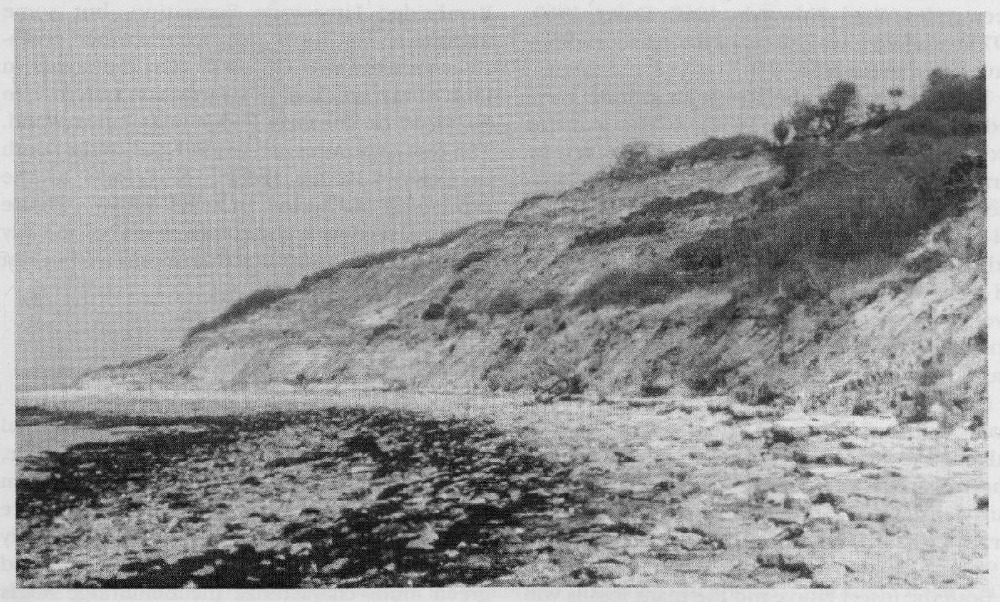
Thorness Bay, and especially the section near Gurnard Ledge, has attracted geologists since the middle of the 19th century and various aspects of the geology have been described in the Memoirs of the Geological Survey (Bristow et al., 1889; White, 1921) and a number of other publications, including the recent comprehensive review by Daley (1999, pp. 55–60).
Much of the early interest was palaeontological, attention being especially focused on the so-called 'Insect Limestone' just above the base of the
Recent years have seen a renewed interest in the geology of Thorness Bay. The succession has been redescribed (Edwards, 1967; Daley, 1969, 1973a) and various aspects of the palaeontology have been researched.
The isopods from the 'Insect Limestone' were redescribed by Martini (1972), whilst a major account of the insect fauna was undertaken by Jarzembowski (1980). Machin (1971) found that the 'Insect Limestone' was the richest microfloral horizon in the local Palaeogene succession, although work by Collinson (1978a) has indicated that plant macrofossils from it are now relatively uncommon. The macroinvertebrate fauna from the
Daley and Edwards (1971) used evidence from Thorness Bay to demonstrate intra-Palaeogene warping. Other references to Thorness Bay include Daley (1972c, 1974), Curry et al. (1972), Daley and Edwards (1974), Jarzembowski (1976) and Daley and Insole (1984, pp. 30–1).
Both the insect fauna and the plant fossils will be considered in more detail in separate GCR volumes.
Description
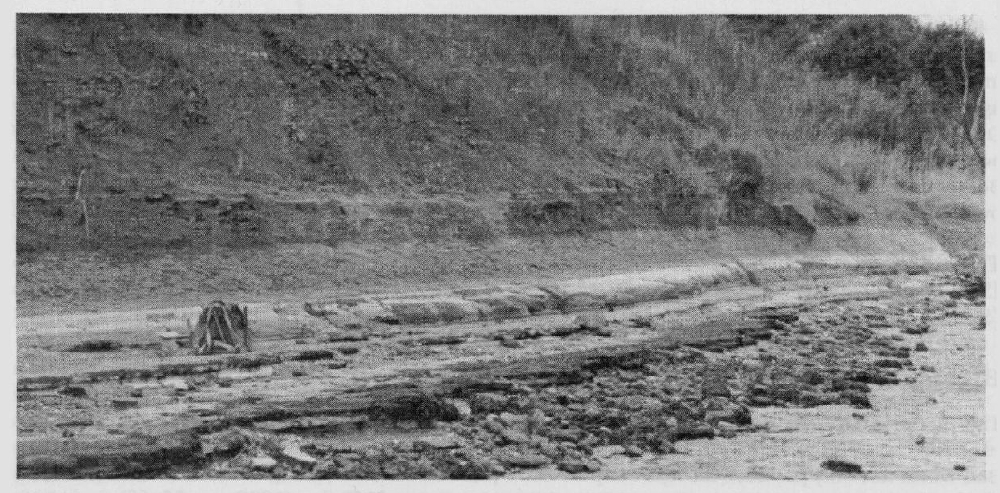
The site traverses the NW–SE trending Thorness Bay Syncline. The northern limit of Thorness Bay comprises Gurnard Ledge, formed from the
Lithological succession
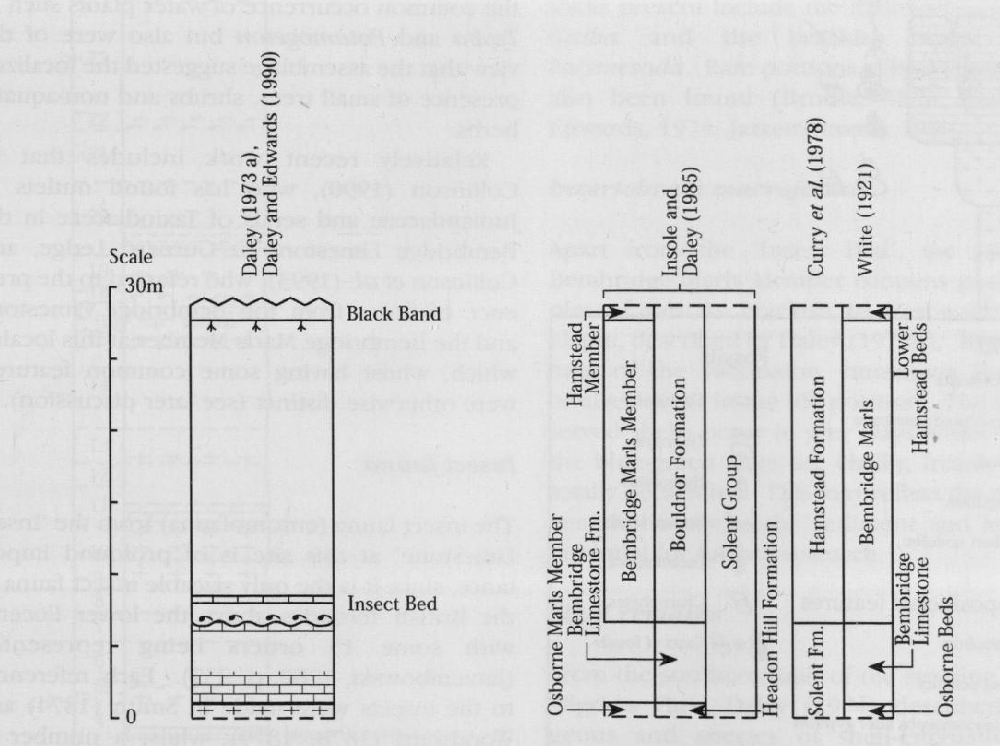
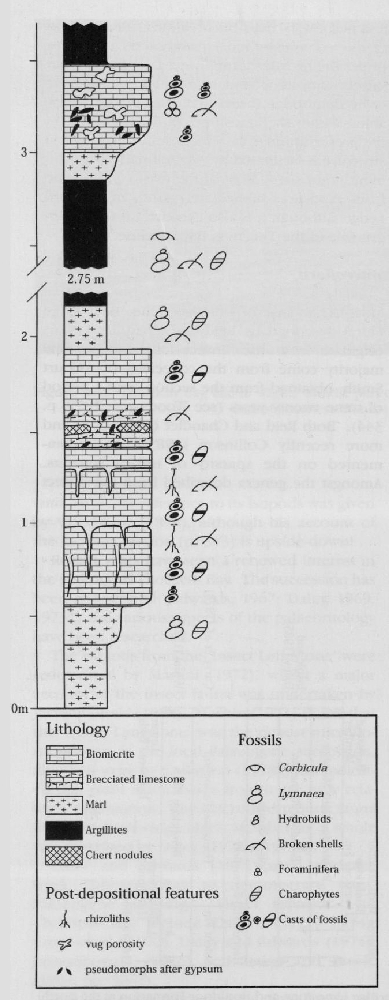
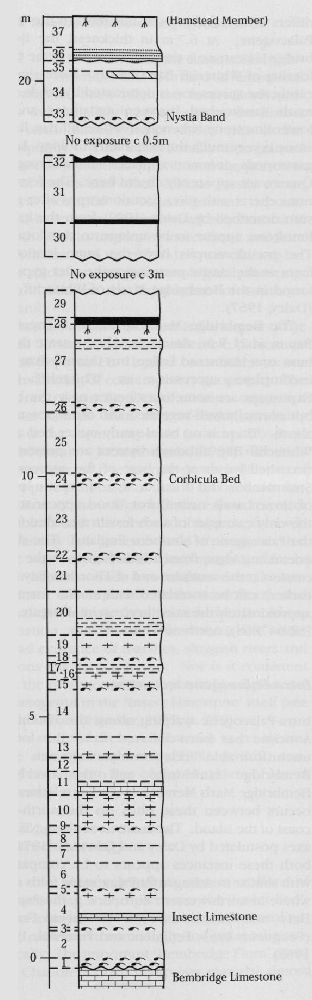
The succession here
Bembridge Insect Bed
The prime focus of interest in the section has been in the so-called 'Insect Limestone', whose flora and fauna has been famous since the 19th century. The singular form 'Insect Limestone' is in reality a misnomer since, although a more or less c. 10 cm thick tabular limestone is often present, discontinuous concretionary limestones and hard marls also occur in places, all within a predominantly argillaceous unit (bed GUR IV of Daley (1973a) near Gurnard Ledge and bed BW IV near Burnt Wood). Recognition of this complexity led Jarzembowski (1980) to prefer the broader term 'Insect Bed' rather than 'Insect Limestone' but in a wider context, the term 'Bembridge Insect Bed' is probably preferable. Within the limestones of the 'Insect Bed', the preservation of extremely delicate biological structure is facilitated by exceptionally fine sediment grain size. Most of the fossils have come from exposures immediately south of Gurnard Ledge, although it is also exposed on the southern side of the Thorness Bay Syncline.
Macroflora
Most of the macrofossils from the 'Bembridge Flora' described by Reid and Chandler (1926) originate from the 'Insect Limestone'. The majority come from the collection of A'Court Smith, obtained from the section over a period of some twenty years (see Woodward, 1879, p. 344). Both Reid and Chandler (1926, p. 3) and more recently Collinson (1983b) have commented on the sparsity of in-situ remains. Amongst the genera described from the 'Insect Limestone' are Engelhardtia, Hooleya, Typha, Ranunculus, Abelia and Clematis. Fowler (1975) has made a special study of the fern Azolla from this unit.
The total 'Bembridge Flora' described by Reid and Chandler (1926) comprised 108 named species. Some of these came from higher up the
According to Machin (1971), the 'Insect Limestone' in Thorness Bay possibly contains the richest microfossil assemblage of the local Palaeogene strata. Collinson and Hooker (1987) referred to the assemblage as mainly comprising wind-dispersed disseminules. They referred to the common occurrence of water plants such as Typha and Potamogeton but also were of the view that the assemblage suggested the localized presence of small trees, shrubs and non-aquatic herbs.
Relatively recent work includes that of Collinson (1990), who has found nutlets of Judlandaceae and seeds of Taxiodiaceae in the Bembridge Limestone at Gurnard Ledge, and Collinson et al. (1993), who referred to the presence of floras from the Bembridge Limestone and the
Insect fauna
The insect fauna (entomofauna) from the 'Insect Limestone' at this site is of profound importance, since it is the only sizeable insect fauna in the British Tertiaries above the lower Eocene, with some 15 orders being represented (Jarzembowski, 1980, p. 239). Early references to the insects were made in Smith (1874) and Woodward (1878, 1879), whilst a number of authors studied various aspects of the fauna over a number of years prior to 1940 (see the selected resume of previous work in Jarzembowski, 1980, p. 240). A major contribution to our knowledge of this insect fauna has been made by Jarzembowski (1976, and, more importantly, 1980). As well as reviewing the history of study of the fauna, he describes a number of forms, including new genera and species. Of the insects he examined, 70% belong to the Hymenopera, Diptera and Coleoptera. The first two of these are especially common, with more than 120 species described from this fauna.
Other fossils from the 'Insect Bed'
Amongst other fossils found in the 'Insect Limestone' are an anostracan crustacean, Branchipodites vectensis (Woodward, 1879); an isopod crustacean, identified by Martini (1972) as Eosphaeroma margarum; a spider, Eoatypus woodwardii (McCook, 1888a,b); and an ostracod, Potamocypris brodiei (Jones and Sherborn, 1889) which Haskins (1968b) compared with the freshwater genus Cypridopsis. Molluscan shells present include the freshwater gastropod Galba and the brackish water bivalve Polymesoda. Rare portions of bird feathers have also been found (Brodie, 1878; Daley and Edwards, 1974; Jarzembowski, 1980).
Invertebrate macrofauna
Apart from the 'Insect Bed', the remaining
Algal remains
From the southern limb of the syncline, west of Pilgrims Park, Daley (1974) described a new genus and species of shell-encrusting alga, Epivalvia edwardsii, from the lower part of the Bembridge Marls Formation (bed THOR III; see Daley, 1973a). Further westwards, as yet undescribed, small stromatolitic/oncolitic algae are well-preserved in the bottom bed of the Bembridge Marls Formation (bed BW I of Daley, 1973a).
Sedimentology
Whilst the stratigraphy of both the
Of work published, Daley (1972c) has described small-scale deformation structures from the 'Insect Limestone', whilst more recently, silica pseudomorphs after microlenticular gypsum have been found in cherts in the Bembridge Limestone to the north-east of Gurnard Ledge (Daley, 1989). The original gypsum crystals are considered to have been pedogenic in origin. Their occurrence provides evidence for a reappraisal of the climate of southern Britain in Palaeogene times.
Intra-Palaeogene tectonism
The tectonic structure of Thorness Bay is superficially simple. Daley and Edwards (1971), however, made a detailed study of the relationship of the
Interpretation and evaluation
Although Thorness Bay contains strata of limited stratigraphical range, from the top of the
Comparison with other localities
Stratigraphically, the Thorness Bay succession differs from other sites at this level in the local Palaeogene. At 6.7 m in thickness, the Bem-bridge Limestone is thinner here than at the type locality of Whitecliff Bay (8.5 m). More significantly, the succession is dominated by muds and marls sandwiched between an upper and a lower limestone, whereas at Whitecliff Bay, limestone is very much the dominant lithology. Land gastropods, common at places such as Prospect Quarry, are apparently absent here. The ferruginous cherts with silica pseudomorphs after gypsum described by Daley (1989) from the lower limestone appear to be unique to this locality. The pseudomorphs have the same lenticular form as the clastic pseudomorphs after gypsum found in the Bembridge Marls of Whitecliff Bay (Daley, 1967).
The
Intra-Palaeogene tectonism
Intra-Palaeogene warping along the Porchfield Anticline has been inferred from the locally unconformable relationship between the Bembridge Limestone and the overlying
Fossil insects and their significance
There is little doubt that the fame and importance of Thorness and Gurnard is associated with what has been called the 'Insect Limestone' or, to use the slightly broader term, the 'Insect Bed' sensu Jarzembowski (1980) (see earlier description). The exceptionally fine-grained limestones present have facilitated the preservation of insects and other delicate fossils whose survival potential in coarser-grained deposits would have been, at most, markedly limited, if not nil. With its important insect fauna and flora (both macro- and microflora), it may claim to be, for its thickness, the palaeontologically most significant bed in the Palaeogene of southern England.
Since the insect fauna here is the largest of the British Tertiary, it is of considerable palaeontological importance. It also contributes to our understanding of contemporary geography. The presence of four families of termites suggests a warmer climate than that of today, probably close to the warm temperate (subtropical)–tropical boundary. Jarzembowski (1980) mentions the presence of one termite genus indicative of lower precipitation than that of modern rain forest. Most of the insects found are from terrestrial habitats and the rareness of aquatic, freshwater insects led Jarzembowski to suggest that there was only a limited development of freshwater habitats. Such a conclusion does, however, seem incompatible with macrofloral and macroinvertebrate studies of the
The study of the insect fauna is as yet incomplete since Jarzembowski (1980, p. 240) confined his study to five of the 15 orders of insect present.
Fossil plant remains and palaeoclimatology
Both the plant macroflora and microflora of Thorness Bay, and in particular the 'Insect Bed', are of considerable significance, palaeontologically, palaeoenvironmentally and palaeoclimatologically. The important 'Bembridge Flora' (Reid and Chandler, 1926) comprises material almost exclusively from Thorness Bay and most of this is from the 'Insect Bed', also the richest microfloral source in the local Palaeogene (Machin, 1971). Consequently, the site makes a major contribution, regarding aspects of palaeogeography in which plants provide some degree of explanation.
In considering its significance, Chandler (1964) had no doubt that the Bembridge Flora was tropical in nature, although Reid and Chandler (1926, p. 26) had earlier suggested that it represented warm temperate and subtropical regions. Machin's (1971) interpretation was that the climate was subtropical, perhaps like that of Florida today (i.e. warm temperate eastern margin). The presence in the flora of temperate genera led Chandler (1964) to suggest a derivation from mountains where, at higher altitudes, the temperature would have been cooler. Unfortunately, other geological evidence does not support the existence of contemporary mountains (Daley, 1972a). Recent palaeopedological work, including that of Daley (1989) on the Bembridge Limestone at this site, supports the idea that there were dry climatic periods rather than persistent humid tropical or subtropical conditions as had hitherto been supposed. Recent work by Hooker (1994) on mammalian faunas from the Bembridge Limestone adds some support to this view. The presence of pedogenic gypsum in this formation at this site fits in well with the suggested correlation of the Bembridge Limestone with the Gypse of the Paris Basin (Curry et al., 1978, table 2), the existence of which only2–3° of latitude further south must indicate a prolonged deficit in precipitation (Daley, 1972a).
Depositional environment
Palaeoenvironmentally, exposures of Bembridge Limestone in Thorness Bay indicate more 'offshore' deposition than that of the land gastropod-rich lithologies at Prospect Quarry, whose pedogenic alteration suggests a more palustrine (lake-margin) situation. The muds with brackish water fossils indicate the proximity of the sea, perhaps more so than at Whitecliff Bay where the argillaceous unit is much thinner. It may be that the lateral interstitial transportation of water from such marine areas provided the saline pore water which on evaporation led to the formation of the microlenticular gypsum referred to above (Armenteros et al., 1997).
As at other localities where the
Remarkably, very thin beds, characterized by a particular fauna, can be recognized at localities many kilometres apart. By way of example, the thin Serpulid-rich unit present here (Daley, 1973a, bed GUR IX, fig. 4) is traceable wherever the lower part of the member is visible, including in Howgate Bay north of Whitecliff Bay. Such cases appear to indicate how rapidly (geologically) circumstances could change over a wide area.
The generally quiescent environment under which the member accumulated is well illustrated by the Thorness Bay succession. Some coquinas, including convex-upward bivalve concentrates, clearly indicate water movement, but shallow-burrowing bivalves in life position and varve-like laminations indicate that for long periods the sediments lay undisturbed. Mud cracks and pyrite 'pins', representing rooted herbaceous vegetation, indicate shallow water, whilst locally there were probably small 'tree islands' with small trees, shrubs and non-aquatic herbs (Collinson and Hooker, 1987, p. 270).
In a more recent paper Collinson et al. (1993) concluded that the Bembridge Limestone flora indicated the presence of ponds or lakes with a limited catchment area in comparatively dry sur roundings, with warm, clear, calcareous waters including areas of open water and others with emergent vegetation. Collinson et al. (1993) considered that the
Conclusions
Although restricted in its stratigraphical range, Thorness Bay and Gurnard comprises an important site from a number of geological standpoints. It represents brackish and freshwater facies together with a variety of well-preserved molluscan assemblages. It is one of the two sites on the Isle of Wight providing evidence of intra-Palaeogene earth movement.
Its most important component unit is the 'Insect Bed' which is particularly significant both palaeontologically and palaeoclimatologically. This unit contains not only probably the most important insect fauna in the British Palaeogene but is the main source of the 'Bembridge Flora'. For its thickness, there is little doubt that palaeontologically it is one of the richest units in the British Tertiary succession.
From a palaeoclimatological standpoint, evidence from this site indicates that the view that the 'Bembridge Flora' represents a sample of an essentially humid tropical flora can no longer be maintained. It seems that the climate was somewhat less tropical than the London Clay and other earlier Palaeogene floras, perhaps representing subtropical or warm temperate conditions. Mineralogical evidence suggests that from time to time the climate might have been more arid in character.