Hordle Cliff
(Potential GCR site)
Highlights
Fish remains from Hordle Cliff in Hampshire, which have recently been found associated with a diverse fauna of tetrapods including mammals, reptiles and amphibians in terrigenous deposits, may be derived from earlier or contemporaneous marine beds. The importance of the site lies in this juxtaposition of marine and terrestrial late Eocene faunas. Collecting here has also been profitable in recent decades. Continuing natural erosion of soft strata provides good opportunity for collecting from the several yielding horizons.
Introduction
The Late Eocene (Priabonian)
The first vertebrate remains reported from the sections of Hordle (or Hordwell) Cliff were described from the extensive collections of Searles Wood and Barbara, Marchioness of Hastings, which were assembled during the late 1840s. These remains, including numerous specimens of fishes, reptiles and mammals, were initially reported by Wood (1844) and Charlesworth (1845). Wood (1846) listed and figured further material from Hordle Cliff and Hastings (1852, 1853) reported the results of six years' further collecting, listing important finds of mammals, fishes, reptiles and birds. Subsequently, in 1855, the Hastings collection was acquired by the Natural History Museum. The site has been selected as an SSSI on the basis of its reptile fauna (Benton and Spencer, 1995). A collection of small tetrapods, including numerous well-preserved amphibian remains, made from Hordle Cliff between 1976 and 1981, containing numerous new specimens, has greatly expanded the faunal list. The specimens were obtained by Mr Roy Gardiner of Fareham from the
Description
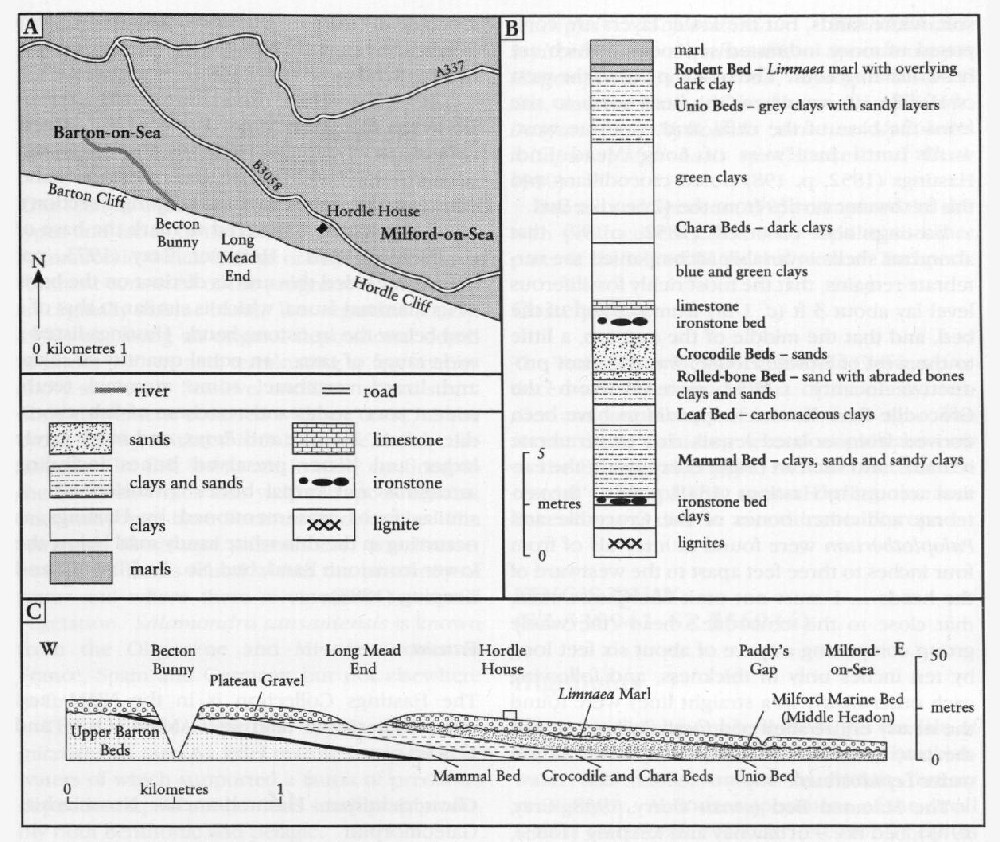
As Benton and Spencer (1995) report, the stratigraphy of Early Palaeogene rocks at Hordle Cliff was described by Gardiner et al. (1888) and Cray (1973). The following section is abridged from Cray (1973, p. 11). The beds dip gently south-east at about 2.5°
| Thickness (m) | |
| Marl seen | 0.5 |
| Rodent Bed: Limnaea Marl with overlying dark clay ( = Rodent Bed Marl) | 0.25 |
| Unio Beds: grey clays with sandy layers | 3.5 |
| Green clays | 2.5 |
| Chara Bed: dark clays | 1.4 |
| Blue and green clays | 2.7 |
| Limnaea Limestone | 0.4 |
| Ironstone Bed | 1.2 |
| Crocodile Bed: sands | 2.0 |
| Rolled-Bone Bed: sand with abraded bones | 0.3 |
| Clay and sands | 1.4 |
| Leaf Bed: carbonaceous clay | 1.0 |
| 3.5 | |
| Ironstone bed | 0.4 |
| Clays | 1.1 m |
| Lignites | seen 1.4 m |
The
It has been established (e.g. Cray, 1973; Milner et al., 1982) that the Hordle amphibians were all found in the
Hastings (1852, p. 194) recorded an extensive vertebrate fauna from the Rodent Bed. The finds may be bracketed with the dark clayey marl on the basis of Hastings' detailed description of the host sediment and mention of the underlying Limnaea Marl.
Cray (1973, pp. 10–12) described the occurrence and preservation of the vertebrates: 'occasional rodent teeth and turtle fragments were recovered from the upper levels of the Limnaea marl, and the overlying dark sandy clay has yielded a moderate quantity of small-sized vertebrate debris … This material is always of very small size and evidently represents a current-sorted accumulation; all the large Headon Beds species are absent. All the specimens are fragmentary and … some of the material is water worn'. Fish were not included.
The upper part of the Crocodile Bed is of fine, soft, white sands, but the lower layers are composed of more indurated sediments, which are brownish in colour. The outcrop lies to the west of Hordle House, where the beds seem to rise from the base of the cliffs, and continue westwards until just west of Long Mead End. Hastings (1852, p. 198) noted crocodilians and the freshwater turtles from the Crocodile Bed.
Hastings also observed (1852, p.197) that abundant shells invariably accompanied the vertebrate remains, that the most richly fossiliferous level lay about 3 ft (c. 1 m) from the top of the bed, and that the middle of the outcrop, a little to the west of Hordle House, was the most productive locality. Most material from the Crocodile Bed, however, appears to have been derived from isolated lenses rich in vertebrate remains, and such an origin is explicit in the earliest account by Hastings (1848, p. 63) : 'the vertebrae and other bones of the Crocodile and Paloplotherium were found at intervals of from four inches to three feet apart to the westward of the heads … I must not omit likewise to state, that close to this crocodile's head (the whole group comprising a space of about six feet long by ten inches only in thickness, and following each other nearly in a straight line) were found the nearly entire shell of a fossil Trionyx … and the jaw, vertebrae, and scales of a fish of the order Lepidosteus'.
The
The specimens collected recently by Mr Gardner also derive from the
Other horizons that have yielded vertebrate remains include the Rolled-Bone Bed. In 1852 (p. 199) Hastings reported finds of turtles and crocodilians from it. However, most of the specimens are generally highly abraded and cannot be identified precisely.
The Thin Shell Bed above the Lower Ironstone Band has yielded one of the largest collections of reptiles from Hordle. This bed occurs immediately above the ironstone band (numbered 8 in Tawney and Keeping's section), which is usually considered to mark the base of the
Fauna
The Hastings Collection is in the NHM, and other material is held in CAMSM, OUM and YORMS.
Chondrichthyes: Elasmobranchii: Neoselachii: Galeomorphii
Physogaleus secundus (Winkler, 1874)
Syliorhinus woodwardi Cappetta, 1976
'Scyliorhinus' biauriculatus (Casier, 1950)
Synodontaspis acutissima (Agassiz, 1843)
Chondrichthyes: Elasmobranchii: Neoselachii: Batomorphii
Dasyatis spp.
Myliobatis striatus Buckland, 1837
M. toliapicus Agassiz, 1843
Myliobatis sp.
Rhinobatos bruxelliensis (Jaekel, 1894)
Otoliths
TETRAPODA
Lissamphibia: Anura: Discoglossidae
'discoglossid 1' of Milner et al. (1982)
'discoglossid 2' of Milner et al. (1982)
Anura: Pelobatidae
Eopelobates cf. E. hinschei Estes, 1970
Anura: Palaeobatrachidae
Albionbatrachus wightensis Meszoely et al., 1984
Caudata: Salamandridae
Salamandra sansaniensis Lartet, 1851
Chelotriton cf. C. paradoxus Pomel, 1853
Triturus sp.
Interpretation
This section exposes a wide variety of sediment types and facies of the late Eocene
The Milford Marine Band fauna of microsharks marks a brief marine incursion, the waters of which supported a fauna of predators dependent upon unidentified small prey, probably both benthonic and pelagic.
Comparison with other localities
The
The Milford Marine Bed within the overlying Middle Headon Beds (
Benton and Spencer (1995) compared the site with productive localities for reptiles in other parts of the Isle of Wight and western Europe.
Conclusion
The