Cwm Idwal
M. Smith
Introduction
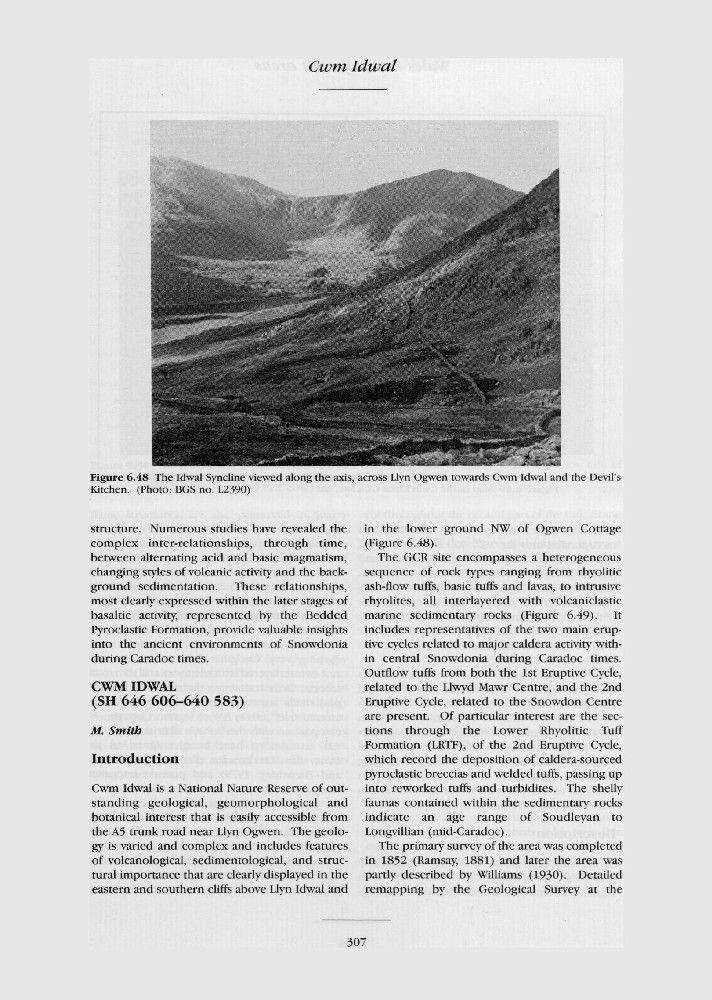
Cwm Idwal is a National Nature Reserve of outstanding geological, geomorphological and botanical interest that is easily accessible from the A5 trunk road near Llyn Ogwen. The geology is varied and complex and includes features of volcanological, sedimentological, and structural importance that are clearly displayed in the eastern and southern cliffs above Llyn Idwal and in the lower ground NW of Ogwen Cottage
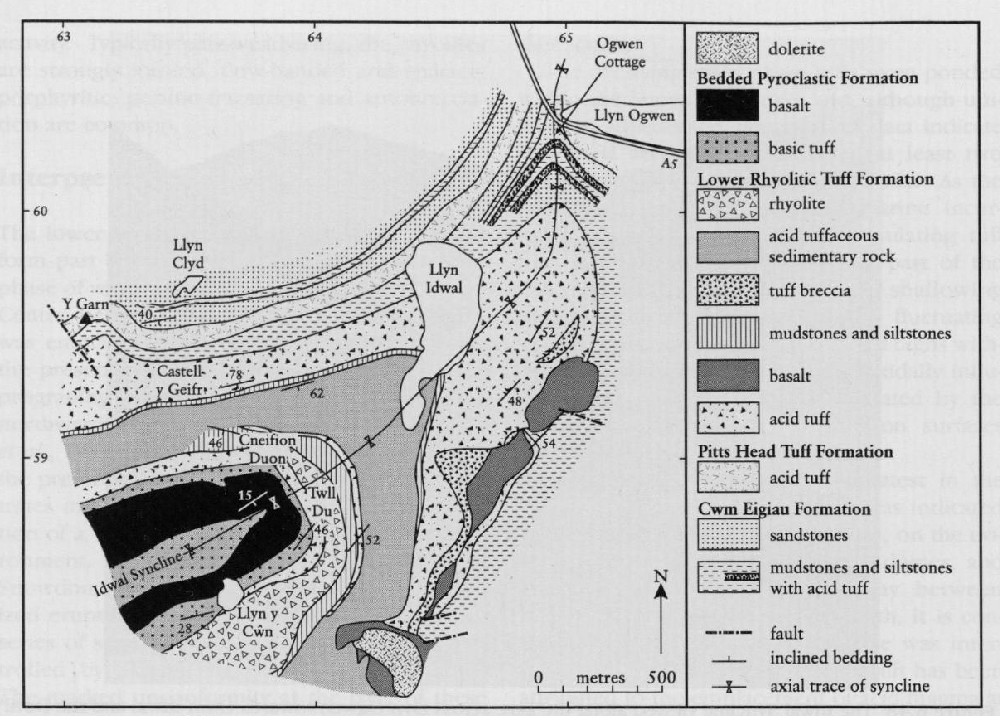
The GCR site encompasses a heterogeneous sequence of rock types ranging from rhyolitic ash-flow tuffs, basic tuffs and lavas, to intrusive rhyolites, all interlayered with volcaniclastic marine sedimentary rocks
The primary survey of the area was completed in 1852 (Ramsay, 1881) and later the area was partly described by Williams (1930). Detailed remapping by the Geological Survey at the 1:10 560 scale was completed in 1977 and incorporated into the 1:25 000 scale geological Sheet SH65/66 (Passes of Nant Ffrancon and Llanberis) (1985). General descriptions of Cwm Idwal were given by Roberts (1979) and Howells et al. (1981), with detailed descriptions of parts of the succession in Reedman et al. (1987), Fritz et al. (1990), Howells et al. (1991) and Kokelaar et al. (1994). Geochemical data were presented by Howells et al. (1991).
In ascending order the succession includes the
Description
In the site area, strata occurring immediately below the
The lower strata of the
The overlying acidic ash-flow tuff is the most northerly representative of the
Three main sub-units are recognized in the Pitts Head Tuff at this locality: a basal non-welded zone 1–2 m thick and rich in feldspar crystals with a vitrodastic texture; this grades up into 25–45 m of white, siliceous, welded tuff with a prominent eutaxitic foliation; and an upper fine-grained tuff. Distinctive ragged, flattened and streaky fiamme, up to 5 cm in length, are pres ent throughout the central part of the tuff. Some 5 m above the base, cooling and contraction joints are well developed and fiamme increase markedly in size. The welding foliation is accentuated by siliceous segregations locally reaching 30 cm in length, although these are less well developed compared with the southern outcrops around Moel Hebog. Zones of siliceous nodules 1–3 cm in diameter occur irregularly through the tuff and rheomorphic flow textures, indicated by the variable orientation of the fiamme with respect to the margins of the flow, are common. Locally, (for example at
The Pitts Head tuffs, in turn, are sharply overlain by up to 200 m of sandstones representing a continuation of the
The acidic ash-flow tuffs, intrusive rhyolites, breccias and interbedded sedimentary rocks which comprise the overlying
The LRTF is a heterogeneous unit up to 110 m thick, which rests with marked disconformity on the underlying sedimentary rocks. This discordance increases to the south to an unconformity (Howells et al., 1986). In the west, the LRTF cuts down through easterly-dipping sandstones, locally cutting out thin tuffaceous units, and comprises welded primary ash-flow tuffs with no intercalated sediments. In contrast, on the eastern limb of the Idwal Syncline the basal relationships are complicated by intrusive basalts, lavas and the development of a pyroclastic breccia facies at the base of the LRTF.
The basal sections of the LRTF are best seen at the foot of a wall immediately SW of two streams that drain into Llyn Idwal at
The main part of the LRTF is a thick sequence of stratified welded lapilli ash-flow tuffs with beds up to 1.5 m thick and a prominent eutaxitic foliation. Thin breccia layers similar to the basal breccia have been recorded up to 42 m above the base (Kokelaar et al., 1994). In thin section, the fiamme are chloritic and are set in a matrix of undeformed devitrified shards and fine-grained dust. Several units are indicated on the 1:25 000 scale map and are separated by laterally impersistent layers of siltstone. The highest beds are composed of well-bedded and upwardly graded reworked tuffs. A dark porcellaneous laminated fine-grained tuff marks the top of the sequence.
The overlying sedimentary rocks, up to 100 m in thickness, have been described in detail by Fritz et al. (1990). The lowest bed is a 2 m-thick laminated pyritic mudstone, passing up into tuffaceous siltstones with hummocky and swaley cross-stratification and abundant large carbonate concretions. Above, are up to 75 m of brown-weathering, greenish coarse-grained volcaniclastic sandstones with interbeds of pale tuffaceous siltstone and rare impersistent ash-flow tuffs. Individual bed thicknesses range between 10–50 cm and show a progressive upward decrease in the volcaniclastic component. The sandstones, up to 7 cm thick, are massive and planar bedded with flat, locally scoured bases and reworked hummocky tops. Sedimentary features include cross-lamination, ripples, grading, washouts, intraformational unconformities, and slump folds with contorted bedding indicating deformation of semi-lithified sediment (for example at
The upper parts of the backwall of Cwm Idwal are dominated by a thick columnar-jointed rhyolitic lava flow, which can be traced across the core of the synclinal structure. The rhyolite lava is dark blue-grey, flinty and finely banded with locally developed perlitic fracturing. The upper surface, exposed along the footpath between Cneifion Duon and Y Garn, is brecciated, and in places, hollows and depressions are infilled with coarse volcanic detritus. The zones of brecciation contain classic jig-saw breccia fabrics and can be traced laterally into flow-banded rhyolite indicating in-situ autobrecciation. The rhyolite lava is in places separated from the overlying BPF by up to 35 m of planar and cross-laminated rhyolitic tuffaceous sandstone representing the top of the LRTF.
The
Interpretation
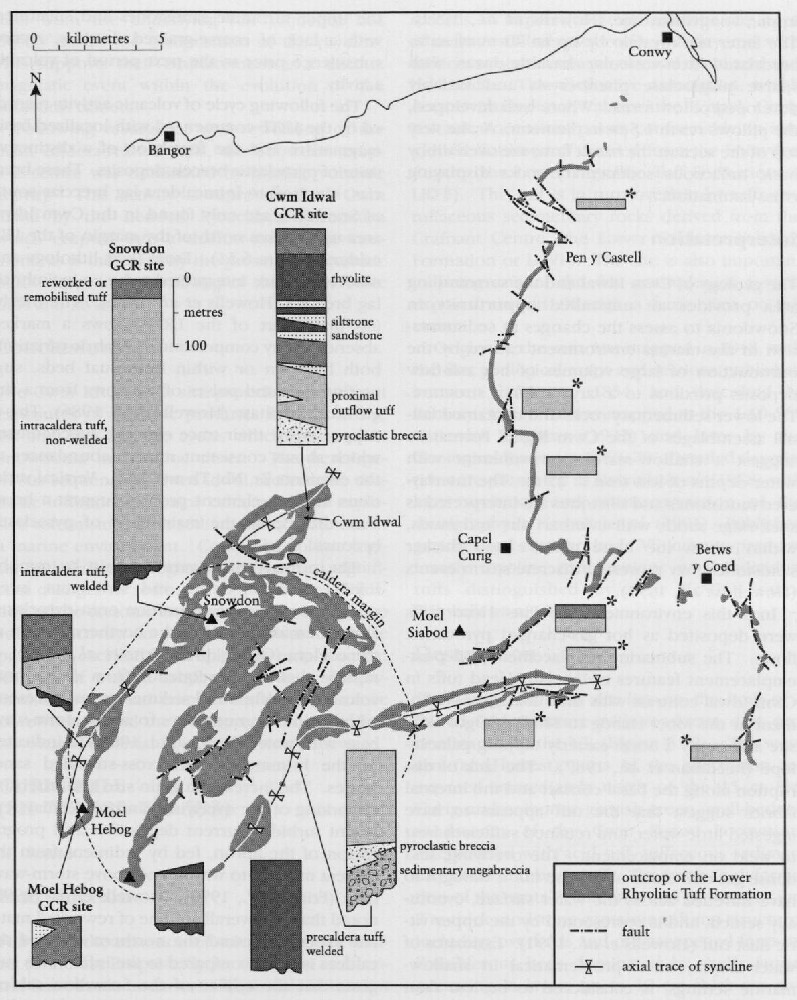
The geology of Cwm Idwal and the surrounding area provides an unrivalled opportunity in Snowdonia to assess the changes in sedimentation in the marine environment caused by the introduction of large volumes of hot ash-flow deposits proximal to a large caldera structure. The lower sedimentary rocks and contained faunal assemblages of the
Into this environment the Pitts Head tuffs were deposited as hot gas-charged pyroclastic flows. The submarine emplacement and post-emplacement features of the Pitts Head tuffs in Cwm Idwal contrast with the subaerial environment at the Moel Hebog to Moel yr Ogof GCR site and imply a north-easterly dipping palaeoslope (Reedman et al., 1987). The lack of disruption along the basal contact and the internal fabrics suggest that the tuff appears to have ingested little water, and retained sufficient heat to weld on emplacement. The overlying, less dense gas-rich cloud above the tuff is thought to have travelled across the water surface, eventually settled, and is represented by the upper vitric dust tuff (Howells et al., 1991). Estimates of water depth, often problematical in shallow-marine settings, is considered to be less than 20 m, and therefore it would seem unlikely that the tuffs would have been completely submerged.
The overlying sandstones, with their abundant sedimentary features and transported faunal debris, represent the continuation of marine conditions with high-energy regimes on a mid-to outer storm-dominated shelf (Orton, 1988). With time, deeper water conditions prevailed; the upper turbiditic sandstones and siltstones, with a lack of coarse-grained detritus, record subsidence prior to the next period of volcanic activity.
The following cycle of volcanic activity recorded by the LRTF commenced with localized basic magmatism and the formation of a distinctive suite of pyroclastic breccia deposits. These breccias, identical to intracaldera lag breccias south of Snowdon, are only found in the Cwm Idwal area up to 4 km north of the margin of the LRT caldera
The primary tuffs were overlain by remobilized pyroclastic debris and sediments, interpreted to represent deposition on a pyroclastic apron that formed along the northern margin of the caldera (Orton, 1988; Fritz et al., 1990). A rapidly shallowing sequence from deep, non-volcanically influenced sedimentation represented by the black mudstones to above storm-wave base with water depths of c. 100 m is indicated by the hummocky and cross-stratified sandstones. The increase in grain size and extensive reworking of the overlying sandstones may represent turbidity-current deposition and progra-dation of the apron, fed by sediment from the caldera margin, to within and above storm-wave base (Fritz et al., 1990). Howells et al. (1991) noted that the overall volume of reworked material exposed around the northern edge of the caldera is small compared to the infill. This suggests that the edifice of the Snowdon caldera had a limited subaerial expression and ponding of eruptive products occurred within a shallow-marine depression.
A thick rhyolite flow was intruded into the upper part of the LRTF; the presence of an auto-brecciated carapace indicates that this was probably locally extrusive onto the sea floor. The overlying tuffs and their rhyolitic clasts, which mark the top of the LRTF, are geochemically distinct from the underlying tuff sequence but closely match the composition of the rhyolite. This supports their emplacement as a distinct magmatic event within the evolution of the Snowdon caldera.
Following resurgence and reworking of the main caldera-related tuffs, the Snowdon eruptive centre was dominated by basaltic volcanic activity. This activity is represented at Cwm Idwal by the
Conclusions
The Cwm Idwal GCR site provides magnificent exposures of volcanic products from both the 1st and 2nd eruptive cycles which occurred in Snowdonia in Caradoc times. The heterogeneous sequence at Cwm Idwal records the dramatic influence of major caldera-related explosive volcanism on the sedimentation patterns in a marine environment. Combined volcanological and sedimentological studies reveal significant changes in sediment supply and modification of the tectonic environment in response to volcanic activity. In addition the Cwm Idwal site provides excellent examples of emplacement features of welded ash-flow tuffs in a shallow-marine setting and emphasizes the importance of reworking and the widespread redistribution of volcanic material in such an environment.