Ffestiniog Granite Quarry
M. Smith
Introduction
Within the Ordovician (Caradoc) cycle of volcanism in Snowdonia there are only a small number of subvolcanic intrusions that are not spatially related to the main eruptive centres. Among the largest are the granite plutons of Tan y Grisiau and Mynydd Mawr, which lie several kilometres outside the main zone of Caradoc caldera structures, intrusions and related extrusions as defined by Howells et al. (1991). They were emplaced mainly into Lower Ordovician (Tremadoc) or Cambrian (Merioneth) sandstones and siltstones. Sections in the Ffestiniog Granite Quarry provide a rare example of the contact relationships and autometasomatic effects that occurred in the granite roof during volatile streaming and crystallization. The area was originally described by Jennings and Williams (1891) and later revised by Bromley (1963), whose maps and descriptions are incorporated into the recent resurvey (Howells and Smith, 1997).
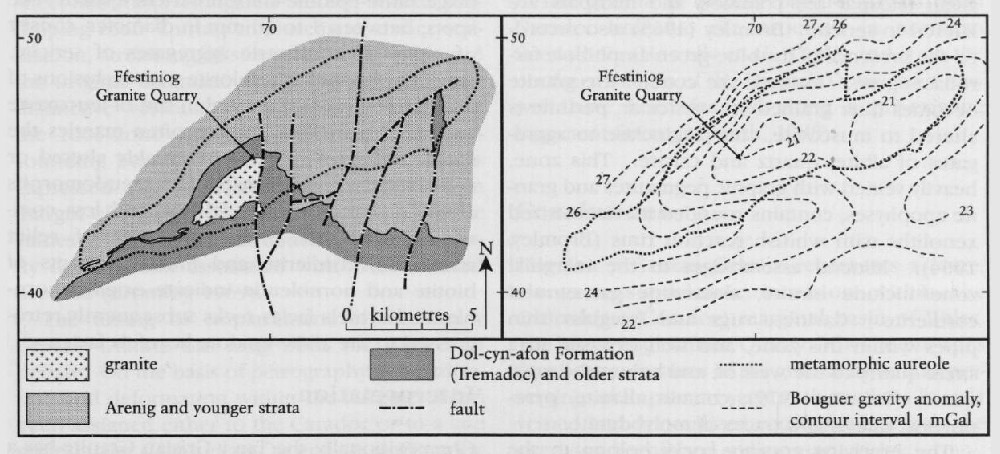
The Tan y Grisiau Granite has an outcrop area of c. 4 km2 and is intruded into sandstones and siltstones of the
Description
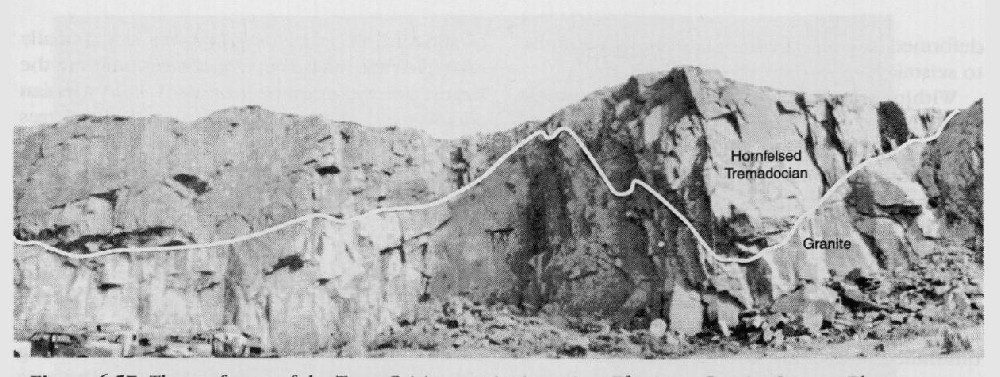
The Ffestiniog Granite Quarry GCR site exposes the upper contact of the Tan y Grisiau Granite, here dipping 40° to the NW The contact is clearly discordant
In the lower quarry face (now largely obscured) the granite is a grey-green, homogeneous, fine-grained equigranular mosaic of plagioclase (albite–oligoclase), perthite and quartz with dark clots (0.5–1.0 cm in diameter) of chlorite after biotite. Common accessories include magnetite, zircon and allanite with traces of titanite, monazite, fluorite and epidote. In thin section, granophyric intergrowths of quartz and alkali feldspar are common and feldspars are altered to sericite. Bromley (1963) also recorded the presence of the blue-green amphibole ferrohastingsite. Towards the contact the granite becomes finer grained and vesicular, perthite is altered to muscovite, and plagioclase to aggregates of albite, quartz and calcite. This zone, heavily veined with graphic pegmatites and granite apophyses, contains rounded metasomatized xenoliths with whitish reaction rims (Bromley, 1964). Mineral assemblages in the marginal zone include biotite, almandine garnet and cordierite. Cavities, vugs and irregular thin pipes within this zone, and well exposed in a small quarry to the west of, and below, the main quarry (Roberts, 1979), contain allanite, pyrophyllite, quartz and traces of molybdenite.
The overlying country rocks belong to the Upper Sandstone Member of the
At 10–15 m from the contact, the above rocks pass gradationally up into coarser grained, foliated, spotted hornfelses comprising the assemblage albite-epidote-chlorite-sericite-quartz. The spots, between 1 to 10 mm in diameter, consist of radial or concentric aggregates of sericite, quartz and penninitic chlorite with inclusions of fine-grained magnetite. A thin rim of leucoxene and microcrystalline chlorite often mantles the spots. Where the spots are weakly altered or deformed they are identifiable as pseudomorphs after porphyroblastic andalusite and less commonly cordierite. The presence of relict andalusite, cordierite and minor amounts of biotite and hornblende indicate original hornblende hornfels facies rocks subsequently retrogressed to the albite-epidote hornfels facies.
Interpretation
Compositionally, the Tan y Grisiau Granite has a rhyolitic to rhyodacitic trace element signature and Howells et al. (1991) noted a close comparison with the main phases of rhyolite dome emplacement in the
The extensive hornfels aureole and associated geophysical anomalies clearly show that the outcrop in the Tan y Grisiau area represents only a small part (less than 10%) of a large granite body
The timing of emplacement of the Tan y Grisiau Granite has long been the subject of debate. On the basis of petrography, mineralization and deformation within the aureole, it has been assigned either to the Caradoc or to a late stage in the Caledonian Orogeny (see Bromley, 1969 for review). To the SW of the main out crop, granophyric apophyses and sheets intrude Arenig strata, and transgress the mid-Caradoc unconformity (Smith et al., 1995) and the disrupted strata within the Rhyd mélange (Bromley, 1969; Smith, 1988; Howells and Smith, 1997). The extent of the hornfels (thermal spotting) aureole (Bromley, 1963, 1969) further indicates that rocks up to Costonian–Harnagian in age (the
Magnetic studies by Piper et al. (1995) indicate that the tilt-adjusted remnance directions are pre-Silurian and that magnetization occurred after deformation in late Ordovician times. K-Ar isotopic determinations by Thomas et al. (1966) suggest an age of c. 408 Ma, and recent Rb-Sr determinations by Evans (1990) provide an age of 384 ± 10 Ma. In common with many other younger Caledonian granites in North Wales thcsc arc considcrcd to be rcsct agcs affcctcd by low-grade metamorphism and deuteric alteration during the Acadian Event (Evans, 1991). The emplacement age is probably concordant with the Mynydd Mawr Granite (438 ± 4 Ma) and the Bwlch y Cwyion hornfels (454 ± 20 Ma) which are the only two North Wales granites currently known to have escaped isotopic resetting (Evans, 1991).
The granite is broadly parallel to the main Caradoc volcanic rift structure in northern Snowdonia (Howells et al., 1991), and is on the northern margin of the Harlech Dome, so it may well have been focused along a pre-existing basement fracture (Smith, 1988).
Conclusions
The Tan y Grisiau Granite represents a large, elongate, subvolcanic intrusion within the Ordovician (Caradoc) marginal basin of Wales. The Ffestiniog Granite Quarry GCR site provides excellent exposures of the granite as well as preserving an important section through its heavily veined and mineralized roof zone and into the overlying hornfelsed sedimentary rocks.