Chapter 9 Arenig to Ashgill of North Wales
R. M. Owens, A. W Owen and A.W.A. Rushton
Introduction
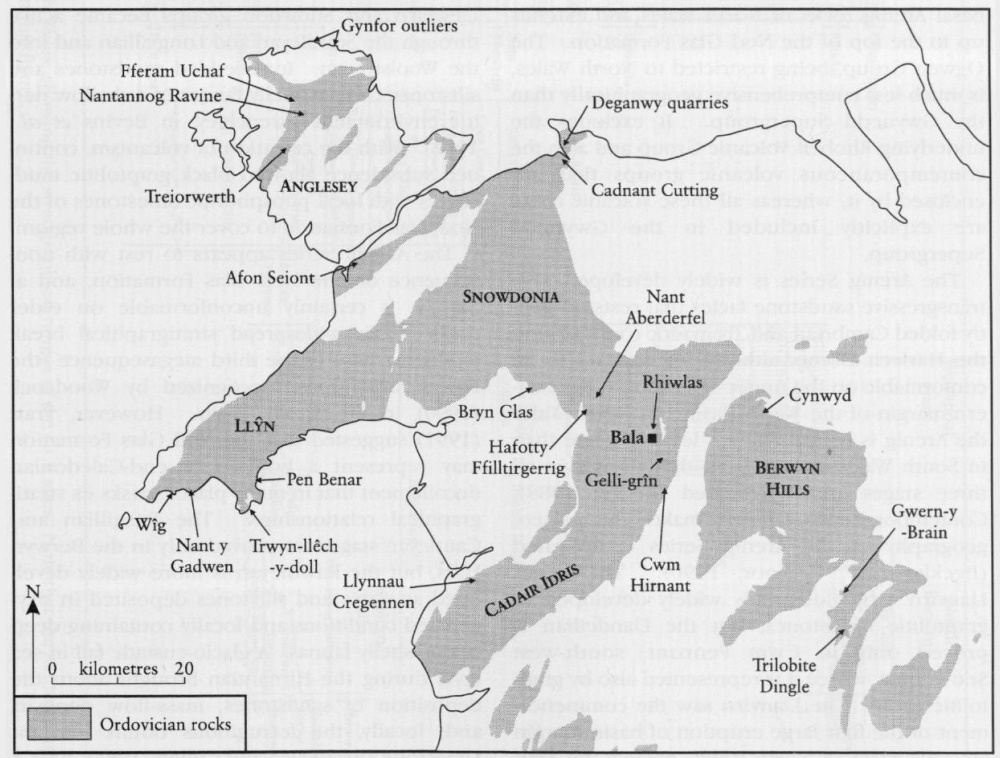
In North Wales the Ordovician occupies a broad tract surrounding the Cambrian of the Harlech Dome and extends eastwards to the Bala area and westwards over most of Llŷn (the Lleyn Peninsula). In addition, the lower parts of the Ordovician are preserved on Anglesey and the upper parts are well developed in the Berwyn Hills
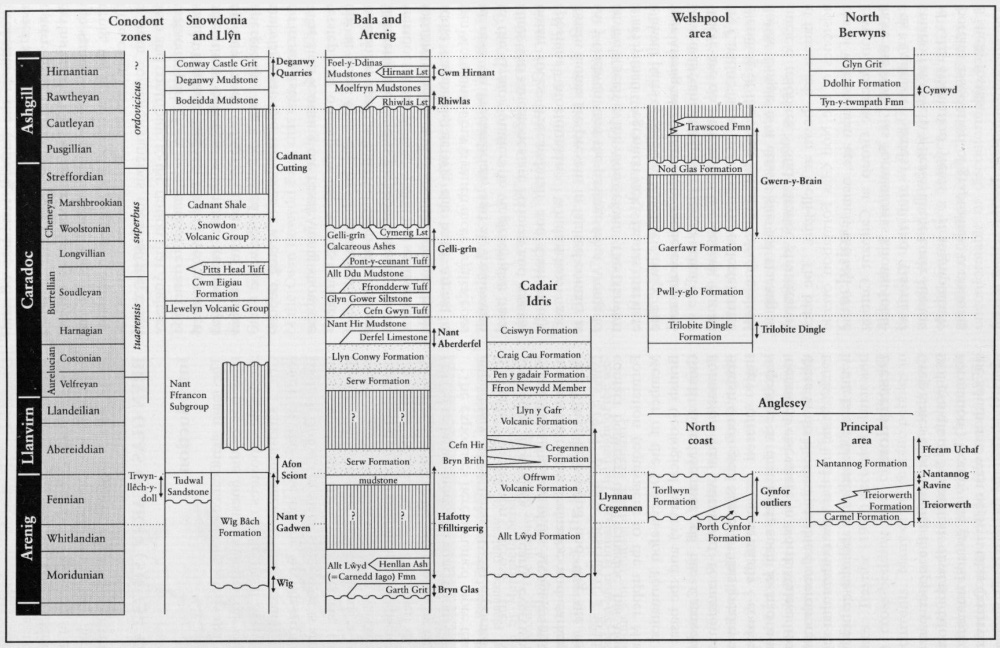
In outline, the Ordovician of the North Welsh Basin consists of mudstones, siltstones and sandstones of great aggregate thickness deposited in oxygenated waters commonly of no great depth (above wave base). Basin subsidence was roughly balanced by deposition, except perhaps during parts of the Caradoc, when Prigmore et al. (1997) considered subsidence at a maxi mum. The stratigraphical sequences are fairly complete, although there are breaks below and within the Arenig, there is generally no evidence for the Llandeilian Stage and the Pusgillian Stage is proved only locally in the Berwyn Hills. All the rocks in Wales from the sub-Arenig unconformity to the hiatus below the Ashgill fall within the
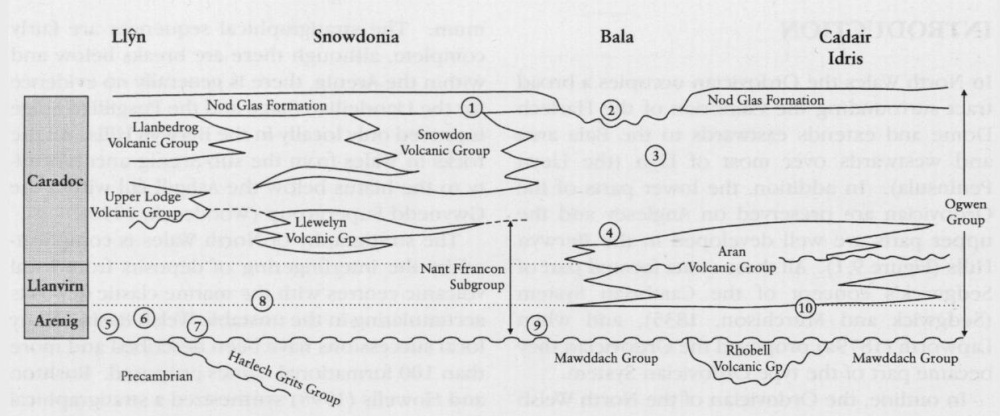
The stratigraphy of North Wales is complicated by the interfingering of deposits from local volcanic centres with the marine clastic deposits accumulating in the unstable Welsh Basin. Many local successions have been described and more than 100 formational names proposed. Rushton and Howells (1998) synthesized a stratigraphical framework for the Tremadoc to Caradoc of Snowdonia, though they did not review the Ashgill Series, nor the areas of Anglesey and the Berwyn Hills. They distinguished as volcanic 'groups' the products of each volcanic centre. For the marine sequence that envelops the volcanic groups of North Wales, Rushton and Howells (1998) proposed the new term '
The Arenig Series is widely developed as a transgressive sandstone facies that rests on gently folded Cambrian and Tremadoc rocks around the Harlech Dome, although it appears to be conformable on the upper Tremadoc at the eastern margin of the Welsh Basin. In North Wales the Arenig is typically much less complete than in South Wales
During the Caradoc the Aran volcanic activity ceased at about the beginning of the Harnagian, and farther north new volcanic centres of the Llewelyn and Snowdon groups became active through the Soudleyan and Longvillian and into the Woolstonian. Interbedded sandstones and siltstones contain shelly faunas of a shallow neritic environment (Brenchley, in Bevins et al., 1992). With the cessation of volcanism, continued subsidence allowed black graptolitic mudstones with local phosphoritic limestones of the
The Ashgill Series appears to rest with non-sequence on the
The Ordovician of Anglesey is rather different. It consists of the outlying remnants of sandstones and shales deposited on the prevailingly positive area of the Irish Sea horst complex (Bevins et at, 1992) during periods of marine high-stand, namely the Fennian Stage of the Arenig, the Llanvirn and the Costonian Substage of the early Caradoc. The facies and faunas differ from contemporaneous rocks of the Welsh Basin and contribute to the notion that Anglesey represents part of an independent terrane, the Monian Terrane. Tietzsch-Tyler (1996) reviewed correlations between south-east Ireland and Anglesey and inferred that the
The sites featuring the basal Arenig show the overstep and overlap by the Arenig transgression: at Bryn Glas the basal sandstone is of Moridunian age (as inferred from the Hafotty Ffilltirgerig site) and is paraconformable on the Tremadoc; at Trwyn-llêch-y-doll the sandstone is probably Fennian and rests unconformably on
There are no sites in the Llandeilian, but an early Caradoc fauna from Nant Aberderfel dates the ending of the
The unconformable base of the Ashgill is seen at Rhiwlas in the Bala area, where the Rhiwlas Limestone of Rawtheyan age rests on Woolstonian strata; Cynwyd in the northern Berwyn Hills is a classic site for later Rawtheyan faunas. The sedimentological effects of the end-Ashgill glacio-eustatic fall in sea level are shown by the sites at Deganwy and Cwm Hirnant.