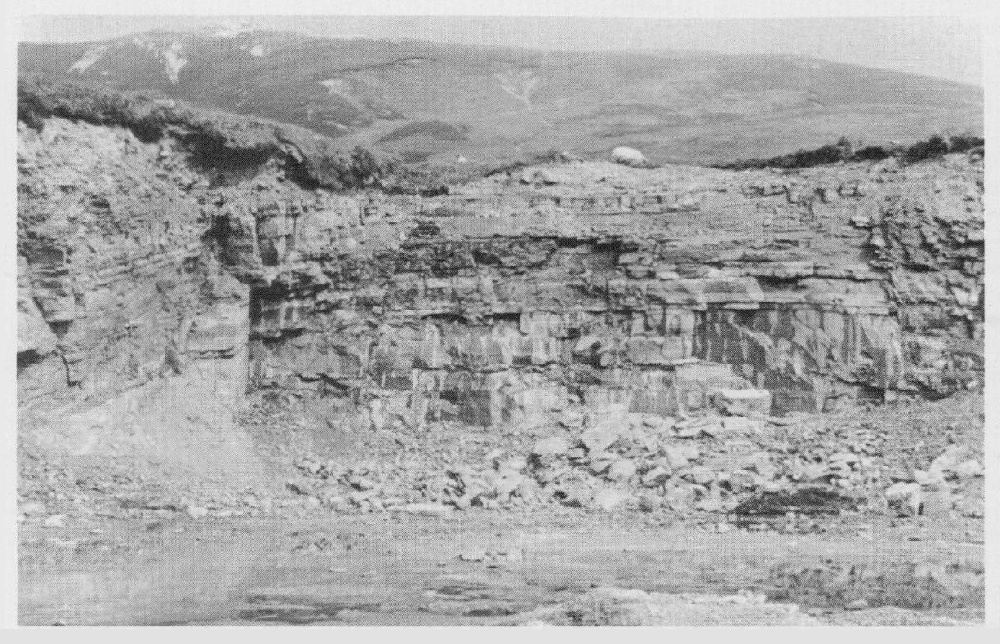
Loch Awe Quarry
Introduction
The quarry at Loch Awe has yielded the most prolific trilobite fauna of the
The sequence of rocks from quartzites to limestones has long been recognized in the Assynt area (e.g. Macculloch, 1836), although the first recognition of the Fucoid Beds as a separate unit was by Cunningham (1841). Nicol (1857), who examined the strata in the Loch Assynt region, recorded brown shale-like beds, with what appeared to be fucoid (seaweed) impressions, though today these are considered to be Planolites burrows. These, the
Description
Loch Awe Quarry, situated by the road south of Inchnadamph, exposes about 7–8 m of the
This site has yielded a large number of trilobites from various horizons, the best-preserved specimens coming from an unbedded mudstone unit some 1.5 m above the top of the calcareous portion of the Fucoid Beds that forms the main mass of the quarry The dominant species is Olenellus reticulatus Peach (Cowie and McNamara, 1978, p. 625), with rarer O. lapworthi Peach and Horne and a few specimens of O. hamoculus Cowie and McNamara, for which this is the type and only known locality. The trilobites indicate the Bonnia–Olenellus Zone of late Lower Cambrian age, as discussed under Fuaran Mor (see site report). Hyolithids, echinoderm fragments (McKie and Donovan, 1992) and inarticulate brachiopods also occur. Faunal details can be found in Brand (1965), Cowie (1974) and Cowie and McNamara (1978).
Interpretation
The conditions of deposition of the Fucoid Beds are discussed under Fuaran Mor (see site report). The species of Olenellus described by Peach and Horne (1892) and Peach (1894) were based on few specimens, and it is evident from the discussion in Lake (1906–1946, pp. 238–44) that distinction among them was a matter of uncertainty. The large number of cranidia obtained from Loch Awe Quarry (more than 100 specimens of O. reticulatus) enabled Cowie and McNamara (1978) to describe the variation within the species of Olenellus and hence to delimit the species, including their new species O. hamoculus, with greater clarity.
Potash-rich beds are widespread on the western margin of the Iapetus Ocean. Bowie et al. (1966) suggested that the potash in the Fucoid Beds originated from a volcanic source in the underlying Precambrian rocks. However, Swett (1969) pointed to a general lack of volcanic sources in both the Lewisian and the Torridonian and suggested instead that potassium was released during dolomitization from illite, which is present in the overlying limestones.
Conclusions
Loch Awe Quarry is important palaeontologically, in that it exposes a fossiliferous bed that yields the trilobite Olenellus in exceptional abundance, enabling the study of populations of this genus. They are much the most useful fossils for dating the lower part of the north-west Highlands of Scotland as of Early Cambrian age and enable correlation with areas in Greenland, Canada and Spitsbergen.