Perton Road and Quarry
Introduction
The Perton Lane locality of many published accounts consists of laneside and disused quarry exposures extending for about 0.5 km immediately south of Perton hamlet, Herefordshire, in the south-central Welsh Borderland
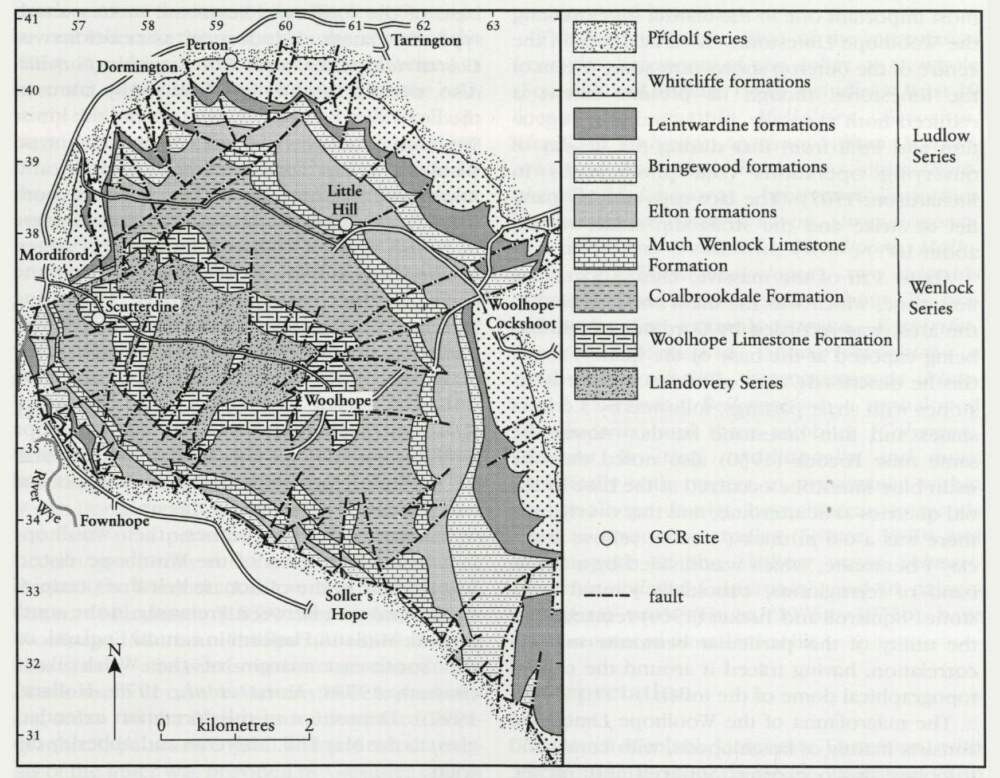
The most recent study of the stratigraphy and faunas of the inlier and locality is by Squirrell and Tucker (1960; see also 1967, 1982). Earlier accounts elucidating the local Silurian geology include those by Murchison (1839), Phillips (1848), Strickland (1853), Brodie (1871), Gardiner (1927) and Pocock (1930). Earp and Haim (1971) published a modified version of Squirrell and Tucker's geological map of the inlier. Correlation of the Woolhope sequence with the standard Silurian is reviewed in Cocks et al. (1971, 1992) and Butler et al. (1997) drew the extent of the Woolhope Basin based on subsurface mapping.
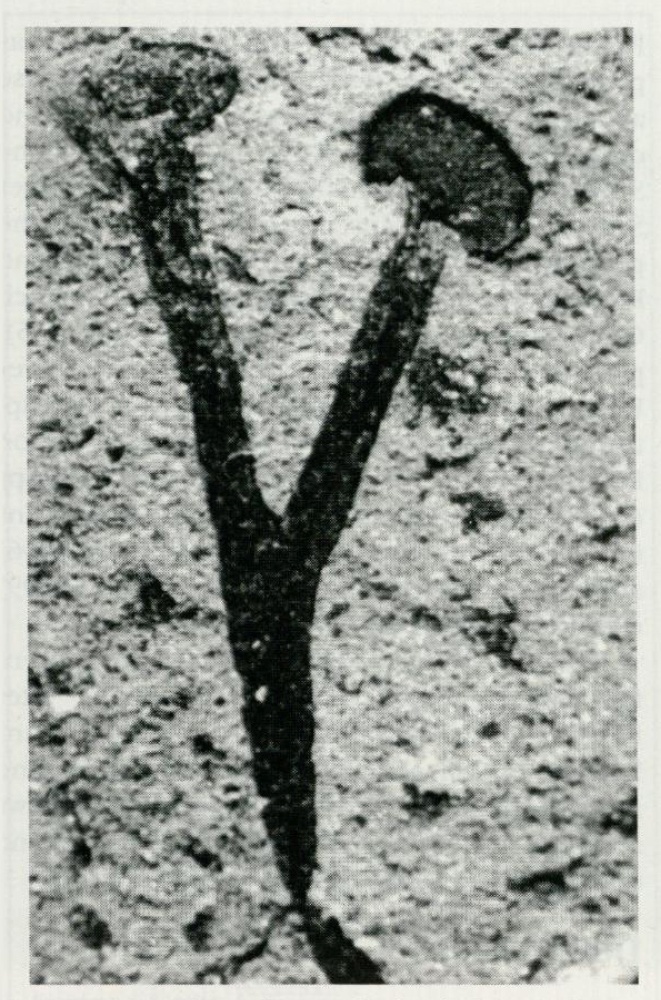
The abundant, well-preserved fossils at Perton Lane have attracted many specialist studies. Amongst them are papers documenting eurypterids (Brodie, 1871; Kjellesvig-Waering, 1951, 1961), microfaunas (Aldridge, 1985; Miller and Aldridge, 1993, 1997; Miller, 1995), shelly macrofaunas (Watkins, 1978a, 1979; Watkins and Aithie, 1980; Cherns, 1988) and micro- and macrofloras (Brodie, 1871; Lang, 1937; Richardson and Lister, 1969; Edwards, 1979; Edwards et al., 1979, 1996; Dorning, 1981b; Fanning et al., 1988, 1990, 1991a, 1991b; Burgess and Edwards, 1988; Richardson and Rasul, 1990; Edwards and Richardson, 1996; see also review by Cleal and Thomas, 1995).
Perton Lane is the longest, largely continuous section through the late Silurian of the Woolhope Inlier and it includes the Ludlow–Přídolí series boundary. As Phillips remarked (1848, p. 175), 'At Perton... the sides of the valley offer an intelligible section from the Aymestry limestone to the Old Red.' Its fossil assemblages include world famous collections of early land plants.
Description
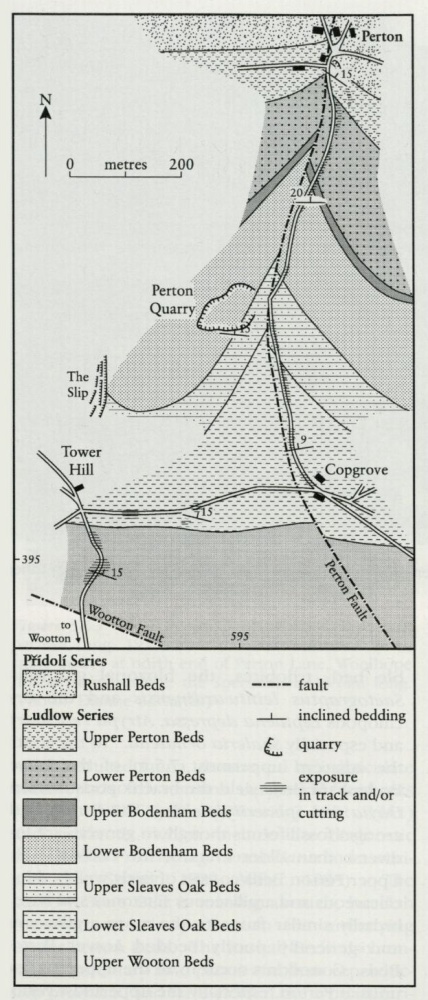
The Ludlow of the Woolhope Inlier consists of eight stratigraphical units, each based on faunal and, to a lesser degree, lithological distinctions (Squirrell and Tucker, 1960). The divisions reach maximum thickness in the north crop, at Perton, where they young and dip 15°–20° to the north
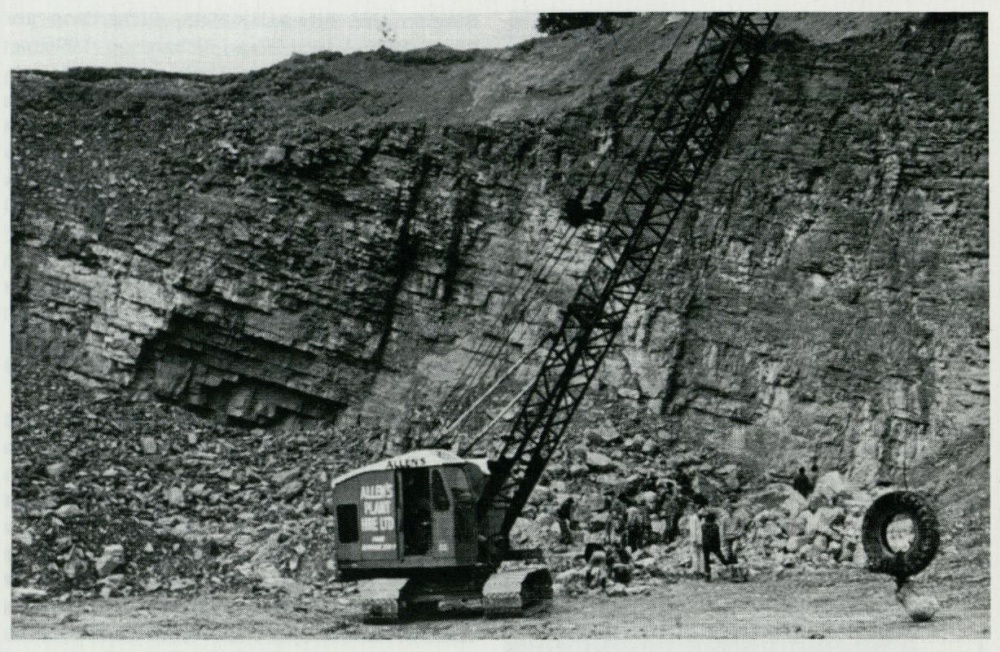
The disused Perton Quarry
In the Perton area the
On the east side of the lane north of Perton Quarry Squirrell and Tucker (1960, 1967, 1982) recorded sequences showing: the 4.5 m thick
The thinly bedded, calcareous siltstones of the
The Rushall Beds here are fine-grained siltstones and mudstones and massive sandstones. Compared to the Ludlow strata this unit has a much reduced fauna, dominated by inarticulate brachiopods, fish remains, eurypterid fragments (Brodie, 1871; Kjellesvig-Waering, 1951, 1961) and ostracods, which include the diagnostic early Přídolí Frostiella groenvalliana and associates (see Siveter, 1989; Miller, 1995). The Ludlow Bone Bed is missing as such, but fish remains occur in pockets in the underlying
Interpretation
In the upper Silurian this locality was sited on the Midland Platform, which formed the east and south-eastern flank of the Welsh Basin (Siveter et al., 1989, figs 10, 11; Bassett et al., 1992, figs S5a, S5b, S8b). The rocks and fossils of Perton imply an overall regressive sequence, from the relatively shallow, open marine shelf deposits of the Ludlow to a more restricted and ultimately land influenced, alluvial plains environment in the Přídolí (e.g. see Bassett et al., 1982; Allen, 1985). The middle Ludlow calcareous silts and carbonates of Perton accumulated in a sheltered area behind the higher energy shelf edge zone to the west (Watkins and Aithie, 1980; Cherns, 1988;
This is the only GCR site that contains a Ludlow–Přídolí boundary sequence in the Woolhope Inlier. Comparable shelf sections occur at Welsh Borderland sites at May Hill (Longhope Hill and Wood Green), Gorsley (Linton Quarry), Usk (Brook House), the Abberleys (Woodbury Quarry) and the Tortworth area (Tites Point), and elsewhere in the central Welsh Borderland at Ludlow (Ludford Lane and Ludford Corner) and the English West Midlands (Brewin's Canal and Turner's Hill). Other Welsh Basin sites displaying Ludlow–Přídolí rocks are the Sawdde Gorge in southern Wales and, in a more basinward setting, Lower Wallop Quarry, in the Long Mountain in Shropshire. Little Hill and Scutterdine Quarry are the two Wenlock GCR sites in the Woolhope Inlier.
Conclusions
This site has regional stratigraphical and international palaeontological significance and is also a valued teaching resource. It is part of an unequalled sequence through the entire Ludlow and into the Přídolí Series of the Woolhope Inlier and is the fundamental reference section for the Lower and Upper Perton beds of the Inlier. Fossils are abundant and it is the type locality for many species of micro- and macrofauna and flora. It is internationally renowned for its important early plant remains. High value should be placed on conserving the site.