Skelghyll Beck
Introduction
The stream of 'Skelgill Beck' was selected by Marr and Nicholson (1888) as the type section of their 'Skelgill stage', the lower unit of the 'Stockdale-Shale series'. These beds had previously been referred to as the 'Graptolitic Mudstones', following Aveline and Hughes (1872), but Marr and Nicholson (1888, p. 659) considered that this term did not distinguish them sufficiently from other graptolitic beds in the district. More recently, Kneller et al. (1994) have formalized this lithostratigraphical unit as the
South-west of the Brathay Fault, for example in the area around Yewdale Beck, the
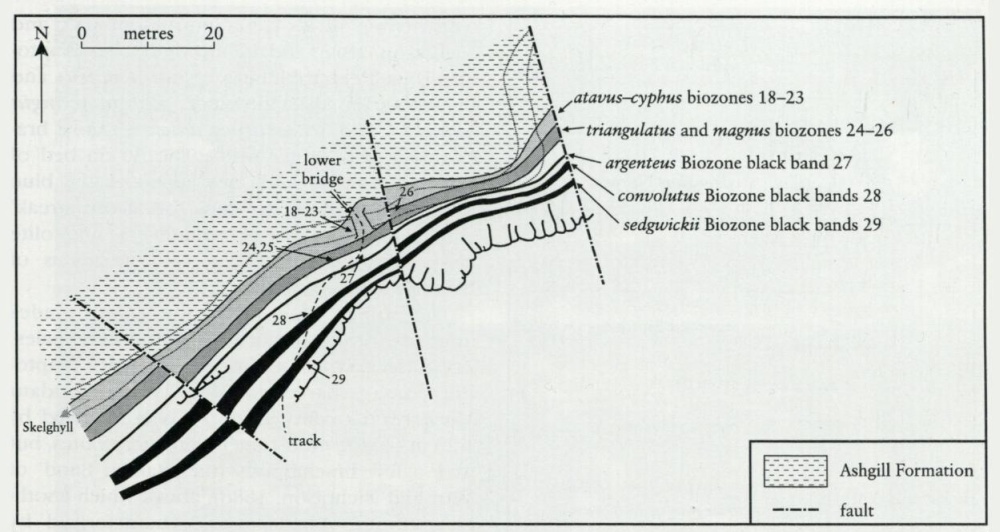
The GCR site of Skelghyll Beck follows the stream course south-westwards from Skelghyll Upper Bridge, which carries the Hundreds Road from Troutbeck, past the Lower Bridge to the point where the ground becomes marshy and exposure is lost. The stream flows approximately parallel to the strike of the beds, so that the various horizons in the
The Skelghyll section is the type locality for a number of fossil taxa, including the trilobites Acernaspis glabra (Marr and Nicholson, 1888), Youngia moroides (Marr and Nicholson, 1888), Scotoharpes judex (Marr and Nicholson, 1888) and Raphiophorus aloniensis (Marr and Nicholson, 1888) (see Curtis and Lane, 1997–8), the brachiopod Plectatrypa flexuosa (Marr and Nicholson, 1888) and the graptolites Glyptograptus sinuatus sinuatus (Nicholson, 1869), Diplograptus diminutus Elles and Wood, 1907, and Monograptus argenteus (Nicholson, 1869).
Description
A very full description of the strata exposed in Skelghyll Beck was provided by Marr and Nicholson (1888), and a long list of graptolite localities and horizons was given by Hutt (1974, localities 18–52; see also
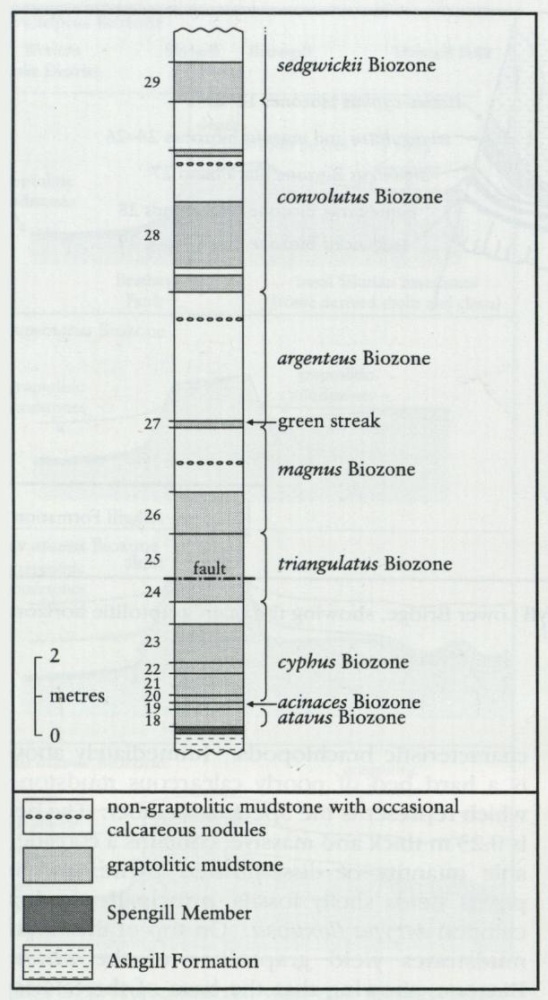
Graptolites are not always easy to collect from the cliff section itself, but excellently preserved specimens occur in other exposures in the stream banks. The faunas are diverse, with the lowest beds particularly characterized by swarms of Dimorphograptus confertus confertus and abundant monograptids of the Monograptus revolutus–M. austerus group (Marr and Nicholson, 1888). The triangulatus Biozone is marked by numerous specimens of M. triangulatus jimbriatus, with M. triangulatus triangulatus largely absent; this suggests that only the upper part of the biozone is represented by graptolitic beds, with the lower part represented by pale beds succeeding the strata of the typhus Biozone (Hutt, 1974).
The middle part of the
The upper blue mudstone (Ab4) grades upwards into a unit of finely laminated shales, 2.5 m thick, which again contains a rich graptolite fauna, characterized by very abundant Monograptus convolutus. This is followed by 1.25 m of blue mudstone lacking graptolites, but with a few brachiopods (the 'Barren Band' of Marr and Nicholson, 1888), above which another graptolite band occurs, characterized by numerous specimens of Campograptus clingani. The succeeding blue mudstones contain a variety of trilobites, among which Raphiophorus aloniensis is particularly characteristic, and these are overlain by 1 m of predominantly black mudstones crowded with graptolites, including abundant Stimulograptus sedgwickii and Lagarograptus tenuis. Above these are the uppermost beds of the
Interpretation
The Lake District Basin was situated on the northern part of Avalonia, where it succeeded the mid-Ordovician development of an island arc system (see Chapter 1). The Skelghyll section is situated immediately east of the Brathay Fault, and was interpreted as occupying a relatively shallow-water position on the footwall block of the fault (Hutt, 1974; Rickards, 1978;
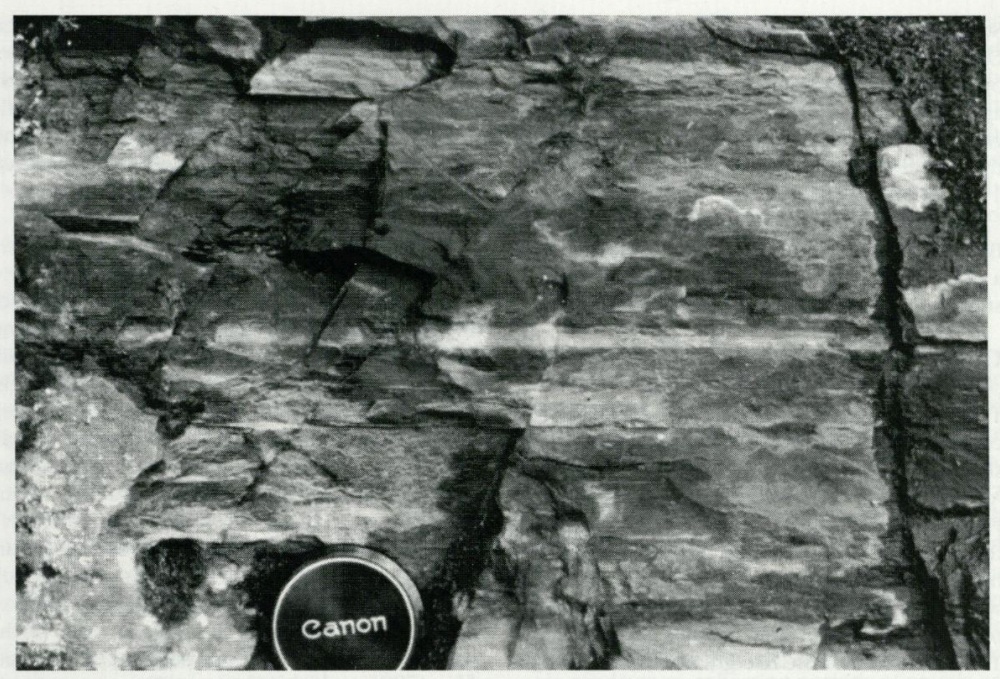
The alternation between graptolitic black shales and paler graptolite-poor mudstones reflects changing bottom conditions, from anaerobic to aerobic. This variation may be related to influxes of carbonaceous matter, perhaps algal (Rickards, 1978), or may have been influenced by sea-level or climatic fluctuations. The patterns seen in Skelghyll are maintained coevally throughout the Lake District Basin, and can also be identified in Wales and in the Southern Uplands of Scotland (Rickards, 1978). One band, the 'green streak', is also widely recognized in the Lake District and Wales; it is apparently not a bentonite, but has the same geochemistry as the black shales, simply lacking the pyrite and carbonaceous matter (Rickards, 1964; Spencer, 1966).
Together with the GCR sites in Yewdale Beck, Brow Gill Beck and Spen Gill, this site provides a representative coverage of the Llandovery stratigraphy of the English Lake District.
Conclusions
The stream banks of Skelghyll Beck display a continuous, well-exposed section through black shales and pale mudstones of Rhuddanian and Aeronian age. These are referred to the