Blind Lane
B.M. Cox
Introduction
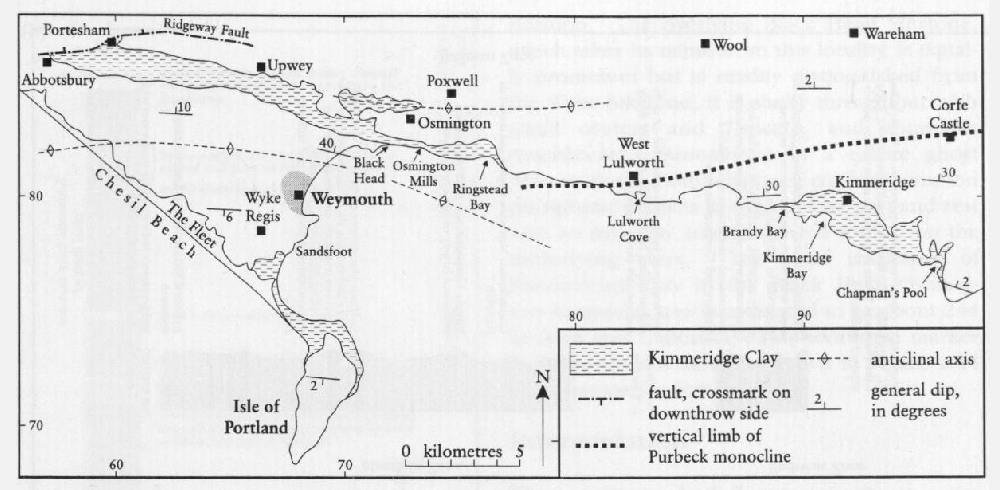
The village of Abbotsbury, Dorset, is located on the south-westernmost outcrop of Kimmeridgian strata on the English mainland
Description
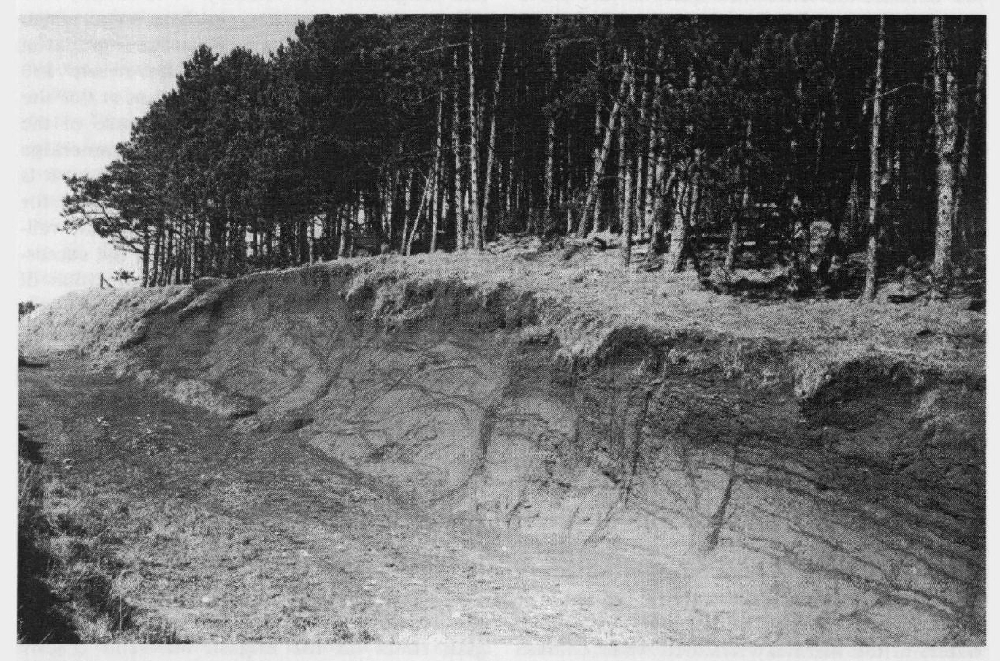
A section in Blind Lane, at the western end of Jubilee Coppice, comprises the GCR site
| Thickness (m) | |
| Abbotsbury Ironstone | |
| 6. Sand, yellowish brown, ferruginous, veined by thin | |
| 5. Ironstone, reddish brown; ferruginous ooids as shining 'millet-seed' grains in matrix of fine-grained quartz sandstone; interbeds of concretionary ironstone and ferruginous mudstone; abundant fossils including brachiopods, bivalves, gastropods, ammonites, serpulids and fossil wood; harder band of sandstone near base | 6.0 |
| Abbotsbury Sandstone | |
| 4. Sandstone, dark brown, coarse-grained; ferruginous peloids; ammonites | 0.8 |
| 3. Sand, soft, weathering yellow | 0.6 |
| 2. Sandstone, dark brownish green, ferruginous | 0.3 |
| 1. Sandstone, brown, ferruginous; variably cemented; fossils preserved as casts | c. 3.0 |
All outcrops are oxidized and the iron ore is red or reddish brown in colour except where seen in deep trenches when it appears green owing to the presence of the iron silicate mineral berthierine, commonly (though incorrectly) referred to as 'chamosite'; much of the berthierine is now weathered to limonite (House, 1989). Bed 6 of the above section may be merely the weathered upper portion of the ironstone Bed 5 (Arkell, 1936).
Interpretation
The lithostratigraphical classification of the Abbotsbury Ironstone has not been straightforward, not least because authors have been influenced by its chronostratigraphy rather than following strict lithostratigraphical principles. Arkell (1936) described the Abbotsbury Ironstone as forming an upward lithological continuation of the 'already ferruginous Sandsfoot Grits' of the
A full faunal list for the Abbotsbury Ironstone was given by Brookfield (1978), updated from Brookfield (1973b). This included 17 bivalve taxa (the taxonomically most diverse group) together with gastropods, brachiopods, ammonites, a nautiloid, a serpulid, an echinoid and a crustacean. According to Cope (1980), the species of Rasenia that characterize the Abbotsbury Ironstone constitute a distinctive fauna that is different from that of the four Rasenia faunal horizons recognized by Birkelund et al. (1978) (see site report for East Fleet–Small Mouth, this volume). Callomon (in Cope, 1980) believed it was closest to, and possibly identical with, that of the 'Marnes à Pterocères' at Villerville in Normandy, which yielded the type specimens of Rasenia erinus (d'Orbigny) and R. berryeri (Dollfus). Specimens from the Abbotsbury Ironstone comparable with the former species were illustrated by Morris (1968) in his unpublished thesis. There is no definitive evidence for the age of the underlying Abbotbury Sandstone. Blake and Hudleston (1877) reported 'numerous Ammonites decipiens'but no one has been able to substantiate this record. Arkell (1947a) suggested they might be Pictonia or Ringsteadia but was not able to verify this. Morris (1968) reported that these beds had 'yielded only one ammonite which may be referred to the Pictoniinae but is not sufficiently well preserved to be of any stratigraphical value'. The few bivalve records are not age diagnostic. On the basis of this evidence, one can only conclude that Brookfield's (1978) Abbotsbury Sandstone is Late Oxfordian and/or Early Kimmeridgian in age. Future detailed palaeontological work on cores from two recent British Geological Survey boreholes at Abbotsbury (Newell, 2000) may provide additional useful data.
Although bivalves dominate the fauna of the Abbotsbury Ironstone taxonomically, brachiopods are locally more abundant. The brachiopod fauna is rich and varied for the British Kimmeridgian (Sandy, 1985). The rhynchonellid ?Septaliphoria hudlestoni has already been mentioned but, in addition, Brookfield (1973, 1978) recorded 'Terebratula'subsella (Leymerie), Ornitbella lampas (J. Sowerby), Aulacothyris dorsetensis (Davidson) and Lingula sp.. Following investigation of the internal shell structures, Sandy (1985) reassigned the specimens previously identified as Aulacothyris dorsetensis to the genus Rugitela, and indicated that the 'Terebratula' subsella belonged to the genus Kutchithyris.
The faunal and lithological characteristics of the Abbotsbury Ironstone suggest a nearshore depositional environment or, more likely, because of the lack of any indications of shoreline or strand, or sediment derived from southwest England, an environment marginal to an offshore (barrier) bar facing south-east (Brookfield, 1973). This scenario, analogous to the present-day barrier bar environments of the Gulf of Mexico, was apparently terminated by a marine transgression that brought relatively quiet water and mud (Kimmeridge Clay) deposition to the area (Brookfield, 1973).
Conclusions
The village of Abbotsbury in Dorset is sited on the outcrop of the Abbotsbury Ironstone that represents a unique deposit in the British Kimmeridgian. The ironstone, comprising (when fresh) berthierine ooids in a fine-grained quartz sandstone matrix, was once worked on a small scale but has never been fully exploited for iron because of its high silica content. It has, however, been much used locally as a building stone. The GCR site offers a readily accessible exposure in one of the lanes leading northwards from the village. The Abbotsbury Ironstone has yielded a rich benthic fauna, including an unusually rich and varied brachiopod fauna, as well as age-diagnostic ammonites of the genus Rasenia. Known only at Abbotsbury, this unique and unusual deposit is interpreted as representing an Early Kimmeridgian offshore barrier bar.