Bracklesham
Introduction
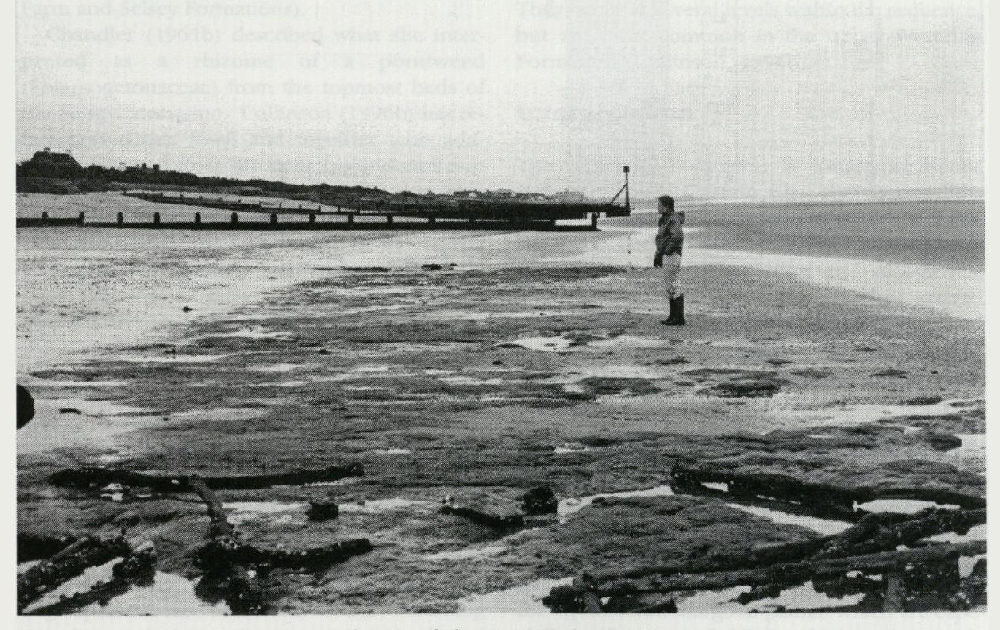
The foreshore between Chichester Harbour and Selsey Bill
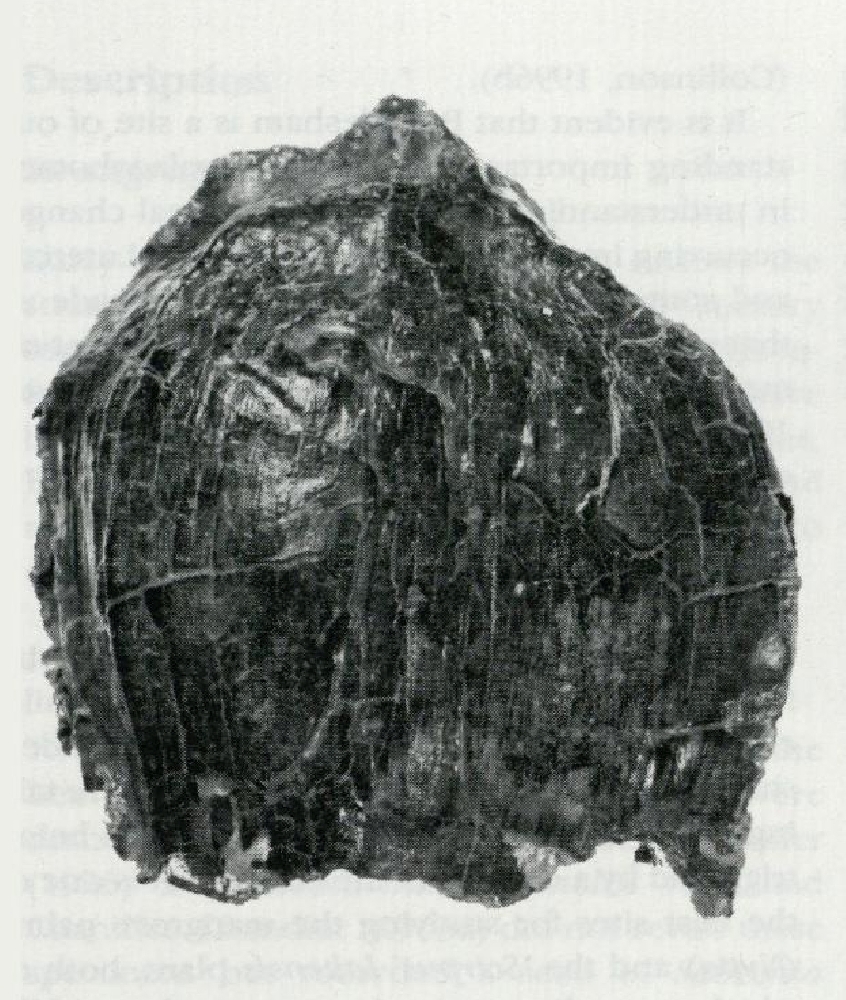
The earliest record of plant fossils from here was by Dixon (1850), in his account of the geology of this stretch of coast, while a second edition of the work (Dixon, 1878) included a review of the fossils by Carruthers. Gardner (1884) figured conifer cones from here, and Rendle (1894) and Reid (1897) illustrated examples of Nypa fruits. More recent accounts of the palaeobotany of this site are by Chandler (1961b) and Collinson (1978a, 1996b).
Description
Stratigraphy
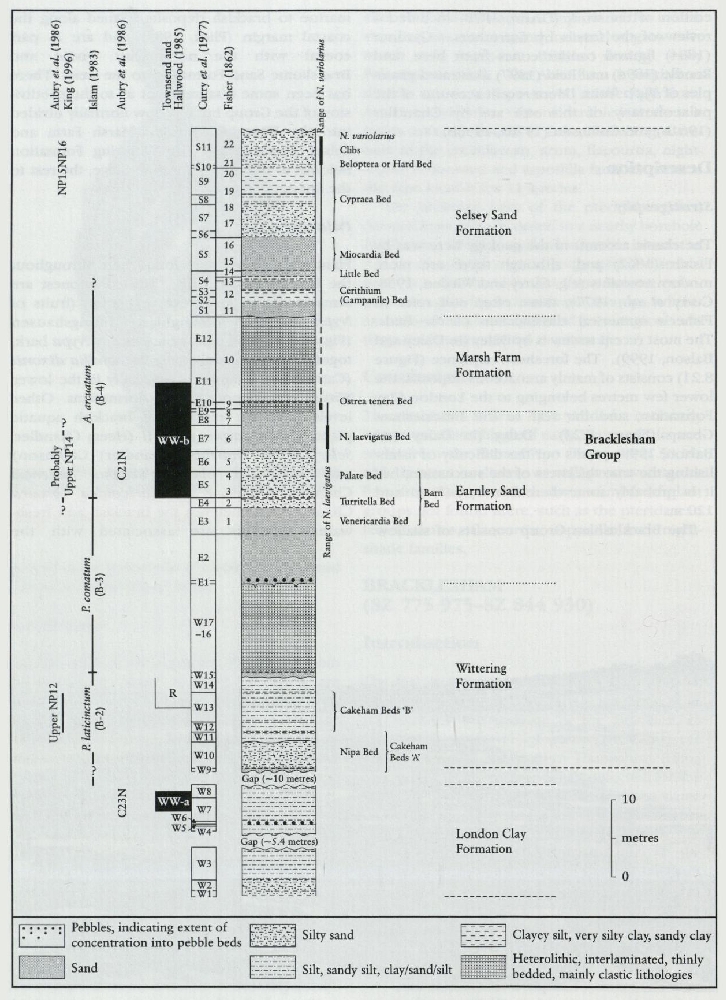
The classic account of the geology here was by Fisher (1862) and, although there are more modern accounts (e.g. Curry and Wisden, 1958; Curry et al., 1977), these often still refer to Fisher's numerical classification of the beds. The most recent review is by Daley (in Daley and Balson, 1999). The foreshore sequence
The
Palaeobotany
Plant fossils have been found here throughout the
Chandler (1961b) described what she interpreted as a rhizome of a pondweed (Potamogetonaceae) from the topmost beds of the Selsey Formation. Collinson (1996b) has reinterpreted this fossil and together with additional material from the same bed, identifies it as a seagrass-like plant. Significantly, also from this bed, Murray and Wright (1974) described forminifera that are very similar to the faunas found today in seagrass communities.
In addition to these aquatic and marginal plants derived from the vegetation near to where these deposits were formed, there are the remains of trees presumably representing the vegetation of the surrounding forests. Most widely found are conifers, including Pinus cones, and leafy shoots known as 'Araucarites' selseyensis Chandler. The latter might in fact have been from the extinct conifer genus Doliostrobus Marion, which belongs to either the redwood or monkey puzzle families (Mai, 1976; Collinson, 1996b). There are also various angiosperm fruits, seeds and foliage, including members of the sedge (Carcoidea), laurel (Laurocalyx sp.), moonseed (Palaeococculus lakensis Chandler, Palaeosinomenium cf. venablesi Chandler), mastic tree (cf. Eomastixia rugosa (Zenker) Chandler), rue and tea families. They occur at several levels within the sequence, but are most common in the upper
Interpretation
The
Bracklesham is also important as the only British site with a good record of plant macrofossils through the late Ypresian-early Lutetian
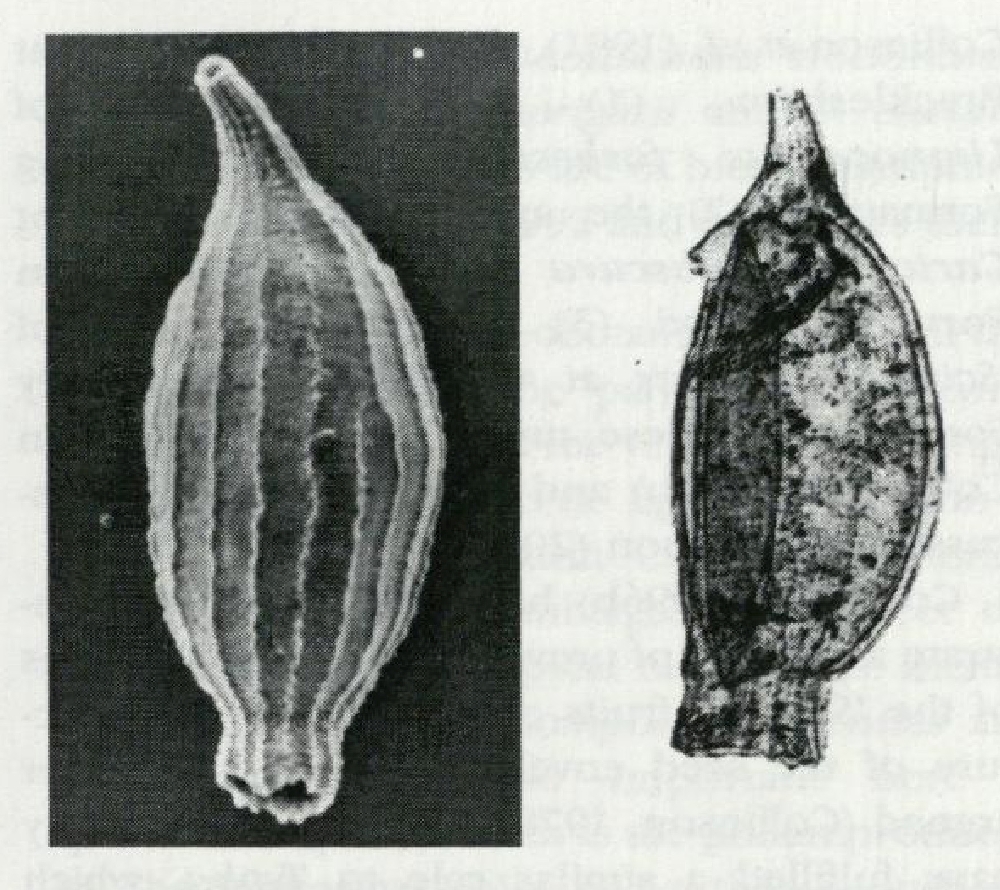
Collinson (1996b) has been able to demonstrate a number of previously unknown features of the 'Scirpus' fruits, including the ultrastructure of the seed envelopes. She had earlier argued (Collinson, 1978a) that these plants may have fulfilled a similar role to Typha, which occurs in the late Eocene floras of Britain. Although the work is still in progress, it is clear that the Bracklesham fossils will play a major role in understanding the affinities of this important Ypresian–lower Lutetian aquatic plant.
The Nypa burtinii from near the top of the Selsey Formation is one of the youngest authenticated examples of that genus known from the fossil record (Collinson, 1996b). The only younger example is a single specimen said to be from the
Bracklesham is the best site for the study of Eocene seagrass communities. Seagrasses are generally very rare in the fossil record and were for a long time only recognized through the presence of the characteristic foraminifera faunas (Brasier, 1975). While macrofossil remains of the plants themselves are known from Herne Bay and Belgium (Stockmans, 1936; Chandler, 1961a; Collinson, 1983b), Bracklesham has yielded the plants with their associated fauna (Collinson, 1996b).
It is evident that Bracklesham is a site of outstanding importance for Tertiary palaeobotany, in understanding both the vegetational changes occurring in the late Ypresian and early Lutetian, and some of the individual plants that made up that vegetation. This was a time of significant climatic and vegetational change (Collinson et al., 1981; Collinson, 2000a,b) and Bracklesham is crucial for understanding them.
Conclusions
Bracklesham is an internationally important site for early and middle Eocene plant fossils, c. 45–50 Ma old. It helps significantly in understanding the changes in vegetation that were taking place at that time, changes that were being triggered by a cooling of the climate. It is one of the best sites for studying the mangrove palms (Nypa) and the 'Scirpus' lakensis plant, both of which were diagnostic elements in the middle Eocene vegetation of Europe. It is also the best site for the study of seagrass communities of this age.