Paddy's Gap
[SZ 282 915]
Introduction
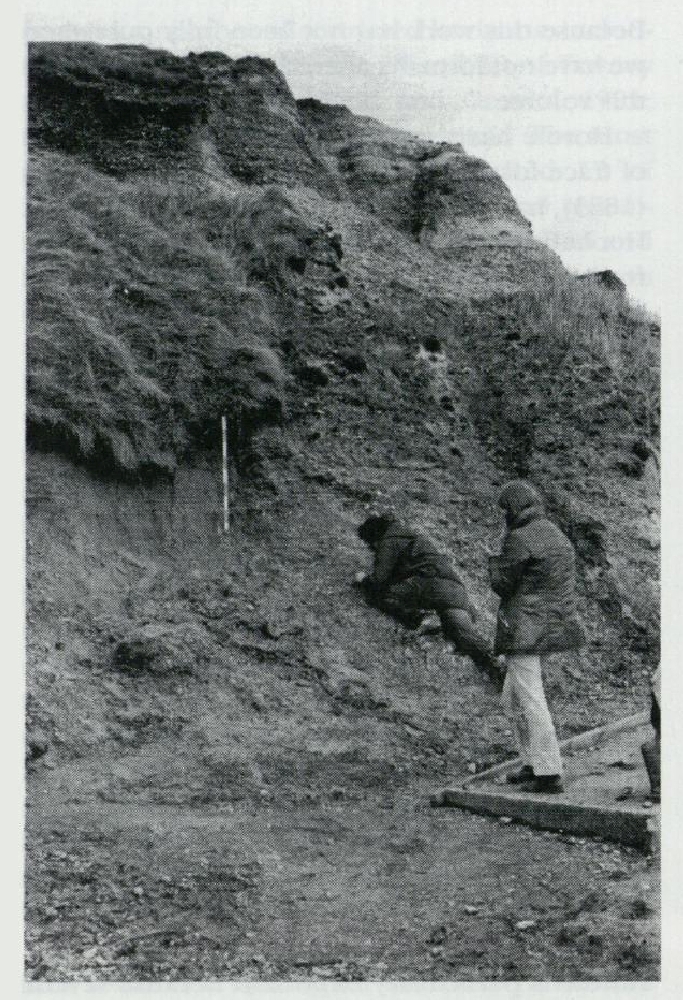
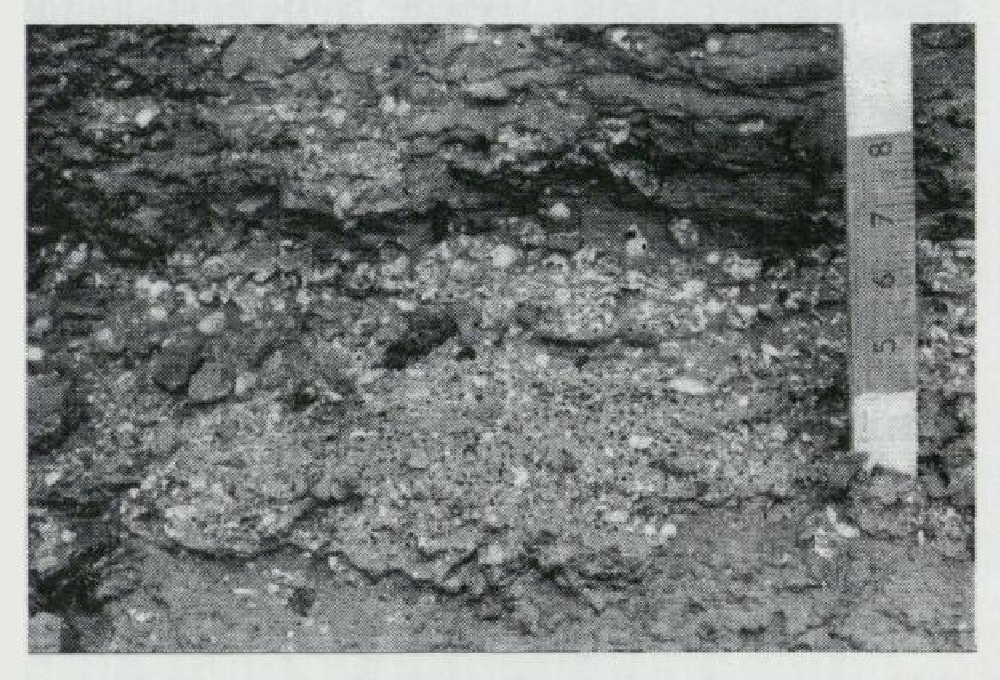
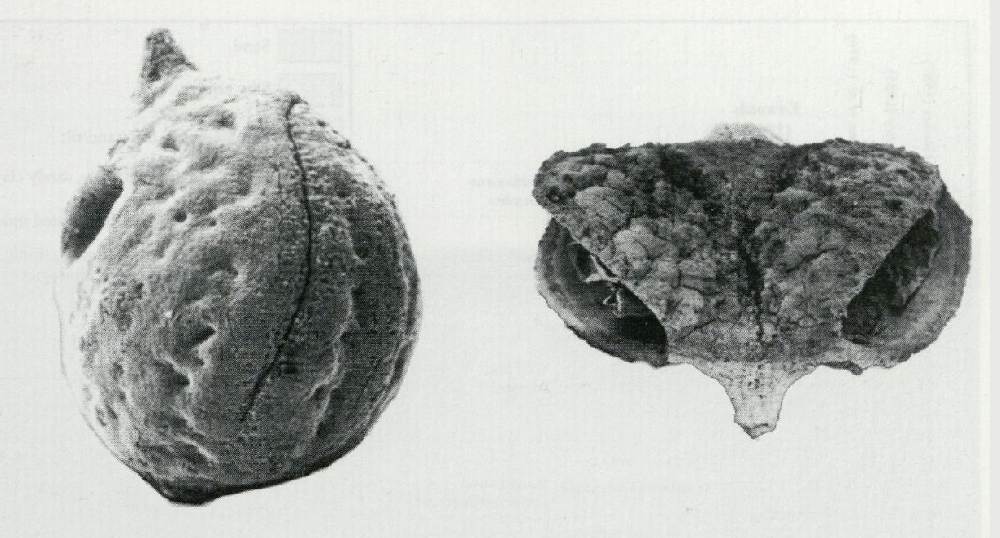
The site (Figure 9.9) is a short distance to the east of the Hordle Cliffs site discussed earlier in this chapter, and it exposes strata of only slightly younger age. Paddy's Gap is the best site for the late Eocene Limnocarpus band, which yields abundant fruits and seeds of the aquatic plant L. forbesii (Figure 9.10). The specimens described by Reid (1898) probably originated from here. The site is also included in the monograph on the flora of the Totland Bay MemberBay Member (lower Headon Beds of earlier authors) by Chandler (1961c).
Description
Stratigraphy
The cliffs below Paddy's Gap expose the upper strata in the Totland Bay MemberBay Member, often referred to as the 'Unio Bed' or 'Limnocarpus Band' (Bed 31 of Tawney and Keeping, 1883). They are mainly laminated clays in the lower part, grading up into coarse sands.
Palaeobotany
The plant fossils at Paddy's Gap consist almost exclusively of carbonaceous fruits of the aquatic plants, including Limnocarpus forbesii (Heer) Chandler emend. Collinson 1982a, Stratiotes headonensis Chandler, Aldrovanda ovata (Chandler) Chandler and Sabrenia chandlerae Collinson (Chandler, 1961c; Collinson, 1978a, 1980a, pers. obs.). Collinson (1980b, pl. 24, fig. 11) also documented from here Azolla prisca Reid and Chandler emend. Fowler. L. forbesii is especially abundant here.
Interpretation
The abundant remains of the aquatic plant Limnocarpus forbesii have attracted considerable attention from palaeobotanists over the years. Tawney and Keeping (1883) noted the presence of 'little black seeds' in what they termed the 'Unio Bed', and Reid (1898) described them as Limnocarpus headonensis. Chandler (1961b) demonstrated that they should more correctly be referred to as L. forbesii. Most recently, the species has been reviewed and emended by Collinson (1982a), who included it in a cladistic analysis of extant and fossil potamogetonean fruits. She suggested that it was probably a primitive member of this tribe of pondweeds, being distinguished from the other members by the fruits being bicarpellate rather than individual (Figure 9.11). The fossils from Paddy's Gap have been crucial in demonstrating this phylogenetically important feature (first documented by Reid and Chandler, 1926, p. 69); only five specimens preserved in the original bicarpellate condition were recovered from a sample of 8000 (Collinson, 1982a, p. 87). The concentrated remains of Limnocarpus are significant in understanding the growth site of the plant, which is thought to have tolerated both fresh and slightly brackish water (Collinson, 1996b). Furthermore, the abundance of specimens is valuable for new, organic geochemical or isotopic approaches, which involve destructive analyses. Van Bergen et al. (2000) have shown that Limnocarpus carries a chemosystematic signature confirming an affinity with the pondweeds, as originally proposed on morphological grounds (Collinson, 1982a).
Conclusions
Paddy's Gap is the best site in Britain for the fruits of the primitive pondweed Limnocarpus forbesii, one of the most characteristic plants of the British late Eocene floras (c. 36 Ma old).
References