Hapsford Bridge, Vallis Vale, near Frome, Somerset
Introduction
The Upper Triassic succession exposed at Hapsford Bridge, Vallis Vale, is one of the best seen in the east Mendip region. It is most famous as the site of De la Beche's (1846) unconformity between the Carboniferous and the Jurassic rocks, with evidence for the progressive overstep of the Carboniferous Limestone Mendip islands through Rhaetian and Jurassic time. The site shows a sequence of sed iments developed against one of the limestone islands of the Mendip archipelago, and has yielded important fossil finds. Of particular importance are the occurrence of the Cotham and Langport members of the
Vallis Vale and Hapsford Bridge have been described by De la Beche (1846), Moore (1867), Richardson (1907, 1911), Duffin (1982), and Duff et al. (1985).
Description
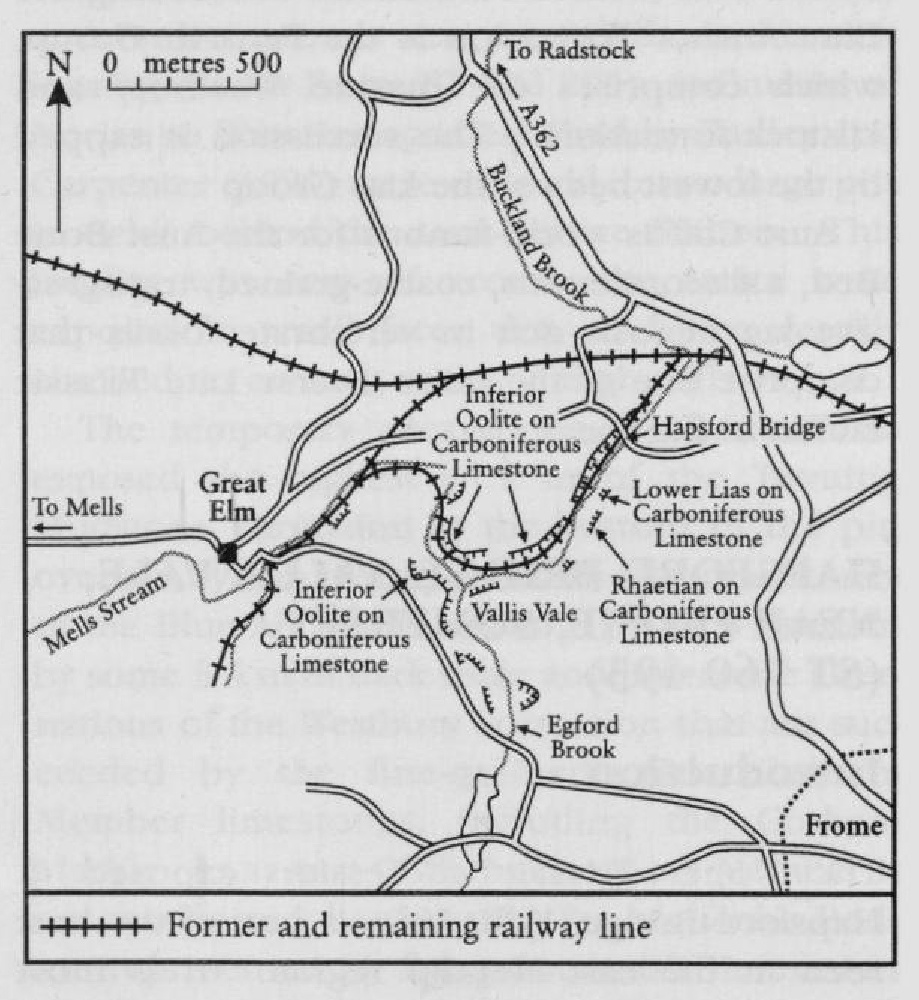
Hapsford Bridge is situated approximately 1 km north-west of Frome, at the confluence of Egford Brook and Mells Stream. It was known in the older literature as 'Hapsford Mills' (Moore, 1867). Quarrying ceased some time ago. Together with other geologically significant sites, the various disused and overgrown quarries along the sides of the Egford Brook, it forms part of the Vallis Vale Site of Special Scientific Interest (SSSI).
Sedimentology
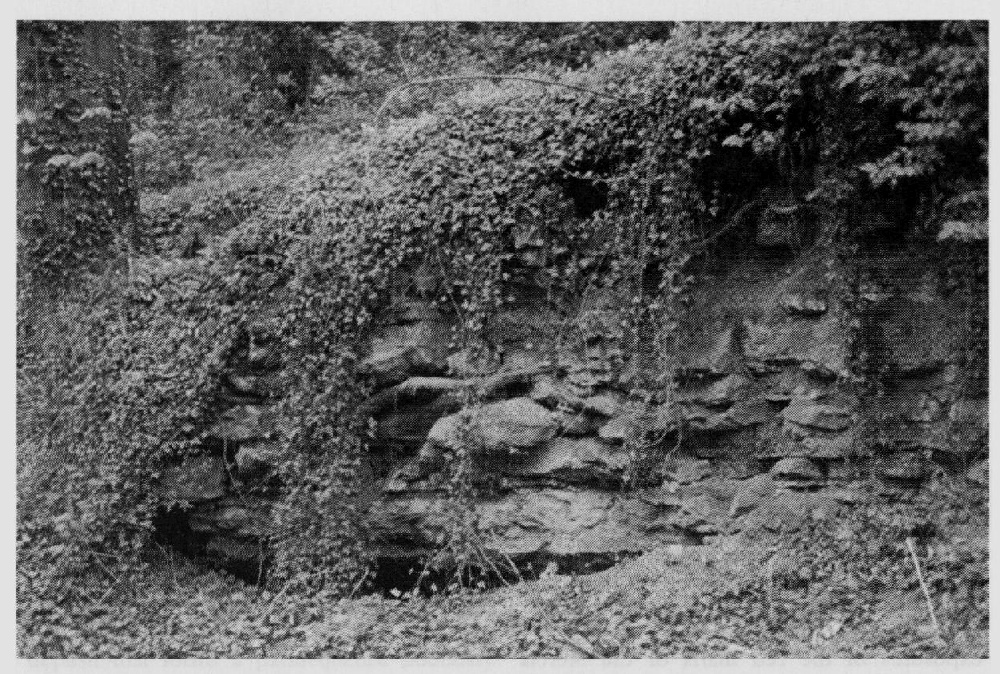
The Rhaetian sediments at Hapsford Bridge are best seen in the walls of a disused quarry in the south side of Vallis Vale
| Thickness (m) | |
| Middle Jurassic, Upper Inferior Oolite | 1.0 |
| Fine-grained micrites | 0.60 |
| Conglomeratic limestone | 0.30–0.60 |
| Interbedded clays, micrites and sparry limestones | 0.15 |
| Micrite | 0.12 |
| Pale clay | 0.15 |
| Micrite/calcisiltite | 0.05 |
| Pale clay | 0.02 |
| Micrite/calcisiltite | 0.10 |
| Finely laminated calcisiltites with pebbly base | 0.40 |
| Thin conglomerate | 0.01 |
| Micrite/calcisiltite with pebble lenses and ripple lamination | 0.27 |
| Ripple cross-laminated micrite with pebbly base | 0.07 |
| Organic clay, dark in colour | 0.05 |
| Conglomeratic limestone | 0.12 |
| Dark clay with lensoidal limestones | 0.05 |
| Conglomeratic limestone | 0.30–0.45 |
| Dark organic clay yielding Vallisia | 0.05 |
| Carboniferous Limestone |
Older sections, for example by Moore (1867) and Richardson (1911), record the presence of a basal Triassic conglomeratic bed lying on the Carboniferous Limestone, and other conglomerates throughout the sequence. The Rhaetian succession at Hapsford Bridge oversteps the Carboniferous Limestone, with the boundary marked by an unconformity.
Palaeontology
The Rhaetian sediments at Hapsford Bridge have yielded a wide variety of fossils, including palynomorphs (Orbell, 1973; Warrington, 1984), plants, invertebrates, and vertebrates (Savage, 1977, Dineley and Metcalfe, 1999). Invertebrates include typical Rhaetian forms, such as the bivalves Rhaetavicula contorta, Ostrea, and Cardinia (Moore, 1867; Savage, 1977) and the crustacean Euestheria minuta.
Vertebrate remains include the teeth of the shark Vallisia coppi, recovered from the dark clays that immediately overlie the Carboniferous Limestone. Vallisia was described by Duffin (1982) as a neoselachian, in other words, a modem shark, but the fine structure of its tooth enamel makes this assignment questionable (Cuny and Benton, 1999). Richardson (1911) noted remains of sharks and other fishes through much of the section. Thecodontosaurus, the prosauropod dinosaur described from here by Moore (1867), was initially thought to have come from Hapsford Bridge, but analysis of the material by Duffin (1978) suggests that this assumption may be incorrect. Benton and Spencer (1995, p. 72) mistakenly recorded prosauropod material from this site, based on this old record of Thecodontosaurus.
Plant fossils are found throughout the section, and are especially common within the dark clays of the
Interpretation
The section at Hapsford Bridge records a range of marine environments. The Upper Triassic sediments were deposited directly upon the Carboniferous Limestone, which formed part of the Upper Triassic Mendip archipelago (Duffin, 1982).
The
The generally paler-coloured limestones and clays of the
Conclusions
Hapsford Bridge represents one of the most easterly exposures of the