Orcombe Rocks, Devon
Introduction
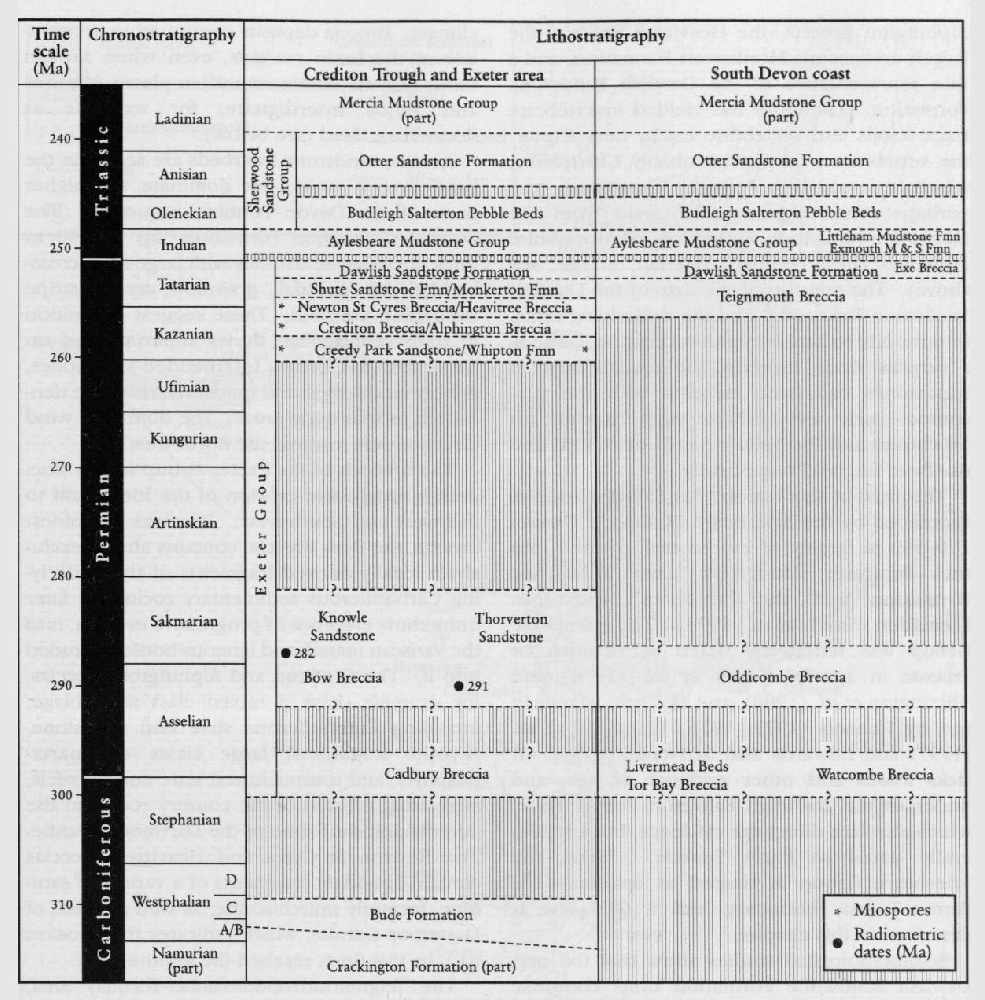
The site is an excellent coastal section in the sandstones, siltstones, and mudstones of the Permo-Triassic
The
Description
Orcombe Rocks form part of the Exe Estuary Site of Special Scientific Interest (SSSI) and part of the Dorset and East Devon Coast World Heritage site (established December, 2001).
The Permo-Triassic sediments are faulted and comprise mudstones, with thick interbedded sandstones. Most of the faults follow the line of strike (Harrison, 1975; Selwood et al., 1984, pp. 104–5).
The cliffs and foreshore expose the
Sedimentology
The
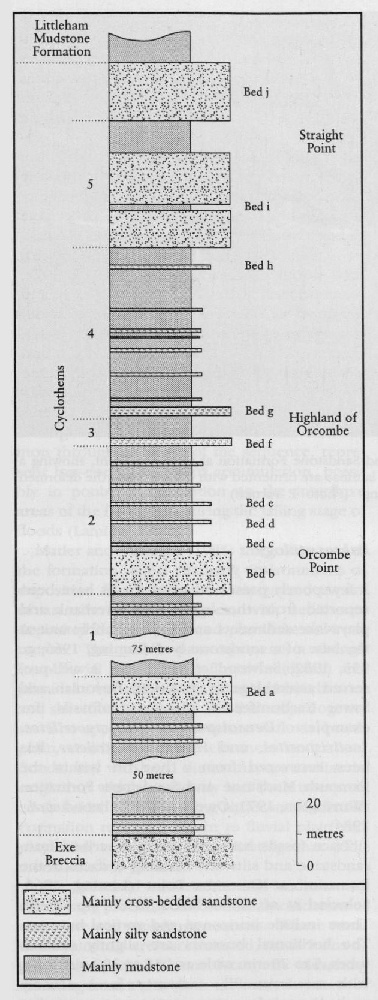
Three distinct sedimentary facies have been distinguished in the
- Poorly sorted, locally impersistent, green sandstone beds, 0.15 to 1.0 m thick, interbedded with mudstones. Sedimentary structures include small-scale cross-bedding and small channels cut into the underlying sediments.
- Red and green, cross-bedded sandstones with mudstone lenses, arranged in fining-upwards sequences, with trough and planar cross-bedding, and a few intraformational mud-pellet conglomerates. The lenses are between 1.25 and 3.0 m thick, and generally rest on erosion surfaces cut into the underlying silts.
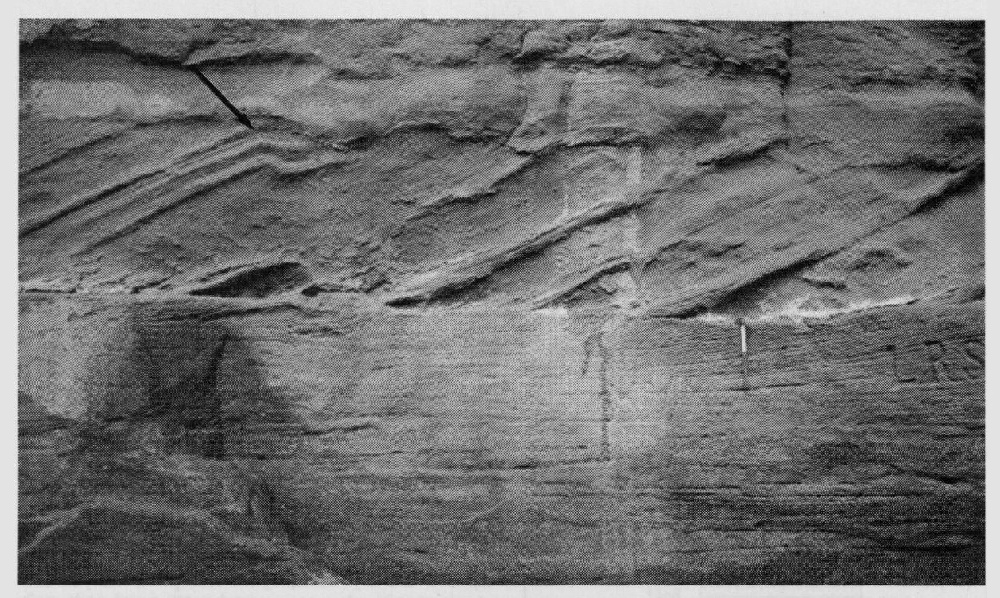
- Red and green sandstone beds, with mudstone beds and lenses. Large- and small-scale cross-bedding structures and fining-upwards sequences are common
(Figure 2.43) . Thicker units may display sun cracks and bioturbation. The clay lenses have well-developed small-scale cross-bedding and pipes and burrows infilled with sandstone.
A more detailed sequence of facies divisions has been outlined by Mader and Laming (1985), who divided the formation into lower, middle, and upper parts. The middle and upper parts are further divided into five and four units respectively. These authors note channels, sheet floods, some development of sand dunes, and limited pedogenesis in the upper units.
At Orcombe Point, bleached sandstone beds are present, with grey-green sandstone dykes radiating from them and penetrating the underlying reddish-brown marls to a depth of 0.1 to 0.2 m. The bleaching is associated with malachite (Carus-Wilson, 1913). Clay minerals in the sandstones include kaolinite, swelling chlorite, and mixed-layer illite. Euhedral calcite crystals, rare dolomite, and possible gypsum crystals have also been noted (Henson, 1973).
Palaeontology
A few poorly preserved plant fossils have been reported from the argillaceous overbank and playa-lake sediments and from a rubbly unit at the base of a sandstone bed (Laming, 1966, p. 955, 1982; Selwood et al., 1984). A well-preserved assemblage of reworked Devonian and lower Carboniferous plant microfossils, for example Densoisporites, Dictyotriletes, Savitrisporites, and Hymenozonotriletes, has been recovered from a horizon within the
Trace fossils have also been described from sandstone and siltstone bedding surfaces in the formation at Orcombe Point (Laming, 1966; Selwood et al., 1984; Mader, 1985, pp. 23–5). These include horizontal and vertical burrows. The horizontal burrows are slightly sinuous tubes, 5 to 20 mm wide and 30 to 300 mm long, with meniscus fill, and may form densely packed, complex cross-cutting structures that thoroughly rework the sediment. Vertical tubes reach depths of 10 mm and may be up to 20 mm wide; they are either isolated or tightly packed, and are filled with massive medium- to coarse-grained sand. Less distinct bioturbation traces are also visible in mudstone units in the
Interpretation
The
The first facies association (see above) with poorly sorted, greenish, laterally discontinuous sandstone beds, was interpreted as overbank deposits with evidence of crevasse splays and the gradual accumulation of fine-grained material. The red and green, cross-bedded sandstones of the second and third facies were interpreted as being deposited in river channels, probably on large-scale point bars. The mudstones, common throughout much of the sequence, represent low-energy sediment accumulation, possibly in pools, or deposition on the interfluve areas of the floodplain during the falling stage of floods (Laming, 1966).
Mader and Laming's (1985) three divisions of the formation reflect changing environments of deposition The lower part is interpreted as part of an alluvial fan complex, with sediments deposited in floodplain and playa-lake environments. The middle part represents a change from fluvial braidplain to fluvial braidplain and playa-lake conditions, characterized by channel and sheetflood processes and limited pedogenesis. The upper part sees a return to fluvial braid-plain conditions, with channels and sheet floods, and with sand dunes that are aeolian in origin but which previously had been interpreted as fluvial. The overlying
The bleached sandstones and sedimentary dykes were probably discoloured by oxidation of malachite and vanadium minerals. Where vanadium minerals are concentrated, small halos of paler bleached sediment occur, the bleaching resulting from a change in the oxidation state of iron minerals within the sediment, from ferric to ferrous oxides (Carus-Wilson, 1913; Harrison, 1975). Laming (1966, p. 955) suggested that the malachite might have been a weathering product of diagenetic copper mineralization, probably chalcocite, nucleated around plant debris.
The proportions of clay minerals in the mudstones of the
The poorly preserved, sporadic plant fossils offer little information, other than to confirm that the sediments include terrestrial elements. The burrows appear to have been produced by invertebrates rather than amphibians or reptiles, in contrast with much larger meniscate burrows at Saltern Cove (see GCR site report, this volume). They were classified as dwelling structures by Henson (1970), but they occur so densely in the fluvial sandstones (Mader, 1985, p. 23) that they are more likely to be feeding traces of animals churning the river-bed sediments as they consumed organic debris.
The
Conclusions
The Permo-Triassic sediments exposed at Orcombe Rocks show evidence for deposition in a range of fluvial and playa-lake environments. The section consists of a thick sequence of red and greenish-grey sandstones and siltstones with mudstones. The thick beds of coarser-grained sediments represent channel deposits such as bars, or, in some cases, aeolian dunes; the thinly bedded sandstones and mudstones accumulated in overbank areas and in playa lakes. This is a key site for understanding the palaeogeography of south-west Britain around the time of the Permian–Triassic transition.