Burton Cliff and Cliff Hill Road Section, Dorset
B. M. Cox
Introduction
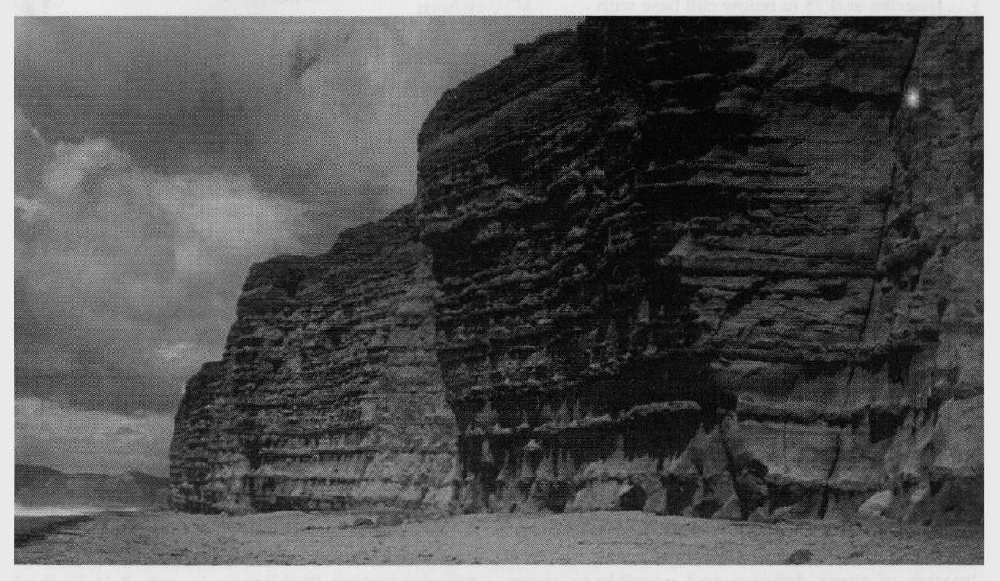
The major part of the Burton Cliff and Cliff Hill Road Section GCR site comprises the coastal section at Burton Cliff, near Burton Bradstock in Dorset, which extends for c. 1.5 km from near Burton Freshwater (the mouth of the River Bride) in the west to the National Trust car park opposite the Bay View Hotel in the east
Description
The following record of the Burton Cliff section (also
| Thickness (m) | |
| 19: Clay, grey, somewhat calcareous and silty; poorly fossiliferous; bivalves (Bositra buchii (Roemer)) | seen to 5.0 |
| Inferior Oolite Formation | |
| 18: The Scroff: Marl, rusty, iron-stained, impersistent; belemnites; brachiopods (Aulacothyris); poorly preserved ammonites, often encrusted with serpulids | 0.05–0.15 |
| 17: Zigzag Bed: Limestone, nodular, hard, blue-hearted, locally limonitic or pyritic; ammonites including Ebrayiceras, Morphoceras, Oecotraustes, Oxycerites, Parkinsonia, Procerites, Procerozigzag and Zigzagiceras welded to underlying bed | c. 0.15 |
| Burton Limestone | |
| 16: Limestone, pale, more-or-less hard and massive, bioclastic, bioturbated, poorly fossiliferous; parting into three courses | 0.65 |
| 15: Sponge Bed: Limestone, marly, variable; well bedded in several courses, separated by thin, marly partings; thicker limonitic marl at top; coarsely bioclastic with clasts largely of sponge fragments; occasional poorly preserved ammonites (Parkinsonia); profuse calcareous sponges; bivalves; brachiopods; bryozoans; crinoids; echinoids (Cidaris, Clypeus, Collyrites); marl parting at base | 0.35 |
| 14: Limestone, harder than above, coarsely biodetrital and somewhat rubbly packstone; clasts largely of echinoids; divided into two courses (a,b) by undulating parting; sparsely fossiliferous with fauna as above but better preserved; ammonites (Parkinsonia (P.) bomfordi Arkell); large nautiloids; bivalves; brachiopods including Sphenorhynchia plicatella (J. de C. Sowerby); echinoids; sponges; undulating parting at base | 0.40 |
| 13: Limestone, in three main courses (a–c), variably hard; brachiopods (Sphaeroidothyris sphaeroidalis (J. de C. Sowerby)) abundant throughout | |
| 13c: Packstone, fine grained, biomicritic, marly, somewhat ferruginous with weathered pockets of limonite; ammonites, as wholly decalcified internal casts including Lobosphinctes intersertus S.S. Buckman, Oxycerites aspidoides (Oppel), and macroconch and microconch Parkinsonia pseudoferruginea Nicolesco; nautiloids | 0.30 |
| 13b: Truellei Bed: Biosparite, hard, somewhat peloidal with scattered large, cream-coloured ooids and characteristic small black grains or specks; many well-preserved but difficult to extract fossils including macroconch and microconch Bigotites petri Nicolesco, Cadomites daubenyi (Gemmellaro), Dimorphinites defrancii (d'Orbigny), Lissoceras spp., Parkinsonia (Durotrigensia) dorsetensis (Wright), Parkinsonia (P.) parkinsoni (J. Sowerby) (β, Polyplectites, Strigoceras truellei (d'Orbigny); large thick-shelled bivalves including Ctenostreon, Neocrassina, Trigonia; echinoids (Holectypus, Stomechinus); gastropods; nautiloids; parting at base | 0.15–0.20 |
| 13a: Limestone, marly, biomicritic packstone or wackestone; sparsely (upper part) to fairly densely (lower part) ooidal with large, weathering cream-coloured, ooids; less fossiliferous than 13b with ammonites including Bigotites sp., Parkinsonia (Durotrigensia) aff. dorsetensis (Wright) and P. (P.) parkinsoni (J. Sowerby) cc; belemnites | 0.10 |
| 12: |
0.10 |
| 11: Red Conglomerate: Oolite, 'iron-shot' with berthierine, highly variable, preserved in patches and pockets let down into karstic undulating surface of bed below; often conglomeratic with limonite-encrusted worn pebbles including belemnites and ammonite nuclei; locally re-cemented in crimson limonite, sometimes with stromatolitic lamination; in places, thickening into lenticular 'iron-shot' oolite with 'fresh' fossils, particularly ammonites; undulating, sharp base | 0–0.15 |
| Divisible into three generations of sediment: | |
| 11c. Limestone, white, preserved in blocks as fissure-infills; ammonites including Cadomoceras and Garantiana; large nautiloids; brachiopods; echinoids | |
| 11b. Limestone, white, soft, in small pockets; ammonites including Leptosphinctes, Spiroceras and Strenoceras | |
| 11a. Oolite, 'iron-shot', bioturbated but well bedded; well-preserved ammonites including Dorsetensia cf. regrediens (Haug), Sonninia cf. hebridica (Morton), rare Sphaeroceras brongniarti (J. Sowerby), Stephanoceras kreter (S.S. Buckman), S. mutabile (Quenstedt), S. umbilicum (Quenstedt), S. (Normannites) braikenridgii (J. Sowerby), S. (N.) latum Westermann and S. (Phaulostephanus) aff. diniense Pavia | |
| Red Bed | |
| 10: Limestone, massive, hard, in two courses; somewhat ooidal, coarse bioclastic packstone rich in crinoid and echinoid plates; weathering white or pale-pink; totally bioturbated with overprint of large, irregular, vertical burrows often marked by red limonite; sparsely fossiliferous; belemnites; undulating surface largely covered in stromatolitic crusts up to 0.05 m thick at base | 0.30–0.50 |
| 9: Limestone, biodetrital packstone as bed above but somewhat finer; moderately to densely ooidal; weathering olive-grey; ammonites including Emileia, Labyrinthoceras, Otoites, Nannina evoluta S.S. Buckman, Sonninia celans S.S. Buckman, S. felix S.S. Buckman, S. propinquans (Bayle) and Stephanoceras rhytum (S.S. Buckman); large bivalves; and gastropods (Bathrotomaria); sharp base | 0.20–0.25 |
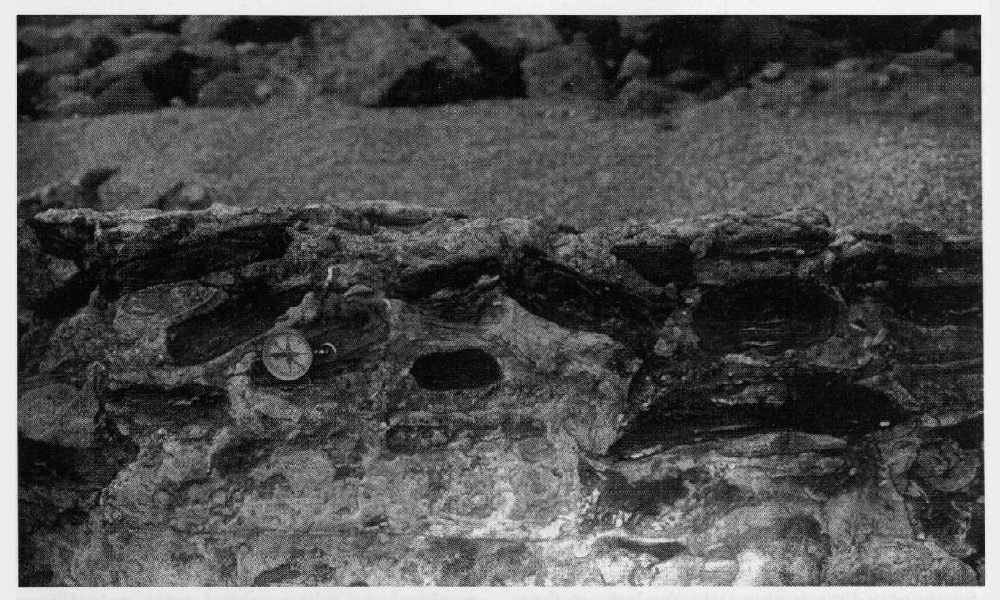
| 8: Snuffbox Bed: Limestone, marly, blue-grey; sparsely to densely ooidal; ooids large and limonitic, concentrated in pockets; scattered large echinoid spines and plates; numerous ellipsoidal, limonitic, strongly laminated oncoids ('snuff-boxes') concentrated locally and embedded at all angles; sharp base | 0–0.10 |
| 7: Yellow Conglomerate: Limestone, marly, weathering yellow with masses of pebbles including rolled, worn ammonites and many belemnites; 'fresh' ammonites including Graphoceras limitatum S.S. Buckman; sharp but undulating erosive base | 0.05 |
| 6: Scissum Bed: Limestone, sandy, hard, massive when unweathered; ammonites including, most commonly, Leioceras (L.) undulatum S.S. Buckman (microconch)/L. (Cypholioceras) lineatum S.S. Buckman (macroconch) and rarer Cylicoceras (C.) uncinatum S.S Buckman (macroconch)/C. subcostatum S.S. Buckman C. paucicostatum Rieber (microconchs) as well as Bredyia subinsignis (Oppel), Csernyeiceras verpillierense (Roman and Boyer), Erycites aff. barodiscus Gemmellaro, E. cf. fallifax Arkell, Hammatoceras lorteti Dumortier, Planammatoceras planinsigne (Vacek), Tmetoceras scissum (Benecke); Leioceras cf. opalinum (Reinecke) in lower part; large bivalves including Ctenostreon and Plagiostoma inoceramoides (Windborne); fossil wood | 0.45–0.50 |
| 5: Rusty or Foxy Bed: Marl, sandy, brown, somewhat laminated, moderately fossiliferous with ammonites, including Alocolytoceras taeniatum (Pompeckj), Bredyia subinsignis (Oppel) and Leioceras opalinum (Reinecke) (microconch)/L. opaliniforme S.S. Buckman (macroconch); brachiopods; passing down into | c. 0.05 |
| 4b: Sandstone, fine grained, highly calcareous, hard, burrowed and piped; few fossils except local accumulations of Leioceras opalinum (Reinecke) near top, Pachylytoceras torulosum (Zieten) and rare Tmetoceras scissum (Benecke); indistinct parting at base | 0.25 |
| 4a: Sandstone, fine grained, weakly calcareous, somewhat concretionary; undulating base | c. 0.20 |
| 1–3: Sand, slightly micaceous, yellow, with layers of calcareous, burrowed concretionary sandstone; ammonites including Pleydellia aalensis (Zieten) | 1.50 |
| Sand with occasional concretionary sandstones | seen to 30–40 |
Interpretation
The ammonite fauna enables recognition of the Aalenian Opalinum, Scissum, Concavum and Discites zones, the Lower Bajocian Sauzei and Humphriesianum zones, and the Upper Bajocian Subfurcatum, Garantiana and Parkinsoni zones
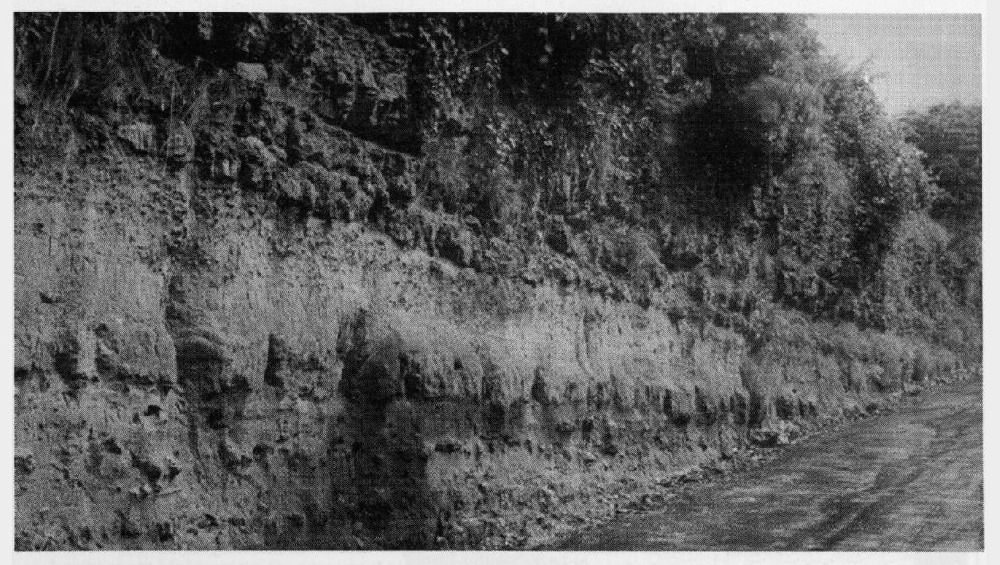
The Toarcian–Aalenian stage boundary is taken at the base of Bed 4 in which the ammonite fauna is indicative of the Opalinum Zone and the oldest known Aalenian ammonite biohorizon (Aa-1 Leioceras opalinum) (Callomon and Chandler, 1990; Callomon and Cope, 1995). The ammonite Pleydellia aalensis (Zieten) in the underlying Bed 3 gives its name to the Aalensis Subzone, the youngest subzone of the Levesquei Zone and Toarcian Stage. At Burton Bradstock and elsewhere in this area, many authors (e.g. Wilson et al., 1958; Torrens, 1969b; Parsons, 1980a; Callomon and Cope, 1995 (text only); Hesselbo and Jenkyns, 1995) have taken the top of the Opalinum Zone at the top of the Rusty or Foxy Bed — alternative stratal names, used since Buckman (1910a) — for a thin, brown, sandy marl (Bed 5 above) or iron-stained clay seam. At some localities including the Cliff Hill Road Section, this bed overlies an irregular hardground (Hesselbo and Jenkyns, 1995). The top of the Rusty or Foxy Bed has also been taken by some authors (e.g. Torrens, 1969b; Parsons, 1980a; Hesselbo and Jenkyns, 1995; Cox et al., 1999; and herein) as the Bridport Sand–Inferior Oolite formational boundary (see Conegar Hill GCR site report, this volume). Although Callomon (in Callomon and Cope, 1995) took this boundary somewhat lower (at the base of Bed 4), he acknowledged that Bed 4a was probably already the topmost cemented member of the
The limonitic oncoids known locally by the quarryman's term 'snuff-boxes', which give their name to Bed 8, are a well-known sedimentological feature in the European Bajocian Stage and they have been investigated in some detail (e.g. Sellwood et al., 1970; Gatrall et al., 1972; Palmer and Wilson, 1990; Hesselbo and Jenkyns, 1995;
As originally used by Buckman (1910a), the term Red Bed referred to all of the strata between the Yellow Conglomerate and the
The oldest element (11a above) of the overlying and discontinuous Red Conglomerate belongs to the basal Humphriesianum Zone, probably near to the Sauzei–Humphriesianum zonal boundary Ammonites in the next youngest element (11b above) indicate the Polygyralis Subzone of the Upper Bajocian Subfurcatum Zone, and the youngest element (11c above), which Buckman (1910a, 1922a) called the 'White Bed' or 'Nautilus Bed', belongs to the Upper Bajocian Garantiana Zone (Callomon and Cope, 1995). Further lithological details of the last-named sediment were given by Jenkyns and Senior (1991). The fissures that it infills were created by movements of the synsedimentary Bride Fault that truncates Burton Cliff at its eastern end and brings the
The algal crust that separates the Red Conglomerate (Bed 11), or in its absence the Red Bed (Bed 10), from the overlying
The term 'Burton Limestone' (beds 13–16) was introduced by Parsons (1975b) for the beds previously and variously known as the 'Microzoa Beds', 'Massive Beds', 'Sponge Beds' and 'Top Limestones' (Richardson, 1928–1930). Parsons (1975b) considered that these earlier terms either referred to facies of limited geographical and stratigraphical range or had been used in a wider sense thereby including several distinct lithostratigraphical units. He therefore proposed the Burton Limestone, with Burton Cliff as its type locality, as a single lithostratigraphical unit covering all of the bioclastic limestones and subsidiary marl partings between the
The Zigzag Bed (Bed 17) and The Scroff (Bed 18), the youngest beds of the Inferior Oolite Formation at this site, belong to the Lower Bathonian Zigzag Zone. The Scroff — the name given to a thin irony layer by the quarrymen who worked the Inferior Oolite Formation in quarries around the village of Burton Bradstock (Buckman, 1910a) — forms the reworked top of the Zigzag Bed, which, like the zone, takes its name from the perisphinctid ammonite Zigzagiceras zigzag (d'Orbigny). This taxon is itself named after its distinctive style of ribbing. As at Horn Park Quarry (see GCR site report, this volume), the Zigzag Bed includes all of the characteristic ammonites of the Zigzag Zone (Arkell, 1951a, 1958a; Torrens, 1974). All three of the latter's subzones (Convergens, Macre-scens and Yeovilensis) are condensed into the two beds, although the youngest (Yeovilensis) is also represented in the overlying
The succession at Burton Cliff featured in the sequence stratigraphical analysis of Rioult et al. (1991), which was based primarily on detailed bed-by-bed outcrop observation and sedimentological and biostratigraphical analysis, as well as comparison with similar data from the Normandy coast of France. They recognized sequence boundaries at the top of the Scissum Bed (base of Bed 7), at the top of the Red Bed (base of Bed 11) and at the base of the Bomfordi Subzone (base of Bed 14b); maximum flooding surfaces between the Snuff-box Bed and the Red Bed (base of Bed 9), possibly between the
The probable palaeogeographical setting for the Inferior Oolite Formation of the Wessex Basin is an intrabasinal structural high distal to carbonate ramp facies developed around the London Platform and the Worcester Basin to the north (Hesselbo and Jenkyns, 1995). Some of the characteristic sedimentological features of the formation in Dorset and Somerset and their significance are discussed in the Seavington St Mary Quarry GCR site report (this volume).
Conclusions
The coastal sections of Dorset are among the most famous Jurassic sections in the world. Burton Cliff is the best locality for studying the Inferior Oolite Formation, together with the underlying