Campsie Fells, Stirling and East Dunbartonshire
J.G. MacDonald
Introduction
The Visean lavas and pyroclastic rocks of the
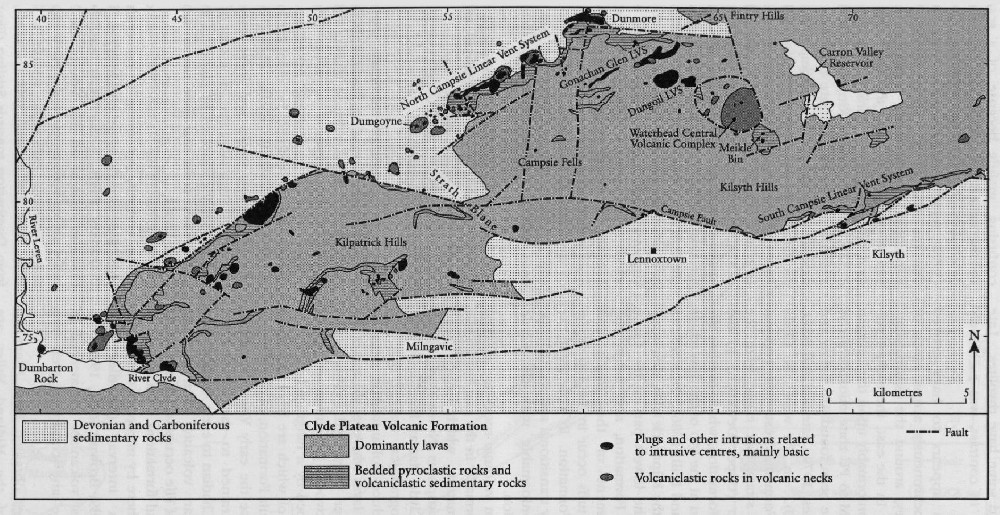
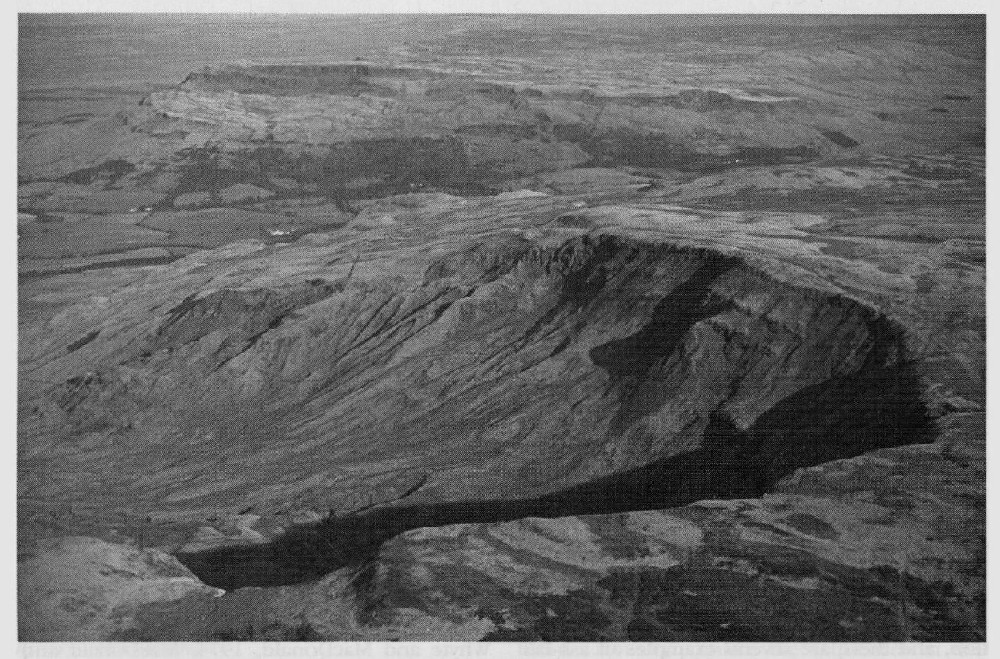
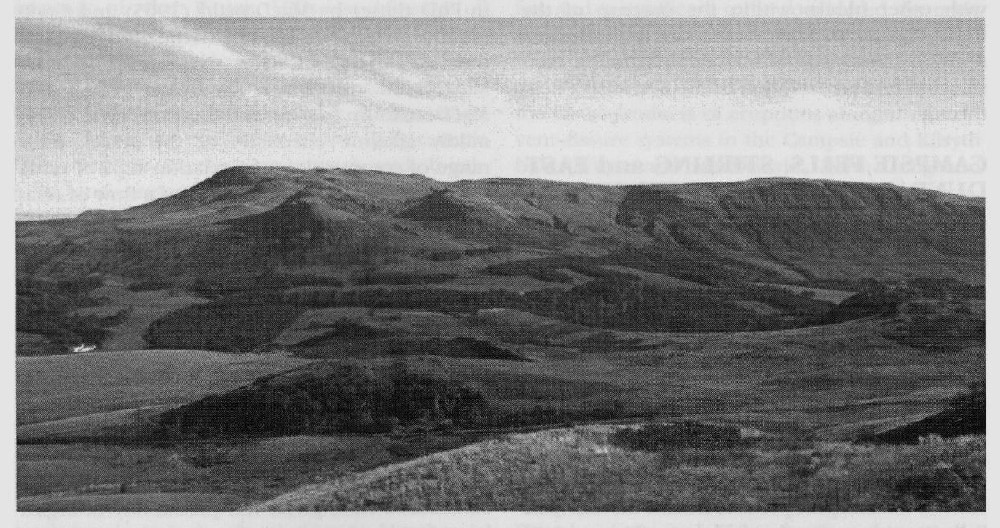
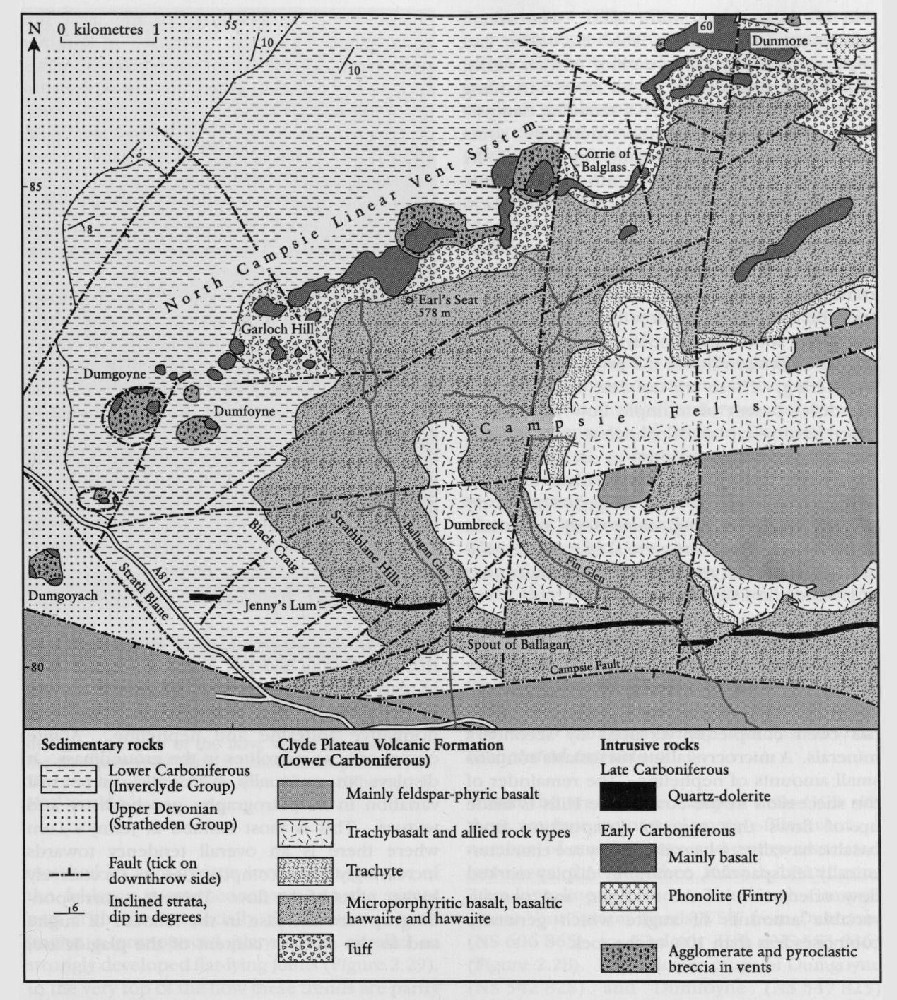
The Campsie Fells GCR site extends for 8 km along the NW-facing escarpment, from Dunmore, above the village of Fintry, as far as the twin volcanic plugs of Dumgoyne and Dumfoyne. From there it continues south-eastwards along a 4.5 km stretch of the SW-facing escarpment of the Strathblane Hills between Dumfoyne and the Spout of Ballagan. As well as the volcanic features of the area, localities of stratigraphical and palaeontological interest have been notified at the Balglass corries in the north and at Ballagan Glen in the south (see Cossey et al., in prep.).
The earliest detailed description of the geology of the Campsie Fells by Young (1860) proved to be so popular that it was reprinted in 1868 and 1893. More recent sources of information (Clough et al., 1925; MacDonald, 1967; Whyte and MacDonald, 1974; MacDonald and Whyte, 1981; Hall et al., 1998) provide a general picture of the petrography and geochemistry of the volcanic rocks, which vary in composition from mafic basalt to trachyte. Most of these accounts draw upon more detailed information in PhD theses by MacDonald (1965) and Craig (1980). Excursions to parts of the Campsie Fells outwith the GCR site are described by MacDonald and Whyte (in Upton, 1969) and MacDonald (in Lawson and Weedon, 1992). The mildly alkaline chemistry of the rocks, their range of composition, the relationships of vents to lava flows, and the presence of a flow of relatively fresh hawaiite that exhibits interesting internal variations, afford a potential for further research in the area, which could be of international significance.
Whole-rock K-Ar radiometric dates from vent intrusions in the western Campsie Fells (De Souza, 1979) include 329 ± 7 Ma (Dumgoyne) and 316 ± 5 Ma (Dunmore) (c. 336 Ma and 323 Ma respectively using new constants). Ages in the range 315 ± 7 Ma to 303 ± 7 Ma were obtained from lavas farther east but De Souza considered that, given the probability of argon loss during alteration, the age of eruption is likely to be in the vicinity of, or older than, 330 Ma (c. 337 Ma using new constants).
Description
The lavas vary in thickess from flow to flow and within flows, averaging about 10 m but in some instances exceeding 20 m. They generally take the form of single flow units, vesicular on top and in some cases displaying well-developed red bole between flows, the product of lateritic weathering. There are no clear indications of the development of multiple flow units or of other features typical of pahoehoe, so it is likely that the lavas were erupted as aa. The upper parts of the three lowest flows at Black Craig are particularly vesicular and slaggy, with drusy cavities, calcite veining, chalcedony veins and jasper lenses. The latter were at one time exploited as a source of material for the manufacture of jewellery in Edinburgh.
The basal lava at Black Craig is the most basic in the western Campsie sequence, being an olivine basalt containing abundant, randomly orientated, laths of labradorite (An66), which comprise 55% of the rock. Olivine (12%) has been completely replaced by secondary minerals. A microcrystalline mesostasis contains small amounts of nepheline. The remainder of the succession in the Strathblane Hills is made up of flows that vary in composition from basaltic hawaiite to hawaiite. They are characteristically feldspar-rich, commonly display marked flow orientation of the feldspar, and contain variable amounts of augite which generally comprises less than 10% of the rock.
Studies of the petrology of the lavas are complicated by the almost ubiquitous replacement of olivine by secondary minerals such as 'serpentine', green pleochroic bowlingite and, in extreme cases, calcite. The oxidation state of the opaque oxides has also been effected to varying degrees so that titanomagnetite, which in some flows exceeds 9%, has undergone alteration resulting in the transformation of exsolved magnetite to maghemite (Goswami, 1968). This has the effect of distorting the ratio of ferrous to ferric iron in whole rock chemical analyses to the extent that some nepheline-bearing rocks appear to be silica-oversaturated in their normative composition. Most of this alteration can be explained by reaction if the early-formed minerals with the volatile reaction of the magma during the late stages of crystallization.
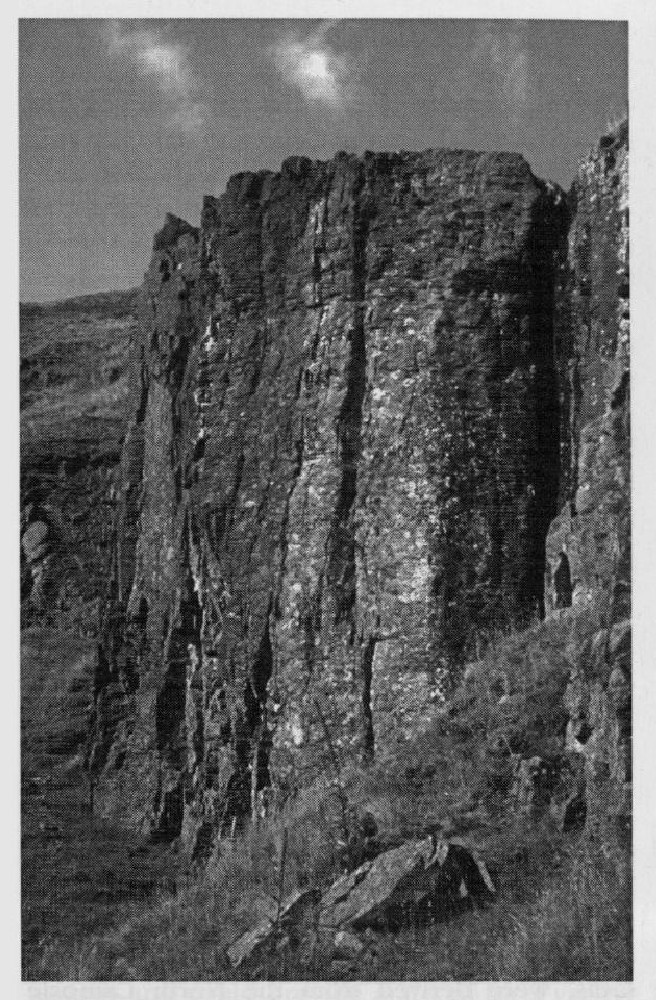
The distinctive texture of a hawaiite flow that occurs near the base of the succession in the Strathblane Hills allows it to be traced along the Campsie escarpment for at least 2.4 km (MacDonald, 1967). At Jenny's Lum
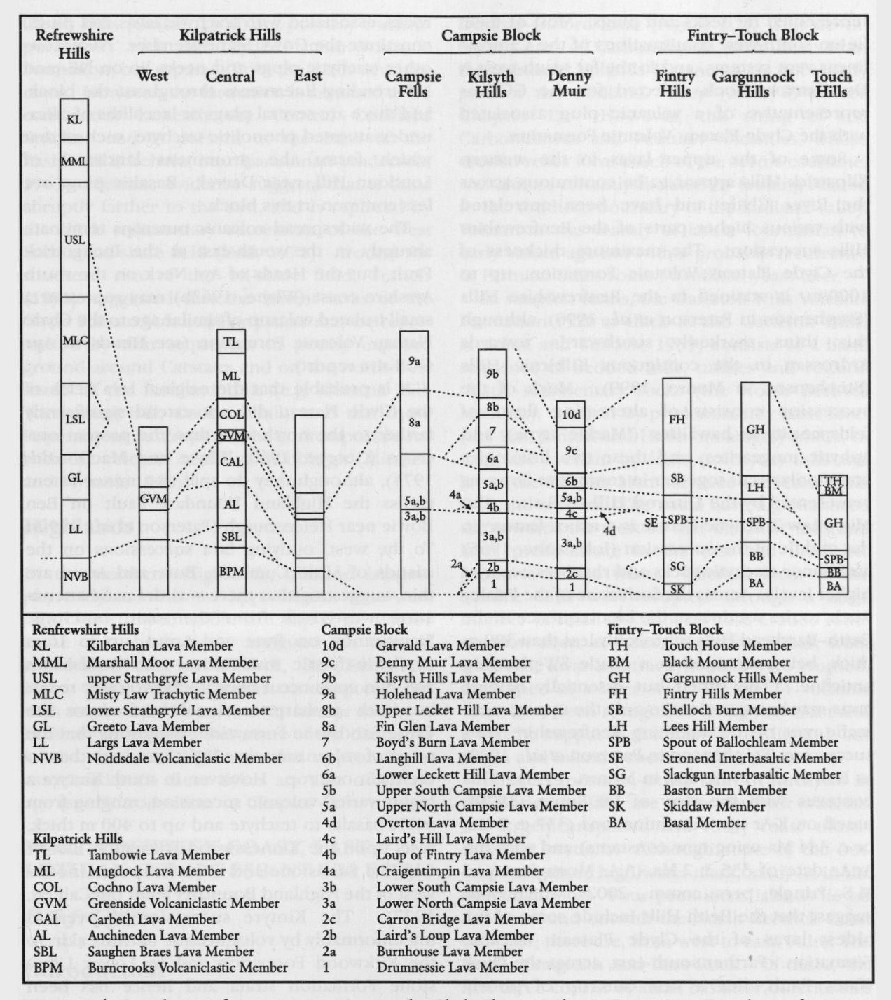
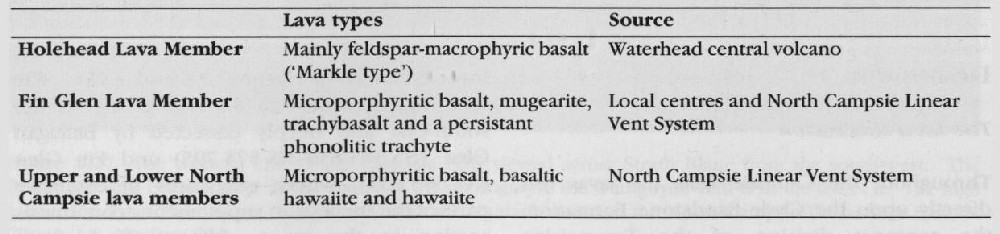
| Lava types | Source | |
| Mainly feldspar-macrophyric basalt ('Markle type') | Waterhead central volcano | |
| Microporphyritic basalt, mugearite, trachybasalt and a persistant phonolitic trachyte | Local centres and North Campsie Linear Vent System | |
| Upper and Lower North Campsie lava members | Microporphyritic basalt, basalticCampsie lava members hawaiite and hawaiite | North Campsie Linear Vent System |
The gradational variations and apparent absence of internal discontinuities are very similar to those observed in hawaiitic flows in the northern part of the Renfrewshire Hills (Kennedy, 1931; see Dunrod Hill GCR site report). However, they are in contrast with composite lava flows involving two markedly different components, such as those described by Kennedy (1933) from elsewhere in the Renfrewshire Hills. One could argue that the Jenny's Lum and Dunrod Hill hawaiites are not truly composite but display gradational variations in composition, suggesting an orderly mode of emplacement of a magma that progressively changed in composition during the course of eruption. Such progressive variation in the composition of lava during the course of an eruption has been observed in historical activity in Iceland (Thorarinsson and Sigvaldason, 1972).
A distinctive phonolitic trachyte flow to the east of Fin Glen has petrographical similarities to an irregular intrusion of phonolite near Fintry (Hall et al., 1998). This flow and a few analcime trachybasalts near North Berwick are the only silica-undersaturated evolved lavas known within the Carboniferous and Permian volcanic sequences of Britain. Elsewhere, any more evolved compositions trend towards quartz-trachytes and rhyolites (for discussion see Traprain Law GCR site report). The phonolitic trachyte marks the base of the Fin Glen lavas, which are, on average, more felsic than the underlying flows; in addition to basalt they include trachybasalt and mugearite. The topmost part of the succession in the western Campsie Fells consists of feldspar-macrophyric basalts ('Markle' type) of the
The North Campsie Linear Vent System and associated intrusions
Within the area of the Campsie Fells GCR site there are four major agglomerate-filled vents, a number of smaller ones and many associated intrusions that together form a continuous 7 km-long linear feature. This North Campsie Linear Vent System trends WSW from Dunmore
The intrusive rocks associated with the vents vary in composition from basalt to hawaiite and mugearite. The basaltic types most commonly include microlitic and feldspar-microphyric varieties ('Jedburgh' type), and less commonly feldspar-macrophyric 'Markle' types. The more mafic varieties, rich in phenocrysts of olivine and augite, which occur in vents in the Kilpatrick Hills to the south of the Campsie Fault, are not represented in the Campsie vents. In general, the basalts and related rocks of the vent intrusions have suffered less immediate post-eruptive alteration than the lavas; olivine is much more commonly preserved, for example (see Dumbarton Rock GCR site report). It is likely that many vent intrusions represent fractions of magma that were emplaced at a late stage in individual eruptive sequences. As such they would commonly have been depleted in volatile constituents that had escaped to the surface through the open vent or had risen as gas bubbles to higher levels, now removed by erosion.
Whereas the North Campsie vents have an almost continuous outcrop that forms the northwestern boundary of the lava plateau, Dumgoyne, Dumfoyne and a number of smaller vents and intrusions lie to the west of the main mass of lavas, forming isolated features. These plugs cut sedimentary rocks of the
Within the western Campsie Fells a number of dykes have trends similar to that of the North Campsie Linear Vent System and coincide with ENE-trending normal faults. Some of these dykes are of feldspar-macrophyric ('Markle' type) basalt. Whyte and MacDonald (1974) have suggested that these could have been feeders for fissure eruptions of feldspar-phyric lavas, the latter having been subsequently removed by erosion of the top of the succession in the western Campsies.
Interpretation
The underlying structural control of the ENE-trending North Campsie Linear Vent System is probably related to a Caledonian lineament in the pre-Carboniferous basement (see 'Introduction' to this chapter). This trend is sufficiently similar to that of the feldspar-phyric dykes and associated normal faults to suggest that all three features are related to a common stress system. The high concentration of magmatic activity along the linear vent system is likely to have been accompanied by corresponding local swelling of the Earth's crust during periods of maximum magmatic activity. Such conditions are conducive to normal faulting, facilitating the intrusion of dykes, parallel to the elongation of the vents, as is seen in many areas of recent active volcanism. The swelling could also have created the palaeoslope, down which the lavas flowed away from the vents.
The similarity in petrography and geochemistry between the vent intrusions and the lavas of the western Campsie Fells (MacDonald and Whyte, 1981) make it appear likely that the bulk of the succession, comprising the
Conclusions
The Campsie Fells GCR site exhibits the lower part of the volcanic succession in the Campsie Fells; it is typical in many respects of the northern outcrops of the Visean
The North Campsie Linear Vent System is the most concentrated example of multiple volcanic vents preserved in Dinantian times in the Midland Valley, and the lava sequence of the Campsie Fells is one of few for which the general source area and hence the type of eruption can be clearly identified. It has even been possible to tentatively suggest specific vents as the sources for some individual lavas. Some of the more distinctive lavas can be traced for considerable distances. The lavas and intrusions have been the subject of several geochemical investigations and could provide material for a variety of further studies into magmatism in the Midland Valley and the origin and evolution of magmas in general. The volcanic plugs in particular could provide fresh rocks suitable for radiometric dating, which would have wider significance for the timing of events in the Midland Valley.