Carron Water, Dumfries and Galloway
I.T Williamson
Introduction
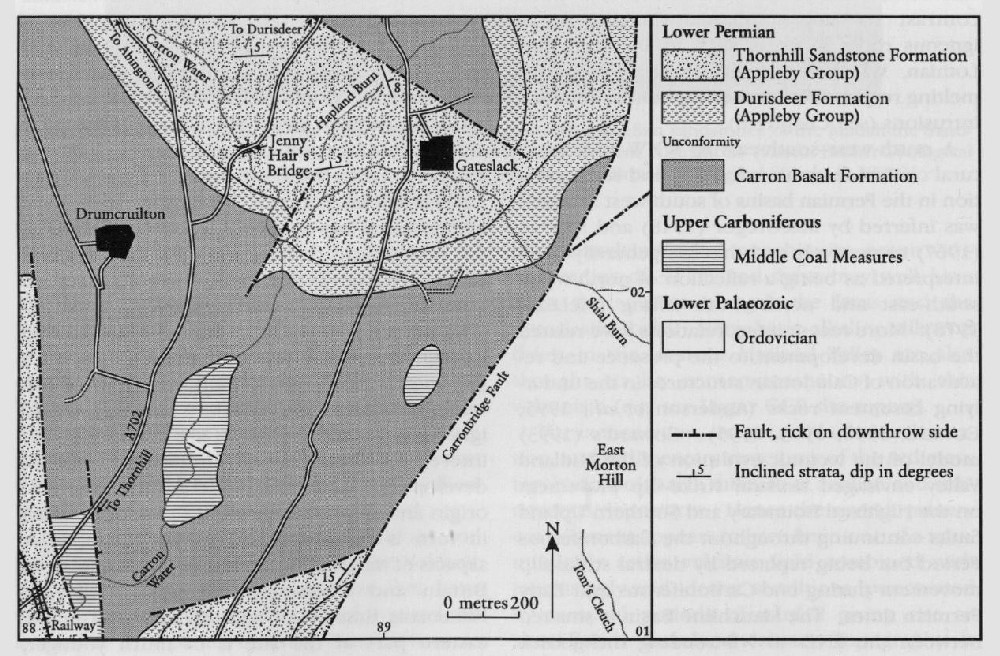
The gorge of the Carron Water, 4 km NNE of Carronbridge, Nithsdale and 0.5 km downstream from Jenny Hair's Bridge, is the type section for the Early Permian
The
These volcanic rocks were identified by Geikie (1866, 1897) and were first described in some detail in the Geological Survey memoir for the Sanquhar and Thornhill coalfields (Simpson and Richey, 1936). A general description of the Thornhill Basin appears in the memoir for the adjacent Sheet 9 (McMillan, 2002) and aspects of the Permian sedimentology and stratigraphy were discussed by Brookfield (1978, 1980) and McMillan and Brand (1995). The basalts have been included in geochemical studies of Silesian and Permian igneous rocks of southern Scotland by Macdonald et al. (1977) and Wallis (1989) and have also been investigated as a potential source of gold that occurs as trace amounts in the associated red beds (Leake et al., 1997). Brief descriptions of the GCR site and nearby localities have been included in field excursion guides (Brookfield, 1981; McMillan in Stone, 1996).
Description
The
The Carron Water GCR site is the type locality for the
Top
Sandstone, brick-red with occasional 'blocks' of basalt
Sandstone, brick-red, cross-bedded, aeolian
Breccia, basaltic
Non-exposed gap
Olivine basalt, amygdaloidal; 2 flows, each with fissured upper surfaces
Sandstone, red, fine grained
Olivine basalt, amygdaloidal
Sandstone, very fine-grained, with basaltic pebbles in upper part
Non-exposed gap
Carboniferous sedimentary rock
Bottom
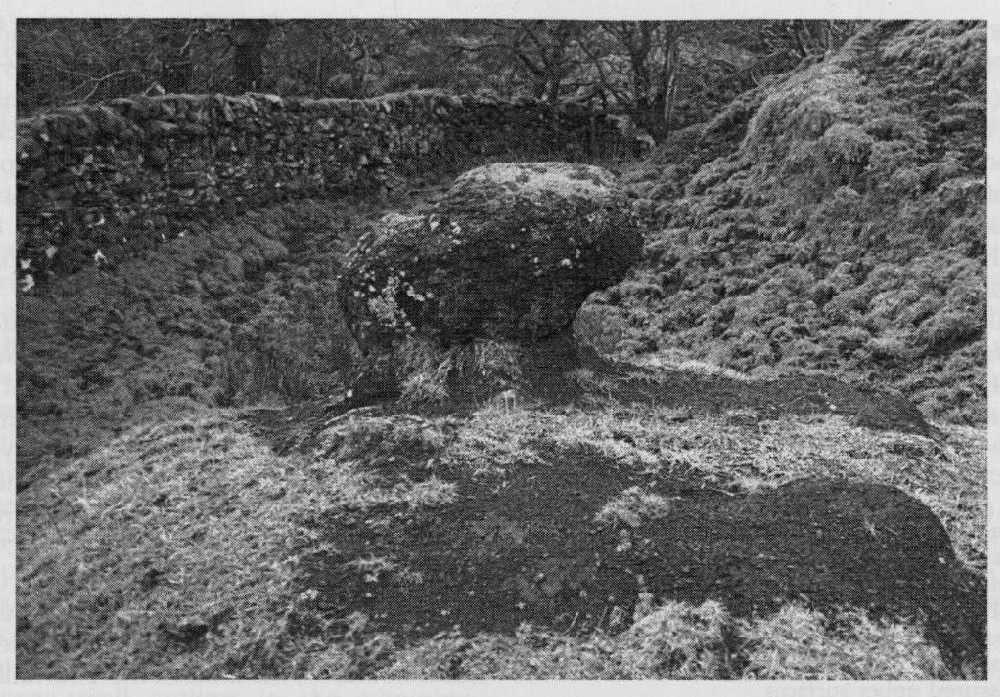
Locally, the base of the volcanic formation is a breccia with small angular clasts of greywacke and basalt in a sandy matrix. The presence of basaltic clasts indicates that lavas were already present and were being eroded elsewhere in the basin. Some basalts incorporate wind-blown sand in their matrix (Brookfield, 1980). The lavas, for the most part, comprise deeply and extensively weathered olivine basalts, 1–3 m thick
The top of the
There are few analyses of lavas from the Thornhill Basin (Macdonald et al., 1977; Wallis, 1989). Although the latest Carboniferous and Early Permian igneous rocks of south-west Scotland are dominantly alkaline and silica-undersaturated, the lavas of the Thornhill Basin, like those of the Mauchline Basin, show a range of compositions from hypersthene-normative (transitional) basalts to nepheline-normative alkali basalts and basanites.
Interpretation
Because of its association with red fluvial and aeolian strata, the
The palaeoenvironment of the Thornhill Basin during the volcanic period is best assessed by considering both the lavas and the facies of the associated sedimentary rocks. The volcanism appears to have been short-lived and intermittent. Locally, flows show reddened upper surfaces suggesting atmospheric weathering, and the incorporation of unconsolidated sand into the matrix of some flows and the sandstone dykes in fissures also point to surface exposure. The lavas were emplaced subaerially; there is no evidence by way of pillow structures or hyaloclastites for the existence of bodies of standing water, despite the presence of interbedded, waterlain sedimentary rocks.
The lower sandstones and those infilling fissures on the flow surfaces contain mainly sub-angular grains, typical of immature fluvial facies. Brookfield (1978, 1980) and McMillan and Brand (1995) have interpreted the basal breccias and conglomerates of the
The Thornhill Basin is one of a number of now isolated Permian sedimentary basins in the Southern Uplands that are orientated perpendicular to the north-east–south-west Caledonian fabric of the underlying rocks. They developed under extensional regimes, with their shape and orientation controlled by the re-activation of deep-seated structures in the basement (Anderson et al., 1995). Limited transitional to alkaline volcanism was associated with the early phases in the rift-history of the basin and may have been contiguous with other Permian volcanic sequences in southern Scotland, for example the
Conclusions
The Carron Water GCR site contains the type section for the
The basalts are among the youngest products of the Carboniferous–Permian Igneous Province of northern Britain and hence are important in any consideration of the overall magmatic evolution. Together with interbedded fluvial and aeolian sedimentary rocks, they are also critical to a full understanding of the complex interplay between magmatic events, sedimentation and basin tectonics in northern Britain and throughout north-west Europe during Early Permian times.