The original source material for these web pages has been made available by the JNCC under the Open Government Licence 3.0. Full details in the JNCC Open Data Policy Cossey, P.J., Adams, A.E., Purnell, M.A., Whiteley, M.J., Whyte, M.A. & Wright, V.P. 2004 British Lower Carboniferous Stratigraphy. Geological Conservation Review Series, No. 29, JNCC, Peterborough.

Trwyn Dwlban, Isle of Anglesey, Gwynedd

[SH 531 821]–[SH 532 814]

Introduction

The Trwyn Dwlban GCR site is a shoreline site, 1.5 km south-east of Benllech, Anglesey. It runs from the headland of Trwyn Dwlban [SH 531 821] 600 m southwards to Red Wharf Bay village [SH 532 814] and includes the quarried exposures of Castell-Mawr. In this area the latest Brigantian beds belonging to the Red Wharf Cherty Limestone Formation of Davies (1982), equivalent to the uppermost part of the Benllech Formation of Power (1977), are exposed. In common with other late Dinantian shelf carbonates, the succession is cyclic, with cycle boundaries defined by palaeokarsts and palaeosols formed during episodes of subaerial exposure. On Anglesey these exposure surfaces are frequently cut by channels filled with detrital material. Trwyn Dwlban is famous for its sandstone-filled pits, usually known as 'sandstone pipes', consisting of more-or-less cylindrical pits up to 3 m wide and 5 m deep, generally filled with sandstone and which are associated with the channels.

Channels and sandstone pipes are known from a number of horizons in Anglesey in the late Asbian and Brigantian succession, but are nowhere as well seen as at this locality. Greenly (1901) was the first to describe them in detail although both Henslow (1822) and Morton (1901) had recorded their presence. Suggestions as to their origin include sand volcanoes (Hobbs, 1907), soft-sediment loading (Greenly, 1919), mechanical potholing (Chalinor and Bates, 1973) and karstic solution (North, 1930; George, 1974; Power, 1977; Baughen and Walsh, 1980). The most detailed descriptions are those of Walkden and Davies (1983), who unequivocally demonstrated the solutional origin of the pits and it is on their work that this account is largely based.

Description

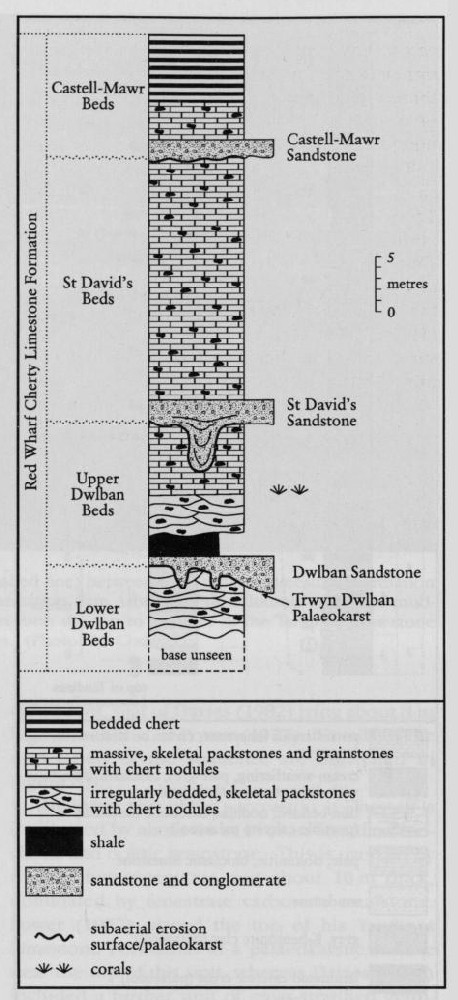
Just over 50 m of strata belonging to four depositional cycles are exposed at the site; three cycle boundaries occur, each marked by a sandstone, and the lower two associated with the sandstone-filled pits (Figure 8.9). The carbonates in the succession are mostly bioclastic packstones and grainstones with significant nodular chert. The cycle between the two horizons with the sandstone pipes contains numerous silicified colonies of the Brigantian coral Lonsdaleia duplicata. At the top of the succession, seen to the south of Castell-Mawr, bedded cherts occur.

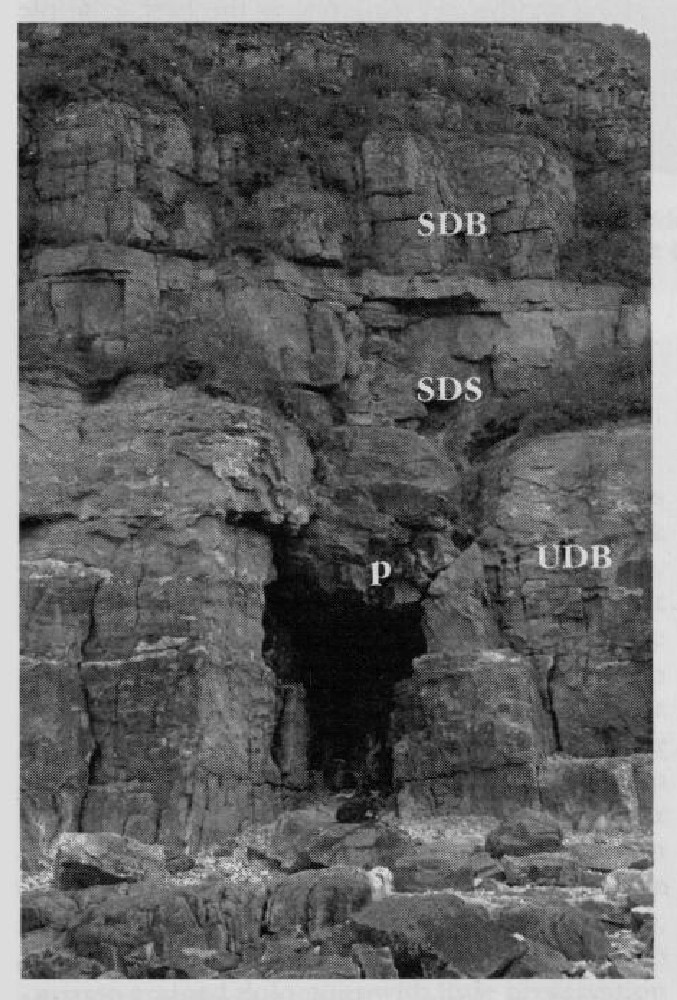
The largest sandstone-filled pits, up to 3 m across and 5 m deep, are recorded from the upper of the two sandstone pipe horizons and these are seen in the cliff midway between the point of Trwyn Dwlban and the northern end of Red Wharf Bay village (Figure 8.10).

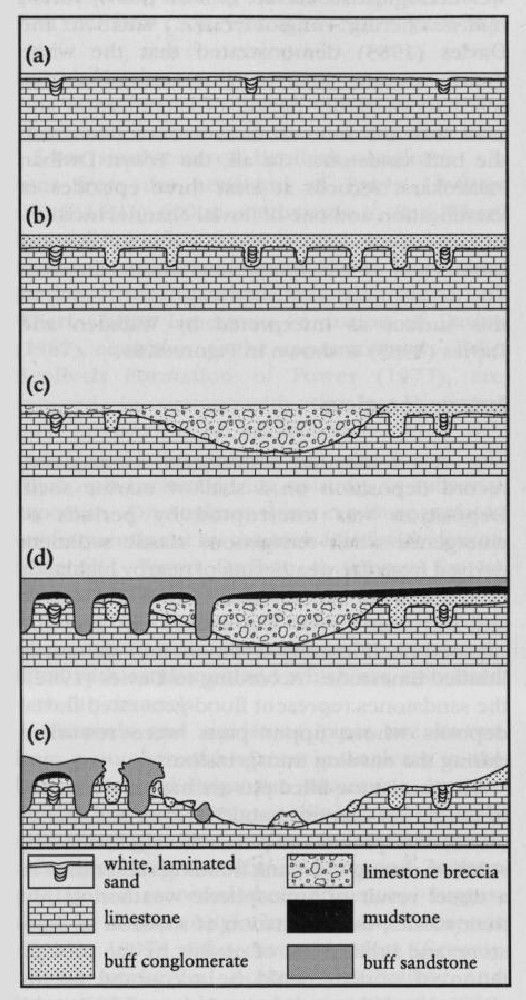
The lower horizon is exposed along the foreshore to the north and here the pits are up to 1.5 m wide and 3 m deep. The sandstone pipes at this level and their relationships with the surrounding rocks reveal a complex depositional and diagenetic history and it is these that formed the focus of the study of Walkden and Davies (1983). Most of the pits are filled with a structureless, buff-weathering sandstone, but a minority are filled with laminated white-weathering quartz arenite or with poorly sorted buff-weathering conglomerate. Walkden and Davies (1983) demonstrated that the white quartz arenite- and conglomerate-filled pits relate to an earlier period of karstification and infill than the more abundant ones filled with the buff sandstone. In all, the Trwyn Dwlban Palaeokarst records at least three episodes of karstification and one of fluvial channel incision. In each case the erosive episode was followed by lithification of the terrigenous clastic material. The depositional and early diagenetic history of this surface as interpreted by Walkden and Davies (1983) is shown in (Figure 8.11).

Interpretation

The late Dinantian limestones of Anglesey record deposition on a shallow marine shelf. Deposition was interrupted by periods of emergence when terrigenous clastic sediment derived from the weathering of nearby highlands (composed of Precambrian, Lower Palaeozoic and Devonian rocks) was carried out over the exposed shelf, cutting channels into the partly lithified limestone. According to Davies (1982), the sandstones represent flood-generated fluvial deposits whose upper parts were reworked during the ensuing transgression.

The sandstone-filled pits are marginal features of the fluvial channels, and Walkden and Davies (1983) interpreted the pits as having formed by solution during overbank flooding rather than as a direct result of atmospheric weathering. In their model, the alternation of solution of limestone and lithification of pit-fills by the precipitation of cement could be accounted for by channel switching without the need to invoke climatic change, although the possibility of alternating wet and dry periods is not discounted.

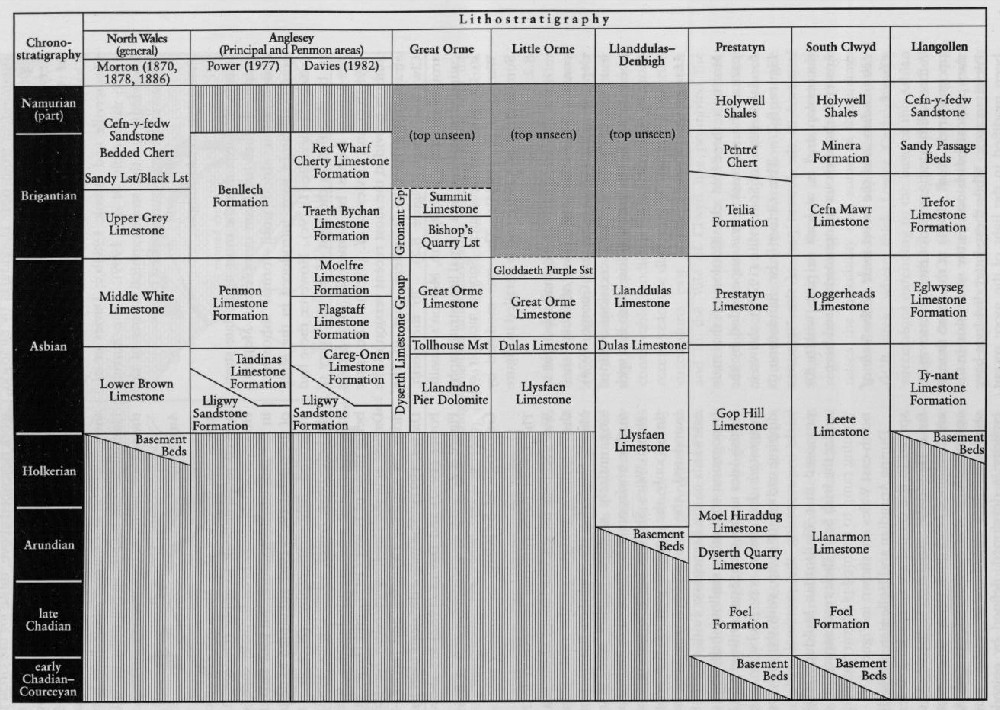
The late Dinantian succession on Anglesey is unique in its interbedding of fluvial terrigenous clastics and marine limestones. Other exposed mixed carbonate–clastic successions of this age, such as the Yoredale cycles of northern England, are clastic-dominated, leading to significant components of marine clastics. During transgressions, clastic deposition on Anglesey appears to have been restricted to the shoreline. The closest parallel to the late Dinantian succession in Anglesey perhaps lies in successions of the same age in west Cumbria, although these are nowhere as well displayed as the succession at Trwyn Dwlban. In addition to its importance in demonstrating the style of mixed clastic–carbonate cyclicity, this site exposes bedded cherts characteristic of the uppermost Dinantian sequence in North Wales (Figure 8.2). However, its major importance lies in the record of alternating solution and lithification processes associated with subaerial exposure revealed by the sandstone-filled pits.

Conclusions

This site provides a unique record of the development of solution pits and sandstone pipes formed by subaerial weathering and fluvial processes during late Dinantian times. The occurrence of these features in a mixed limestone–sandstone sequence is the best example of its kind in Britain.
References

(Figure 8.2) Simplified stratigraphical chart for the Lower Carboniferous succession of North Wales. In the central areas of the Great Orme, the Little Orme and Llanddulas to Denbigh, Warren et al. (1984) placed Brigantian strata in the Gronant Group and Asbian strata in the Dyserth Limestone Group. Compilation based on information from Power (1977), Somerville (1979a), Davies (1982), Somerville and Strank (1984c), Warren et al. (1984), Somerville et al. (1986) and Davies et al. (1989). Areas of vertical ruling indicate non-sequences. Not to scale.

(Figure 8.9) Sedimentary log of the Red Wharf Cherty Limestone Formation (late Brigantian) in the vicinity of Red Wharf Bay village and Trwyn Dwlban. After Walkden and Davies (1983).

(Figure 8.10) Sandstone pipe infilling a palaeokarstic pit in late Brigantian beds of the Red Wharf Cherty Limestone Formation at Trwyn Dwlban. Note the pipe extension (p) from the base of the St David's Sandstone (SDS) into the underlying Upper Dwlban Beds (UDB) and the irregular nature of the subaerial erosion surface (palaeokarst) which separates the two units. (SDB — St David's Beds.) The rucksack, for scale, is approximately 50 cm in length. (Photo: P.J. Cossey.)

(Figure 8.11) Development of the Trwyn Dwlban Palaeokarst. (a) Uplift of carbonate sediments and lithification, followed by karstification and the deposition of white laminated sand. Further lithification produces resistant sandstone plugs. (b) Arrival of buff conglomerate and renewed solution forms conglomerate-filled pits. Some earlier formed plugs are liberated and some 'moating' takes place around others. Lithification of the conglomerate. (c) Channel formation and fdl with limestone breccia. Renewed lithification. (d) Deposition of mud followed by buff sandstone. Renewed solution forms buff sand-filled pits lined with shale and some pits penetrate the breccia. Compaction and lithification of the shale. (e) Quaternary erosion of the surface. After Walkden and Davies (1983).