Chapter 1 British Lower Jurassic stratigraphy: an introduction
Introduction
M.J. Simms
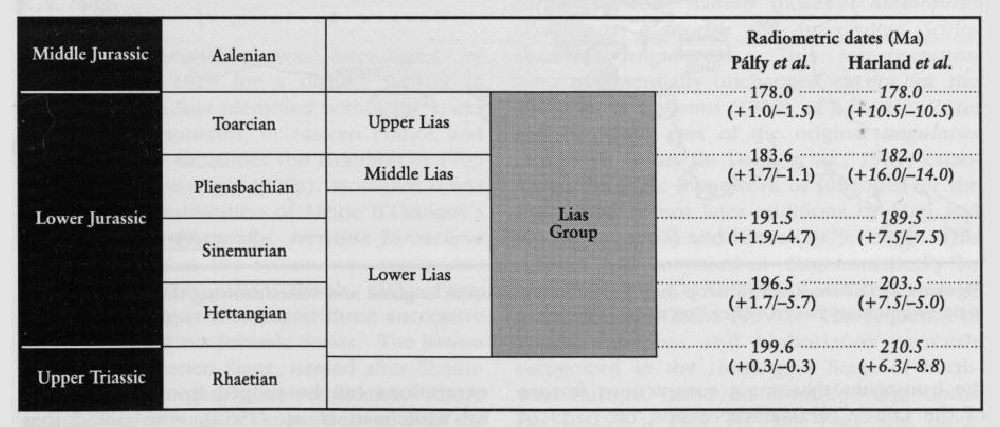
The Lower Jurassic Series encompasses about 22 million years (Ma) of the geological record, from about 200 Ma to 178 Ma, a little more than a third of the total duration of the 58 Ma of the Jurassic Period as based on the most recent radiometric dates (Pálfy et al., 2000a–c). The chronostratigraphically defined Lower Jurassic Series, incorporating the Hettangian to Toarcian stages
Lower Jurassic strata in southern England figured in some of the earliest stratigraphical investigations anywhere in the world (Smith, 1797, MSS; Douglas and Cox, 1949) and many early 19th century collectors acquired some of the more spectacular fossils for which the Lower Jurassic Series was already noted as a result of the labours of Mary Aiming and others (Lang, 1939). Although the coastal exposures of Dorset and Yorkshire clearly were important sources of fossil material and stratigraphical information, inland exposures also were a major source of information in these formative years of the sciences of geology and palaeontology. Until the mid-19th century numerous small quarries were opened along the Lower Jurassic outcrop to provide sources of building stone, bricks, cement and iron, and the materials were commonly used only locally in areas not well served by roads or rail. Even the coastal exposures were extensively modified by quarrying, for stone, lime, cement, alum and jet. Some quarries survived into the early 20th century in areas where transport links were poor, but most were abandoned as others, producing better-quality materials, assumed dominance of the market. Only a small number, such as that producing Ham Hill Stone, still thrive today providing material for a specialist market. Of the countless brickpits and cement works, very few large sites now still operate, such as Blockley Station Quarry.
The Industrial Revolution witnessed the establishment of many new quarries to exploit the ironstones that are a conspicuous feature of the Lower Jurassic succession on parts of the Yorkshire coast, in the east Midlands and in the Hebrides. The scale of some of these excavations can be judged from figures cited by Whitehead et al. (1952), who noted that more than 500 million tons of Liassic ironstone had been worked up to 1945. The Yorkshire succession for a while also supported a flourishing industry extracting alum from some of the Toarcian mudstones, while the growth in popularity of jet jewellery in the 19th century resulted in many small-scale excavations along this stretch of coast. The construction of the railways between the mid-19th and early 20th centuries also gave rise to many temporary exposures that added to our knowledge of the Lower Jurassic Series and its contained fauna (e.g. Gavey, 1853; Richardson, 1918). Economic changes in the latter part of the 19th century and early part of the 20th century saw the decline of the various quarrying industries. Generally the smaller pits became overgrown or flooded and the larger quarries often were used as landfill sites. By the mid-1970s many had all but vanished. Many important sites were never properly documented and received only cursory mention, if at all, in publications. Notable among these is the publication by Woodward (1893), which provides the only record of many sites for which nothing more was ever published. Indeed, many museum collections contain material from sites for which virtually nothing is known, although an inventory of a great many Lower Jurassic sites and their stratigraphical position, as deduced from museum material, was compiled some years ago by C.P. Palmer (pers. comm.).
The establishment of the Jurassic System and the stages of the Lower Jurassic Series
K.N. Page
The term 'Jurassique' was introduced by Brongniart in 1829 for a distinct period of geological time first identified within the rocks of the Jura Mountains, in eastern France and Switzerland, by Alexander von Humbolt in 1795 (Torrens in Cope et al., 1980a). However, it was not until the publication of Alcide d'Orbigny's Palaeontologie Française, terrains Jurassique (1842–1849), that the system was subdivided into stages (Arkell, 1933; Rioult, 1974; Page, 2003). D'Orbigny recognized three successive stages in the Lower Jurassic Series. The lowest was the Sinemurien Stage, named after Semur-en-Auxois in Burgundy, eastern France. Above was the Liasien Stage, it's name derived from the old geological term 'Lias', and the third and youngest, the Toarcien Stage, was named after Thouars in western France. D'Orbigny's divisions were intended to be applied worldwide, this being based on the assumption that stage boundaries marked global mass extinction events followed by rapid re-establishment of new and distinctive faunas (Arkell, 1933, p. 9).
Albert Oppel (1856–1858) established the equivalence of a Lower Jurassic, or Unterer Jura, Subsystem to the earlier established, and essentially lithostratigraphical, division known as 'Lias' and erected his own sequence of stages, called 'zonengruppen' or 'étagen'. These were based, in part, on d'Orbigny's subdivisions but instead were termed Semur-Gruppe' (equivalent to d'Orbigny's Sinèmurian Stage), 'Pliensbach-Gruppe' (equivalent to the Liasien Stage, and named after Pliensbach in Württemberg, Germany) and "Thouars-Gruppe' (equivalent to the Toarcien Stage). The only significant change subsequently was the creation of the Hettangien Stage by Renevier (1864), incorporating the first two zones of Oppel's original scheme for the Semur-Gruppe (Page, 2003). Numerous other stage names have, at various times, been proposed for parts of the Lower Jurassic Series in Europe. A few are still used occasionally for divisions at substage level, but most are now redundant (Arkell, 1933).
Hettangian Stage
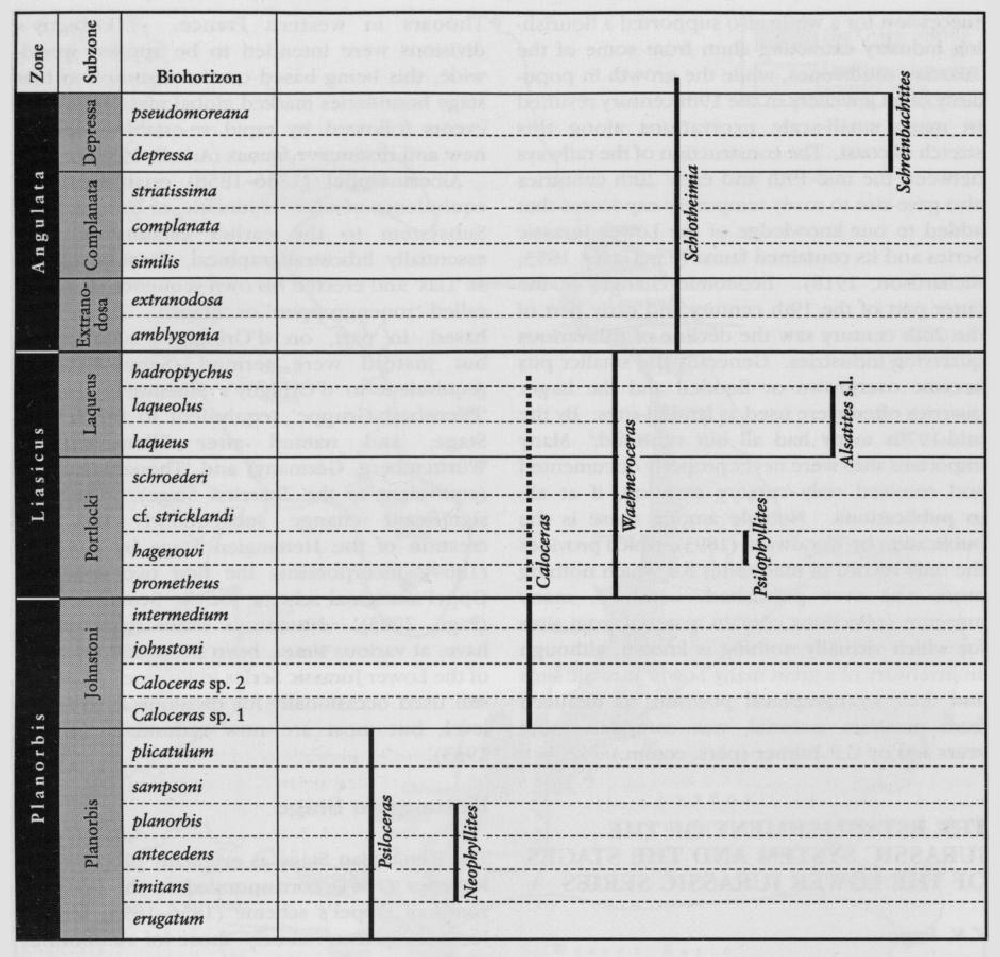
The Hettangian Stage as originally proposed by Renevier (1864) corresponded to the first two zones of Oppel's scheme (1856–1858) for the Jurassic System, namely those of Ammonites (Psiloceras) planorbis and Ammonites (Schlotheimia)angulatus. This interpretation remains essentially unchanged except for the addition, by Collenot (1869), of a Liasicus Zone for the lower part of the original angulatus Zone. Donovan (in Dean et al., 1961) established the basic framework of subzones for the stage, with minor later additions by Elmi and Mouterde (1965) and Bloos (1979, 1983). This scheme was summarized diagrammatically by Mouterde and Coma (1991) and reviewed by Mouterde and Coma (1997). The sequence of zones, subzones and biohorizons currently recognized in the Hettangian Stage of northwest Europe, based on Mouterde and Coma (1991, 1997), Page (1994a), Page and Bloos (1998) and Bloos and Page (2000a), is summarized in
The base of the Hettangian Stage and the Jurassic System
Oppel (1856–1858) first established a zone of Ammonites (Psiloceras) planorbis to mark the base of the Jurassic System and this usage was finally stabilized at the first Jurassic colloquium in Luxembourg in 1962 (Mauberge, 1964). In north-west Europe, this chronozone marks the first occurrence of ammonites following the re-establishment of fully marine conditions towards the end of the Triassic Period.
The type locality of the index fossil for the Planorbis Zone, Psiloceras planorbis (J. de C. Sowerby, 1812–1846), and its lowest subzone, is on the coast of west Somerset near Watchet in south-west England, part of the Blue Anchor–Lilstock Coast GCR site. Subsequently, and almost inevitably, a type section for the subzone, and hence the Planorbis Zone, Hettangian Stage and the Jurassic System, was proposed in this district (Donovan et al. in Morton, 1971). There has been considerable discussion as to where exactly the boundary should be drawn in the coastal sections in this area, especially as to whether the base of the
By comparison with the remarkably complete and expanded Planorbis Subzone seen in the Wilkesley Borehole in Cheshire, north-west England (Page and Bloos, 1998; Bloos and Page, 2000a), the lowest ammonite fauna on the west Somerset coast, in Bed 8, was determined as Psiloceras erugatum (Phillips), a species well known from loose blocks at the Normanby Stye Batts–Miller's Nab (Robin Hood's Bay) GCR site in Yorkshire, but never confirmed previously in a surface exposure. Remarkably, the occurrence of this species below P. planorbis had already been noted by Donovan (in Poole and Whiteman, 1966) in the Wilkesley Borehole, but subsequently had been overlooked in later works. Re-examination of higher levels in this borehole revealed additional faunas, dominated by Neophyllites, below P. planorbis. A similar sequence is also present in west Somerset with Neophyllites in the lower part of Bed 9, below the first P. planorbis in the upper part of the same bed, and especially from Bed 13 to the basal part only of Bed 24 (Page and Bloos, 1998; Bloos and Page, 2000a).
More complete sequences of ammonite faunas are known from uppermost Triassic (Rhaetian Stage) to lowermost Jurassic successions elsewhere in the world, and two have been proposed as candidates for GSSPs; in Nevada, USA (Guex, 1980, 1982; Guex et al., 1997) and in northern Peru (von Hillebrandt, 1994, 1997). It remains to be seen whether a 'New World' definition for the base of the Jurassic System could be accepted in the face of historical reasons for defining it in Europe. However, it is clear that the current state of knowledge is inadequate to correlate these sections accurately with any in Europe (Bloos and Page, 2000a; Page, in press).
Sinemurian Stage
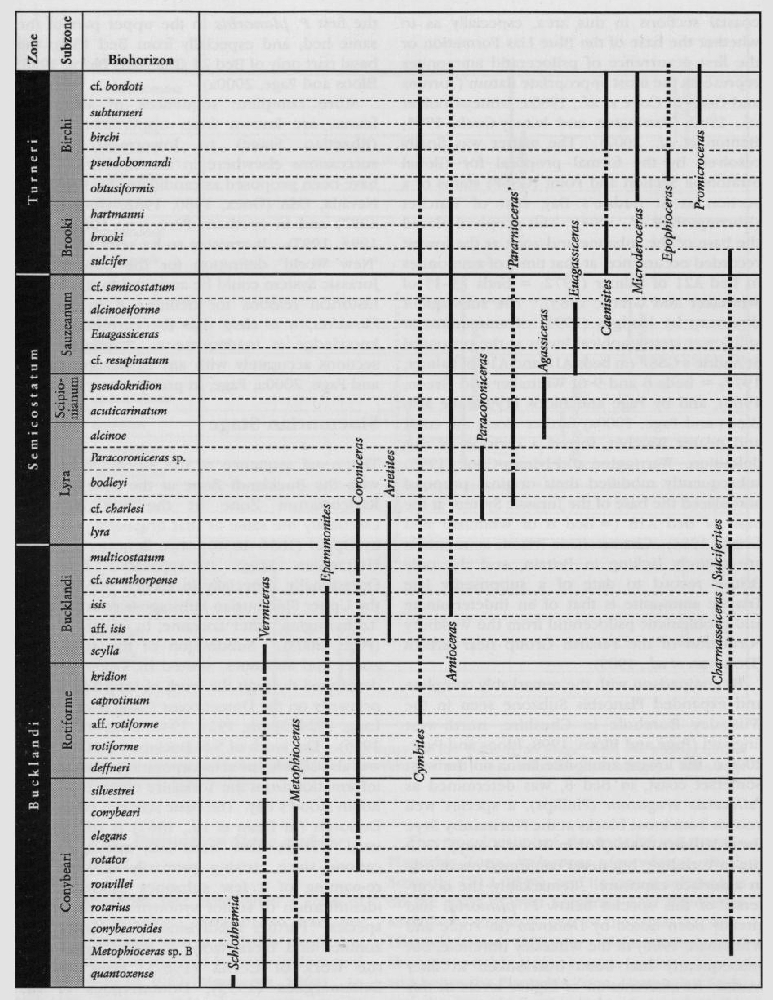
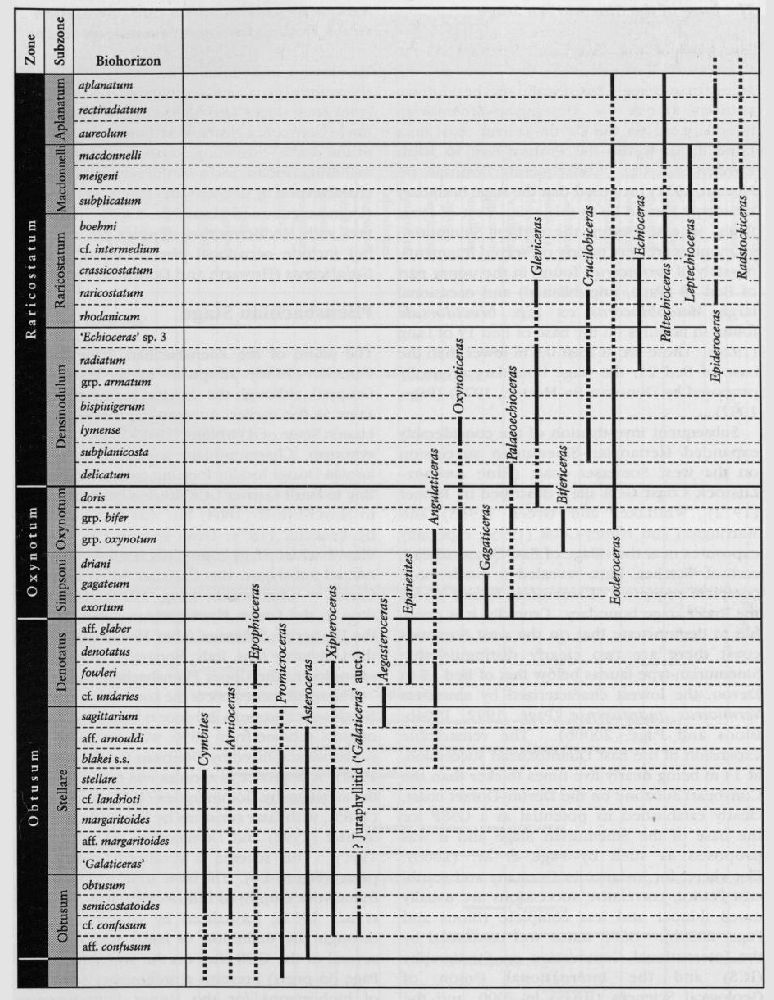
The zonal sequence of the Sinemurian Stage, with the Bucklandi Zone at the base and the Raricostatum Zone at the top, remains essentially the same as that originally proposed by Oppel (1856–1858), once Renevier's (1864) Hettangian Stage is separated from it. Occasionally, especially in French publications, the Upper Sinemurian Substage is referred to as 'Lotharingian', after Lorraine, in eastern France (Page, 2003). Subdivision of the stage into zones and subzones, started by Oppel (1856), developed through the work of Lang and Spath, primarily on the Dorset coast (Lang et al., 1923; Lang, 1924; Spath, 1924, 1942; Lang and Spath, 1926). The work of S.S. Buckman (1909–1930) was also significant in incorporating considerable information from the Yorkshire coast, especially Robin Hood's Bay. The basic scheme, refined by Donovan (in Dean et al., 1961) is 'still widely used. There have been only minor modifications since, arising primarily through the re-naming of a few subzones following the identification of senior synonyms of the index species. Further subdivision of the stage into zonules and biohorizons is based largely on the work of Coma (1987), Page (1992), Dommergues (1993), Dommergues et al. (1994), Page (1995), Coma et al. (1997), Bloos and Page (2000b) and Page et al. (2000) as reviewed by Page (2002) and summarized in
The base of the Sinemurian Stage
The base of the Conybeari Subzone of the Bucklandi Zone defines the base of the Sinemurian Stage. Historically the best-known sections across the Hettangian–Sinemurian boundary are on the Devon–Dorset coast near Lyme Regis, within the Pinhay Bay to Fault Corner GCR site. Consequently Donovan (in Morton, 1971) proposed that the stage boundary stratotype should be in this area. West of Lyme Regis, in east Devon, the earliest Sinemurian ammonites are very poorly preserved fragments, possibly of Vermiceras, found in the upper part of Bed 18 (Page, unpublished) and occasional large Metophioceras ex grp. brevidorsale found in nodules on the base of Bed 19 of Lang (1924). These are at least 0.6 m lower than the base of Bed 21, the stage boundary originally proposed by Donovan (in Morton, 1971) (Page, 1992).
Subsequent investigation of the considerably expanded Hettangian–Sinemurian succession on the west Somerset coast (Blue Anchor–Lilstock Coast GCR site), described by Palmer (1972), Whittaker and Green (1983) and Warrington and Ivimey-Cook (1995), especially exposures near the village of East Quantoxhead, east of Watchet, have revealed a much more complete sequence of ammonite faunas across the lower stage boundary. Crucially, it is possible to demonstrate that on the west Somerset coast there are two clearly distinguishable Sinemurian-type faunas below that of Bed 19 in Devon, the lowest characterized by abundant Vermiceras quantoxense (Page, 1992, 1994b; Bloos and Page, 2000b). The remarkable expansion of the East Quantoxhead succession, at 14 m being nearly five times thicker than the Conybeari Subzone on the Devon–Dorset coast, clearly established its potential as a GSSP for the base of the Sinemurian Stage and it was proposed as such by Page et al. (2000). Elsewhere, for instance in Germany and southeast France, correlative successions are usually much thinner and less complete (Bloos and Page, 2000b). GSSP status was confirmed by the International Commission on Stratigraphy (ICS) and the International Union of Geological Sciences (LUGS) in 2000, and the site represents the first formalized Jurassic stage stratotype in Britain, as reviewed by Page (2002).
Ammonite provincialism and correlation in the Hettangian and Sinemurian stages
Hettangian and Sinemurian ammonite faunas show little provincialism compared with those from later stages although a distinction can be made between a North-west European Province in the north, extending across much of Europe including Britain, and a Mediterranean Province, characterized by deeper-water forms, in the south (Dommergues and Mouterde, 1987). In Britain taxa with Mediterranean affinities are very rare but include occasional phylloceratids such as Galaticeras (Howarth and Donovan, 1964).
Pliensbachian Stage
The name of the Pliensbachian Stage follows Oppel's (1856) adoption of a 'Pliensbach-Gruppe', although the division is essentially the same as the earlier, non-geographically named, Liasien Stage of d'Orbigny (1842–1849). Another synonym, 'Charmouthian', named after the well-known Dorset locality forming part of the Pinhay Bay to Fault Corner GCR site, has been attributed to Mayer-Eymar (1864) but was first published by Renevier (1874; Dean et al., 1961). The Pliensbachian Stage commonly is subdivided into named substages; the Carixian Substage (after Carixa = Charmouth; Lang, 1914) corresponding to the Lower Pliensbachian Substage, and the Domerian Substage (after Monte Domaro in the Lombardy Alps, Italy; Bonarelli, 1894) corresponding to the Upper Pliensbachian Substage.
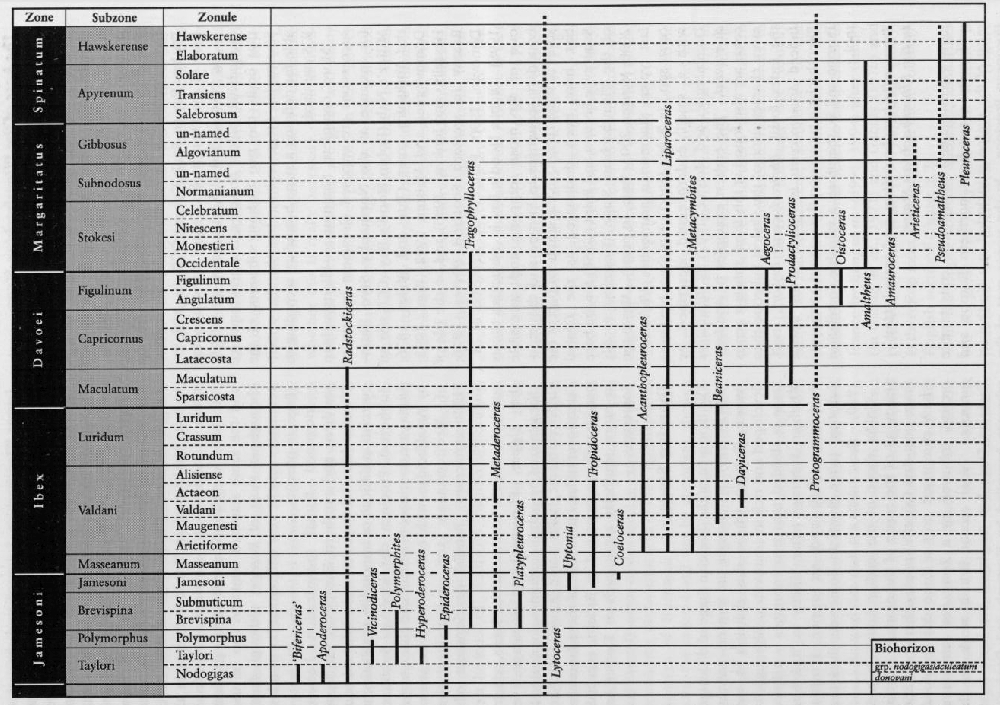
The zonal framework of the Lower Pliensbachian North-west European Province is based on Oppel's original scheme from 1856, with a sequence of subzones stabilized by Donovan (in Dean et al., 1961). A sequence of zonules was established for the substage by Dommergues (1979) and Phelps (1985), with later revisions by Dommergues and Meister (1992) and Dommergues et al. (1991, 1997). This scheme is reviewed by Page (in press)
The base of the Pliensbachian Stage
Following Oppel (1856), the base of the Pliensbachian Stage is still taken as the base of the Jamesoni Zone, the lowest recognized subdivision of which is the Taylori Subzone. According to Donovan (in Morton, 1971) the Taylori Subzone was first recognized on the Dorset coast, near Charmouth, within the Pinhay Bay to Fault Corner GCR site, with the base of the Pliensbachian Stage corresponding to the base of Bed 105 of Lang et al. (1928). Immediately below, however, is a non-sequence that omits the two highest subzones of the Sinemurian Stage and renders the site unsuitable for defining a stage boundary according to ICS standards.
More complete Sinemurian–Pliensbachian successions are exposed elsewhere in Britain, for instance at the Normanby Stye Batts–Miller's Nab (Robin Hood's Bay) GCR site on the Yorkshire coast (Tate and Blake, 1876; Dommergues and Meister, 1992; Page, 1992; Hesselbo and Jenkyns, 1995) and on the Isle of Raasay in western Scotland (Oates, 1976; Donovan, 1990; Page, 1992; Hesselbo et al., 1998). Robin Hood's Bay in particular shows one of the most complete and accessible boundary sequences in Europe and the exposures at Wine Haven, in the southern part of the bay, have been designated as the Global Stratotype Section and Point (GSSP) for the base of the Pliensbachian Stage (Hesselbo et al., 2000; Meister, 2003; Page, in press). Above the last typical Sinemurian ammonites (Paltechioceras spp.) in Robin Hood's Bay there is a fauna with a small eoderoceratid described by Dommergues and Meister (1992) as Bifericeras donovani. The earliest examples of Apoderoceras are also found at this level; this is a genus more characteristic of the Taylori Subzone than the index fossil, Phricodoceras taylori, itself. Indeed Apoderoceras is typical of the lowest Pliensbachian succession throughout north-west Europe and is, therefore, a valuable correlation tool.
Ammonite provincialism and correlation in the Pliensbachian Stage
Early Pliensbachian faunas show considerable uniformity throughout northern Europe and most of the region is included in a North-west European Province. In the upper part of the Lower Pliensbachian Substage and throughout the Upper Pliensbachian Substage, however, the establishment of direct connections with Boreal regions resulted in a faunal spectrum developing across Europe from assemblages dominated by Boreal taxa in the northern areas (characterizing a Subboreal Province) through faunas dominated by Mediterranean faunas in central and western areas (Submediterranean Province) to true Mediterranean Province faunas in the south. Nonetheless, good inter-provincial faunal links allow correlation between these provinces and the same standard zonation can be used throughout most of Europe, although faunal sequences may be very different at horizon level (Page, in press).
Increased faunal polarization between southern and northern Europe in the Upper Pliensbachian Substage can make infra-subzonal correlation difficult or impossible as a distinctive Subboreal Province developed. Subboreal faunas are dominant in Britain and characterized by Amaltheidae with only rare representatives of Mediterranean and Submediterranean Hildocerataceae. Parallel development of a Submediterranean Province, in central and southern France and adjacent areas, during the Upper Pliensbachian Substage was characterized by ammonite faunas dominated by Hildocerataceae, with some Amaltheidae and Dactylioceratidae. Elements of these faunas are occasionally encountered in Britain, especially in more southerly areas such as Dorset and Somerset.
Toarcian Stage
The type area of the Toarcian Stage of d'Orbigny (1842–1849) is Thouars in central western France (Poitou) where this division is well developed and rich in ammonites. Although the stage is divided into two substages — a lower Whitbian Substage (after Whitby in Yorkshire; Buckman, 1910) and an upper Yeovilian Substage (after Yeovil in Somerset; Buckman, 1910) — these terms are now rarely used.
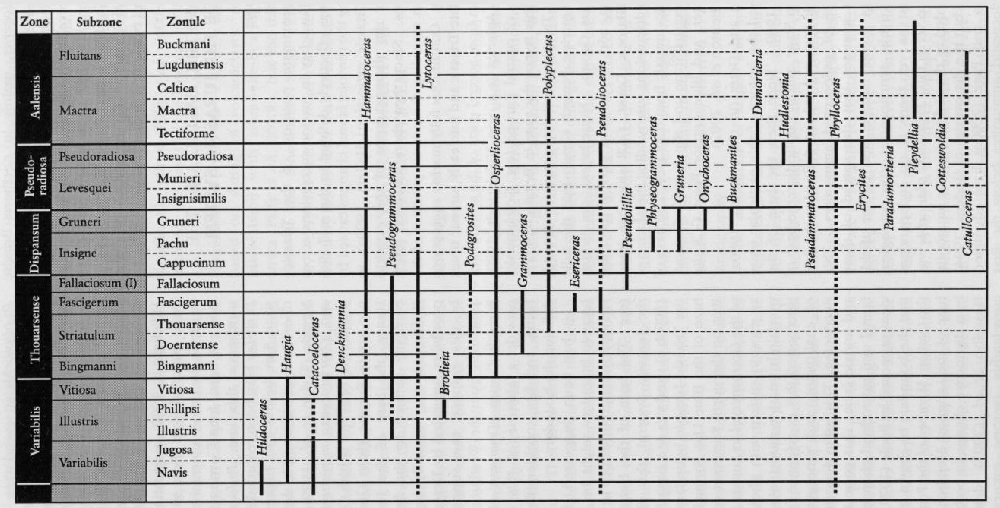
Unlike those of the earlier Lower Jurassic stages, all of the zones of the modern Toarcian Stage post-date Oppel's simple scheme of 1856, which comprised only a Zone des Posidonia bronni, followed by a Zone des Ammonites jurensis. Most recent British work on the Toarcian Stage has employed the basic zonal schemes compiled by Howarth and Dean (in Dean et al., 1961) (e.g. Cope et al., 1980a). However this scheme has been considerably refined through work elsewhere in Europe, especially in France (e.g. by Gabilly et al., 1971; Gabilly, 1976; Elmi et al., 1991, 1994; Elmi, 1997). The results provide a new standard that should now be applied to British successions, as proposed by Page (2003), and which has been adopted in this volume
The base of the Toarcian Stage
The base of the Toarcian Stage corresponds, in north-west Europe, to the change-over from typical Pliensbachian ammonite faunas with Pleuroceras to typical Toarcian faunas with abundant Dactylioceras, and is drawn at the base of the Tenuicostatum Zone. This zone, as proposed by Buckman (1910), has its type locality on the Yorkshire coast and this has led to various proposals or assumptions that the basal boundary stratotype of the stage should be defined in this area (e.g. Howarth in Morton, 1971; Cox, 1990; Howarth, 1992). The lower part of the Tenuicostatum Zone corresponds to a Paltus Subzone, the base of which was defined by Howarth (1992) as the base of Bed 26 at Kettleness, or the base of Bed 58 at Staithes. Both are in Yorkshire (Howarth, 1955, 1973) but only the latter (Staithes to Port Mulgrave) is a GCR site at present. In Yorkshire the subzonal index fossil, Protogrammoceras paltum, is rare and Dactylioceras at this level is extremely rare. In contrast, in the type area of the originalpaltus Hemera of Buckman (1922) on the Dorset coast the index fossil can be abundant, though confined to thin pockets within the highly condensed and stratigraphically incomplete
Farther south in Europe similar Protogrammoceras (or 'Paltatpites') can occur at both higher and lower levels (Howarth, 1992, p. 7) and the first Toarcian Dactylioceras are often abundant and characteristic (Elmi et al., 1997). Although correlation between southern European sections, for instance in Spain and Portugal, and the northern European Tenuicostatum Zone is not yet well-established, it seems clear that sections in Britain are unlikely to be suitable candidates for GSSPs as their relatively impoverished faunas have limited correlation potential.
Ammonite provincialism and correlation in the Toarcian Stage
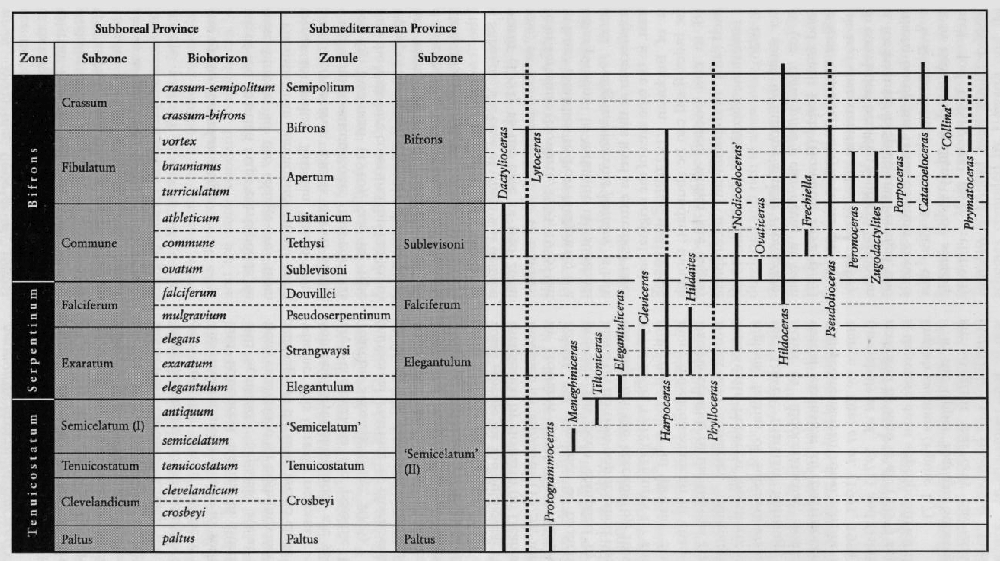
Early Toarcian faunas show distribution patterns similar to those of late Pliensbachian times, reflecting the persistence of Boreal connections throughout the substage, and a Submediterranean to Subboreal transition is recognizable across north-west Europe. Unlike the Pliensbachian Stage, however, the boundary between the two provinces lay across southern Britain, with Submediterranean faunas in southern England and Subboreal faunas in northern England and Scotland. Separate zonal schemes have been established for both provinces
Farther south in Britain, faunas become more Submediterranean in character and later Dactylioceratids of the Bifrons Zone are rare in Dorset and Somerset. Although very strong links exist between northern and southern regions, faunas of Submediterranean areas in the Lower Toarcian Substage are usually richer in Hildocerataceae, sometimes to the virtual exclusion of Dactylioceratidae. The Submediterranean zonal scheme established in France by Elmi et al. (1991, 1994) after Gabilly (in Gabilly et al., 1971) and Gabilly (1976) and reviewed by Elmi et al. (1997) and Page (2003) is therefore most appropriate for these southern English sections
In the Upper Toarcian Substage, similarities are so great that only one zonal scheme is justifiable in north-west Europe
Radiometric dating and the base of the Jurassic System
M.J. Simms
The approximate position of the Triassic–Jurassic boundary in marine successions across Europe was effectively defined in the mid-19th century by the obvious faunal changes caused by the end-Triassic extinction (Hallam, 1990a), in particular the disappearance of the ceratitid ammonites. Since then there has been much discussion regarding the precise position of the boundary. Continuous fully marine successions through late Triassic and into early Jurassic times are known from several parts of the world, such as South America (e.g. von Hillebrandt, 1990) and parts of central Europe (e.g. Golebiowski, 1990). This is not the case in Britain where a terrestrial Triassic succession passes up through the quasi-marine
Torrens and Getty (in Cope et al., 1980a) summarized the history of this particular issue prior to 1980. Since then the base of the Hettangian Stage, and by implication the base of the Jurassic System, has been defined at the first appearance of psiloceratid ammonites. This definition assumes that the spread of these ammonites across Europe, and farther afield, was effectively synchronous (in geological terms) but as yet there is no independent evidence to verify this. Psiloceras planorbis was long regarded as the earliest Jurassic ammonite in Britain, but the discoveries of Hodges (1994) and Bloos and Page (2000a) have identified other psiloceratid ammonites below the first P. planorbis at several sites. These discoveries may be construed as merely refining the precise position of the Triassic–Jurassic boundary, but other factors raise more serious questions. In general ammonites are rare or absent in the critical interval, between the last Choristoceras and the first Psiloceras, at most sites investigated throughout the world (e.g. Hallam, 1990b; von Hillebrandt, 1990), suggesting that ammonites were excluded from these sites either by some extrinsic factor or, alternatively, that they have not yet been found owing to their very low numbers at this time. Psiloceras tilmanni and P. spelae have been recorded in low numbers up to c. 5 m below the highest occurrence of Choristoceras minutum in the Muller Canyon of Nevada (Taylor et al., 1999), while Psiloceras and Choristoceras minutum are also found together in Peru and British Columbia, although not yet in Europe (Jean Guex, pers. comm.). Hence, the base of the Jurassic System, as currently defined by the first appearance of Psiloceras, may actually be diachronous, a possibility suggested by Hesselbo et al. (2002). In this respect, the supposed psiloceratid ammonite from the
It has been suggested that the Triassic–Jurassic boundary might be defined on lithostratigraphical grounds tied in to biostratigraphy (see 'The base of the Hettangian Stage and the Jurassic System', this chapter). Hallam (1990b,c) used this as a basis for suggesting that the Triassic–Jurassic boundary be placed at the base of the
Intriguingly, the isotope excursion of Hesselbo et al. (2002) lies just above an uniquely extensive seismite horizon, typically 1–2 m thick (Mayall, 1983; Simms, 2003a) that can be traced across the entire
Radiometric dates for the base of the Jurassic System have been derived from sites outside of Britain. Harland et al. (1990) settled for a date of 210.5 Ma but accepted that the resolution of this was poor and it could range from 201.7 Ma to 216.7 Ma. The base of the Hettangian Stage has recently been dated both in terrestrial and marine sequences (Pálfy et al., 2000a). The former is derived from sills 'thought to be feeders to basalt flows immediately above the Triassic–Jurassic boundary' in eastern North America but this, coupled with difficulties inherent in correlation between terrestrial and marine sequences, Introduces considerable uncertainty to the accuracy of this date. However, another radiometric date for the base of the Hettangian Stage, obtained from a tuff layer within a marine succession biostratigraphically dated using radiolaria (Pálfy et al., 2000a), has given a date of 199.6 ± 0.3 Ma, which is close to the date for the non-marine sequence of approximately 201 Ma (Pálfy et al., 2000a). The dating of the stage boundaries for the Lower Jurassic Series
Chronostratigraphy in the Jurassic System
K.N. Page
The establishment of a standardized geological timescale using rock units as standards for reference is known as chronostratigraphy (Hedberg, 1976; Callomon, 1985b; Whittaker et al., 1991; Salvador, 1994). Chronostratigraphical divisions are defined only at their base in a suitable stratotype section, the top of the unit being drawn at the actual or correlated base of the next equivalent ranked division of the scale. Chronostratigraphical divisions form a hierarchy with systems, series and stages being three divisions of decreasing rank, although the term 'series' is not commonly referred to in Jurassic stratigraphy.
The definitions of stages and systems are regulated by the International Commission on Stratigraphy (ICS) through subcommissions focused on single systems; in the case of the Jurassic System this is the International Subcommission on Jurassic Stratigraphy (ISJS). Their aims are to formally recognize an internationally agreed Global Stratotype Section and Point (GSSP) for the base of every system and for every stage of every system (Salvador, 1994; Remane et al., 1996). For the Lower Jurassic Series only the Sinemurian Stage has an agreed GSSP, as discussed further below (and in Page, 2001).
Below the level of stage, subdivisions at the level of chronozone and ultimately zonule can be used, although there is no formal regulation of these through the ISJS or the ICS. In the Jurassic System the frequent occurrence of ammonites and their wide geographical distribution has led to their use for correlating sequences of standard zones. As discussed at great length elsewhere (e.g. by Callomon, 1965, 1985b; Callomon and Donovan, 1974; Cox, 1990; Page, 1995), these 'standard zones' are chronozones and should therefore be treated as such — a point overlooked by some authors (e.g. in Whittaker et al., 1991) who confuse Jurassic ammonite zones with biozones, where the use of fossils in correlation is not implicitly linked to a geological timescale. The use of the term 'zone' in a chronostratigraphical sense was first established for the Jurassic System by Albert Oppel (1856–1858) who developed a sequence of such divisions for the entire system. This convention continues today within the working groups of the ISJS.
Like stages, chronozones require definition at their bases in stratigraphical reference sections, or stratotypes, to establish full chronostratigraphical meaning. Although most Lower Jurassic standard ammonite zones are now defined in this way (e.g. in Cox, 1990; Howarth, 1992; Page, 1992; Page and Bloos, 1998), confusion does still exist, even in recent published literature and reviews. In addition, although the names of the chronozone units are derived from species names they are by convention quoted non-italicized (e.g. Jameson (Standard) Zone or Chronozone and not Uptonia jamesoni Zone).
Other fossil groups, especially microfossils, have been used to construct true biozonal schemes for the Jurassic System, but the resolution of these schemes is always inferior to the ammonite scale. Indeed, the latter is often used as a 'standard' against which other biozonal schemes are correlated. For this reason only the ammonite-based standard zonations for Europe will be considered further here. Zonal schemes for the Lower Jurassic Series based on microfossils and non-ammonite macrofossils are discussed in a later section.
High resolution stratigraphy — biohorizons and zonules
Jurassic standard zones (chronozones) are often divided into subzones, largely for historical reasons but also to maintain a degree of nomenclatural stability at zonal level
Biohorizonal and zonule schemes applicable to the Lower Jurassic Series in Britain are introduced below. They represent the ultimate in biostratigraphically resolvable chronology for the Jurassic System as the average zonule or biohorizon-plus-interval duration is potentially less than 200 000 years in the Lower Jurassic Series of north-west Europe (Page, 1995, 2003).
Outcrop, subcrop and structural framework of the Lower Jurassic Series in Britain
M.J. Simms
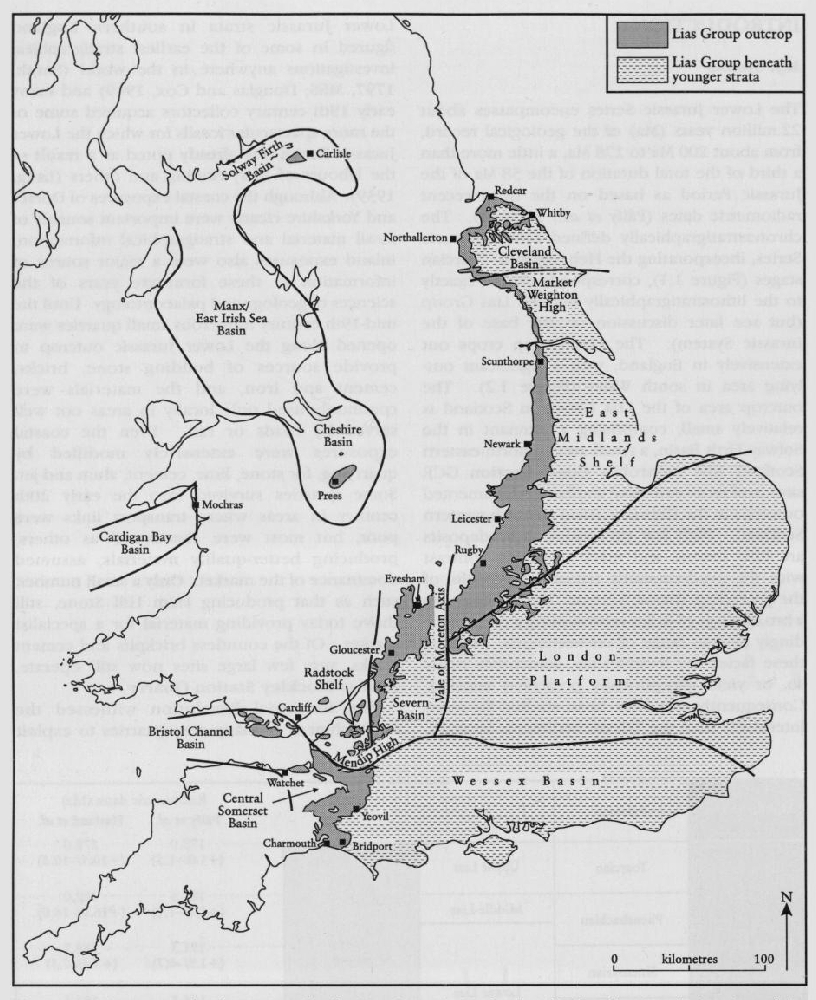
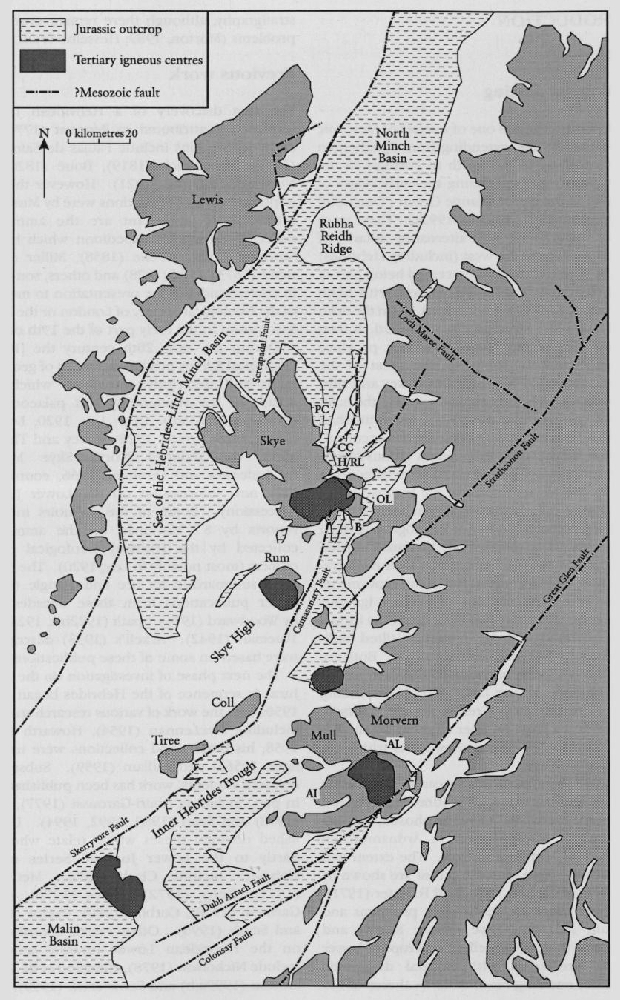
The main outcrop of the Lower Jurassic Series in Britain forms an almost unbroken strip of varying width extending from the east Devon and west Dorset coast, NNE through Somerset, Gloucestershire, the east Midlands and Humberside, to the coast of Cleveland and North Yorkshire. Significant outliers occur on either side of the Bristol Channel, in the Hebrides and adjacent west coast of Scotland, and in north-east Scotland (
To the east of its main outcrop the Lias has an extensive subcrop in England
To the north and west of the main outcrop there is evidence that much of the former cover of Lower Jurassic sediment has been lost through erosion. The Carlisle and Prees outliers are examples of erosional remnants of outcrops that formerly were much more extensive. Estimating the original depositional limits of the Lias is difficult. The presence of marginal facies, such as those exposed on the south Wales coast at the Pant y Slade to Witches Point GCR site, and adjacent to the Mendip Hills in the Hobbs Quarry and Viaduct Quarry GCR sites, provides evidence for the vicinity of shorelines at those specific times. However, such marginal facies are relatively rare and pass laterally and vertically up into offshore facies that provide little information on the limits of deposition. Furthermore, the picture has been complicated by post-Jurassic faulting so that the present-day juxtaposition of Palaeozoic and Lower Jurassic outcrops cannot be taken as evidence for the location of shorelines during early Jurassic times. For example, in the Quantock Hills of Somerset, Devonian sandstones crop out within 1 km of coastal exposures of Lower Jurassic mudstones that contain no evidence of proximity to marginal deposits. Similarly, the presence of more than 1300 m of Lower Jurassic and 600 m of Tertiary sediments in the Mochras Borehole, adjacent to outcrops of Cambrian strata, testifies to the scale of post-Jurassic faulting at the margins of some basins.
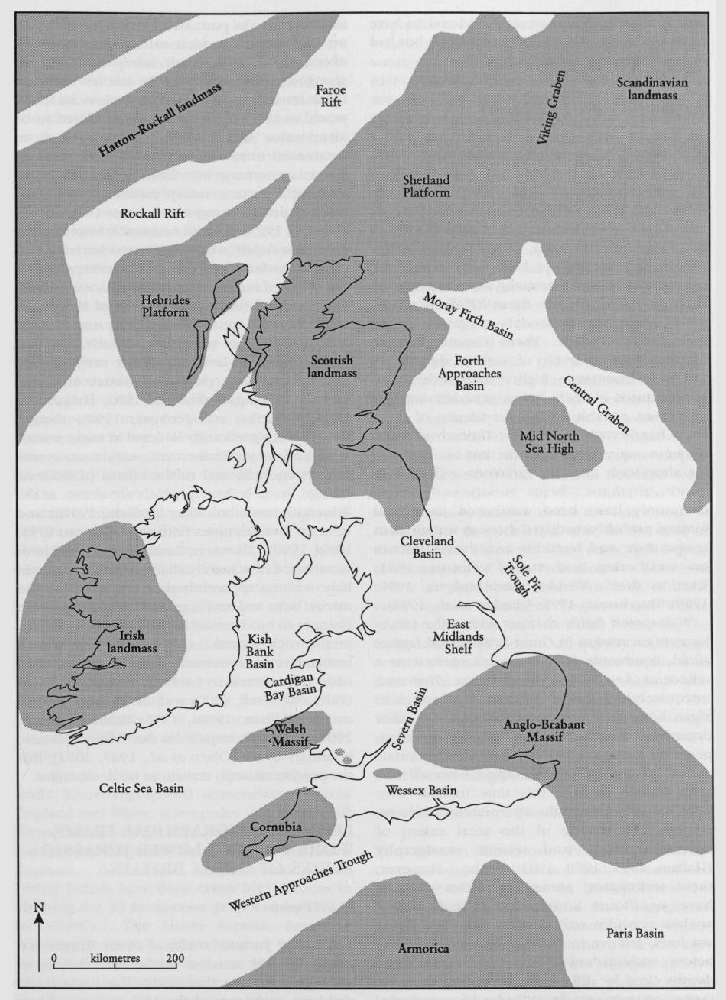
Extensional stresses associated with the breakup of Pangaea in early Mesozoic times saw the development of several major sedimentary basins across Britain, each of which accumulated hundreds of metres of Lower Jurassic sediment as part of a total Mesozoic fill sometimes several kilometres thick. To a large extent the configuration of these various Mesozoic basins was determined by preexisting faults, a concept already alluded to by Godwin-Austen (1856). These fractures originated during the Variscan, Caledonian or even earlier orogenies, and hence show orientations characteristic of these events. In several instances Mesozoic periods of subsidence represent only one episode in a sometimes complex history of basin subsidence and inversion (Chadwick, 1993). The fact that deposition was far from uniform across Britain during early Jurassic times was noted from the earliest days of geology; examples such as the highly condensed sequence in the Radstock district were often compared with the much thicker sequence in Dorset (e.g. Moore, 1867a). Subsequently, more subtle variations in thickness of the Lower Jurassic succession were noted across particular areas, for instance in the Market Weighton area of eastern England (Kendall, 1905) and in the north and mid-Cotswolds (Buckman, 1901). Attention seems often to have been focused on these persistent areas of reduced or interrupted sedimentation, which became known as 'axes of uplift' and were perceived as subdividing the troughs into distinct basins of deposition. Arkell (1933, pp. 59–87) provides a useful summary of the various 'axes' as they were recognized more than half a century ago, grouping them according to the major underlying structural trends that they seem to follow. Subsequently Hallam (1958) formulated the concept of 'swells', as rather broader positive features than the almost two-dimensional 'axes' proposed by Arkell (1933), separating basins in which sedimentation was comparatively rapid. The concept was refined for the Pliensbachian to Bajocian interval by Sellwood and Jenkyns (1975), who highlighted the fact that 'basinal' facies often occurred within sediment sequences developed over these 'swells'. Their conclusions invoked considerable discussion (Hudson, 1976; Kent, 1976) but, simultaneously, Whittaker (1975) had proposed a fault-bounded rift-valley model for the Mesozoic basins in southern Britain. Whittaker's model predicted overlap of earlier by later Mesozoic strata, implying that faults in the lower, Triassic, parts of the succession would pass up into asymmetric folds in the higher, Jurassic, parts of the sediment pile. It was this concealment of the bounding faults of many basins that appears to have led to the notion of the rather ill-defined 'swells' of Hallam (1958) and Sellwood and Jenkyns (1975) and, in earlier times, the 'axes of uplift' of Buckman (1901) and others that were thought, ultimately, to have been determined by folding in the underlying basement. Subsequent research has largely verified Whittaker's predictions, with bounding faults identified at the margins of all of the major Mesozoic basins and other faults commonly subdividing these basins into smaller sub-basins by the development of graben or half-graben structures (e.g. Chadwick, 1985, 1986). Since then the development and widespread use of various geophysical techniques (e.g. Chadwick, 1985, 1986), coupled with refined interpretation of field observations (e.g. Jenkyns and Senior, 1991), has vastly increased our knowledge of the structure of these basins and their development through early Jurassic times.
On this basis several distinct early Jurassic depositional areas can be recognized in Britain, of which nine are covered by the selected GCR sites
Palaeogeography
M.J. Simms
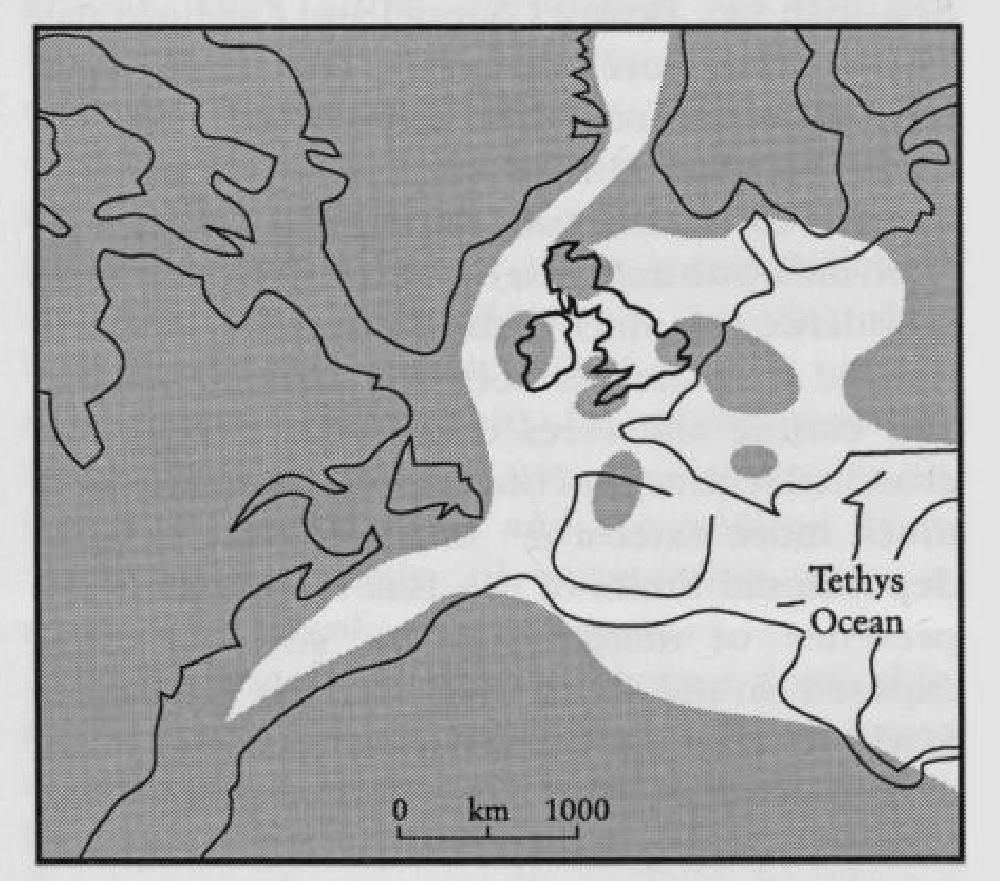
Britain lay between 30° and 40° north of the equator during early Jurassic times and occupied a key position in an epeiric seaway extending south-east into Tethys and north-east towards the Arctic
In the most recently published detailed reconstruction of the palaeogeography during early Jurassic times Bradshaw et al. (1992) considered that much of Scotland, the London Platform and the extreme south-west of England were land areas
Climate and sea level
M.J. Simms
Two environmental factors, climate and sea level, and their influence on Lower Jurassic facies, have been the subject of several reviews by Hallam (1981, 1984, 1985, 1992a, 1994). Britain is considered to have lain towards the southern edge of a seasonally wet climatic zone through early Jurassic times (Hallam, 1985, 1994) while climate models suggest a strong monsoonal influence. There is some evidence for atmospheric levels of carbon dioxide as much as four times higher than today, with temperatures globally being generally warmer and more equable with no evidence of Polar ice (Chandler et al., 1992). There have been frequent suggestions over the last two decades for short-term climatic variations reflected in minor, rhythmic, facies variations. These commonly have been attributed to orbital forcing, probably mediated through variations in temperature and humidity and their influence on weathering and runoff (House, 1985; Weedon, 1986; Weedon and Jenkyns, 1990, 1999; Waterhouse, 1999; Weedon et al., 1999).
Widespread facies changes within the Lower Jurassic succession in Great Britain, and farther afield, commonly have been interpreted as a reflection of eustatic sea-level change. However, unequivocal indicators of water depth, such as algae, hermatypic scleractinian corals and other organisms associated with the photic zone, generally are scarce in the British Lower Jurassic Series. Consequently, interpretations of sea-level change through this time interval have been based largely on the interpretation of facies changes, knowledge of the areal extent of successive units, and seismic stratigraphy (Hallam, 1975, 1978, 1981, 1992a). However, these techniques, particularly facies analysis, have significant limitations. Firstly, facies analysis provides only a qualitative measure of sea level, relative to the facies units above and below, without any quantitative component; depths cited by different authors for the same facies unit may vary by an order of magnitude. Secondly, and perhaps more significantly, the interpretation of particular facies is based largely on depositional models rather than empirical observation. As a result interpretations have changed significantly over the last few decades. For instance, marine black (organic-rich) shales would at one time have been considered to be 'deep-water' facies while erosion surfaces or condensed units were interpreted as 'shallow-water or emergent' facies (Arkell, 1933). However, current interpretations view many black shales as transgressive facies (Wignall and Maynard, 1993), without necessarily implying any particular depth, while condensed horizons and erosion surfaces are commonly interpreted as the result of sediment starvation associated with high sea level (compare the views of Haq et al., 1987; Hesselbo and Palmer, 1992; and Hallam, 1999). In the past two decades several independent sea-level curves for early Jurassic times have been published based on these various techniques (Hallam, 1981; Haq et al., 1987; Hesselbo and Jenkyns, 1998), though these differ significantly in detail at many points.
Several major Phanerozoic extinction events have been attributed to the effects of sea-level change, notable among which are events at the Triassic–Jurassic boundary (Hallam, 1990a) and in early Toarcian times (Little and Benton, 1995; Little, 1996). However, Smith et al. (2001) have questioned how merely changing sea level could have such an apparently profound effect on the marine biota and have suggested that the apparent changes in biodiversity in fact largely reflect bias in the rock record. Other factors have been invoked for these extinction events, such as large-scale volcanic activity for both the early Toarcian (Pálfy and Smith, 2000) and the Triassic Jurassic events (Hallam, 1990a, 1996; Hesselbo et al., 2002), or bolide impact for the Triassic–Jurassic boundary event (Olsen et al., 1987, 2002), but the precise cause(s) remain to be determined.
Lithostratigraphical framework for the Lower Jurassic Series of Great Britain
M.J. Simms
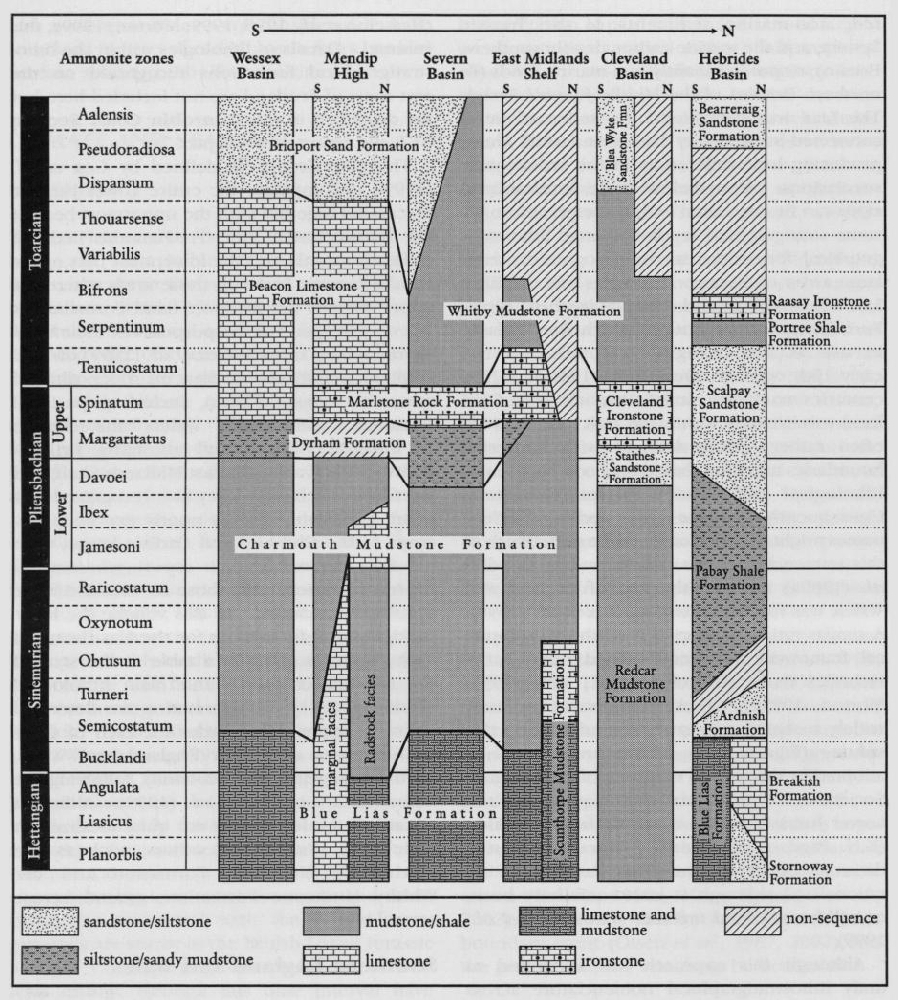
The Lower Jurassic rocks of Great Britain are predominantly marine mudstones that have been grouped together under the name 'Lias' since the early part of the 19th century. They form a distinctive succession between the mostly red, non-marine sediments of the Triassic System, and the marine carbonates (in southern Britain), or predominantly non-marine sands (in northern Britain) of the Middle Jurassic Series. The Lias was deposited in a series of interconnected sedimentary basins and shelf areas, producing local differences in the sedimentary successions. Nonetheless these local successions can be correlated with some precision. At some stratigraphical levels the same lithostratigraphical formation can be recognized across large areas of Britain. Examples are the
Although this approach has attempted to unify lithostratigraphical nomenclature across England and Wales, it concedes that substantial facies differences do exist between some areas, particularly between northern and southern England. Hence both temporal and geographical factors have been taken into account in defining the 12 formations proposed by Cox et al. (1999). The Lower Jurassic Series in Scotland was not considered in their report, but most of the GCR sites there are located within the Hebrides Basin where recent work on the succession there has sought to establish a consistent lithostratigraphical framework (Hesselbo et al., 1998, 1999; Morton; 1999a, this volume). Details of lithologies within the lithostratigraphical formations recognized on the east coast of Scotland are not included here but are described in the Dunrobin Coast Section GCR site report (see Chapter 7).
The
Southern England and Wales
Beacon Limestone Formation
The
Blue Lias Formation
The
bioclastic and skeletal limestones. The formation encompasses several ammonite zones, from the 'Pre-Planorbis Beds' into the Lower Sinemurian Substage. Member names have been proposed for various parts of the
Bridport Sand Formation
The
Charmouth Mudstone Formation
The
Dyrham Formation
The
Marlstone Rock Formation
The
Northern England
Blea Wyke Sandstone Formation
The
Cleveland Ironstone Formation
The
Redcar Mudstone Formation
The
Scunthorpe Mudstone Formation
The
Staithes Sandstone Formation
The
Whitby Mudstone Formation
The
Scotland (Hebrides Basin only)
Ardnish Formation
The
Bearreraig Sandstone Formation
The
Blue Lias Formation
The
Breakish Formation
The
Pabay Shale Formation
The
Portree Shale Formation
The
Raasay Ironstone Formation
The
Scalpay Sandstone Formation
The
Stornoway Formation
The
Biostratigraphy of invertebrate macrofossils and microfossils
M.J. Simms and P Hodges
The criteria for using particular fossil groups as biostratigraphical index fossils are well known. Such fossil species must have existed for a relatively short period of time, and hence be found through only a limited vertical thickness of rock; they must have a wide geographical distribution to allow correlation between widely separate sites; they must be relatively independent of facies, again to allow correlation between widely separated sites and different palaeoenvironments; they must be common and easy to collect; and they must be readily identifiable to species level. Within the British Lower Jurassic succession various macrofossil taxa, particularly ammonites, have been used for this purpose since the earliest days of geology (Smith, 1797, MSS). Other macrofossil groups have also been shown to have some stratigraphical use in the Lower Jurassic Series, especially where their stratigraphical distribution can be tied in to the ammonite biostratigraphy. Neaverson (1955) summarized the stratigraphical ranges of some of the more important non-ammonite taxa. Range charts or zone/ subzone specific lists for various taxonomic groups or stratigraphical intervals have also been published, and can provide a useful source of information, particularly for groups that have received no recent taxonomic treatment (Melville, 1956; Hallam, 1961, 1987a; Whittaker and Ivimey-Cook, 1972; Ivimey-Cook, 1978, 1982; Hauff and Hauff, 1981; Dommergues, 1997).
Over the last few decades the needs of the hydrocarbon-exploration industry have led to the development and refinement of a range of biostratigraphical schemes based on microfossils. Most commercial boreholes produce only rock chips rather than cores and hence macrofossils of any sort are seldom identifiable. Under such circumstances biostratigraphical correlation is achieved through the use of various microfossil groups, each with particular advantages and drawbacks. None of the microfossil biostratigraphical schemes has attained a resolution comparable to that provided by ammonites, and the criteria used to define microfossil zones and subzones commonly are less rigorous than those for ammonites. However, used together these microfossil zonal schemes can provide a reasonable level of stratigraphical precision.
Macrofossils
Ammonites
K.N. Page
Ammonite biostratigraphy and chronostratigraphy and the British Lower Jurassic Series
The importance of ammonites in the biostratigraphical subdivision of the British Lower Jurassic Series is unparalleled. They possess all of the essential attributes of ideal zonal index fossils; genera and species typically have a wide geographical distribution, are largely facies independent, are often common and easily identified, and evolved rapidly such that successive taxa represent geologically short periods of time. The stratigraphical range of most of the ammonite genera found in Britain is summarized in
British successions and localities have contributed significantly to the establishment of this role through the work both of British authors and visiting Europeans. For instance, the seminal works of d'Orbigny (1842–1849) and Oppel (1856–1858), which established the basic sequence of Jurassic stages and their mainly ammonite-correlated zones, were primarily syntheses of information from France, Germany and Britain. Indeed, five of d'Orbigny's étages and four of Oppel's Étagen, though none of them from the Lower Jurassic Series, were named after English locations (Arkell, 1933, pp. 8–17).
William Smith's work in England began the process of establishing the sequence of guide fossils for the Jurassic System for Britain, culminating in his Stratigraphical System of Organised Fossils of 1817. A remarkably early, and long-forgotten, study showing the value of a bed-by-bed approach to sampling and the correlation potential of ammonites, was that of Louis Hunton (Hunton, 1836; Arkell, 1933, pp. 14–15). His work on the Middle and Upper Lias of North Yorkshire and Cleveland was based on the Boulby Quarries GCR site and, remarkably, remains the most detailed published stratigraphical description of the latter locality. The significance of this work would not have been lost on one of Hunton's contemporaries, Martin Simpson, who was based at Whitby Museum from 1837 and began to describe extensive ammonite collections from the district, including notes on their stratigraphical occurrence (Simpson, 1843, 1868). These same Yorkshire sections, and their contained fossil faunas, had already been described by John Phillips (1829), a nephew of William Smith who applied Smith's undescribed stratigraphical methods. Throughout the 19th century these Yorkshire coast sections remained fundamental to the development of Lower Jurassic biostratigraphy in Britain (e.g. in Tate and Blake, 1876; Fox-Strangways, 1892) and certainly were more influential in this respect than correlative sections in Dorset.
It was work in Germany, however, by Quenstedt (1856–1858) and Oppel (1856–1858) that refined that theory and method of Jurassic biostratigraphy (Arkell, 1933, pp. 8–17). Remarkably, Oppel's basic Hettangian to Pliensbachian zonal sequence is broadly the same as that used today, although zonation of the Toarcian Stage has been significantly refined, a process contributed to by Thomas Wright (1860a, 1878–1886) in his review and subsequent monograph of British Lower Jurassic ammonites. The latter work was the first attempt to provide a systematic overview of ammonite taxonomy and faunal successions in Britain, although it must now be viewed in conjunction with Donovan's synoptic supplement of 1954.
The next major advance was based on detailed bed-by-bed, layer-by-layer documentation of British strata and marked a major conceptual leap in the use of ammonites as stratigraphical guide fossils, the full significance of which has only really been appreciated in the last 30 years or so. S.S. Bucicman's early work concentrated on determining the sequence of ammonite faunas in the mainly Aalenian–Bajocian
The meticulous bed-by-bed collecting of ammonites by Lang, largely identified by Spath, from the Lower Lias of the Dorset coast (Lang, 1914, 1917, 1924, 1932, 1936; Lang et al., 1923, 1928; Lang and Spath, 1926) complemented the largely theoretical chronology of Buckman (1898) by establishing high-resolution sequences of zones in the field, mainly in the Sinemurian and Pliensbachian stages. As with Buckman's hemera, however, these units were largely overlooked in later generalized syntheses of Lower Jurassic ammonite zones. Spath continued to contribute to the understanding of the British Lower Jurassic Series himself; through various important works (Spath, 1924, 1925a-h, 1926a-d, 1942, 1956).
In the 1950s and 1960s major advances were made in documenting Lower Jurassic ammonite sequences in other areas in Britain. Howarth investigated the Upper Pliensbachian Substage of Yorkshire, Dorset and north-west Scotland (Howarth, 1955, 1956, 1957, 1958) and the Lower Toarcian Substage of Yorkshire and Northamptonshire (Howarth, 1962a, 1973, 1978, 1992), while Donovan worked on the Hettanglan and basal Sinemurian stages of the Bristol–Bath area (Donovan, 1952a,b, 1956). It was their work in the 1950s that ultimately led to the publication of the then-definitive work on the standard zonal framework for the entire Lower Jurassic Series of north-west Europe (Dean et al., 1961). Ammonite faunas from the remainder of the Sinemurian Stage and the Lower Pliensbachian Substage have received rather less coverage although monographic treatments of some taxa have been published, such as the Juraphyllitidae (Howarth and Donovan, 1964) and the Echioceratidae (Getty, 1972, 1973) to name but two.
Subsequent refinement of the ammonite stratigraphy of the British Lower Jurassic Series has concentrated largely on establishing rigorously defined, high-resolution, correlation schemes using 'horizons', including 'faunal horizons' or biohorizons, as pioneered by Callomon in the Middle and Upper Jurassic series (e.g. Callomon, 1985a,b) or zonules (sensu Phelps, 1985), the 'horizons' of French authors (Page, 1995). These are incorporated into
Despite the numerous revisions, compilations and refinements of the last 150 years or so, the ammonite-based zonation for the north-west European Lower Jurassic Series is still heavily dependent on British reference sections. At least 9 of the 22 zones, and around 35 of the 61 subzones still use an index fossil based on a type specimen from a British or Northern Irish locality. Inevitably, therefore, these sections will continue to play a key role in Lower Jurassic stratigraphy on a global scale as stratotypes for each unit are proposed and internationally agreed.
Ammonoid provincialism in the Lower Jurassic Series of Europe
Like any group of organisms, ammonoids show distinctive geographical distribution patterns, reflecting ecological and physical controls on individuals and populations. These patterns are characterized as biogeographical provinces and the inevitable consequence of using ammonites for correlation purposes is that every province, almost by definition, will have a different scheme of standard zones. These differences inevitably make inter-provincial correlations at zonal, and especially subzonal and horizon, level difficult.
Representatives from up to three contemporaneous faunal provinces can be recognized at various levels in the Lower Jurassic Series of Britain (Page, 1996) and are summarized below:
1. North-west European Province: The province is typical of much of the shelf seas of Europe from Hettangian to Early Pliensbachian times and again in Late Toarcian times, when great faunal uniformity characterized most of the region. Faunal affinities are almost entirely from southern or Tethyan areas (i.e. from a Mediterranean Province) and direct connection to an Arctic or Boreal Sea is lacking (except perhaps in earlier Late Toarcian times). Zonal schemes of the North-west European Province are well developed reflecting the long history of research on the area.
2. Subboreal Province: The establishment of direct marine connections with the circumpolar Boreal Sea in Late Pliensbachian and Toarcian times enabled some mixing of Arctic Province faunas and the previously separated faunas of north-west Europe
3. Submediterranean Province: The province developed in parallel with the Subboreal Province in late Pliensbachian times in regions between the former and the southern European Mediterranean Province. Boreal taxa usually are infrequent and an independent zonation is used in the Lower Toarcian Substage, but with significant links to that of Subboreal areas. Typical Mediterranean Province faunas are never developed in Britain, although a few genera and species typical of the province (e.g. Phylloceratina and Lytoceratina) do turn up occasionally, mainly in the Pliensbachian and Toarcian stages, interestingly associated with both Submediterranean and Subboreal faunas.
Belemnites
M.J. Simms
Belemnites are the only nektonic group of invertebrate macrofossils, other than ammonites, that have been proposed as biostratigraphical index fossils for the Lower Jurassic Series. Records of belemnites from the Carboniferous Period are questionable, the first definite appearance being in upper Triassic or lower Jurassic strata of Europe. However, their potential as biostratigraphical index fossils in the Lower Jurassic sequence is limited by several factors. They are rare in the Hettangian Stage and do not become abundant until the mid-Sinemurian Stage. They may have been facies-dependent to some extent, with several species apparently affected by benthic anoxia in early Toarcian times (Simms, 1986; Doyle, 1990–1992); and the identification of individual species can be difficult, being based largely on subtle variations in guard morphology. However, belemnites have the advantage that they are abundant at some stratigraphical levels and their tough calcitic guards have a very high preservation potential, even in environments where the aragonitic shells of ammonites are destroyed or poorly preserved.
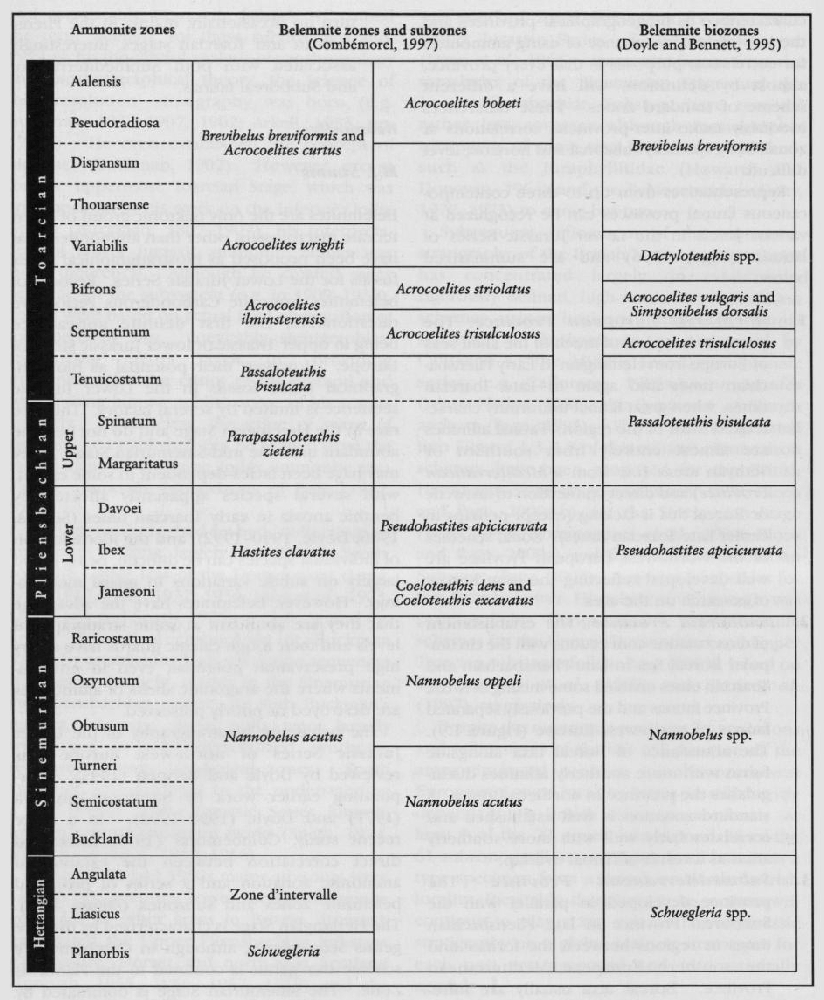
The belemnite biostratigraphy of the Lower Jurassic Series of north-west Europe was reviewed by Doyle and Bennett (1995), incorporating earlier work by Stoyanova-Vergilova (1977) and Doyle (1990–1992). In a more recent study, Combémorel (1997) attempted direct correlation between the established ammonite zonation and a series of proposed belemnite zones and subzones
Belemnite diversity is higher for the Toarcian Stage than for earlier stages, allowing for greater refinement of belemnite biozonation. By mid-Toarcian times the Belemnitinae were replaced by the more diverse Megateuthidlnae. Doyle (1990–1992) proposed five belemnite biozones for the Toarcian Stage, based on a combination of the ranges of the biozonal index fossils and of other species, and provided an indication of their correlation with the standard ammonite zones. Combémorel (1997) recognized four zones and three subzones but there is a reasonable correspondence between the two schemes. Combémorel (1997) cites characteristic species for each of his zones and subzones whereas Doyle (1990–1992) provides range charts for all species of belemnite found in the British Toarcian Stage.
Bivalves
P. Hodges and M.J. Simms
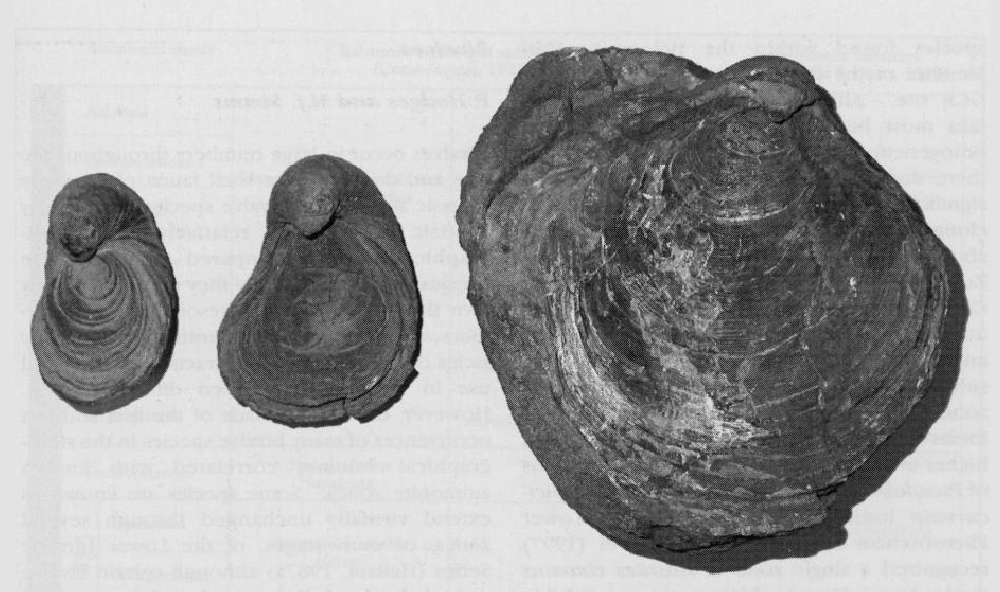
Bivalves occur in large numbers throughout the Lias and dominate the shelf fauna of the early Jurassic seas. Most bivalve species in the early Jurassic Period have relatively long stratigraphical ranges compared to ammonite species, and consequently they do not generally give the same degree of resolution. Furthermore, most bivalves are benthic and strongly facies dependent, which detracts from potential use in correlation between different facies. However, use can be made of the first and last occurrences of many bivalve species in the stratigraphical column, correlated with known ammonite zones. Some species are known to extend virtually unchanged through several zones, or even stages, of the Lower Jurassic Series (Hallam, 1987a) although certain bivalve groups do show distinct and well-documented evolutionary changes through early Jurassic times and hence do have a limited biostratigraphical significance. Of these the most notable is the ostreid genus Gryphaea, which Trueman (1922a) was the first to use in biostratigraphical correlation based on material from the Pant y Slade to Witches Point GCR site. Subsequent publications challenged his conclusion that Gryphaea evolved from Liostrea, proposing instead an origin from late Triassic gryphaeate oysters. Nonetheless Gryphaea does exhibit distinct morphological changes through early Jurassic times, with three distinct species recognized
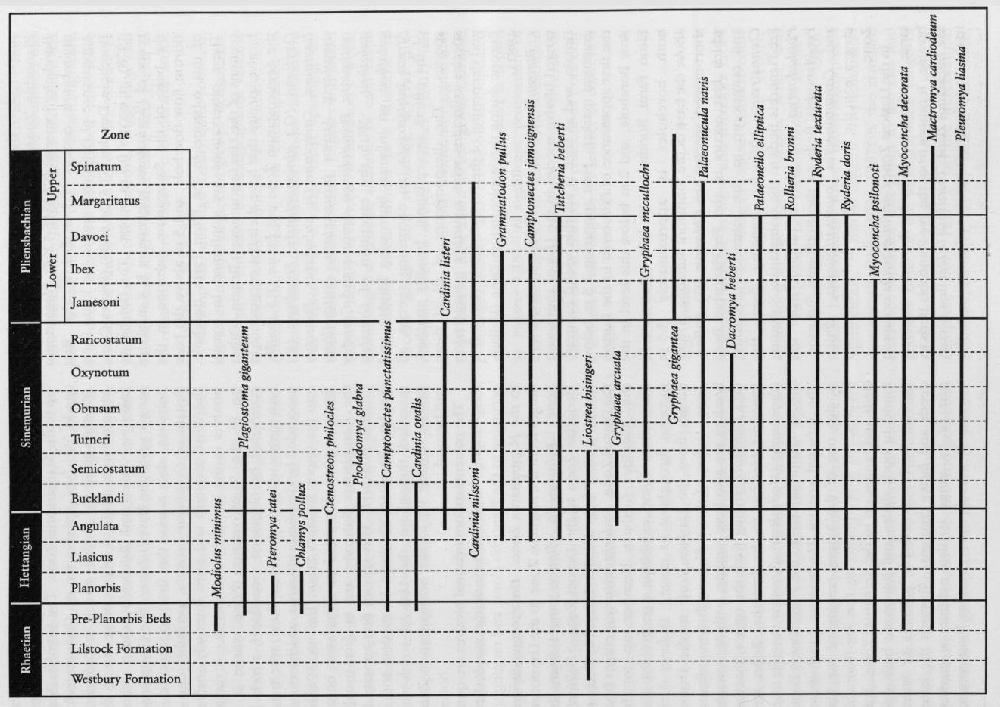
Detailed investigation by Peter Hodges of the bivalve faunas in several boreholes drilled by the British Geological Survey, and from coastal exposures in south-west Britain, indicate that some species are stratigraphically useful, particularly where ammonites are absent. His observations, summarized below, and in
In south-west Britain the Pre-Planorbis Beds of the Lower Lias are dominated by the mussel Modiolus (Modiolus) minimus, which locally may cover the upper surfaces of limestone beds. They suggest very shallow-water, possibly intertidal, conditions. The last occurrence of Modiolus (M.)minimus, coincides with the first appearance of Plagiostoma giganteum and indicates a marked increase in water depth. This relationship can be demonstrated at the Pant y Slade to Witches Point GCR site, in south Wales, where the
Throughout south-west Britain, the first occurrence of Plagiostoma giganteum precedes the first occurrence of the ammonite genus Psiloceras (Hodges, 1994). In the absence of ammonites, it can be used as a biostratigraphical marker for the approximate base of the Planorbis Zone. In the BGS Burton Row Borehole, Somerset
Pteromya tatei is one of the very few short-ranged bivalve species in the Lias of south-west Britain, and as such is another useful biostratigraphical marker. First appearing 2.5 m below the first appearance of Psiloceras in the Burton Row Borehole, and 2 m below this level in the Elton Farm Borehole. Its last occurrence in both boreholes is approximately 3.5 m above the base of the Johnstoni Subzone. Other short-ranged species are Chlamys (C.) pollux, which first occurs in the Pre-Planorbis Beds and ranges up to the Johnstoni Subzone; Ctenostreon philocles, ranging from the Pre-Planorbis Beds to the Complanata Subzone; Pholadomya (P.) glabra, ranging from the Pre-Planorbis Beds to the Rotiforme Subzone; and Camptonectes punctatissimus, which ranges from the Planorbis Zone to the Bucklandi Zone.
In the Liasicus Zone Cardinia ovalis occurs in large numbers and is by far the most common bivalve. It ranges from the Pre-Planorbis Beds to the Bucklandi Zone. Cardinia listeri first occurs in the Complanata Subzone and ranges up to the Raricostatum Zone while Cardinia nilssoni first occurs in the Sauzeanum Subzone and ranges up to the Margaritatus Zone. The Angulata Zone marks the first appearance of Grammatodon (Grammatodon) pullus and Camptonectes famoignensis, both of which range up to the Jamesoni Zone, and Tutcheriaheberti, which ranges up to the Davoei Zone. The Complanata Subzone also marks the first appearance in Britain of Gryphaea arcuata, probably one of the most common and most intensely studied bivalves in the Lower Jurassic Series. It ranges up to the Semicostatum Zone where it is succeeded by Gryphaea mccullochi, which in turn ranges up to the Jamesoni Zone, where it is succeeded by Gryphaea gigantea, which extends into the upper Toarcian Stage (Hallam, 1968b). Bivalves often identified as Gryphaea below the Complanata Subzone are in fact usually Liostrea hisingeri. This species first appears in the late Rhaetian
The palaeotaxodont infaunal bivalves are quite long-ranging, with Palaeonucula navis first occurring in the Planorbis Zone, and ranging up to the Margaritatus Zone. Dacryomya heberti ranges from the Angulata Zone to the Oxynotum Zone. Palaeoneilo elliptica ranges from the Planorbis Zone to the Davoei Zone. Rollieria bronni ranges from the Pre-Planorbis Beds to the Davoei Zone. Ryderia texturata ranges from the Rhaetian
The dominance of some species at certain horizons can also be used locally as stratigraphical markers. This can be demonstrated by the bivalve genus Posidonia, which can be picked out as a distinct marker bed, owing to its abundance, in both the Burton Row and Elton Farm boreholes. This Posidonia-dominated shale occurs approximately 5 m above the base of the Lyra Subzone in both boreholes.
In conclusion, it can be seen that infaunal bivalves are relatively tolerant of changes in water depth, and are quite long-ranging stratigraphically. However, the epifaunal bivalve species, particularly the byssally attached species, are more susceptible to changes in water depth. The first and last recorded occurrences of bivalve species that are water-depth dependant can, therefore, be useful as chronostratigraphical event markers over a wide area of western Europe during the early part of the Jurassic Period.
Gastropods and scaphopods
M. J. Simms
Gastropods are locally common in the Lower Jurassic Series but they have never been an intensively studied group and no substantial work has been published in several decades. Hudleston and Wilson (1892) published a census of Jurassic gastropods but more than 40 years ago this was described as suffering from outdated nomenclature and a lack of stratigraphical precision (Wilson et al., 1958). Melville (1956) published distribution tables for gastropod taxa recorded from the Sinemurian, Pliensbachian and Toarcian stages of the Stowell Park Borehole, also describing several new taxa from there, but recognized that their significance for correlation remained to be assessed. Hallam (1961) commented that species appeared to be long-ranging, citing as examples Pleurotomaria anglica and Cryptaenia expansa, which are found from at least the Lower Sinemurian to the Upper Pliensbachian substages. McDonald and Trueman (1921) specifically addressed the biostratigraphical potential of gastropods in the Lower Jurassic Series but discussed only selected taxa. They noted that, in general, gastropod evolution was slow during early Jurassic times and hence did not favour their use in biostratigraphy. However, they also commented that some species of the Procerithidae were found to characterize specific horizons, suggesting that further work might render these taxa useful in correlation. There remains considerable scope for research in this area.
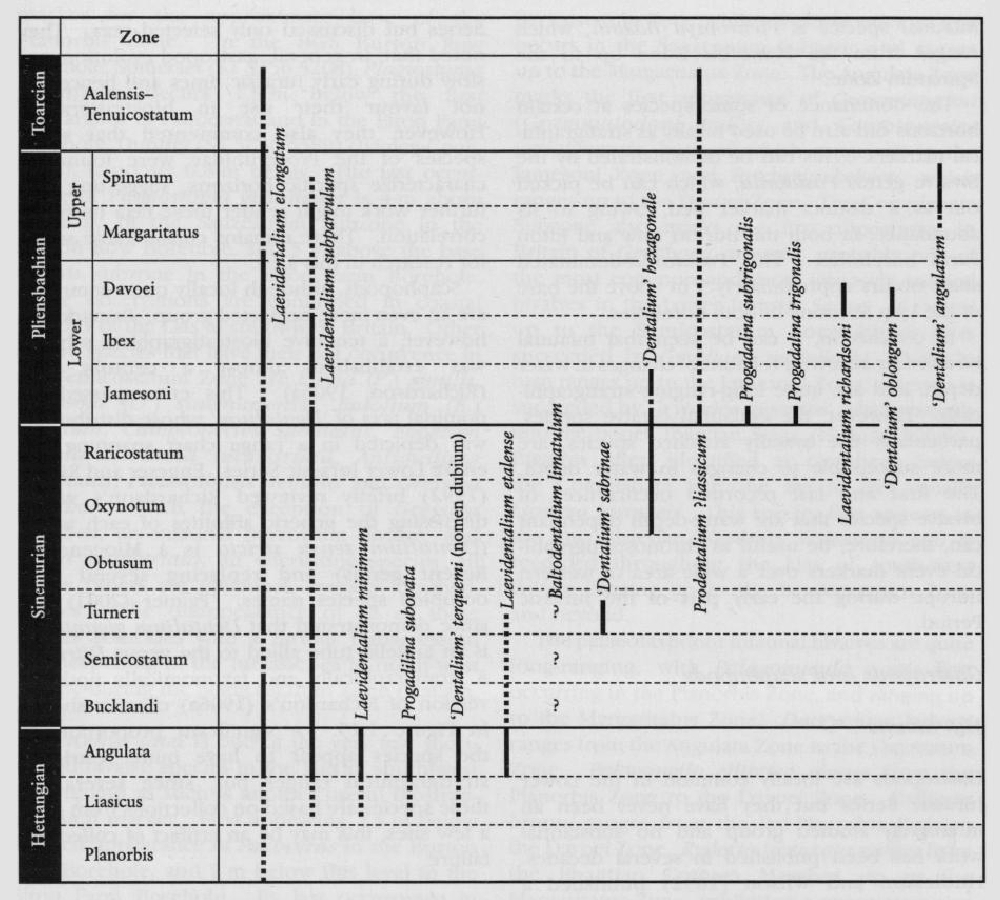
Scaphopods, although locally quite common, are an even more neglected group. Remarkably, however, a tentative biostratigraphical scheme was established almost a century ago (Richardson, 1906a). This encompassed 16 nominal taxa of 'Dentalium'whose distribution was depicted in a range chart spanning the entire Lower Jurassic Series. Engeser and Riedel (1992) briefly reviewed Richardson's work, discussing the generic affinities of each taxon (Dentalium sensu stricto is a Miocene to Recent genus) and replacing several preoccupied species names. Palmer (2001) has since demonstrated that Dentalium giganteum is an annelid tube allied to the genus Ditrupa. A stratigraphically and taxonomically updated version of Richardon's (1906a) chart is shown in
Brachiopods
M.J. Simms
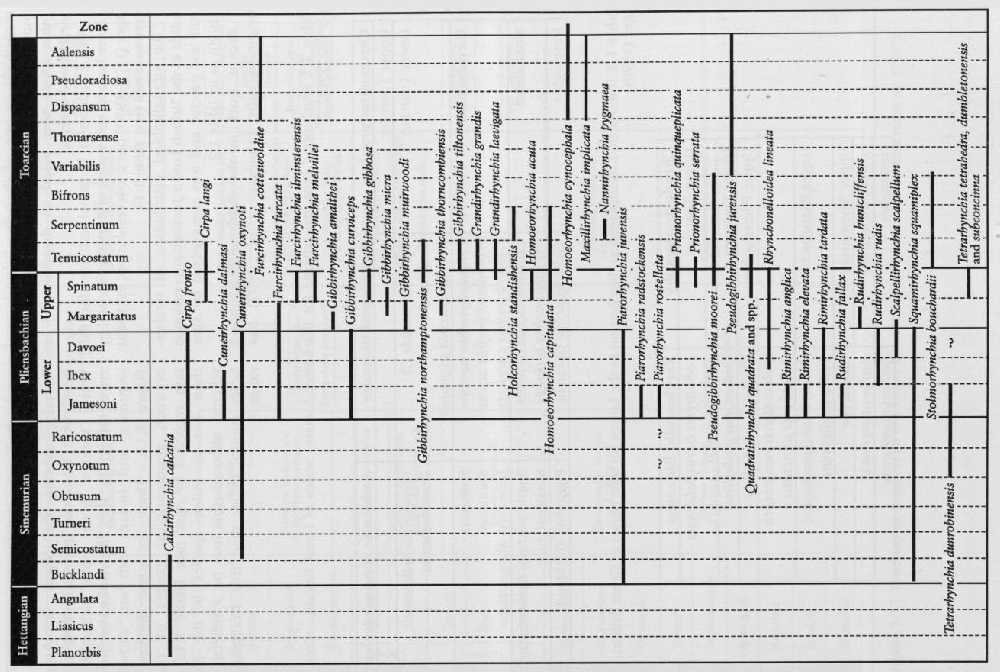
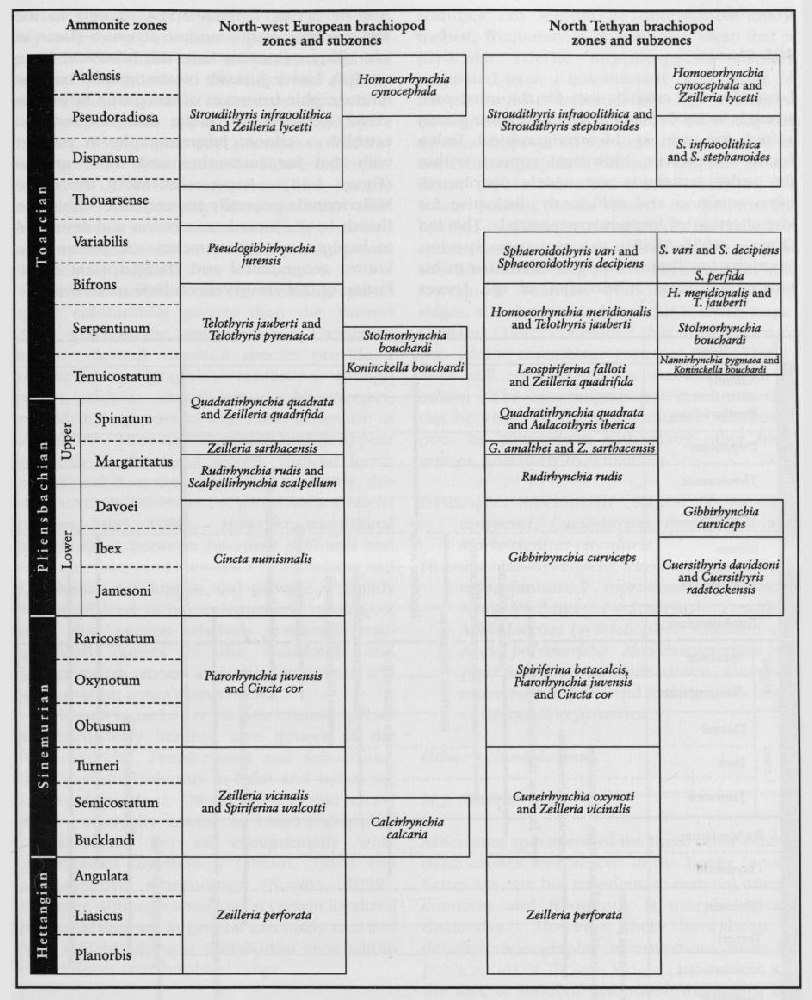
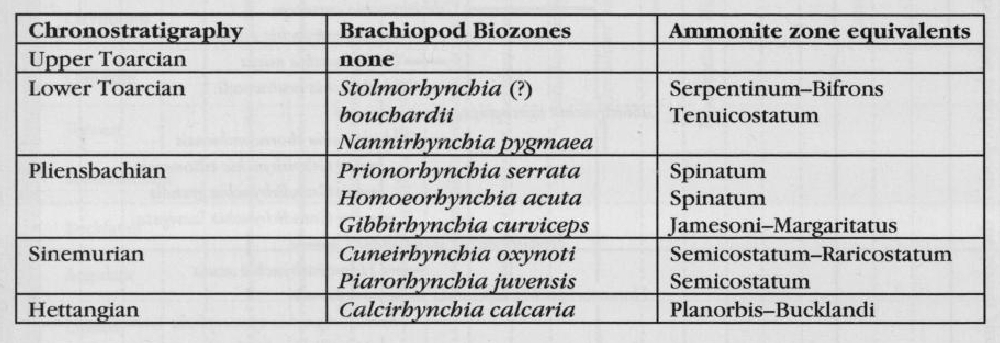
Although benthic in habit and therefore facies dependent, the morphological distinctiveness of certain brachiopod taxa, their relative abundance in the Lower Jurassic Series, and the existence of monographic studies, notably by Ager (1956–1967, 1956b, 1990), lends brachiopods some biostratigraphical significance. Derek Ager's rhynchonellid monograph (Ager, 1956–1967) is the standard reference work for this group in the Lias and provides data on the stratigraphical range of each species. However, he was able to complete only Part 1 of the terebratulid monograph (Ager, 1990) before his death, whilst a proposed monograph on the genus Spiriferina never came to fruition. Nonetheless, in the terebratulid monograph and an earlier publication (Ager, 1978) he provided a valuable overview of Lower Jurassic brachiopod biostratigraphy, based both on his own work and that of others. He concluded that rhynchonellids were the most useful group on account of their greater diversity and more rapid evolution, though, with few exceptions, individual species ranges extend through several ammonite zones
The biostratigraphical potential of other brachiopod taxa is poorly known, though some have been discussed in earlier publications. Davidson (1851–1852, 1876–1878) described a diverse range of Lower Jurassic species and provided a table showing the stratigraphical distribution of all of the taxa in his monograph, although the stratigraphical resolution of this was low and divided only into the Lower, Middle and Upper Lias, and the 'Passage beds, Midford Sands'. Neaverson (1955) briefly described the application of species of terebratulid, rhynchonellid and Spiriferina in Lower Jurassic biostratigraphy, and Revert and Tchoumatchenco (1973) included Spiriferina quenstedti as one of their brachiopod zonal index fossils for the Sinemurian Stage, though other zones were based on rhynchonellid or terebratulid species.
The brachiopod biozonal scheme for the Lower Jurassic succession of Britain proposed by Ager (1978, 1990) has a low resolution, except at certain levels (see
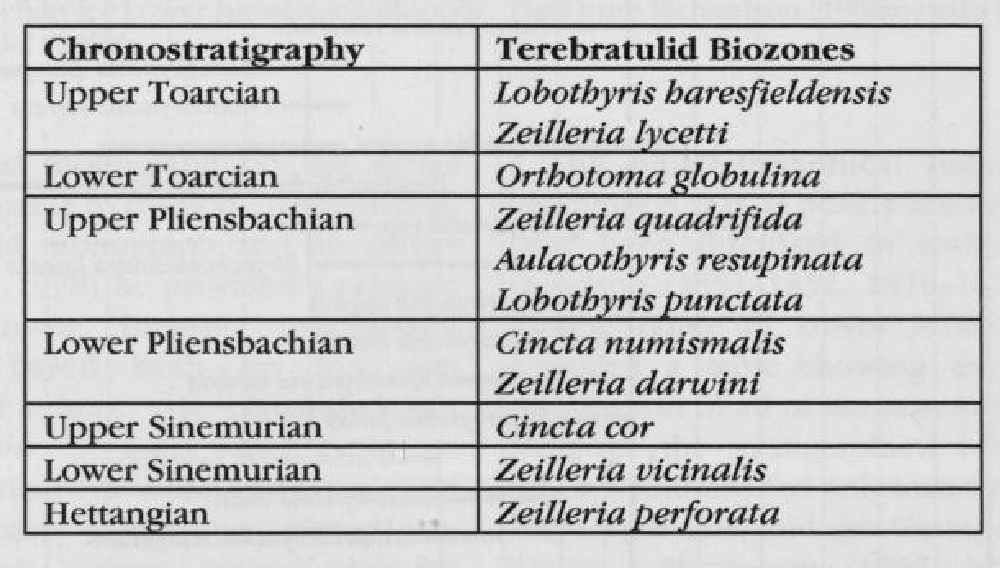
The stratigraphical distribution of terebratulids in the British Lower Jurassic succession is still less precise and was summarized by Ager (1990) as in
Recent work in the field of brachiopod biostratigraphy (Almeras et al., 1997) has established two parallel zonation schemes for the Lower Jurassic succession of France, covering the North Tethyan and North-west European provinces respectively. Index species from both schemes are encountered in the British Lower Jurassic sequence and hence both are shown in
Crinoids
M.J. Simms
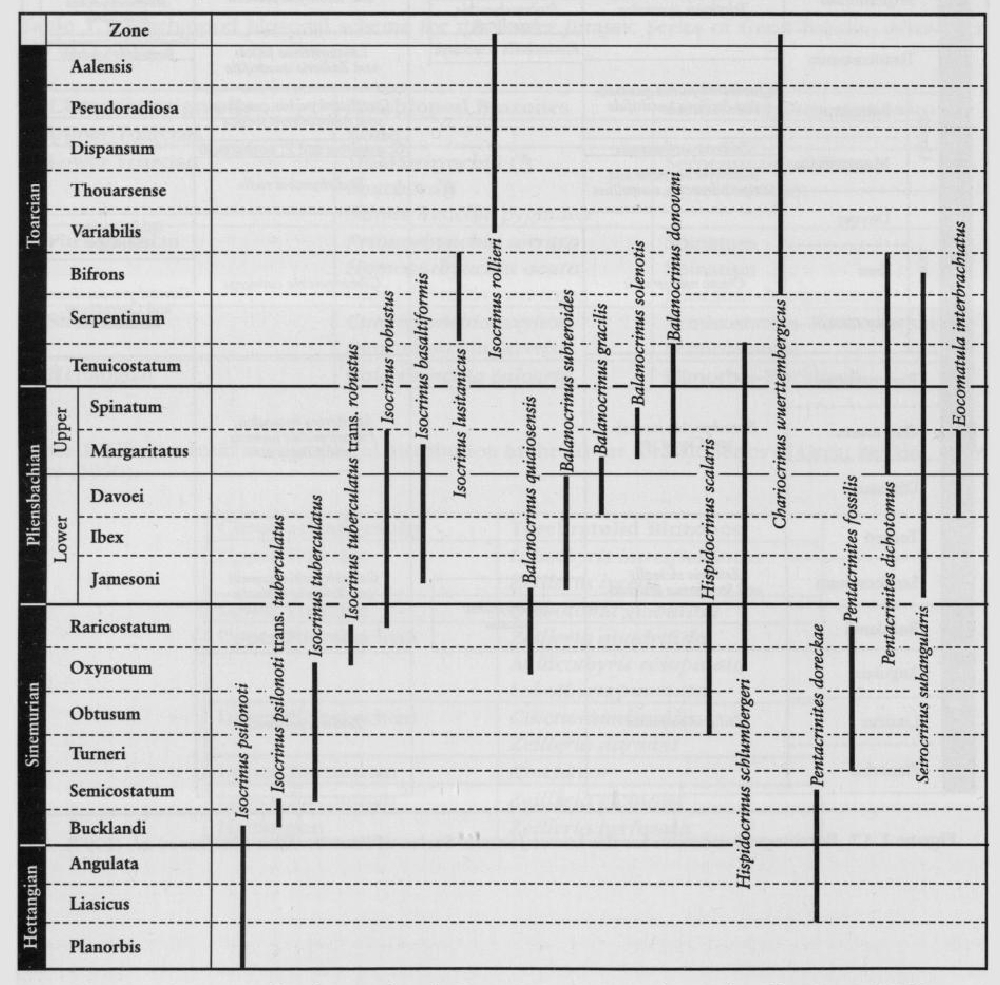
Lower Jurassic crinoids are, for the most part, strongly facies dependent and hence are poorly suited for use as biostratigraphical index fossils. However, individual species within the order Isocrinida are widely distributed, often common and sufficiently distinctive for identification of fragmentary material. This led Oppel (1856–1858) to use one species, Isocrinus (= Tentacrinus) tuberculatus in his biostratigraphical subdivision of the Lower Jurassic Series, corresponding roughly to the Turneri Zone of the modern schemes (Dean et al., 1961). Crinoids have not otherwise been used in Lower Jurassic biostratigraphy but the monographic treatment of this group by Simms (1989) provides all of the data necessary to establish a crinoid biostratigraphy in parallel with that for ammonites and other groups
Isocrinus tuberculatus has a stratigraphical range substantially greater than the Turneri Zone, spanning the Semicostatum to Oxynotum zones. Several common species provide a similar biostratigraphical resolution, though others, such as Hispidocrinus schlumbergeri, extend through several stages and hence are of limited use. Most species of each lineage appear suddenly in the fossil record, without forms transitional from their presumed ancestors; this is particularly evident in the genus Balanocrinus (Simms, 1985, 1988). However, transitional morphotypes between Isocrinus psilonoti and I. tuberculatus, and between I. tuberculatus and I. robustus are known and provide a slightly enhanced level of biostratigraphical resolution, since they occupy relatively restricted stratigraphical ranges in the Bucklandi and Semicostatum zones and the Oxynotum and Raricostatum zones respectively.
Although most Lower Jurassic crinoid species are exclusively benthic, two genera of the Pentacrinitidae, Pentacrinites and Seirocrinus, were pseudoplanktonic in habit and hence are facies independent. Other attributes that render them potentially useful as biostratigraphical index fossils are an exceptionally wide geographical distribution (Simms, 1986) and a distinctive morphology (Simms, 1989). However, although abundant at certain localized horizons, they are in general extremely rare and have a highly disjunct distribution even within their known stratigraphical range.
Holothurians
M.J. Simms
With rare exceptions fossil holothurians are found only as disarticulated, usually microscopic, sclerites whose precise taxonomic affinities can seldom be determined easily. Indeed, frequently it is not even clear that a particular sclerite morphospecies actually originated from a holothurian! Knowledge of Lower Jurassic holothurians has increased through the work of Gilliland (1992, 1993) but this also highlighted the limitations inherent in any biostratigraphical scheme using this group. Rioult (1961) published a subdivision of the Lower Jurassic Series based on holothurian sclerites in which he recognized three morpho-species associations that defined the Hettangian and Sinemurian stages, the Pliensbachian and lowermost Toarcian (Tenuicostatum Zone) stages, and the remainder of the Toarcian Stage. Gilliland (1992) concluded that only the lower two sclerite assemblage zones of Rioult (1961) were still recognizable, in modified form, as below. The biostratigraphical resolution that can be achieved using holothurian sclerites is poor by comparison with many other fossil groups, and likely to remain so.
Hettangian–Sinemurian stages: Binoculites terquemi, Cucumarites mortenseni and Mortensenites circularis Pliensbachian-lowermost Toarcian stages; Media crassidentata, T. mortenseni, T. rigauda, Myriotrochites (= Stueria)? costifera, Ambulacrites (= Stichopites) terquemi and A. (S.) polymorpha. Also characterized by a predominance of wide-armed Staurocumites bartensteini and early growth stages of Binoculites jurassica.
Other echinoderms
M.J. Simms
Articulated specimens of the three other echinoderm classes represented in the Lower Jurassic Series are rare but fragmentary material often is common and frequently is morphologically distinctive. However, there have been no detailed monographic investigations since the publications of Thomas Wright (1857–1880) and the lack of modern taxonomic treatments is a major hindrance to identification. Coupled with this they exhibit strong facies dependence, and so clearly have a very limited application in biostratigraphy.
Asteroids are poorly known and intact specimens are very rare, although isolated ossifies are not uncommon in washed mudstones. Little can be said about the stratigraphical distribution of species or even genera until a thorough investigation of such disarticulated material has been undertaken. Intact ophiuroids are similarly rare and generally confined to particular horizons, the Starfish Bed in the Stokesi Subzone of the Pinhay Bay to Fault Corner GCR site being perhaps the best-known example (Goldring and Stephenson, 1972). In a study of disarticulated ophiuroid ossicles from Jurassic clays, Hess (1960, 1962, 1964) described various Lower Jurassic taxa and their approximate stratigraphical ranges. These studies may provide a basis for the future development of an ophiuroid biostratigraphy for the Lower Jurassic but the current state of knowledge is inadequate to draw any firm conclusions about the stratigraphical distribution of this group.
Echinoids are also rare as intact specimens in the British Lower Jurassic Series, though significantly less so than either of the other two echinoderm groups. Disarticulated echinoid plates and spines are common but little has been published on this group in recent years. Unpublished observations (Simms, 1987) suggest that most taxa are fairly long-ranging. For instance Miocidaris lobatum ranges at least from the Planorbis Zone to the Semicostatum Zone, whereas higher in the succession Eodiadema minuta extends from the Oxynotum Zone to at least the Davoei Zone. Thierry et al. (1997) tabulated the stratigraphical distribution of 32 echinoid species in the Lower Jurassic succession of France, but only a small proportion of these are taxa known to occur in the British Lias. Most of the species included in their table have poor stratigraphical resolution; most precision is no better than stage or substage level and only four species are confined to individual ammonite zones.
Corals
M.J. Simms
The predominantly argillaceous sediments of the Lower Jurassic succession in Britain do not favour the growth of hermatypic colonial corals, and even solitary corals, presumably ahermatypic, generally are far from common. They occur in abundance at only a few sites, such as on the Ob Lusa to Ardnish Coast GCR site on the Isle of Skye, and the Panty Slade to Witches Point GCR site in south Wales. There has been no modern monographic treatment of the group since that of Duncan (1867a) and the tabulated data of Negus (1991) provides only a tripartite division of the Lower Jurassic Series into Lower, Middle and Upper Lias. Even with more precise information on the stratigraphical distribution of coral species in the Lower Jurassic Series it is unlikely that their value as biostratigraphical index fossils would be significant owing to the overwhelming facies control that they suffer, their relatively slow rate of evolution, and difficulties of identification for many species. However, certain coral-bearing horizons do have a value as local marker bands that in some instances can be traced over distances of several tens of kilometres; examples include the Coral Band containing abundant Stylophyllopsis rugosa in the Raricostatum Zone of Gloucestershire and Worcestershire (Richardson, 1918), and a limestone bed (Bed 28 of Trueman, 1930) containing profuse Montlivaltia guettardi in the Conybeari Subzone of the Pant y Slade to Witches Point GCR site in south Wales (Wobber, 1968a).
Microfossils
M.J. Simms
Foraminifera
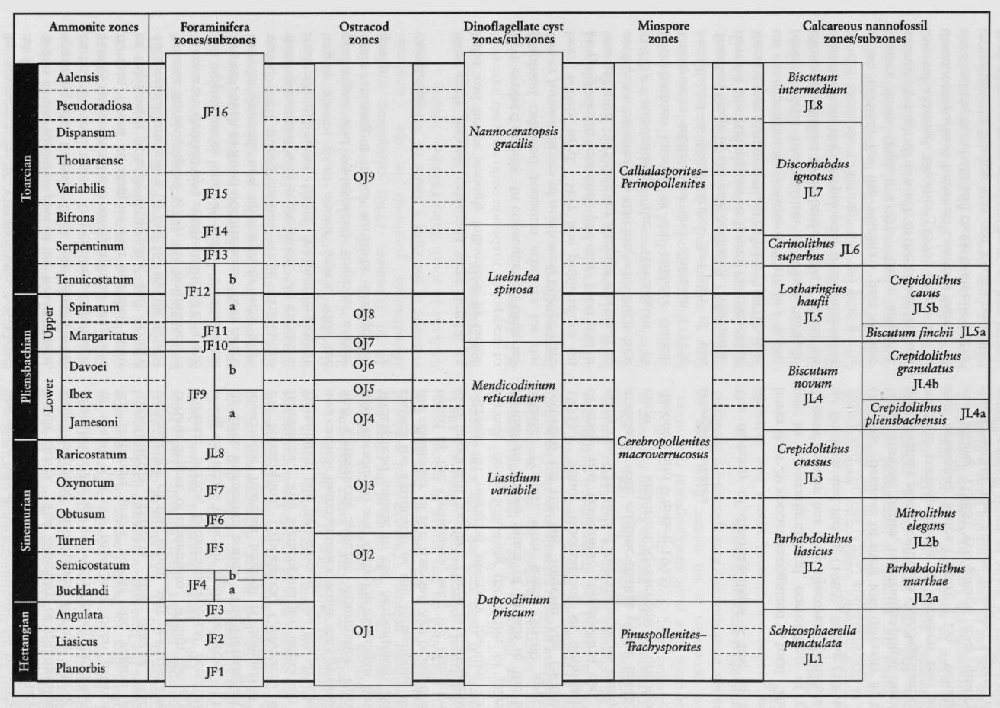
All Early Jurassic foraminifera were benthic in habit and hence facies controlled. Nonetheless, they are often abundant and diverse in Lower Jurassic mudstones and many species have limited stratigraphical ranges. They also have been documented and described for more than a century and a half (Strickland, 1846), substantially longer than any other microfossil group known from the Jurassic Period. Several GCR sites have been important sources of material from these earliest papers right up to the present time (e.g. Tate and Blake, 1876; Richardson, 1908; Macfadyen, 1941; Barnard, 1950; Hylton, 1998). Lower Jurassic foraminiferal assemblages comparable with those found in Britain have been studied in many other parts of Europe. Bartenstein and Brand (1937) were the first to appreciate the stratigraphical significance of foraminifera in the Lower Jurassic Series and paved the way for all subsequent zonation schemes. Various regional zonal schemes have been proposed, reflecting facies control and/or provincialism, most recently that by Ainsworth et al. (1998a) who recognized 10 foraminifera zones within the Lower Jurassic Series in the southern part of the Wessex Basin, spanning the interval from late Rhaetian to earliest Bajocian times. Copestake and Johnson (1989) summarized the stratigraphical ranges of 62 taxa, based on samples that included many of the Lower Jurassic GCR sites, and defined 16 foraminifera zones OF1–JF16) for the Lower Jurassic Series
Ostracods
Most early Jurassic ostracods were benthic in habit and hence strongly influenced by facies. However, they are often abundant and appear to have evolved rapidly. In consequence, biostratigraphical ostracod zonation schemes for the Lower Jurassic Series of north-west Europe have been widely used. Very few publications on Lower Jurassic ostracods pre-date 1960 and it was not until 1975 that any attempt was made to establish a biozonation scheme, with Michelsen (1975) subdividing the Hettangian to Pliensbachian interval of the offshore Danish Embayment while Bate and Coleman (1975) established a biozonation for part of the Toarcian Stage of the east Midlands. The zonation for the Hettangian to Lower Pliensbachian interval was further refined by Park (1987) based on records from the southern North Sea Basin. More recent biozonation schemes include those established by Boomer (1991), based on material from the exceptionally thick succession in the Mochras Borehole, and by Ainsworth et al. (1998a) for the southern part of the Wessex Basin
Dinoflagellates
The diversity of dinoflagellates is low in the Rhaetian and Lower Jurassic succession, with fewer than 20 species recognized in total. Their use in biostratigraphical correlation of the Jurassic System has been discussed particularly by Woollam and Riding (1983), Riding (1984a), Riding and Thomas (1992) and Ainsworth et al. (1998a). Because of their low diversity in the Lower Jurassic Series, biostratigraphical resolution is rather poor, with each dinoflagellate cyst subzone corresponding to between two and four ammonite zones
Pollen and spores
Pollen and spores comprise just two elements of the larger collective termed 'palynomorph', which encompasses a range of chitinous microfossil material of which dinoflagellages are another important group (see Batten, 1996a, for a full discussion of palynomorphs and palynofacies). They are of enormous value in biostratigraphy since potentially they allow correlation between non-marine environments in which they originate, and in which often they are the only biostratigraphically useful fossils, and marine sequences, which commonly are much better dated using a variety of fossil groups. However, palynomorphs are subject to latitudinal zonation and provincialism, and may have diachronous ranges, so correlation over long distances may be unreliable. Some proposed miospore zones are applicable only within individual sedimentary basins, limiting any wider application, while they are often difficult to identify. Batten (1996b) has highlighted the need to consider palynofacies in all such biostratigraphical investigations since this reflects the proximity of terrestrial vegetation, the sedimentary environment, and subsequent diagenesis.
Although the Lower Jurassic succession across virtually the entire United Kingdom is marine almost throughout, and hence commonly yields abundant macrofossil dating evidence, miospores have proven important for correlation with non-marine successions, such as those of the Newark Supergroup of eastern North America, and in helping to identify the provenance of important fossil material for which original collection data are lacking (e.g. Martin et al., 2000). Koppelhus and Batten (1996) reviewed the stratigraphical distribution of miospores for the Lower Jurassic interval and listed the ranges for many taxa in north-west Europe on which miospore zonation schemes have been based
Calcareous nannofossils
Coccolithophorid algae are the dominant calcareous nannofossil in the Jurassic System. The Early Jurassic Epoch was a time of major diversification for the group, from their first appearance in the fossil record in the Upper Triassic Series to six major families by the Pliensbachian Stage and more than 50 described species in the Toarcian Stage. In a comprehensive review of Lower Jurassic calcareous nannofossils in north-west Europe, Bown (1987) standardized the biostratigraphical zonation scheme for the group
Other groups
Several other fossil groups have not been considered here since they form only minor or low-diversity components of most described faunas and their distributions are relatively poorly documented. They include benthic invertebrate groups such as bryozoa, annelids and arthropods, the nektobenthic nautiloids, vertebrates (fish and reptiles) and trace fossils. Ultimately some may prove to be of limited stratigraphical use, or at least display well-defined stratigraphical distributions. There is some evidence for this among vertebrates (Benton and Spencer, 1995) but the data is insufficient to establish any meaningful 'zonal' scheme at present. The rarity of intact material and the difficulty of identifying isolated bones and teeth would render any such schemes of limited use, although further work on isolated fish teeth may eventually establish them as of some value in stratigraphy.
Event stratigraphy in the British Lower Jurassic Series
M.J. Simms
Recent decades have seen the emergence of various techniques for refining the chronostratigraphy of sedimentary sequences independently of any fossil biota they might contain, or of identifying specific events within the succession. These include the use of stable isotopes, particularly of strontium (Jones et al., 1994) or carbon (Hesselbo et al., 2002), radiometric techniques (Pálfy et al., 2000a–c), identification of ejecta from bolide impacts or volcanic eruptions, sedimentary events associated with tectonic activity, rhythmic or cyclic sedimentary sequences caused by climate change linked to Milankovitch cyclicity (House, 1985, 1986; Weedon, 1986; Weedon and Jenkyns, 1990, 1999; Weedon et al., 1999) and sea-level change (Hallam, 1981, 1988; Haq et al., 1988). Of these, most have only limited, if any, application within the British Lower Jurassic Series. Radiometric dating is, of course, crucial to defining the absolute dates for stratigraphical boundaries at stage level and above, but this has not been possible for any British site and hence stage boundary dates have been defined elsewhere. Analysis of strontium isotope ratios has been employed as just one of a suite of techniques used to define proposed GSSPs in the British Lower Jurassic Series (Hesselbo et al., 2000) but otherwise it has little general stratigraphical application at this level of resolution. Ejecta from bolide impacts, such as are well documented for the Cretaceous–Tertiary boundary (Smit, 1999) have not been found at any level in the British Lower Jurassic sequence, although an iridium anomaly has been reported from the terrestrial Triassic–Jurassic boundary in the Newark Supergroup of eastern North America and cited as tentative evidence for bolide impact at the end of the Triassic Period (Olsen et al., 2002). The most recent dating of the Manicouagan impact crater at 214 ± 1 Ma (Hodych and Dunning, 1992) places it almost within the range of the Triassic–Jurassic boundary as defined by Harland et al. (1990), but re-dating of the boundary close to 200 Ma (Pálfy et al., 2000a) eliminates any possible link between this impact and events at the Triassic–Jurassic boundary. Volcanic ejecta also have not be found in the British Lower Jurassic sequence despite the presence of extensive flood basalts in the Hettangian Stage of the Newark Supergroup on the eastern seaboard of North America (Tankard and Balkwill, 1989; Hesselbo et al., 2002), although this apparent absence may merely reflect a lack of intensive searching. Major tectonic events might be anticipated to show up in the sedimentary record but although there is clear evidence for local influence of tectonic activity on adjacent sediments (e.g. Jenkyns and Senior, 1991), more widespread event horizons of this type have yet to be found in the British Lower Jurassic Series. However, a major, uniquely extensive horizon of soft-sediment deformation occurs in the
The only factors that appear to have had widespread, frequent and easily discernable effects on the sedimentary sequence are climate and sea level, although it can often be difficult to distinguish between the effects of the two. The link between orbitally induced climatic fluctuations and small-scale sedimentary cyclicity in the British Lower Jurassic sequence is now fairly well-established, with well-documented case studies from several GCR sites (House, 1986; Weedon, 1986; Weedon and Jenkyns, 1990, 1999; van Buchem et al., 1994; Weedon et al., 1999). Direct correlation of individual decimetre-scale units between Dorset and Yorkshire, a distance of more than 400 km, has even been attempted (Hesselbo and Jenkyns, 1995). However, although these Milankovitch-scale sedimentary rhythms may be common and widespread, they are by no means ubiquitous and other factors may effectively mask the climatic signal. Furthermore, although broad-scale correlation of the larger units may be relatively straightforward, correlation of individual beds in isolation from these larger units is greatly hampered by the presence of other, essentially indistinguishable, beds in close stratigraphical proximity. Essentially, these small-scale, climatically induced, sedimentary rhythms do represent extremely widespread event horizons. However, they appear to be preserved only in certain parts of the Lower Jurassic succession where their stratigraphical frequency is too high for individual beds to be especially useful as marker horizons. Although there have been claims that these climatically controlled sedimentary sequences offer potential for establishing a high-resolution absolute timescale (House, 1985), in truth the stratigraphical distribution of such sequences is far too disjunct for this to be realized at present.
That changes in sea level can effect the Lower Jurassic sedimentary sequences has been recognized for far longer than has the influence of climate change, being exemplified by sites such as Pant y Slade to Witches Point, south Wales, where there is a clear upward, and lateral, transition from marginal to 'offshore' facies. As discussed elsewhere in this volume, changes in relative sea level, as interpreted from the sedimentary sequence at a particular site, can be under the control of several factors. However, global or eustatic sea-level changes should be traceable across many sites over a very wide area and, as such, offer the potential for useful event horizons, if these can be identified. Consideration of the effects of rising or falling sea level on the style of deposition in the Lower Jurassic Series has been a subject of investigation for many decades. For instance Arkell (1933) wrote widely of the evidence for transgressions and regressions in the British Jurassic System while in a series of papers Hallam (1961, 1964b, 1978) discussed the patterns of cyclic sequences produced by eustatic changes. These lines of investigation led ultimately to the development of the concept of 'sequence stratigraphy' (e.g. Haq et al., 1987; Vail et al., 1991),with several orders of cycles discernable under ideal conditions. Critical to applying the sequence stratigraphy concept in the field is the identification of key surfaces within a given sedimentary cycle, of which there are three main types; sequence boundaries, transgressive surfaces, and maximum flooding surfaces. The precise sedimentary expression of any one of these varies according to position along a proximal–distal transect but the following criteria were used by Hesslbo and Jenkyns (1998) for their analysis of the British Lower Jurassic Series. They diagnosed a sequence boundary as an erosional unconformity or an abrupt basinward facies shift inferred to be its conformable correlative; a transgressive surface was indicated by an abrupt juxtaposition of deep-water facies over shallow; and a maximum flooding surface was indicated by stratigraphical condensation. Within the British Lower Jurassic sequence Hesselbo and Jenkyns (1998) were able to identify key surfaces for several second-order, or transgressive–regressive facies cycles, and a large number of third-order, or sequence cycles, with a significant number of the latter being correlatable across Britain. Second-order cycles are of durations comparable with stratigraphical stages or substages while third-order cycles are broadly comparable in duration to ammonite zones or subzones. The overall implication of the technique is that if these cycles are primarily under eustatic control then the key surfaces are effectively synchronous and, In geological terms, instantaneous. Consequently they can be considered to represent event horizons that potentially can be correlated over very large areas. However, a significant constraint is that it is dependent on individual interpretation of sedimentary sequences in the field and it is quite possible for the same, apparently quite straightforward, feature to give rise to quite different interpretations, with consequent significance for broader-scale correlation (e.g. Hesselbo and Palmer, 1992; Hallam, 1999).
Morton (1993) contends that within individual basins or broader regions the influence of tectonics may be greater than eustatic changes. Hence major sequence boundaries may be diachronous, in marked contrast to what is implied by eustatically determined sequence boundaries. This is 'genetic stratigraphy', in which gradationally changing packages of sediment are bounded by major abrupt changes of facies that often correspond to hiatuses or unconformities. These genetic sequences represent a record of the dynamic development and infill by sediment of a basin and hence are the basic unit for analysis of basin evolution. Inevitably these genetic stratigraphical sequences are not synonymous with stratigraphical sequences defined by eustatic events (e.g. Haq et al., 1987; Vail et al., 1991; Hesselbo and Jenkyns, 1998) but eustatic events may be superimposed upon the genetic stratigraphy.
GCR site selection
M.J. Simms
The rationale, methodology and history behind the selection of sites for inclusion within the Geological Conservation Review programme was discussed in detail by Wimbledon et al. (1995) and much of this has been re-iterated in the introductory GCR volume (Ellis et al., 1996). The main factors considered during the selection process for the stratigraphy GCR sites are: (a) is the site of importance to the international Earth scientist community on account of the site being the type locality for a particular time interval, boundary or fossil species? (b) does the site encompass exceptional geological features? (c) Is the site nationally important because features there are representative of geological events or processes that are fundamental to understanding the geological history of Britain? and (d) is the site of historical significance in the development of the science? There is also a stated philosophy in site selection that within the list for a particular stratigraphical interval (such as the Lower Jurassic Series), the site should be the best-available example and should encompass a minimum of duplication with features seen at other GCR sites. Ideally it should also be accessible and not obviously vulnerable to any threat that might compromise its scientific importance.
Following these basic guidelines an initial selection of Lower Jurassic GCR sites was undertaken in the early 1980s through consultation with appropriate Earth scientists with relevant experience, and preliminary reports were prepared. Inevitably the list that was compiled reflected, to some extent, the personal preferences and knowledge of those consulted so that a number of important or poorly documented sites were excluded. In the intervening two decades some of the selected sites have become degraded through weathering and growth of vegetation, although this does not necessarily detract from their ultimate scientific importance if they still remain recoverable with only a little excavation. Other important new sites have become available but, with the increasing reluctance of many journal editors to publish descriptive accounts of such sites, they often remain poorly known. However, with only one or two additions and deletions from the original list the selection of Lower Jurassic GCR sites has remained largely unchanged, although undoubtedly there are sites that others will feel should have been included.
Although the title of this volume is 'British Lower Jurassic Stratigraphy', the site accounts are not confined only to the description and interpretation of that particular aspect of their geology Many sites are justly important for their fossil biotas or have been the subject of palaeoenvironmental, diagenetic or other investigations. The scientific value of any site is increased by the breadth of research undertaken there and hence the site accounts have attempted to be as comprehensive as possible in their coverage. For some there has been little modern research and hence description and interpretation is correspondingly brief but for others a great deal more has been published and so much fuller accounts have been compiled. Hopefully one outcome of this review is that long-neglected sites may be looked at afresh and act as a spur to further research on the British Lower Jurassic Series as a whole.
Within this GCR volume the sites are arranged broadly in terms of the depositional basin in which they are located, moving northwards through the Wessex Basin, Mendip High, Severn Basin, East Midlands Shelf, Cleveland Basin and the Scottish localities, with all but one of the latter located in the Hebrides Basin. Within this framework the sites are then arranged in approximate stratigraphical order, where applicable, following a brief overview of each depocentre.
Although some of the GCR sites have been the subject of intensive research for many decades, and hence are well documented, many other sites have long been neglected. Some are represented by little more than a general account of the stratigraphy, often published in a local journal a century or more ago and with little interpretation relevant to the present account. The situation now is little better and indeed quite possibly worse than in the past. Although basic stratigraphical investigations of sites must form the basis for larger-scale geological and palaeoenvironmental interpretations, such research is seldom supported by academic institutions today and many journals are reluctant to publish the results. As a result new exposures, which may have significant implications for palaeogeography, facies analysis or basin history, often remain unknown to geologists active in those fields of research. Journal editors, PhD supervisors and research students, must strive to ensure that this basic stratigraphical data enters the public realm before published interpretations become too distant from the actual field exposures on which, ultimately, they are based. With the ever increasing pressure on journal space, these GCR stratigraphy volumes therefore serve an invaluable function. Unconstrained by the research 'fashions' of the day, they provide a vehicle for the publication of reviews, newly measured sections and new interpretations of old sites that otherwise would never receive the attention they deserve. Furthermore it attempts to take a holistic view, with even the smallest, seemingly insignificant, site contributing to an understanding of the whole picture of Lower Jurassic events in Great Britain.
Invertebrate fossils and GCR site selection
Although the relatively common invertebrate fossils do not have a separate selection category in the GCR in their own right, the scientific importance of many stratigraphy sites lies in their fossil content. Invertebrate fossils are important in stratigraphy because they help to characterize stratal units. In practice, stratigraphy is at its most secure where adequate fossils are found. One of the main tasks of stratigraphers is to determine the relative ages of strata and to compare or correlate them with strata of the same age elsewhere. Fossils have long provided one of the most reliable and accurate means of approaching these problems.
Therefore, some 'stratigraphy' GCR sites are selected specifically for their faunal content, which facilitates stratal correlation and enables the interpretation of the environments in which the animals lived. Other 'stratigraphy' GCR sites are of crucial importance palaeontologically and palaeobiologically, because they yield significant assemblages of invertebrates that provide evidence for past ecosystems and the evolution of life. Moreover, some sites have international significance because they have yielded fossils that are the 'type' material for a species.
In contrast to the manner in which most invertebrate fossils are represented in the GCR, fossils of vertebrates, arthropods (except trilobites) and terrestrial plants do have their own dedicated selection categories, owing to the relative rarity of the fossil material.