Whitby to Saltwick, North Yorkshire
KN. Page
Introduction
The town of Whitby is one of the best-known Lower Jurassic sites in Britain, and the Whitby to Saltwick coast section is of international importance for its classic Lower Toarcian exposures, unconformably overlain by the Middle Jurassic
The coastal exposures of the
Some of the fossils for which Whitby is so well known have formed the basis for folklore. The best known of these is the legend of the Whitby snakestones. When St Hilda (614–680), founder of one of the first churches in England, arrived in Whitby she found the area infested with snakes. To eradicate this supposed evil she cut off the serpents' heads and cast them into the sea, the legend thereby conveniently explaining why ammonites are common on the beaches of the district (Scrutton, 1996). This event is commemorated by the three coiled 'snakes' (ammonites) on the town's coat of arms and it spawned a souvenir trade in the mid- to late-19th century, with snakes' heads being carved on fossil ammonites (usually Dactylioceras). Legend meets science in the lectotype of Dactylioceras commune, which bears just such a carved snake's head at the end of its last whorl (Dean et al., 1961). St Hilda's association with the town is further celebrated in the ammonite genus Hildoceras, the type species of which, H. bifrons, came from the area. Jet was another geological product that was sold extensively, mostly as jewellery or small carvings, in Whitby during the 19th century, although most material was obtained from sites elsewhere on the coast since the main jet-bearing beds are exposed here only in small patches at low tide.
Description
Only the middle part of the
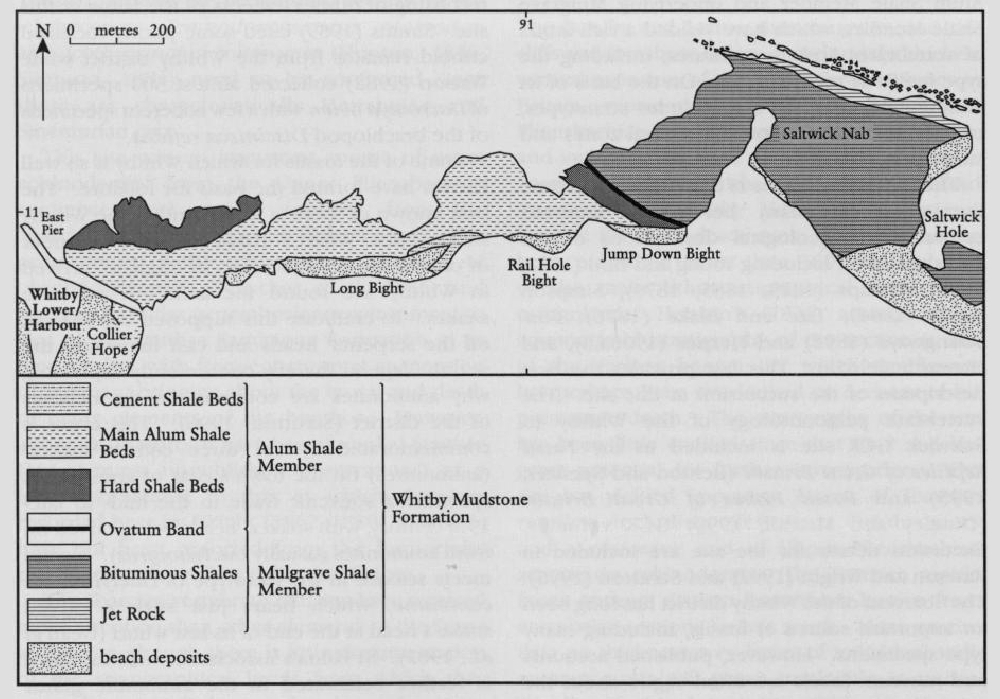
Howarth's (1962a) description of the Bituminous Shales was based on the exposures around Saltwick Nab. This is the only location where the complete Bituminous Shales succession can be examined on the foreshore: it effectively forms the type locality for this bed. Lamination is less well-developed, and the organic content lower, in the Bituminous Shales than in the
| Thickness (m) | |
| AALENIAN STAGE | |
| Sandstone, grey, at base, lying unconformably on |
|
| LOWER TOARCIAN SUBSTAGE | |
| Cement Shale Beds | |
| Bifrons Zone, Crassum Subxone | |
| 72 (part): Shale, grey, with calcareous nodules. Catacoeloceras crassum, Hildoceras semipolitum, H. ex grp bifrons. Belemnites include Acrocoelites levidensis, A. tricissus, A. subtricissus, Simpsonibelus expansus, S. dorsalis, S. lentus and Dactyloteuthis crossotela. This horizon corresponds to the crassum–bifrons and crassum–semipolitum biohorizons, while the base of the unit at Whitby is a parastratotype for defining the Crassum Subzone of Howarth (1992). | 2.5 |
| Fibulatum Subzone | |
| 72 (part): Shale, grey, with calcareous nodules. Porpoceras cf vortex, P. verticosum, Hildoceras ex grp. bifrons, Acrocoelites levidensis, A. tricissus, A. subtricissus, Simpsonibelus expansus, S. dorsalis, S. lentus and Dactyloteuthis crossotela. This corresponds to the vortex Biohorizon. | 1.5 |
| 65–71: Shale with several rows of calcareous concretions. Hildoceras ex grp. bifrons, occasional Phylloceras heterophyllum and rare Lytoceras cornucopia at base. Acrocoelites levidensis, A. subtricissus, A. inequistriatus, Simpsonibelus expansus, S. dorsalis and S. lentus present. | 1.85 (6 ft) |
| Main Alum Shale Beds | |
| 63 (part)–64: Shale with bands of calcareous nodules. Peronoceras fibulatum, P. turriculatum, Zugodactylites braunianus, Pseudolioceras lythense, Hildoceras ex grp. bifrons, Phylloceras heterophyllum and Lytoceras cornucopia with Acrocoelites vulgaris, Simpsonibelus expansus and S. dorsalis. Corresponds to the braunianus Biohorizon. | 1.9 |
| 60–63 (part): Shale with bands of calcareous nodules. The fauna is reported to be in the lower approximately 1 m and includes Peronoceras fibulatum, P. turriculatum, P. perarmatum, P. subarmatum, Pseudolioceras lythense, Hildoceras ex grp. bifrons and Phylloceras. Belemnites include Acrocodites vulgaris, A. tricissus, A. inequistriatus, Simpsonibelus expansus, S. dorsalis and S. lentus. These beds correspond to the turriculatum Biohorizon, while the base of Bed 60 at Whitby corresponds to the base of the Fibulatum Subzone as defined by Howarth (1992). | 1.33 |
| Commune Subzone | |
| 55–59: Shale with bands of calcareous nodules. Dactylioceras athleticum and D. spp., Hildoceras ex grp. lusitanicum, Pseudolioceras lythense, Phylloceras heterophyllum and Lytoceras cornucopia. Also Acrocoelites oxyconus, A. subtenuis, A. subgracilis, A. pyramidalis, A. vulgaris, A. tricissus, A. subtricissus, A. inequistriatus, Simpsonibelus expansus, S. dorsalis and S. lentus. Corresponds to the athleticum Biohorizon. | 2.8 (9 ft 2 in) |
| 51–54: Shale with bands of calcareous nodules. D. commune and D. spp., Hildoceras ex grp. lusitanicum, Phylloceras heterophyllum and rare Frechiella subcarinata. Belemnites include Acrocoelites oxyconus, A. subtenuis, A. longiconus, A. subgracilis, A. pyramidalis, A. vulgaris, A. tricissus, A. subtricissus, A. inequistriatus, Simpsonibelus expansus and S. dorsalis. Corresponds to part of the commune Biohorizon. | 9.5 (31 ft) |
| Hard Shale Beds | |
| 49–50: Shale with concretions and pyritic masses, capped by a 0.13 m-thick red sideritic mudstone band. Dactylioceras commune, D. temperatum in upper part, also Hildoceras cx grp. lusitanicum, Parapassaloteuthis polita, Acrocoelites subtenuis and Simpsonibelus dorsalis. This corresponds to the lower part of the commune Biohorizon, while the base of Bed 49 here marks the base of the Commune Subzone as defined by Howarth (1992). | 6.4 (20 ft 9 in.) |
| Bituminous Shales | |
| 48: Ovatum Bed: Double row of large sideritic concretions in grey shale, with irregular masses of pyrite and occasional 'belemnite battlefields' with abundant Acrocoelites subtenuis and A. vulgaris. Ovaticeras ovatum formerly common, probably including the holotype, with Dactylioceras cf. consimile and occasional Phylloceras heterophyllum. Corresponds to part of the ovatum Biohorizon. | 0.25 (10 in.) |
| 47 (part): Shale, grey bituminous with occasional Ovaticeras ovatum, also Parapassaloteuthis polita, Acrocoelites subtenuis, A. vulgaris and Simpsonibelus dorsalis. Corresponds to part of the ovatum Biohorizon. | 0.75 |
| Serpentinum Zone, Falciferum Subzone | |
| 46–47 (part): Shale, grey, bituminous, with a 0.13 m-thick sideritic mudstone at base. Dactylioceras sp., Parapassaloteuthis polita, Acrocoelites subtenuis, A. vulgaris and Simpsonibelus dorsalis. | 4.98 |
| 44–45: Shale, grey, bituminous, with a row of scattered concretions at base. Harpoceras ex grp falciferum (J. Sowerby), D. cf. consimile and P. heterophyllum, also Parapassaloteuthis polita, Acrocoelites (A.) subtenuis, A. (O.) subtricissus and Simpsonibelus dorsalis. The falciferum Biohorizon lies within these two beds. | 3.5 (11 ft 6 in.) |
| 41–43: Shale, grey, bituminous, with a row of scattered, pyrite-skinned concretions, containing abundant Pseudomytiloides, near the middle. Harpoceras ex grp. falciferum, including Harpoceras mulgravium, Dactylioccras spp. and Nodicoeloceras incrassatum, Parapassaloteuthis robusta, P. polita, Acrocoelites subtricissus, A. inequistriatus, Simpsonibelus dorsalis, Youngibelus tubularis and Y. simpsoni; the last two species are restricted to Bed 43 of Howarth (1962a), which was termed the 'tubularis Bed' in unpublished notes by Phillips (Doyle, 1985). These beds probably include the mulgravium Biohorizon. The base of Bed 41 at Saltwick is effectively a parastratotype for the base of the Falciferum Subzone (Howarth, 1992). | 13.8 (44 ft 10 in.) |
| Exaratum Subzone | |
| 40: Millstones: Giant, flattened lenticular calcareous concretions, reaching more than 4.5 m in diameter, in grey bituminous shale. They are exposed near low-water mark to the north of Saltwick Nab, extending south-eastwards in the direction of Whitestone Point. Corresponds to part of the elegans Biohorizon. | 0.3 (1 ft) |
| 39: Top Jet Dogger: Continuous band of argillaceous limestone. Acrocoelites trisulcolosus. Corresponds to part of the elegans Biohorizon. | 0.23 (9 in) |
| 38: Shale, grey, bituminous, with occasional calcareous concretions. Acrocoelites trisulcolosus and A. ilminsterensis present. | 1.5 (5 ft) |
| 37: Curling Stones: Calcareous concretions up to 0.45 m in diameter, with pyritic skins and almost perfect spheroidal shape, set in grey bituminous shale. Acrocoelites trisulcolosus and A. ilminsterensis present. Corresponds to part of the elegans Biohorizon. | 0.3 (1 ft) |
| 36: Shale, grey, bituminous. Acrocoelites trisulcolosus and A. ilminsterensis. | 1.08 (3 ft 6 in) |
| 35: Whalestones: Large ovoid calcareous concretions up to 3 m long and 1 m thick, with many smaller concretions, in grey bituminous shale. They form a conspicuous feature at low tide, beyond the outcrop of the Millstones, capping pillars of the underlying shale (Bed 34). Between Black Nab and Whitestone Point their position is often marked by a line of breaking waves. Cleviceras exaratum, with less frequent Harpoceras serpentinum, Lytoceras crenatum and probably also Dactylioceras sp.. This may be the type locality and horizon for Hildaites forte and H. murleyi (Howarth, 1992). Acrocoelites trisulcolosus and A. ilminsterensis. Corresponds to part of the exaratum Biohorizon. | 0.92 (3 ft) |
The invertebrate macrofossil fauna of the
The vertebrate fauna of this site is well documented through the work of Benton and Taylor (1984), Benton and Spencer (1995) and Dineley and Metcalf (1999). Among the reptile fauna plesiosaurs, ichthyosaurs, crocodiles and possibly a dinosaur are represented and include many nominal type species (Benton and Taylor, 1984). However, although detailed locality data is available for some specimens, even from more than two centuries ago (e.g. Chapman, 1758; Wooller, 1758), for many others a Whitby label is not necessarily proof that the specimen was obtained from this site. It is clear from Benton and Taylor's (1984) study that Saltwick was an exceptionally rich source of fossil marine reptiles with most of the better-recorded specimens obtained from the Main Alum Shale Beds (Benton and Spencer, 1995), the only level which was extensively quarried in the region, with a few from the Bituminous Shales. Fish remains have an almost equally long history of study, with eight type species described from here in papers by Agassiz (1833–1845), Egerton (1852), Simpson (1855) and especially by Woodward (1896, 1897, 1898, 1899). However, some taxa listed as from here have since been deemed indeterminate or are thought to have originated from localities outside of Yorkshire (Dineley and Metcalf, 1999). Many of the earlier collections were made from the Bituminous Shales but in later times material was also obtained from industrial workings of the
Interpretation
The ammonite faunas of the Bituminous Shales and the
These include Cleviceras exaratum, Dactylioceras commune, Hildoceras bifrons and Peronoceras fibulatum. Unusual elements in the ammonite faunas include the Tethyan giant Phylloceras heterophyllum, which occurs sporadically throughout the succession here, and the rarer Lytoceras ex grp. cornucopia. Both appear to have greatly expanded their range northwards at this time, perhaps due to more open seaways associated with the mid-Toarcian eustatic highstand (Hesselbo and Jenkyns, 1998). This may also account for the presence of the Mediterranean Bouleiceratine Frechiella subcarinata, of which the holotype is probably from Whitby, which reached the area in small numbers during the Commune Subzone (Donovan, 1967).
Throughout the
The absence of chondrichthyan fish at this site, a common element of many other early Jurassic fish faunas (Dineley and Metcalt 1999) seems significant. However, this observation appears to hold largely true also for the German correlative of these strata, the Posidonienschiefer. Only Hybodus hauffianus occurs in equivalent strata in Posidonienschiefer, where it has been reported from the Serpentinum Zone, but even there it occurs only rarely among a fish fauna comprising many thousands of specimens. Perhaps the rarity of chondrichthyans in these anoxic mudstone facies reflects an at least intermittently benthic habit for these fish which lack a swim bladder, and hence must swim actively to remain at the bottom.
The lithostratigraphy of the Mulgrave Shale and Alum Shale members at this site is similar to that at others north-west of the Peak Fault. Many of the marker bands can be recognized along this whole stretch of coast. The succession differs markedly from the correlative succession south-east of the Peak Fault. There is little difference in the thickness of the
Conclusions
The cliffs and foreshore between Whitby and Saltwick expose a classic Toarcian section which has been a rich source of type and figured fossils, particularly ammonites and vertebrates. The section exposes the higher part of the