Bouldnor Cliff, Isle of Wight
Introduction
Bouldnor Cliff exposes the
Description
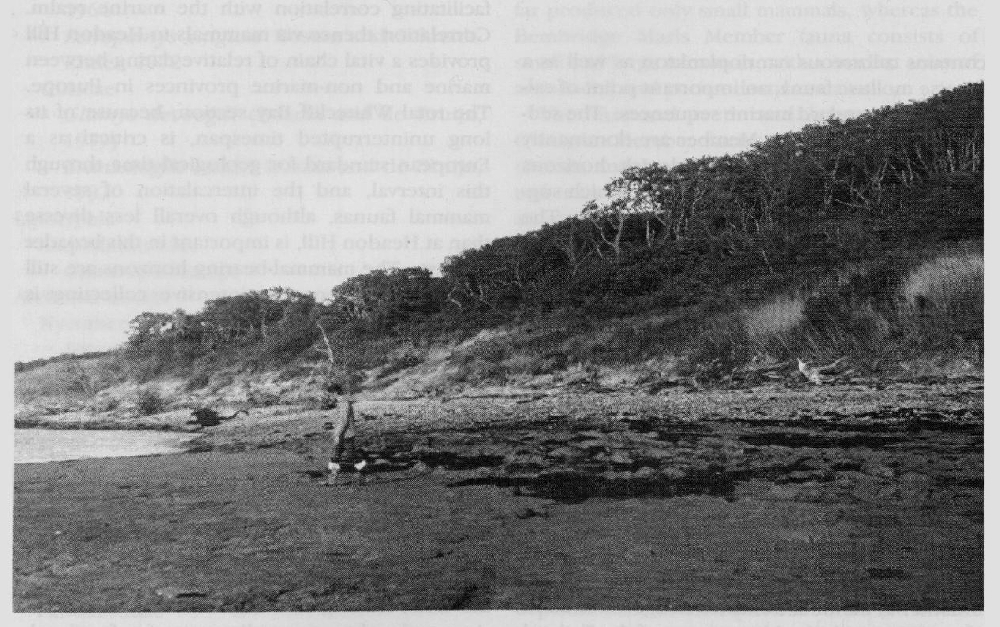
The coastal section at Bouldnor Cliff (including Hamstead Cliff and Ledge) exposes the
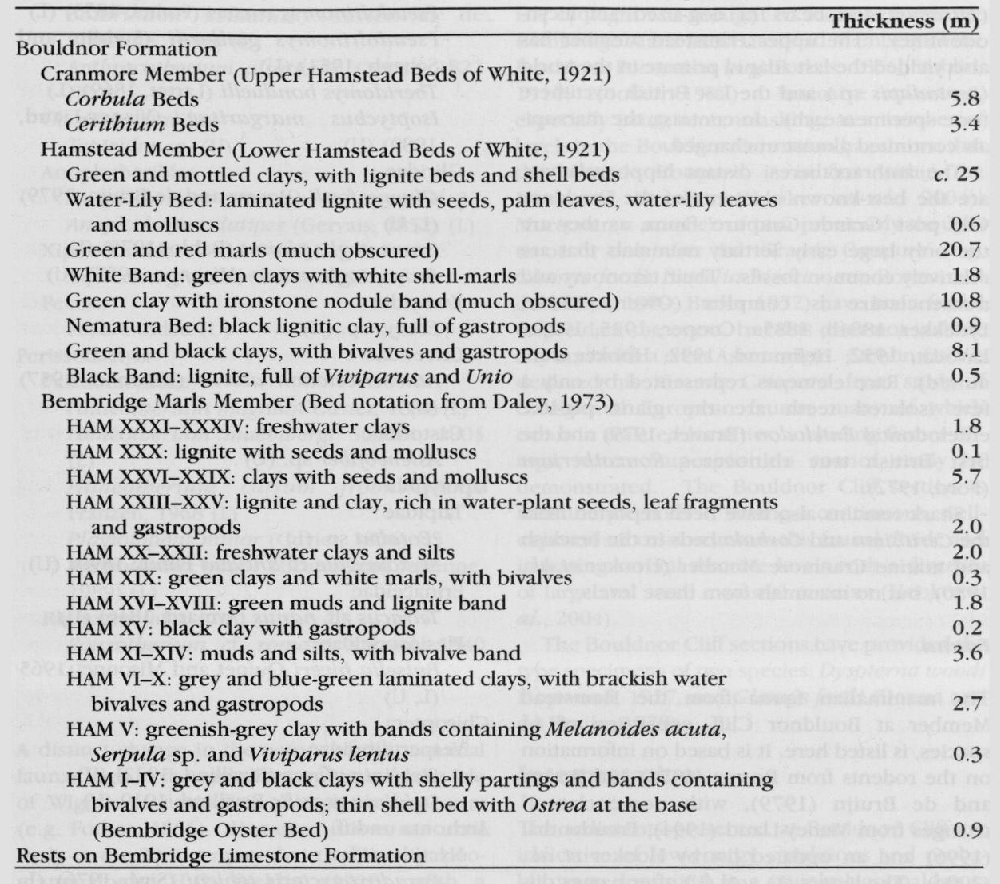
The section
Mammal remains, together with fish, turtles and crocodiles, occur at several levels in the
Lower parts of the
| Thickness (m) | |
| Corbula Beds | 5.8 |
| Cerithium Beds | 3.4 |
| Green and mottled clays, with lignite beds and shell beds | c. 25 |
| Water-Lily Bed: laminated lignite with seeds, palm leaves, water-lily leaves and molluscs | 0.6 |
| Green and red marls (much obscured) | 20.7 |
| White Band: green clays with white shell-marls | 1.8 |
| Green clay with ironstone nodule band (much obscured) | 10.8 |
| Nematura Bed: black lignitic clay, full of gastropods | 0.9 |
| Green and black clays, with bivalves and gastropods | 8.1 |
| Black Band: lignite, full of Viviparus and Unio | 0.5 |
| HAM XXXI–XXXIV: freshwater clays | 1.8 |
| HAM XXX: lignite with seeds and molluscs | 0.1 |
| HAM XXVI–XXIX: clays with seeds and molluscs | 5.7 |
| HAM XXIII–XXV: lignite and clay, rich in water-plant seeds, leaf fragments and gastropods | 2.0 |
| HAM XX–XXII: freshwater clays and silts | 2.0 |
| HAM XIX: green clays and white marls, with bivalves | 0.3 |
| HAM XVI–XVIII: green muds and lignite band | 1.8 |
| HAM XV: black clay with gastropods | 0.2 |
| HAM XI–XIV: muds and silts, with bivalve band | 3.6 |
| HAM VI–X: grey and blue-green laminated clays, with brackish water bivalves and gastropods | 2.7 |
| HAM V: greenish-grey clay with bands containing Melanoides acuta, Serpula sp. and Viviparus lentus | 0.3 |
| HAM I–IV: grey and black clays with Shelly partings and bands containing bivalves and gastropods; thin shell bed with Ostrea at the base (Bembridge Oyster Bed) | 0.9 |
| Rests on |
Upper parts of the
The anthracotheres, distant hippo relatives, are the best-known elements of the Bouldnor Cliff post 'Grande Coupure' fauna, as they are the only large early Tertiary mammals that are relatively common fossils. Their taxonomy and nomenclature is complex (Owen, 1848c; Lydekker, 1884b, 1885a; Cooper, 1925, 1926a; Lavocat, 1952; Hellmund, 1992; Hooker, submitted). Rare elements represented by only a few isolated teeth are the giant pig-like entelodontid Entelodon (Brunet, 1979) and the first British true rhinoceros Ronzotherium (Ford, 1972).
Shark remains also have been reported from the Cerithium and Corbula beds in the brackish and marine
Fauna
The mammalian fauna from the
MAMMALIA
Marsupialia
Herpetotheriidae
Amphiperatherium exile Gervais, 1852 (L,U)
Amphiperatherium minutum (Aymard, 1846) (U)
Amphiperatherium sp. (L, U)
Peratherium cuvieri (Fischer, 1829) (L)
Peratherium elegans (Aymard, 1846) (U)
Peratherium cf. perrierense Crochet, 1979 (U)
Rodentia
Pseudosciuridae
Suevosciurus fraasi (Major, 1873) (L)
Theridomyidae
Pseudoltinomys cuvieri (Pomel, 1853) (L)
Pseudoltinomys gaillardi (Stehlin and Schaub, 1951) (U)
Theridomys bonduelli (Lartet, 1869) (L)
Isoptychus margaritae (Vianey-Liaud, 1989) (U)
Gliridae
Glamys fordi (Bosma and de Bruijn, 1979) (L, U)
Bransatoglis planus (Bahlo, 1975) (L)
Bransatoglis micio (Misonne, 1957) (U)
Eomyidae
Eomys sp. (U)
Cricetidae
Atavocricetodon atavus (Misonne, 1957) (1–1)
Castoridae
Asteneofiber sp. (U)
Lipotyphla
Talpidae
?Eotalpa sp. (L)
Myxomygale cf. antiqua Filhol, 1890a (U)
Erinaceidae
Tetracus aff. nanus (Aymard, 1846) (U)
Plesiosoricidae?
Butselia biveri Quinet and Misonne, 1965 (L, U)
Chiroptera
Vespertilionidae
Stehlinia minor (Revilliod, 1922) (U)
Stehlinia gracilis Revilliod, 1919 (U)
Archonta undiff.
Nyctitheriidae
Paradoxonycteris tobieni (Sigé, 1976) (L, U)
Amphidozotherium aff. cayluxi Filhol, 1877 (L)
Primates
Adapidae
Leptadapis sp. (U)
Pantolesta
Pantolestidae
Dyspterna woodi Hopwood, 1927 (L, U)
Carnivora
Ursidae
?Amphicynodon sp.
Creodonta
Hyaenodontidae
Hyaenodon cf. dubius Filhol, 1873 (U)
Artiodactyla
Entelodontidae
Entelodon magnus Aymard, 1846 (U)
Anthracotheriidae
Elomeryx porcinus (Gervais, 1852) (U)
Bothriodon velaunus (Cuvier in de Blainville, 1846) (U)
Anthracotherium alsaticum Cuvier, 1822 (U)
Choeropotamidae
Tapirulus sp. (U)
Anoplotheriidae
Anoplotherium commune Cuvier, 1804 (L)
Anoplotherium latipes (Gervais, 1852) (L)
Xiphodontidae
Xiphodon gracilis Cuvier, 1822 (L)
Pecora
Pecora indet. (U)
Perissodactyla
Palaeotheriidae
Palaeotherium magnum Cuvier, 1804 (L)
Palaeotherium muehlbergi Stehlin, 1904 (L)
Palaeotherium curtum frohnstettense Franzen, 1968 (L)
Plagiolophus minor (Cuvier, 1804) (L)
Plagiolophus major (Brunet and Jehenne, 1989) (L)
Rhinocerotidae
Ronzotherium cf. romani Kretzoi, 1940 (U).
A distinct change in the nature of the mammal faunas high in the early Tertiary strata in the Isle of Wight was noticed in the pioneering years (e.g. Forbes, 1856). However, it was not until early in the 20th century that the Swiss palaeo-mammalogist H.G. Stehlin (1910), with a European perspective, recognized the scale and significance of this faunal turnover, which he termed the 'Grande Coupure' (meaning 'big break'). During most of the Eocene Epoch, Europe had been a series of islands, intermittently linked, but separated by seaways from other continents. European mammal faunas quickly became endemic and, when Europe and Asia became reconnected early in the Oligocene Epoch, Asian species dispersed into Europe and much of the European endemic fauna (e.g. most palaeotheres, anoplotheriid, xiphodontid and choeropotamid artiodactyls, nyctitheres and primates) became extinct. How much the extinction was due to competition with the newcomers and how much to climatic change (this time was also marked by the first major glaciation of Antarctica in the Cenozoic Era) is still unclear (Hooker et al., 2004).
Until recently, the 'Grande Coupure' in the Isle of Wight was thought to occur between the Bembridge Marls and Hamstead Members of the
The Bouldnor Cliff sections have provided the type specimens of two species: Dyspterna woodi Hopwood, 1927, and Glamys fordi (Bosma and de Bruijn, 1979).
Interpretation
The sediments preserved at Bouldnor Cliff are indicative of low-energy conditions and probably were deposited in a mainly lagoonal-lacustrine complex. Salinity ranged from brackish to freshwater. At times the water levels were low and desiccation cracks formed, for example in the lower sections of the
The sample of mammal specimens from the upper part of the
The dating of this dominantly non-marine sequence is complex. However, using the combination of a number of different markers (dinoflagellate cysts, mammals and sea-level changes), it is possible to correlate with successions in the Paris and Belgian basins, which have more marine intervals. From these areas, calibration with the standard marine sequences is possible (Liengjarern et al., 1980; Aubry, 1986; Brinkhuis and Visscher, 1995; Steurbaut, 1992). It suggests that the Eocene–Oligocene boundary lies approximately between the Bembridge Limestone and Bembridge Marls and that the 'Grande Coupure' is therefore within the Early Oligocene (Hooker et al., 2004).
Comparison with other localities
The Bembridge Marls and lower Hamstead members are assigned to the suevicum–frohnstettense Zone (Hooker, 1992; Hooker et al., 2004) and Mammal Paleogene Reference Level MP20 (Schmidt-Kittler, 1987). As such, they are age-equivalent of continental European mammal faunas in Spain (Huermeces del Cerro, Sierra Palomera, Villarrosano 1, 12), France (St Capraise-d'Eymet, Tabarly, Baby 2, Villeneuve-la-Comptal, Paris Basin Marnes supragypseuses) and Germany (Frohnstetten, Bernloch 1A, Weissenburg 2). The lower Hamstead fauna is specifically age equivalent of the Marnes Blanches de Pantin in the Paris Basin on the shared presence of Theridomys bonduelli.
The upper
Conclusions
The sequence at Bouldnor Cliff is the only one in Europe that shows a well-exposed, superposed succession of multiple pre- and post-'Grande Coupure' mammal faunas, thus accurately documenting the major European faunal turnover just after the Eocene–Oligocene boundary. For this it is important internationally. It is the type locality for two mammal species. Although the cliff sections are much subject to slipping, washing by the sea continues to yield fresh sections and material.