Bouldnor Cliff, Isle of Wight
Introduction
Bouldnor Cliff (including Hamstead Ledge and Cliff and 'Yarmouth'; but note that Yarmouth is treated as a separate locality in Chapter 3) exposes the latest Eocene (Priabonian)
Description
The geology of the site and occurrence of vertebrate fossils are outlined in Chapter 3. The bird fossils probably came from the muds and clays of the
Fauna
The Bouldnor Cliff avifauna is summarized here from the review by Harrison and Walker (1979b).
Palaeognathae
?Eleutherornithidae
Proceriavis martini Harrison and Walker, 1979b
Anseriformes
Presbyornithidae
Headonornis hantoniensis (Lydekker, 1891)
Anatidae
Palaeopapia eous (Harrison and Walker, 1976c)
Palaeopapia hamsteadensis Harrison and Walker, 1979b
Paracygnopterus scotti Harrison and Walker, 1979b
Galliformes
Phasianidae
Argillipes magnus Harrison and Walker, 1979b
Pelecaniformes
Pelagornithidae
?Macrodontopteryx sp.
Falconiformes
Cathartidae
Oligocathartes olsoni Harrison and Walker, 1979b
Gruiformes
Gruidae
Geranopsis hastingsiae Lydekker, 1891
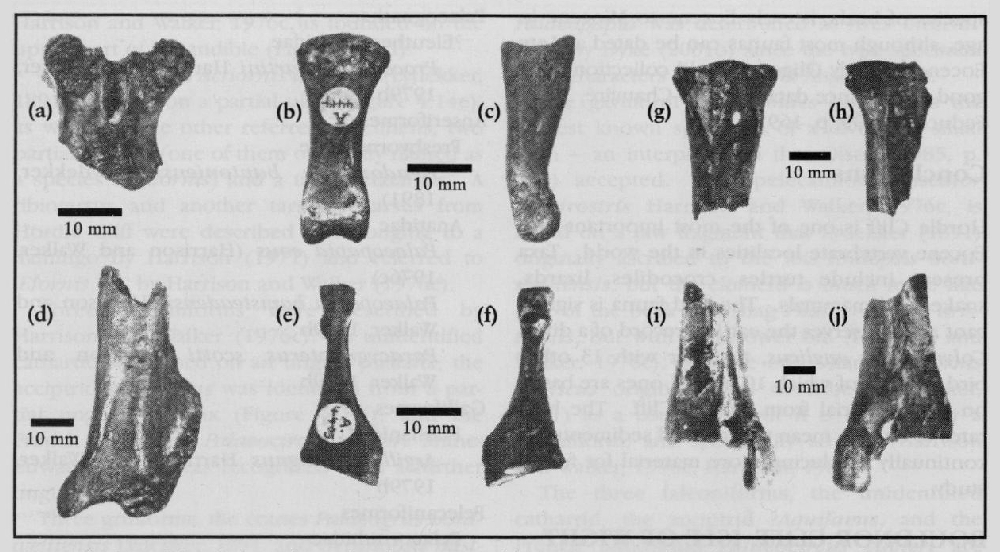
The Bouldnor Cliff locality has produced specimens of nine species, of which five are the type materials of species described by Lydekker (1891) and Harrison and Walker (1979b) from Bouldnor Cliff. Bouldnor Cliff is just east of the town of Yarmouth. Some specimens of bird bones are labelled 'Yarmouth', and are likely to be from the western end of the Bouldnor Cliff locality, and relatively low in the sequence.
The flightless ratite bird Proceriavis martini Harrison and Walker, 1979b, was based on a partial cervical vertebra and a toe phalanx from Yarmouth
The galliform (gamebird) Argillipes nzagnus Harrison and Walker, 1979b, was based on a partial tarsometatarsus from Yarmouth and another tentatively referred tarsometatarsus from Bouldnor Cliff
Interpretation
In the Hampshire Basin, a sequence of over 600 m of clastic sediments, with minor limestones, rests unconformably on the Chalk. These sediments represent a series of transgressions and regressions. Marine conditions predominated from soon after the beginning of the Eocene Epoch, until the end of Mid Eocene times in central and eastern parts of the basin, when non-marine environments became increasingly significant (Daley, 1989; Armenteros et al., 1997).
Three main environments of deposition have been suggested for the
The ratite Proceriavis martini shows affinities with modern ostriches and cassowaries, but the remains are too incomplete for further determination (Harrison and Walker, 1979b). This find of a ratite in England may seem unusual, but such flightless birds are relatively widespread in the Eocene and Oligocene deposits of Europe (Houde, 1988).
The three ducks Palaeopapia eous (Harrison and Walker, 1976c), Palaeopapia hamsteadensis Harrison and Walker, 1979b, and Paracygnopterus scotti Harrison and Walker, 1979b, are respectively comparable in size to a true goose of the genus Branta, the shelduck Tadorna ferruginea and a whistling duck of the genus Dendrocygna. Note, however, that Dyke (2001b) was not convinced that Palaeopapia has any diagnostic anseriform characters, nor whether P hamsteadensis belongs to the genus. Dyke (2001b) was also unconvinced by the limited material of Paracygnopterus scotti, referring it also to Ayes incertae sedis.
The gamebird Argillipes magnus Harrison and Walker, 1979b, was about the size of a domestic fowl Gallus gallus. The falconiform Oligocathartes olsoni Harrison and Walker, 1979b, was assigned to the family Cathartidae, containing today the New World vultures.
The birds are mainly representative of terrestrial and freshwater environments, except for the possible pelecaniform bony-toothed bird Macrodontopteryx, a thorough-going marine form best known from the Early Eocene
Comparison with other localities
Early Oligocene bird fossils have been reported from the
The presence of some of the Bouldnor Cliff bird taxa (Headonornis hantoniensis, Palaeopapia eous) in the Late Eocene record of Hordle Cliff indicates faunal continuity between the two time periods. Two of the genera (Macrodontopteryx, Argillipes) are also known from the Early Eocene
Conclusions
Bouldnor Cliff, near Yarmouth on the Isle of Wight, has yielded one of the best early Oligocene bird faunas in Europe and possibly the world. Nine bird species have been reported, of which five are type specimens of species named from the site. The cliffs are undergoing erosion, and the site has great potential for future finds.