Headon Hill, Isle of Wight
Introduction
The locality of Headon Hill displays a section of sediments spanning all of Late Eocene (Priabonian) time
Headon Hill has been studied extensively, initially during the 19th century, with the first report of mammal specimens from the site in a stratigraphical account by Prestwich (1846) and a description of one of the artiodactyls by Owen (1857a).Further new records from the
Description
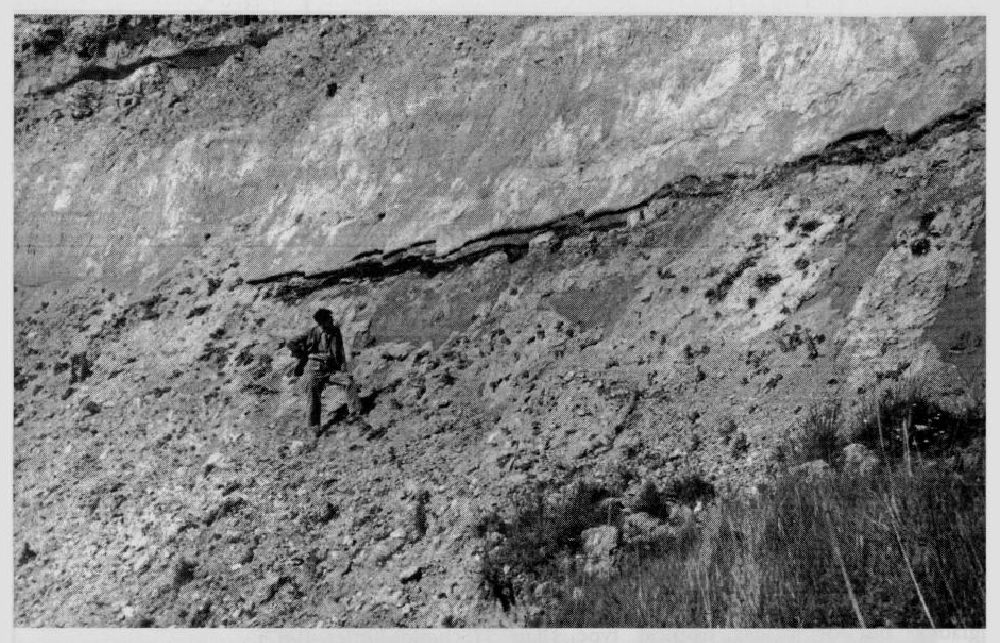
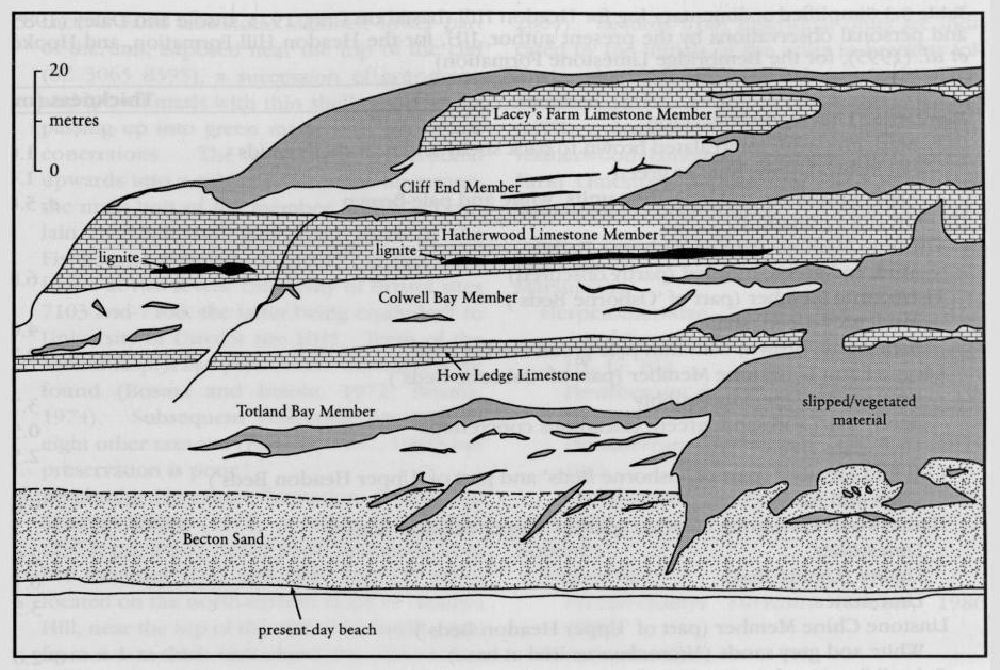
At Headon Hill Late Eocene sediments are exposed in the cliff, although vegetation and landslips obscure parts of the succession
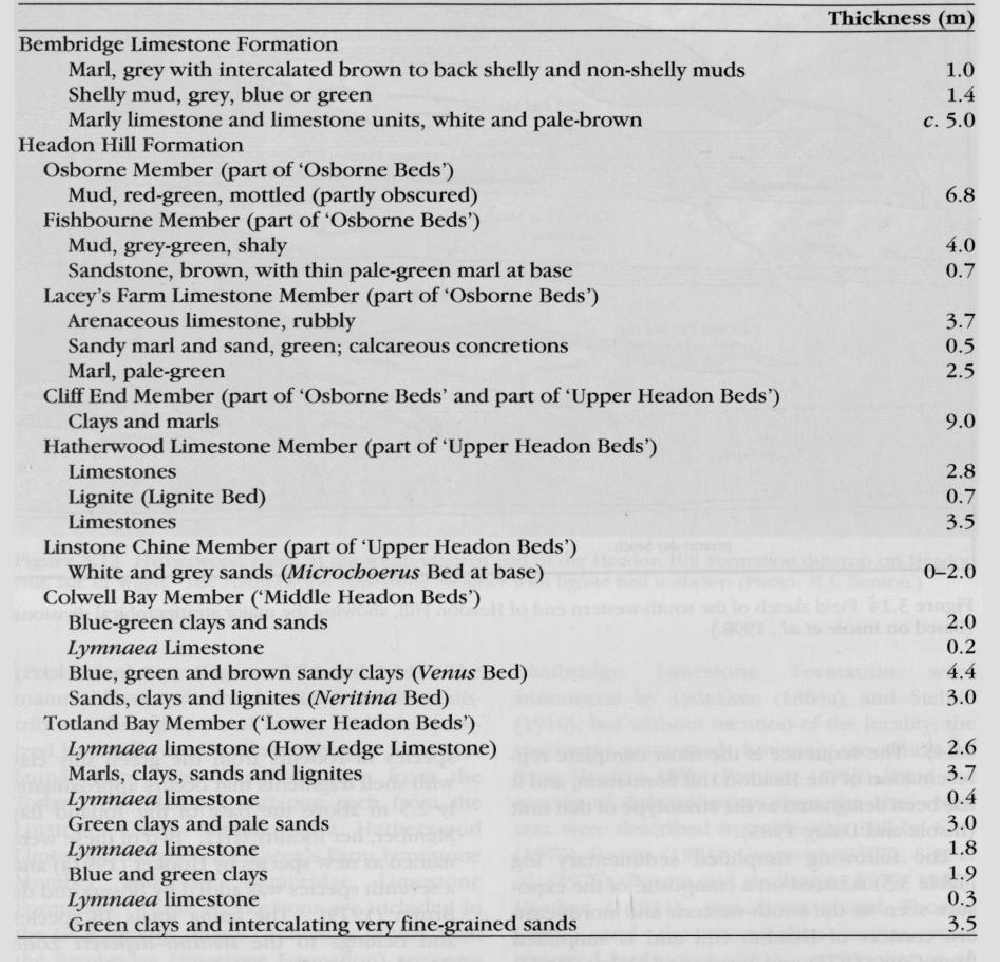
The following simplified sedimentary log
The exact provenance of most of the older Headon Hill specimens is not recorded in detail. Cray (1973, pp. 19–27) analysed existing records, and he himself discovered some relatively productive horizons.
- Tolland
Bay Member , green clay at base of section, 2.1 m above theBecton Sand Formation (Headon Hill Sands'): a fragmentary lower jaw of Dichodon cuspidatus (Wright, 1852; Owen, 1857a). Bosma (1974) described six species of rodents from the green silty clay with shell fragments that occurs approximately 2.5 m above the base of the TollandBay Member , her locality HI-11. Two of these were named as new species by Hooker (1991a) and a seventh species was added by Bosma and de Bruijn (1979). The fauna totals 18 species and belongs to the stehlini–depereti Zone (Hooker, 1987) and Mammal Paleogene Reference Level MP17A (Legendre and Hartenberger, 1992). - Tolland
Bay Member , green marl immediately below the How Ledge Limestone: a partial skeleton, as yet undescribed (Cray, 1973). Bosma (1974), Bosma and de Bruijn (1979, 1982) and Hooker (1991a) described 11 species of rodents from grey-green marls below the How Ledge Limestone, from Bosma's locality HH2. The fauna totals 29 species and belongs to the vectisensis–nanus Zone (Hooker, 1987) and Mammal Paleogene Reference Level MP17B (Legendre and Hartenberger, 1992). Linstone Chine Member , Microchoerus Bed, a small lenticular horizon of buff clay-rich sand containing wood debris at the base of the unit, some 100 m in lateral extent and located at the south-west corner of Headon Hill: 16 species, generally small in size (Hooker, 1987), site found in 1962 (Cray, 1973).Hatherwood Limestone Member , Lignite Bed, a 0.4–0.7 m thick unit of carbonaceous clay and lignitic shell marl, filling an eroded surface, located about a third of the way up the vertical cliff formed by the limestone on the south-west seaward face of Headon Hill: 33 species, the most extensive fauna from theHeadon Hill Formation , found since 1961 (earlier isolated finds, including that noted by Prestwich (1846) also probably came from this member). Bosma's (1974, p. 26) localities HH3 and HH4, respectively below and above a 0.5 m lignite bed, produced rodent remains from brown silty marls. A few larger mammals have also been found in the upper limestone unit of the member (Franzen, 1968; Hooker and Thomas, 2001)- Lacey's Farm Limestone Member, lower part of the unit, exposed near the top of the cliff
[SZ 3065 8595] , a succession of grey-green and brown marls with thin shelly sand seams passing up into green marls with calcareous concretions. The marls are transitional upwards into a rubbly arenaceous limestone, the main unit of the member, which is overlain by laminated grey-green clays of theFishbourne Member . Mammal remains were found at two levels, University of Bristol sites 7103 and 7106, the latter being equivalent to University of Utrecht site HH5. Teeth of the rodent Isoptychus pseudosiderolithicus were found (Bosma and Insole, 1972; Bosma, 1974). Subsequent collecting has yielded eight other taxa too (Hooker, 1987; 1992) but preservation is poor. Bembridge Limestone Formation . Bosma and Schmidt-Kittler (1972, p. 182) and Bosma (1974, pp. 26–7) noted fossil mammals from her localities HH6 and HH7[SZ 317 863] , located on the north-eastern slope of Headon Hill, near the top of the cliff. The fossils came from a 1 m-thick unit above the main lower limestone succession of theBembridge Limestone Formation . The unit is composed of marls and black muds, and it is overlain by a fine pale-yellow sand of probable Quaternary age. The fossils were found in the black muds with shell fragments in the upper part of the unit. Specimens included isolated teeth of the rodent Ectropomys exiguus Bosma and Schmidt-Kittler, 1972, a species founded on specimens from Whitecliff Bay (see GCR site report). More extensive collecting, summarized by Hooker et al. (1995, 2004), indicated a large fauna of 51 small and large mammals, found both in the main lower limestone unit and in nine separate horizons in the overlying muds and marls. The fauna belongs to the medium–curtum Zone (Hooker (1987) and Mammal Paleogene Reference Level MP19 (Schmidt-Kittler, 1987).
| Thickness (m) | |
| Marl, grey with intercalated brown to back shelly and non-shelly muds | 1.0 |
| Shelly mud, grey, blue or green | 1.4 |
| Many limestone and limestone units, white and pale-brown | c. 5.0 |
| 6.8 | |
| Mud, grey-green, shaly | 4.0 |
| Sandstone, brown, with thin pale-green marl at base | 0.7 |
| Lacey's Farm Limestone Member (part of 'Osborne Beds') | |
| Arenaceous limestone, rubbly | 3.7 |
| Sandy marl and sand, green; calcareous concretions | 0.5 |
| Marl, pale-green | 2.5 |
| 9.0 | |
| Limestones | 2.8 |
| Lignite (Lignite Bed) | 0.7 |
| Limestones | 3.5 |
| White and grey sands (Microchoerus Bed at base) | 0–2.0 |
| Blue-green clays and sands | 2.0 |
| Lymnaea Limestone | 0.2 |
| Blue, green and brown sandy clays (Venus Bed) | 4.4 |
| Sands,clays and lignites (Neritina Bed) | 3.0 |
| Tolland |
|
| Lymnaea limestone (How Ledge Limestone) | 2.6 |
| Mans, clays, sands and lignites | 3.7 |
| Lymnaea limestone | 0.4 |
| Green clays and pale sands | 3.0 |
| Lymnaea limestone | 1.8 |
| Blue and green clays | 1.9 |
| Lymnaea limestone | 0.3 |
| Green clays and intercalating very fine-grained sands | 3.5 |
Fauna
The fossil mammals are found in horizons that also contain plant remains, as well as fishes (Dineley and Metcalf, 1999) and reptiles (turtles, crocodiles, lizards, snakes; Benton and Spencer, 1995). The combined faunal list for all six major units is compiled from Cray (1973), Bosma (1974), Hooker (1992) and Hooker et al. (1995, 2004). Records from individual units are indicated by the initials of the units in brackets following the taxonomic name: lower Tolland
MAMMALIA
Marsupialia
Herpetotheriidae
Amphiperatherium spp. (LTB, UTB, LC, HL, LF, BL)
Peratherium cuvieri (Fischer, 1829) (UTB, HL, BL)
Peratherium perrierense Crochet, 1979 (BL)
Peratherium lavergnense Crochet, 1980 (BL)
Rodentia
Paramyidae
Plesiarctomys curranti Hooker, 1986 (LTB)
Pseudosciuridae
Sciuroides ehrensteinensis Schmidt-Kittler, 1971 (LTB, UTB)
Treposciurus mutabilis Schmidt-Kittler, 1970 (LTB, UTB, HL, LF)
Treposciurus gardneri Hooker, 1991a (LTB, UTB, HL, BL)
Suevosciurus bosmae Hooker, 1991a (LTB, UTB, LC, HL)
Suevosciurus minimus (Major, 1873) (BL)
Suevosciurus fraasi (Major, 1873) (BL)
Suevosciurus ehingensis Dehm, 1937 (BL)
Tarnomys quercyi vectisensis Bosma, 1974 (UTB)
Tarnomys 'quercyi quercyi' (Schlosser, 1884) (LC, HL, LF)
Tarnomys schmidtkittleri Hooker and Weidmann, 2000 (BL)
Theridomyidae
Isoptychus euzetensis (Depéret, 1917) (UTB)
Isoptychus pseudosiderolithicus de Boris, 1964 (HL, LF)
Isoptychus sp. (LC, BL)
Thalerimys hedonensis (Bosma, 1974) (LTB)
Thalerimys fordi (Bosma and Insole, 1972) (UTB, LC, HL, LF, BL)
Ectropomys exiguus Bosma and Schmidt-Kittler, 1972 (BL)
Gliridae
Glamys priscus (Stehlin and Schaub, 1951) (LTB, UTB, LC, HL, LF)
Glamys devoogdi (Bosma and de Bruijn, 1979) (BL)
Miniglis minor (Bosma and de Bruijn, 1982) (LTB, UTB, HL)
Gliravus daamsi Bosma and de Bruijn, 1982 (LTB, UTB, HL, BL)
Bransatoglis bahloi Bosma and de Bruijn, 1982 (UTB, LC, HL, BL)
Lipotyphla
Talpidae
Eotalpa anglica Sigé, Crochet and Insole, 1977 (LTB, UTB, LC, HL, BL)
Amphilemuridae
Gesneropithex grisollensis (Louis and Sudre, 1975) (LTB, UTB)
Chiroptera
Hipposideridae
Pseudorhinolophus sp. (BL)
Vespertilionidae
Stehlinia gracilis Revilliod, 1919 (BL)
Stehlinia minor (Revilliod, 1922) (BL)
Archonta undiff.
Nyctitheriidae
Saturninia gracilis Stehlin, 1941 (UTB, LC, HL, BL)
Euronyctia grisollensis (Sigé, 1976) (UTB, BL)
Scraeva hatherwoodensis Cray, 1973 (LC, HL)
Cryptotopos woodi (Cray, 1973) (UTB, LC, HL)
Cryptotopos sp. (BL)
Paradoxonycteris tobieni (Sigé, 1976) (BL)
Paradoxonycteris aff. tobieni (Sigé, 1976) (UTB, LC, HL)
Amphidozotherium cayluxi Filhol, 1877 (BL)
Primates
Omomyidae
Microchoerus erinaceus Wood, 1844 (LTB, UTB, LC, HL)
Microchoerus edwardsi (Filhol, 1880) (BL)
Pseudoloris parvulus (Filhol, 1890b) (UTB)
Adapidae
Leptadapis stintoni (Gingerich, 1977) (UTB, HL)
Leptadapis magnus (Filhol, 1874) (LTB, UTB, HL)
Protoadapis ulmensis (Schmidt-Kittler, 1971) (UTB, HL, BL)
Apatotheria
Apatemyidae
Heterohyus nanus Teilhard, 1922 (UTB, LC, HL, BL)
Pantolesta
Pantolestidae
Opsiclaenodon major (Lydekker, 1887) (LTB, UTB)
Dyspterna hopwoodi Cray, 1973 (HL)
Cryptopithecus sp. (BL)
Creodonta
Hyaenodontidae
Hyaenodon brachyrhynchus Blainville, 1841 (I-IL)
Pterodon dasyuroides Blainville, 1839 (BL)
Carnivora
Amphicyonidae
Cynodictis lacustris Gervais, 1852 (BL)
Cynodictis sp. (LC)
Artiodactyla
Cebochoeridae
Acotherulum saturninum Gervais, 1850 (HL)
Acotherulum quercyi (Stehlin, 1908) (BL)
Choeropotamidae
Rhagatherium cf. valdense Pictet, 1857 (LTB, BL)
Arvhirhagatherium edwardsi Hooker and Thomas, 2001 (HL)
Amphirhagatherium fronstettense (Kovalevskii, 1874) (BL)
Choeropotamus parisiensis Cuvier, 1821 (BL)
Cainotheriidae
Paroxacron sp. (BL)
Anoplotheriidae
Dacrytherium ovinum (Owen, 1857b) (HL)
Anoplotherium commune? Cuvier, 1804 (BL)
Anoplotherium latipes (Gervais, 1852) (BL)
Anoplotherium laurillardi? Pomel, 1851 (BL)
Diplobune sp. (BL)
Xiphodontidae
Xiphodon gracilis Cuvier, 1822 (BL)
Dichodon cuspidatus Owen, 1848b (LTB, HL)
Dichodon cervinus (Owen, 1841a) (BL)
Dichobunidae
Dichobune leporina Cuvier, 1822 (BL)
Amphimerycidae
Pseudamphimeryx hantonensis Cooper, 1928 (LTB, HL, LE)
Perissodactyla
Palaeotheriidae
Plagiolophus annectens (Owen, 1848b) (UTB, HL, LF, BL)
Plagiolophus minor (Cuvier, 1804) (BL)
Palaeotherium magnum Cuvier, 1804 (BL)
Palaeotherium muehlbergi Stehlin, 1904 (UTB, LC, HL, BL)
Palaeotherium duvali Pomel, 1853 (BL)
Palaeotherium curtum Cuvier, 1812 (HL, BL)
Palaeotherium medium Cuvier, 1804 (BL)
Pachynolophidae
Anchilophus radegondensis radegondensis (Gervais, 1852) (BL)
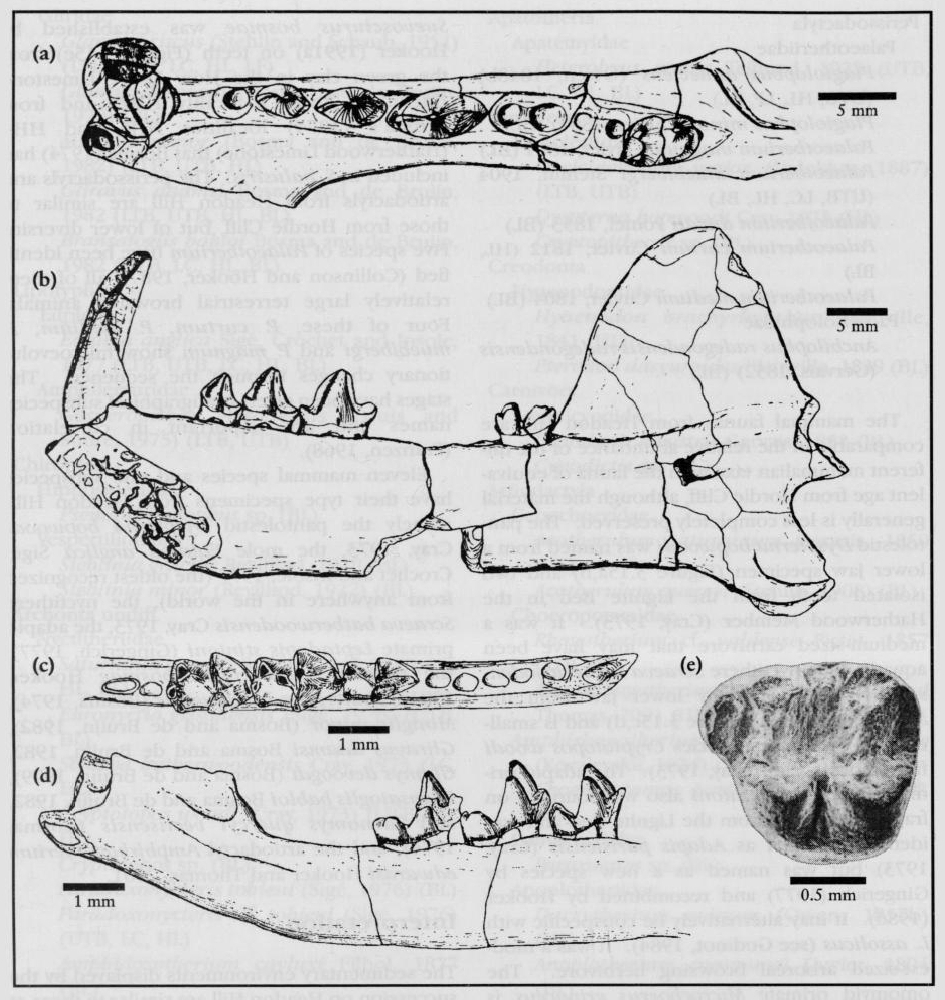
The mammal faunas from Headon Hill are comparable in the relative abundance of the different mammalian taxa with the fauna of equivalent age from Hordle Cliff, although the material generally is less completely preserved. The pantolestid Dyspterna hopwoodi was named from a lower jaw specimen (
The rodents from Headon Hill are more diverse than those from Hordle Cliff, and most of the glirid species recorded have their type specimens from the locality. The species Suevosciurus bosmae was established by Hooker (1991a) on teeth
Eleven mammal species and one subspecies have their type specimens from Headon Hill, namely the pantolestid Dyspterna hopwoodi Cray, 1973, the mole Eotalpa anglica Sigh, Crochet and Insole, 1977 (the oldest recognized from anywhere in the world), the nyctithere Scraeva hatherwoodensis Cray, 1973, the adapid primate Leptadapis stintoni (Gingerich, 1977), the rodents Suevosciurus bosmae Hooker, 1991a, Thalerimys headonensis (Bosma, 1974), Miniglis minor (Bosma and de Bruijn, 1982), Gliravus daamsi Bosma and de Bruijn, 1982, Glamys devoogdi (Bosma and de Bruijn, 1979), Bransatoglis bahloi Bosma and de Bruijn, 1982, and Tarnomys quercyi vectisensis (Bosma, 1974), and the artiodactyl Amphirhagatherium edwardsi Hooker and Thomas, 2001.
Interpretation
The sedimentary environments displayed by the succession on Headon Hill are similar to those at Hordle Cliff (see GCR site report). The succession also is dated by the same criteria as used at Hordle Cliff, although only the lower mammal-bearing units within the Tolland
Two mammal assemblages from Headon Hill, those from the How Ledge Limestone green clay (upper Tolland
The depositional environments of the
The
Comparison with other localities
The
Higher faunas at Headon Hill have no or insignificant representation at other British localities (except at Lacey's Farm Quarry — see GCR site report). They can, however, be compared with faunas in continental Europe. Thus the
The
These mammal-bearing localities in continental Europe, although faunally rich, are mostly isolated geographically one from another, often occurring in different basins, and may have no superpositional information at all, such as the fissure fillings of Quercy (France), Mormont (Switzerland) and Bavaria (Germany). Therefore, the long sequence of superposed mammal levels at Headon Hill is unique and vital for demonstrating the time order of most European Late Eocene faunas.
Conclusions
Headon Hill has international importance for its a unique sequence of superposed mammal faunas spanning all of Late Eocene time that can be used to calibrate stratigraphically and geographically isolated faunas in the rest of Europe. It is the stratotype for the Headonian European Land Mammal Age (Bosma, 1974; Fahlbusch, 1976) and is the only site in the Hampshire Basin at which a succession of four European mammalian biozones (stehlini–depereti, vectisensis–nanus, pseudosiderolithicus–thaleri and medium–curtum) can be observed. Early collections consist almost entirely of a few large mammals found by prospecting. Screenwashing in the 1960s and 1970s and ongoing large-scale sediment processing and sieving, operations (e.g. Hooker et al., 1995) are both enlarging the faunas and increasing the density of the succession. Stratigraphical overlap with Hordle Cliff is restricted to the