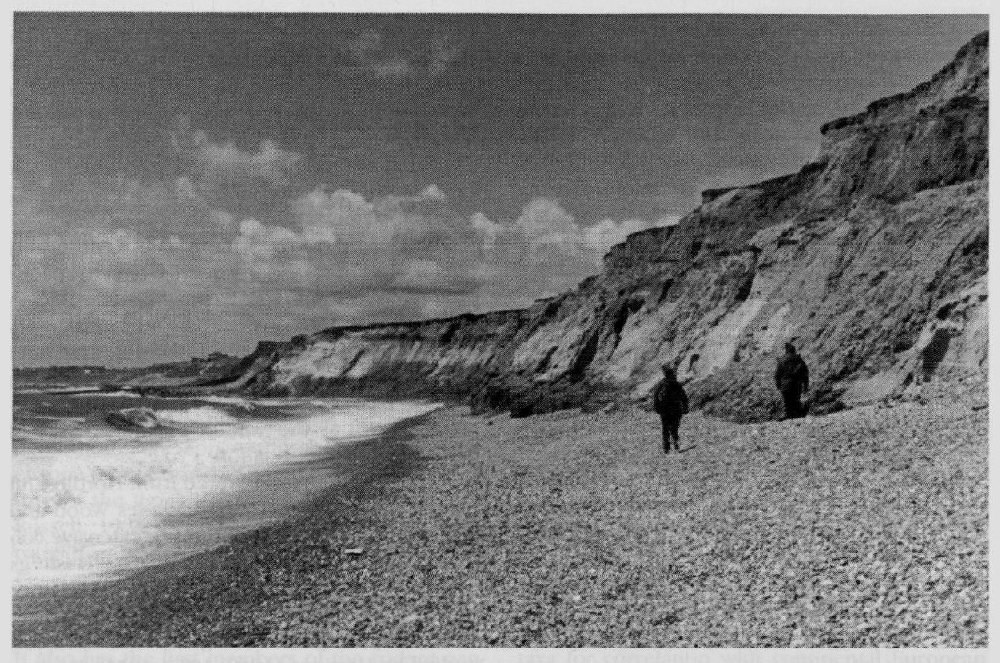
Hordle Cliff, Hampshire
Introduction
Hordle Cliff has produced one of the richest early Late Eocene (early Priabonian) mammalian faunas in Europe, belonging to the Headonian European Land Mammal Age. Other taxa, for example turtles, crocodilians, lizards, snakes and birds, are also well-represented (Benton and Spencer, 1995; Holman, 1996; see Chapter 4). What also makes the site exceptional is the exquisite preservation of fragile bones, especially in the Mammal and Crocodile beds.
The Hordle (formerly Hordwell) Cliff locality
Fossils have been recovered from Hordle Cliff since the 19th century, when Searles Wood and the Marchioness of Hastings made extensive collections of vertebrate material. The Hastings Collection is held at the Natural History Museum, London. Hordle Cliff also has a long history of geological investigation and has been studied by Hastings (1848, 1852, 1853), Tawney and Keeping (1883), Gardner et al. (1888), Curry (1958), Cray (1973), Milner et al. (1982), Plint (1984), Edwards and Daley (1997) and Hooker (1992). Early accounts of the fossil mammals from Hordle Cliff were published by Wood (1844, 1846), Owen (1848a,b 1857b), Lydekker (1884a, 1885a,b) and Cooper (1926b). Stehlin (1910) provided an overview of the fauna, and he listed 16 species from Hordle Cliff. Further revisions and additions of individual mammals from Hordle Cliff were made by Butler (1946), Simons (1961), Franzen (1968), Hooker (1991a, 2001), Harrison et al. (1995), Norris and Harrison (1998a,b) and Hooker and Thomas (2001). Cray (1973) provided an overview of the fauna and revised the non-ungulate 'mammals in some detail. Comprehensive revised faunal lists have been provided by Hooker et al. (1980), Collinson and Hooker (1987) and Hooker (1987, 1992).
Description
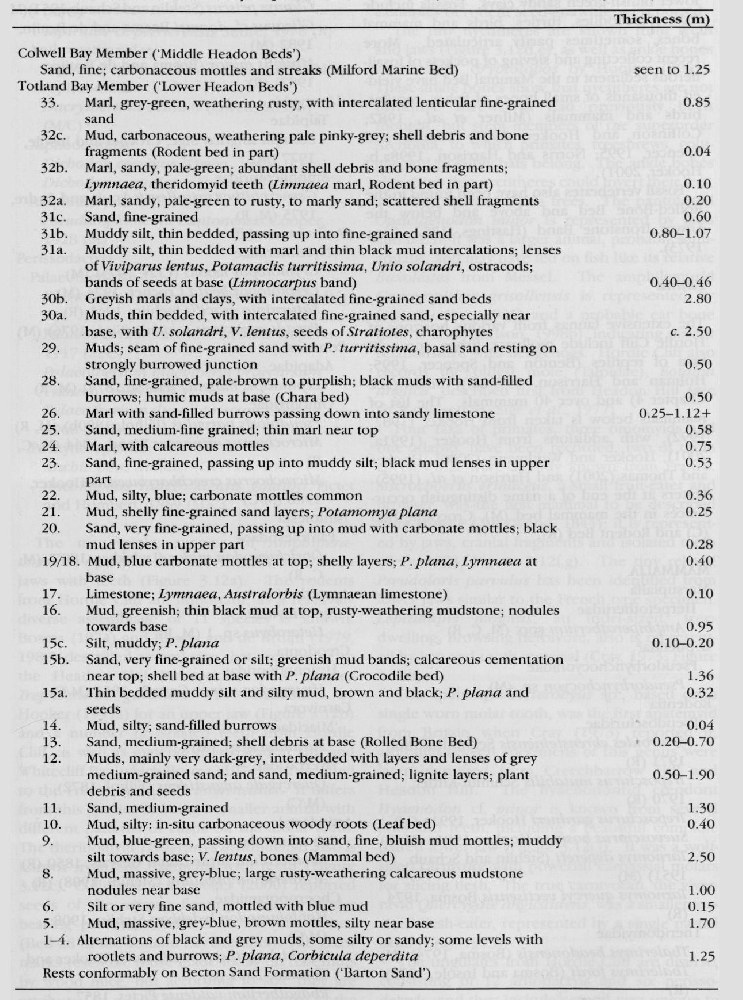
Since the 19th century, the sedimentary sequence exposed at Hordle Cliff has been successively described by Hastings (1852), Tawney and Keeping (1883), Gardner et al. (1888), Cray (1973) and Plint (1984). The most recent account is by Edwards and Daley (1997), from whom the following composite sequence
The lowest part of the section, seen just east of Becton Bunny, exposes the
The fossil vertebrates have been found mainly in the lbtland
The Rodent Bed consists predominantly of grey clays and marls. It has produced an extensive fauna of rodent jaws, turtle carapace, teeth and bone fragments of crocodiles, snake vertebrae, and teeth and bones of other mammals (Hastings, 1852). Cray (1973) noted occasional rodent teeth and turtle fragments from this horizon and observed that all of the specimens were small and fragmentary and presumably transported and water-sorted.
The Crocodile Bed is composed of an upper, soft, white sandy layer and a lower brownish indurated layer. Fossils from this horizon included crocodile and turtle remains (Hastings, 1852), with spectacular nearly complete crocodile skulls and turtle carapaces.
| Thickness (m) | |
| Sand, fine; carbonaceous mottles and streaks (Milford Marine Bed) | seen to 1.25 |
| 33. Marl, grey-green, weathering rusty, with intercalated lenticular fine-grained sand | 0.85 |
| 32c. Mud, carbonaceous, weathering pale pinky-grey; shell debris and bone fragments (Rodent bed in part) | 0.04 |
| 32b. Marl, sandy, pale-green; abundant shell debris and bone fragments; Lymnaea, theridomyid teeth (Limnaea marl, Rodent bed in part) | 0.10 |
| 32a. Marl, sandy, pale-green to rusty, to manly sand; scattered shell fragments | 0.20 |
| 31c. Sand, fine-grained | 0.60 |
| 31b. Muddy silt, thin bedded, passing up into fine-grained sand | 0.80–1.07 |
| 31a. Muddy silt, thin bedded with marl and thin black mud intercalations; lenses of Viviparus lentus, Potamaclis turritissima, Unio solandri, ostracods; bands of seeds at base (Limnocarpus band) | 0.40–0.46 |
| 30b. Greyish marls and clays, with intercalated fine-grained sand beds | 2.80 |
| 30a. Muds, thin bedded, with intercalated fine-grained sand, especially near base, with U. solandri, V. lentus, seeds of Stratiotes, charophytes | c. 2.50 |
| 29. Muds; seam of fine-grained sand with P. turritissima, basal sand resting on strongly burrowed junction | 0.50 |
| 28. Sand, fine-grained, pale-brown to purplish; black muds with sand-filled burrows; humic muds at base (Chars bed) | 0.50 |
| 26. Marl with sand-filled burrows passing down into sandy limestone | 0.25–1.12+ |
| 25. Sand, medium-fine grained; thin marl near top | 0.58 |
| 24. Marl, with calcareous mottles | 0.75 |
| 23. Sand, fine-grained, passing up into muddy silt; black mud lenses in upper part | 0.53 |
| 22. Mud, silty, blue; carbonate mottles common | 0.36 |
| 21. Mud, shelly fine-grained sand layers; Potamomya plana | 0.25 |
| 20. Sand, very fine-grained, passing up into mud with carbonate mottles; black mud lenses in upper part | 0.28 |
| 19/18. Mud, blue carbonate mottles at top; shelly layers; P. plana, Lymnaea at base | 0.40 |
| 17. Limestone; Lymnaea, Australorbis (Lymnaean limestone) | 0.10 |
| 16. Mud, greenish; thin black mud at top, rusty-weathering mudstone; nodules towards base | 0.95 |
| 15c. |
0.10–0.20 |
| 15b. Sand, very fine-grained or silt; greenish mud bands; calcareous cementation near top; shell bed at base with P. plana (Crocodile bed) | 1.36 |
| 15a. Thin bedded muddy silt and silty mud, brown and black; P. plana and seeds | 0.32 |
| 14. Mud, silty; sand-filled burrows | 0.04 |
| 13. Sand, medium-grained; shell debris at base (Rolled Bone Bed) | 0.20–0.70 |
| 12. Muds, mainly very dark-grey, interbedded with layers and lenses of grey medium-grained sand; and sand, medium-grained; lignite layers; plant debris and seeds | 0.50–1.90 |
| 11. Sand, medium-grained | 1.30 |
| 10. Mud, silty: in-situ carbonaceous woody roots (Leaf bed) | 0.40 |
| 9. Mud, blue-green, passing down into sand, fine, bluish mud mottles; muddy silt towards base; V. lentus, bones (Mammal bed) | 2.50 |
| 8. Mud, massive, grey-blue; large rusty-weathering calcareous mudstone nodules near base | 1.00 |
| 6. |
0.15 |
| 5. Mud, massive, grey-blue, brown mottles, silty near base | 1.70 |
| 1–4. Alternations of black and grey muds, some silty or sandy; some levels with rootlets and burrows; P. plana, Corbicula deperdita | 1.25 |
| Rests conformably on |
The
Fossil vertebrates also have been found in the Rolled-Bone Bed and above and below the Lower Ironstone Band (Hastings, 1852; Cray, 1973).
Fauna
The extensive faunas from various horizons at Hordle Cliff include molluscs, fishes, some 40 taxa of reptiles (Benton and Spencer, 1995; Holman and Harrison, 1998a,b), birds (see Chapter 4) and over 40 mammals. The list of mammals below is taken from Hooker (1987, 1992), with additions from Hooker (1991a, 2001), Hooker and Weidmann (2000), Hooker and Thomas (2001) and Harrison et al. (1995). Letters at the end of a name distinguish occurrences in the mammal bed (M), Crocodile Bed (C) and Rodent Bed (R).
MAMMALIA
Marsupialia
Herpetotheriidae
Amphiperatherium spp. (M, C, R)
Leptictida?
Pseudorhynchocyonidae
Pseudorhynchocyon sp. (M)
Rodentia
Pseudosciuridae
Sciuroides ebrensteinensis Schmidt-Kittler, 1971 (R)
Treposciurus mutabilis Schmidt-Kittler, 1970 (R)
Treposciurus gardneri Hooker, 1991a (M)
Suevosciurus bosmae Hooker, 1991a (M, R)
Tarnomys depereti (Stehlin and Schaub, 1951) (M)
Tarnomys quercyi vectisensis Bosma, 1974 (R)
Theridomyidae
Thalerimys headonensis (Bosma, 1974) (M)
Thalerimys fordi (Bosma and Insole, 1972) (R)
Gliridae
Glamys priscus (Stehlin and Schaub,1951) (M)
Gliravus cf. daamsi Bosma and de Bruijn,
1982 (M)
Miniglis minor (Bosma and de Bruijn, 1982) (R)
Lipotyphla
Talpidae
Eotalpa anglica Sigé, Crochet and Insole, 1977 (M)
Amphilemuridae
Gesneropithex grisollensis Louis and Sudre, 1975 (M, R)
Archonta undiff.
Nyctitheriidae
Cryptotopos woodi (Cray, 1973) (M)
Cryptotopos beata Crochet, 1974 (M)
Saturninia gracilis Stehlin, 1941 (R)
Paradoxonycteris tobieni? (Sigé, 1976) (M)
Primates
Adapidae
Leptadapis magnus (Filhol, 1874) (M, R)
Omomyidae
Pseudoloris parvulus (Filhol, 1890b) (M, R)
Microchoerus erinaceus Wood, 1844 (M, C, R)
Microchoerus creechbarrowensis Hooker, 1986 (M/C)
Pantolesta
Pantolestidae
Opsiclaenodon major (Lydekker, 1887) (M, C, R)
Apatotheria
Apatemyidae
Heterohyus sp. 1 (M, R)
Creodonta
Hyaenodontidae
Hyaenodon minor Gervais, 1852 (M/C)
Carnivora
'Miacidae
Paramiacis sp. (M)
Viverravidae
Quercygale angustidens (Filhol, 1872) (M/C)
Artiodactyla
Cebochoeridae
Acotherulum saturninum Gervais, 1850 (R)
Acotherulum pumilum (Stehlin, 1908) (R)
Choeropotamidae
Haplobunodon lydekkeri Stehlin, 1908 (M/C)
Amphirhagatherium edwardsi Hooker and Thomas, 2001 (C)
Rbagatherium valdense Pictet, 1857
Choeropotamus depereti Stehlin, 1908 (WC)
Tapirulus cf. perrierensis Sudre, 1978 (R)
Anthracotheriidae
Diplopus aymardi Kovalevskii, 1873b (WC)
Anoplotheriidae
Dacrytherium ovinum (Owen, 1857b) (M/C)
Xiphodontidae
Dichodon cervinus (Owen, 1846) (R)
Dichodon cuspidatus Owen, 1848b (M, C)
Amphimerycidae
Pseudamphimeryx hantonensis Cooper, 1928 (M)
Perissodactyla
Palaeotheriidae
Plagiolophus annectens (Owen, 1848b)(M,
C)
Palaeotherium magnum stehlini Deperet, 1917 (M/C)
Palaeotherium muehlbergi praecursum Franzen, 1968 (WC)
Palaeotherium duvali priscum Franzen, 1968 (M/C)
Pachynolophidae
Anchilophus dumasi (Gervais, 1849) (M/C)
Anchilophus radegondensis gaudini Pictet and Humbert, 1869 (M/C).
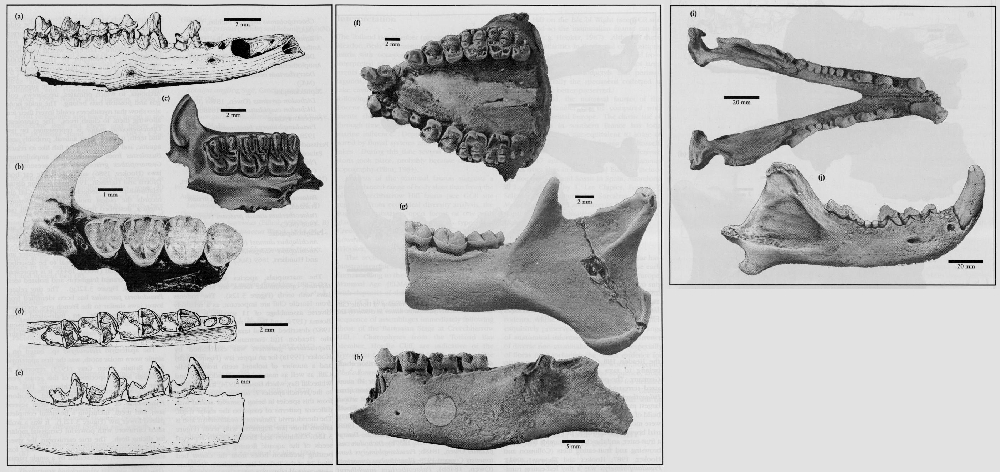
The marsupials, species of Amphiperatherium, opossum-like forms, are known from jaws with teeth (
The tiny nyctitheres are known from teeth and jaws (
Four taxa of primates, three omomyids and one adapid, have been recorded, two of them species that were already known from France. Microchoerus erinaceus, a small fruit-eater and browser, was the first mammal to be described from Hordle Cliff (Wood, 1844); it is represented by jaws, cranial fragments and isolated teeth (Cray, 1973;
The apatemyid Heterohyus sp., based on a single worn molar tooth, was the first apatemyid from Britain when Cray (1973) reported it, although several specimens of this genus were later identified from Creechbarrow Hill and Headon Hill. The hyaenodontid creodont Hyaenodon cf. minor is known from several jaws and teeth, including a beautiful complete paired lower jaw (
The ungulates from Hordle Cliff are diverse, consisting of 12 artiodactyls and six perissodactyls, and they include several taxa unique to the
Hordle Cliff is the type locality for 10 mammalian species and two subspecies: Treposciurus gardneri Hooker, 1991a; Cryptotopos woodi (Cray, 1973); Microchoerus erinaceus Wood, 1844; Opsiclaenodon major (Lydekker, 1887); Haplobunodon lydekkeri Stehlin, 1908; Diplopus aymardi Kovalevskii, 1873b; Dactytherium ovinum (Owen, 1857b); Dichodon cuspidatus Owen, 1848b; Pseudamphimeryx hantonensis Cooper, 1928; Plagiolophus annectens (Owen, 1848b), Palaeotherium muehlbergi praecursum Franzen, 1968 and Palaeotherium duvali priscum Franzen, 1968.
Interpretation
The
Analysis of the mammal faunas suggests a more balanced range of body sizes than from the older Creechbarrow Hill fauna (see GCR site report). From ecological diversity analysis, the suggested habitat is open forest or one with glades, but of a less tropical type than Creechbarrow Hill. The arboreal percentage, however, implies a fairly complex structure (Hooker, 1992, p. 500).
The section is dated by using non-marine biostratigraphical indicators. The mammal faunas belong to the Headonian European Land Mammal Age (ELMA) (Bosma, 1974), shared with deposits of the same age on Headon Hill (see GCR site report), and comparisons with equivalents in southern France establish a clear sequence of assemblages immediately following those of the Bartonian Stage at Creechbarrow Hill. Charophytes from the
The Hordle Cliff faunas from the
Comparison with other localities
The sedimentary sequence preserved at Hordle Cliff spans in age the lowest two horizons at Headon Hill on the Isle of Wight (see GCR site report), and so the mammalian faunas can be compared (e.g. Hooker, 1987). Although there are many similarities in the faunal compositions of the two sites, the assemblages recorded from Hordle Cliff have a greater proportion of large animals, especially artiodactyls and perissodactyls. Generally the specimens collected at Hordle Cliff are better preserved.
Farther afield, the mammal faunas of the Tolland
Conclusions
Hordle Cliff is important internationally for having one of the most taxonomically diverse early Late Eocene mammalian faunal suites in Europe. It is the type locality for 10 species and two subspecies of mammal. On a national scale, it has yielded many taxa of Late Eocene mammals, especially artiodactyls, perissodactyls and rodents, whose osteological remains are often exquisitely preserved and provide a wide range of anatomical information. The co-occurrence of diverse non-mammalian faunas and especially of floras (and including the oldest evidence for seed-gnawing by rodents in the world), together with the laterally well-exposed sequence, facilitating sedimentological study, allow for detailed palaeoenvironmental reconstruction. Coastal erosion here means that new material will be continually available for future study.