Mineralization associated with Caradoc igneous activity in North Wales
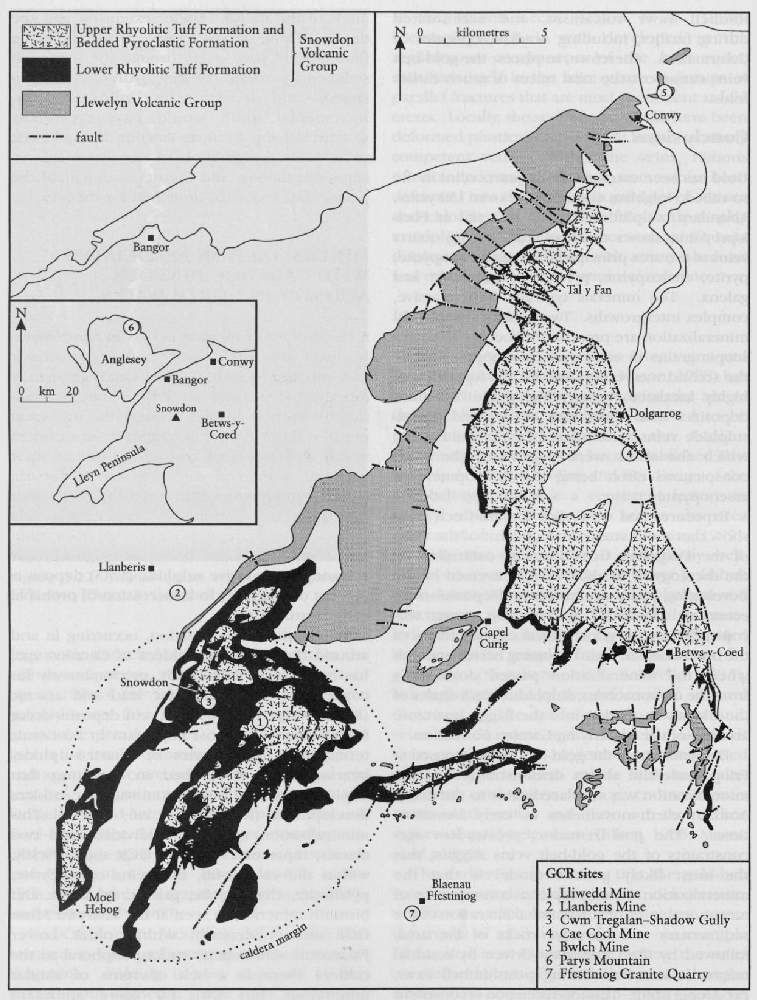
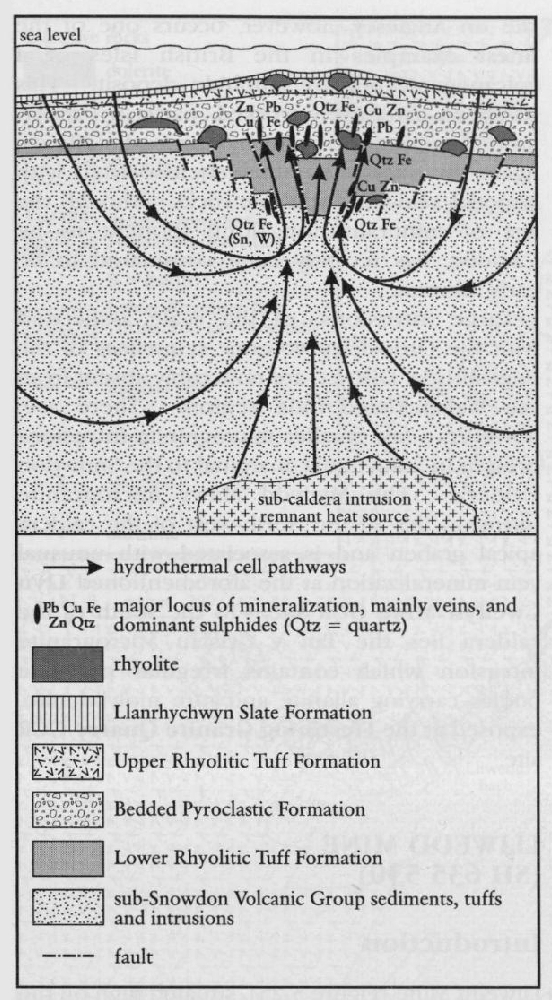
A range of mineralization occurs in North Wales in direct association with volcanic, pyroclastic and intrusive rocks of Caradoc age (Reedman et al., 1985; Howells et al., 1991). Vein mineralization exposed in and around the Snowdon massif is linked to the development of a caldera which was associated with eruption of a thick volcanic sequence of bimodal acid-basic composition
Vein-hosted mineralization, occurring in and around the Snowdon Caldera of Caradoc age, has been mined historically, predominantly for copper but also locally for lead and arsenic (Bick, 1982). Four types of vein deposits occur in the area. The most important in economic terms is a major series of quartz-sulphide-bearing veins, developed in a setting that implies a genetic association with the caldera development (Reedman et al., W85). This mineralization may be subdivided Into two classes, represented by two GCR sites. Firstly, within the caldera-fill, the veins carry pyrite, pyrrhotite, chalcopyrite, galena, sphalerite and bismuth minerals, as seen at the Lliwedd Mine GCR site. Secondly, within older Lower Palaeozoic sedimentary rocks peripheral to the caldera there is a belt of veins of similar mineralogy, but with far more abundant pyrrhotite as well as substantial arsenopyrite, represented by the Llanberis Mine GCR site.
Within the caldera, magnetite-hematite veins and breccia cements, with only minor sulphide content, represent a second type of mineralization. These veins carry minor scheelite and cassiterite, as seen at the Cwm Tregalan–Shadow Gully GCR site. Thirdly, an isolated but extremely unusual vein, outcropping to the west of the caldera at the margin of the Mynydd Mawr microgranite and tried at the Llyn Cwellyn Mine GCR site, contains fluorite and an associated quartz-carbonate-chalcopyrite-dominated assemblage which includes a number of rare, as yet undetermined, telluride minerals. The fourth type of vein mineralization consists of regional, probably Variscan, crustiform fissure- fill calcite-marcasite veins, although no site shows sufficient genetic importance to warrant GCR status.
The Snowdon Caldera developed in mid-Ordovician times (Howells et al., 1991) within an ensialic back-arc setting (Kokelaar et al., 1984). The products of extensive volcanic activity were deposited within a marine basin in which the predominant pattern of sedimentation involved the accumulation of fine- to coarse-grained siliciclastic sequences. Initial volcanism resulted in the deposition of the
The
The
After a break in activity, caldera resurgence occurred with the eruption of the basic volcanic rocks which comprise the
The various volcanic and sedimentary rocks underwent Acadian deformation in early to mid-Devonian times, and were folded along a northeast-south-west axial trend, with an associated axial planar cleavage. Metamorphism to lowermost greenschist facies occurred at some time prior to final deformation (Bevins and Robinson, 1988). In addition, with the exception of the crustiform fissure-fill veins, the mineralization was emplaced prior to Acadian deformation, as there is clear evidence for vein deformation (Fitches, 1987).
To the north of Snowdonia, at the Bwlch Mine GCR site, near Llandudno, an unusual mineral deposit comprising thin veinlets containing sulphantimonide mineralization occurs in highly silicified, nodular ash-flow tuffs of the
At the Cae Coch Mine GCR site a massive stratiform pyrite orebody occurring in black mudstones associated with basic lavas and tuffs is thought to represent contemporary volcanic exhalative mineralization, although an alternative syn-diagenetic fluid inhalation model has been proposed. At the Parys Mountain GCR site on Anglesey, however, occurs one of the finest examples in the British Isles of a volcanogenic massive sulphide deposit. This has been extensively worked, partly by underground mining and partly by opencast methods. Again the deposit is intimately associated with bimodal acid-basic volcanic rocks, although the age of mineralization, long thought to be Caradoc, has recently been considered to be early Silurian.
Large intrusions, of the scale associated with the Ordovician volcanic sequences of the English Lake District, are noticeably absent from the Welsh Caledonide region. There are, however, a few smaller microgranite intrusions present in Snowdonia, marginal to the Snowdon Caldera. The Mynydd Mawr microgranite intrusion lies to the north-west of the caldera apical graben and is associated with unusual vein mineralization at the aforementioned Llyn Cwellyn Mine GCR site. To the south of the caldera lies the Tan y Grisiau Microgranite intrusion which contains irregular pipe-like bodies carrying allanite and rare molybdenite, exposed at the Ffestiniog Granite Quarry GCR site.