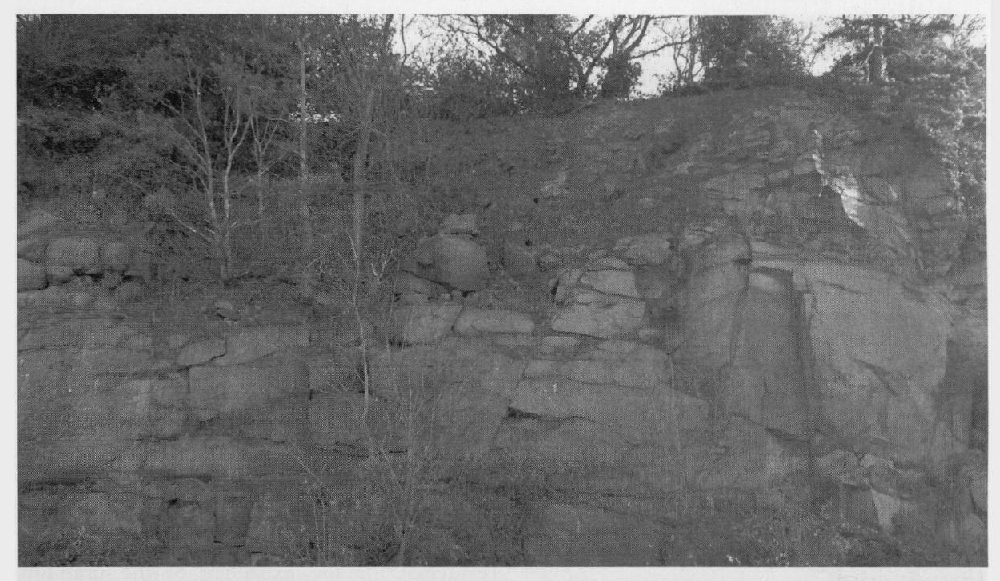
Warren Quarry, Leicestershire
Introduction
Also known as 'Warren Hill Quarry' and 'Enderby Stone Quarry', Warren Quarry worked a Caledonian hornblende tonalite within the Charnwood Forest inlier of Lower Palaeozoic and Precambrian rocks (Sylvester-Bradley and Ford, 1968). The hornblende tonalite is overlain by Triassic rocks of the
Description
The hornblende tonalite Is composed of up to 60% plagioclase, occurring as phenocrysts (2 mm) and groundmass, with 10% hornblende, 5% orthoclase and 15–20% quartz; accessory minerals include iron oxides, apatite and titanite (Le Bas, 1968).
The hydrothermal alteration of the tonalite at Warren Quarry involves the formation of a number of secondary minerals, including analcime, clearly associated with veining (King and Ford, 1968; Pearson and Jeffrey, 1997). Early alteration includes the sericitization and kaolinization of the feldspars, chloritization of mafic minerals, and the formation of secondary epidote. As alteration progressed, layers known as 'rammel' were formed. These are composed of the breakdown products described above, with residual quartz and feldspar. At the centre of the rammel 'beds' veins occur, dominated by the presence of the zeolite analcime, with quartz and calcite.
The tonalite at Warren Quarry represents the bedrock exposed during late Triassic times, when desert conditions prevailed. A number of wadi systems were formed in the Charnwood Forest area, and one of these is located at Warren Quarry (although not currently exposed). According to King and Ford (1968), the mineral palygorskite typically occurs within the
Palygorskite (otherwise known as 'attapulgite') is a fibrous clay mineral that is highly absorbent. Tien (1973) gave a detailed description of palygorskite from Warren Quarry, including beautiful transmission electron microscope images. The palygorskite fibres resemble those of a coarse textured paper, up to 10 mm long in some cases. Occurring in bundles, individual fibres are up to 0.1 mm across. Tien (1973) reported that the palygorskite is close to the magnesium end member composition Mg2Si8Al2O20(OH)6.4H2O.
Interpretation
The origin of the palygorskite is undoubtedly related to the unconformity and to weathering that took place under desert conditions in late Triassic times (Pearson and Jeffrey, 1997). Wright and Sadler (1994) draw parallels with modern examples in Australian inland drainage basins, where alkaline (pH 8–10) groundwater discharges into shallow playa-lakes with strong evaporation. In these circumstances, carbonate minerals and palygorskite both precipitate. Although the details of the late Triassic palaeogeography at Warren Quarry are unknown, the principle that the present is the key to the past suggests that it shared many characteristics with parts of present-day Australia.
Conclusions
Warren Quarry demonstrates the complexities of geological processes that take place at unconformities, where a combination of hydrological, hydrogeological and lithological factors influence the mineralogical composition of the rocks at the location. It provides evidence of specific weathering conditions during late Triassic times, when the climate was hot and semi-arid.