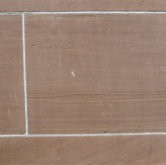
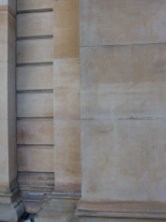
Around St Andrew Square — a Geoheritage walk in Edinburgh
Lothian and Borders Geoconservation
Full colour illustrated PDF download
Building stones of the New Town St Andrew Square and nearby streets
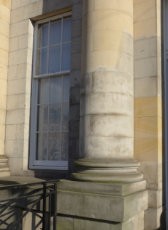
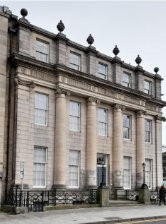
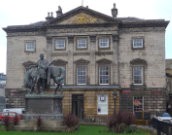
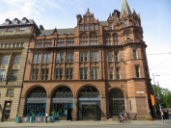
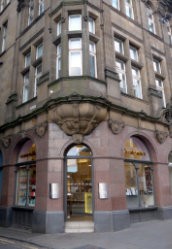
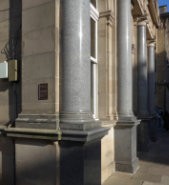
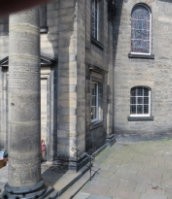
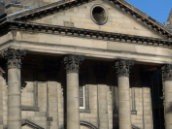
The walk described overleaf demonstrates the geology preserved in the largely sandstone masonry of a selection of neoclassical buildings and monuments in the eastern part of Edinburgh’s First New Town constructed in the late 18th and early 19th century. Imported rock types (largely igneous and metamorphic) employed in more recent architecture also feature. Designed by some of Scotland’s and the world’s most famous architects the buildings have a fascinating story to tell about the use of stone.
Edinburgh’s dramatic landscape today owes much to the varied nature of the underlying geology and the geological processes that operated in the past. The rocks were formed some 300 to 360 million years ago, in the period known as the
St Andrew Square is underlain by interbedded early
In 1750 the land lying to the north of today’s Princes Street Gardens (formerly a swampy lake called the North Loch) consisted of open fields, known as Bearford’s (originally Barefoot’s) Parks which culminated in a low ridge known as the Lang Dykes, along which runs the present George Street. To relieve the overcrowded small town of Edinburgh (the Old Town) occupying the ridge descending from the Castle to Holyrood Palace, a pamphlet entitled Proposals for carrying on certain Public Works in the City of Edinburgh was published in 1752. These ambitious proposals included the expansion of Edinburgh to develop a New Town (now part of the UNESCO Edinburgh World Heritage Site) on Bearford’s Parks. James Craig’s Plan, adopted by the Town Council in 1767, detailed the development of a series of parallel streets, the major thoroughfares being named from south to north as Princes Street, George Street and Queen Street. Charlotte Square (originally proposed as St George’s Square) and St Andrew Square were designed at either end of George Street.
Few of the first houses to be built on these streets exist today, Thistle Court (c. 1768 — see No. 25 in this leaflet) being regarded as the earliest surviving. For the early buildings, sandstones were worked locally in small quarries located near the present Waverley Station and in East Princes Street Gardens. Some of the elegant polished ashlar fronts of the 18th century prestigious buildings utilised durable, very fine-grained, blonde sandstone which came from the famous quarries at Craigleith lying to the west of Edinburgh. Nineteenth-century buildings also used Craigleith and other
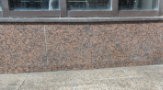
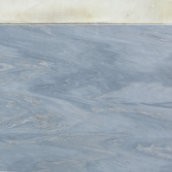
The buildings chosen in the itinerary display many additional rock types, many of which have been used as cladding (thin panels) for shop fronts. These can be considered as ‘geological wallpaper’. Obtained from other parts of Britain and overseas, they include sedimentary rocks (e.g. limestone), igneous rocks (e.g. polished granite, gabbro, diorite, and blue syenite), and metamorphic rocks (e.g. gneiss and marble).
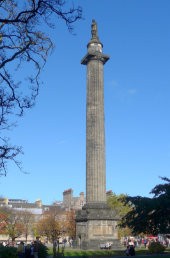
1 St Andrew Square Gardens, Melville Monument
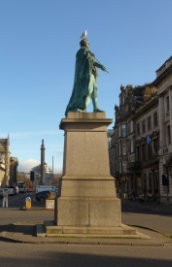
1 St Andrew Square Gardens, Melville Monument, memorial to Henry Dundas, Viscount Melville, 41.5 m high column (1821, designed by William Burn), is built of
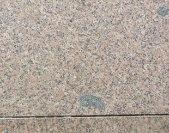
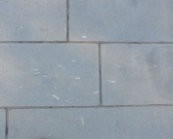
The recently laid surrounding sandstone pavement is made of Scoutmoor Sandstone from Yorkshire. Paving slabs for the diagonal pathways across the garden are made of grey porphyry with ‘floating’ large tabular white orthoclase feldspar crystals up to 5 cms long. Originating from Portugal, trade names for this stone include ‘Silver Granite’ and ‘Crystal Azul’. Similar pavement was laid in Festival Square off Lothian Road.
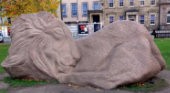
2. Ronnie Rae’s Lion of Scotland, St Andrew Square Gardens
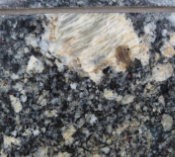
2 Also in the gardens is Ronnie Rae’s Lion of Scotland, sculpted out of c.450 million year old Corrennie Granite from Aberdeenshire. This sculpture was carved by hand (without power tools) over a year in 2002 out of a single block (20 tonnes) of quarried stone. It was moved from Holyrood Park to St Andrew Square in 2010. Corrennie Granite is a medium-grained biotite granite with a salmon-red colour making it favoured for decorative use. The granite exhibits an alignment of minerals known as foliation, with streaked out quartz crystals. Examples of use of Corrennie Granite include parts of the Glasgow City Chambers and the Tay Railway Bridge.
3 Harvey Nichols
3 Harvey Nichols (and entrance to Edinburgh Bus Station), (1999–2002, CDA Architects), Multrees Walk and east side of St Andrew Square, is clad in Catcastle Buff sandstone, from Brinscall Quarry, Blackburn, Lancashire (Dunhouse Quarries). It is a medium- to coarse-grained sandstone with quartz pebbles (Late
4 No. 35 St Andrew Square
4 No. 35 St Andrew Square, North Pavilion of Dundas House, Morgan House (former Royal Bank of Scotland and Barclays Bank, 1769, Robert Adam, built for Andrew Crosbie of Holm) is an original building constructed of
5. The Royal Bank of Scotland, Dundas House
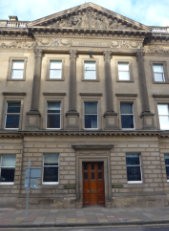
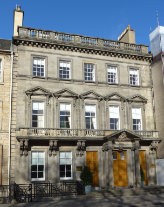
5 In the forecourt The Royal Bank of Scotland, Dundas House (1772–74, a mansion built by Sir William Chambers for Sir Laurence Dundas) is constructed of
6 Nos. 37–38, South Pavilion of Dundas House
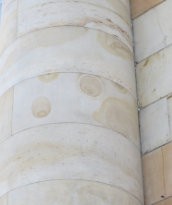
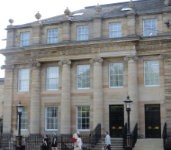
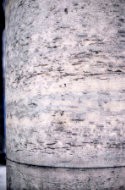
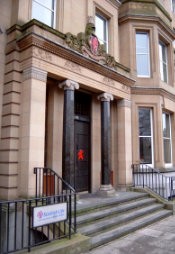
6 The original Nos. 37–38, South Pavilion of Dundas House, on the south side of the forecourt were built by John Young (1781) with instructions to match No. 35 St Andrew Square 6 (above). James Craig seems to have been the architect. It was altered internally and externally to the rear by William Burn in 1823, by David Bryce in 1851 and again more recently for the British Linen Bank. The sandstone is blonde and fine-grained. Many masonry blocks show wispy bedding, some with excellent Liesegang rings (concentric coloured bands of minerals which were precipitated after the sandstone had been deposited).
7. No.38, former Bank of Scotland
7 The present No.38, former Bank of Scotland (commissioned from Burn and Bryce 1846 by the British Linen Bank), is of cleaned
8 No. 42, The Edinburgh Grand
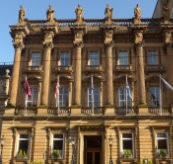
8 No. 42, The Edinburgh Grand next door (former Royal Bank of Scotland, designed as the Head Office of National Bank of Scotland in 1936; Leslie Grahame Thomson was commissioned but Arthur David of Mewès & Davis subsequently appointed), is of cleaned, brown-speckled, yellow
9 Guildford Arms
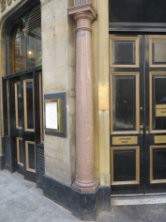
9 Guildford Arms (c.1800, reconstructed 1895–96 by Robert Macfarlane Cameron) and Café Royal Bar (1861, Robert Paterson with many subsequent alterations), Nos. 1, 3 and 17–18 West Register Street, are built of yellow sandstone, origin unknown, with columns and pilasters of 425 million year old pink Peterhead Granite, Aberdeenshire. The granite exhibits many xenoliths of grey Forest of Deer Granite.
10 Nos. 8–10 South St Andrew Street, formerly Hotel Paris
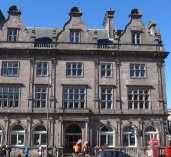
10 Nos. 8–10 South St Andrew Street, formerly Hotel Paris (1900, Cousin, Ormiston and Taylor), are thought to be of buff Blaxter Sandstone (
11 South-east corner of St Andrew Square
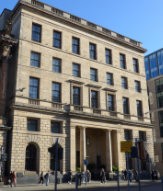
11 South-east corner of St Andrew Square. Nos. 1–2 St Andrew Square and 16–22 South St Andrew Street, former Prudential Assurance office (1892–5, Alfred Waterhouse & Son) is constructed of
The base course is Peterhead Granite. Balmoral Red granite (c. 540 million years old) from south-west Finland has been used at the base of a former entrance to the building on the east side.
12 No. 3 St Andrew Square, Dishoom
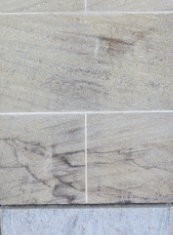
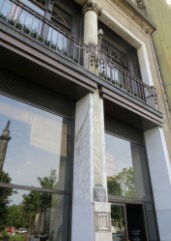
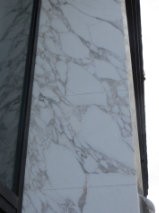
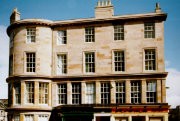
12 No. 3 St Andrew Square, Dishoom (designed as an extension of R W Forsyth’s store by Burnet, Son and Dick 1923–5) comprises a base course of tightly folded grey schist with white brecciated marble columns and cladding to the second floor. Above this there is original sandstone masonry with sandstone columns.
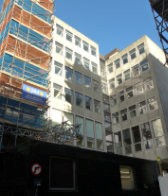
13 No. 6 St Andrew Square, a modern building
13 No. 6 St Andrew Square, a modern building (2016, CDA/Hoskins Architects) with panels of Bavarian Jura Limestone, a pale mottled, beige coloured limestone with numerous belemnite and ammonite fossils. This stone was also used recently for cladding of the new Council offices in Market Street. Jura Limestone was formed in tropical lagoons some 140 to 220 million years ago.
14 Former Scottish Widows building 9–10 St Andrew Square
14 Former Scottish Widows building (1962, Basil Spence, Glover & Ferguson) Nos. 9–10 St Andrew Square, has cladding of
15 Abbotsford Bar, north side of Rose Street
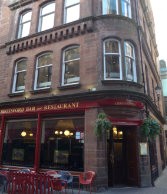
15 Abbotsford Bar, north side of Rose Street (1902, built by Charles Jenner as a part of his workshops), displays bright red, cross-bedded, desert dune sandstone of
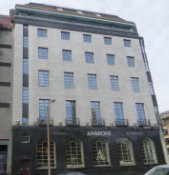
16 Amarone Restaurant and Capital Building
16 Amarone Restaurant and Capital Building, former Guardian Royal Exchange, George Street (south side) (1940, L Grahame Thomson and Frank J Connell), is Heworth Burn sandstone from Tyne and Wear, over gabbro. The east end of building is panelled with silver grey Creetown granite, Galloway, over black Bon Accord gabbro from South Africa.
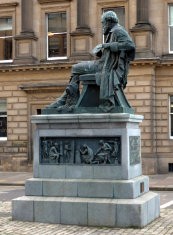
At the end of George Street, opposite Amarone, is the bronze sculpture by Alexander Stoddart (unveiled in 2008), of James Clerk Maxwell, the world-renowned physicist who developed the Theory of Electromagnetism. Maxwell and his dog Toby sit on a pedestal of grey granite imported from China. Maxwell’s experiments into light are alluded to through Greek mythology in two bronze figurative reliefs. On the south side Newton focuses a beam of light through a prism; on the opposite side Einstein demonstrates how light is governed and pulled by gravity.
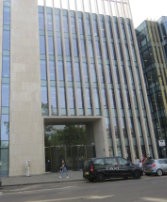
17 No. 10 George Street
17 No. 10 George Street, a modern glass-fronted building. The large windows are separated by panels clad with pale yellow, fine-grained, cross- bedded sandstone; the laminations are emphasised by grey carbonaceous fragments.
18 No. 14 George Street, The Dome
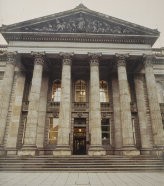
18 No. 14 George Street, The Dome, the former Royal Bank of Scotland with its Corinthian portico (1847, David Rhind), was constructed of
19 Royal Society of Edinburgh and Lakeland
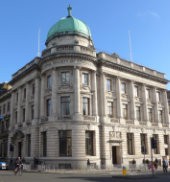
19 Royal Society of Edinburgh and Lakeland, corner of Hanover Street and George Street (1908–9, J M Dick Peddie), is built of fossiliferous Upper
The freestone is an oolitic limestone with fragments of marine bivalves and gastropods and is worth studying with a magnifier. Given this lithology, these carbonates were probably deposited on a platiorm in shallow water offshore, similar to the modern Bahama Banks.
20 Statue of King George IV
20 Statue of King George IV (1831, Sir Francis Chantrey), on the roundabout at the intersection of George and Hanover Street, is in bronze on an early
21 George Street (north side), St Andrew’s and St George’s Church
21 George Street (north side), St Andrew’s and St George’s Church, (1785, Maj. Andrew Fraser), columns and portico are of
22 No. 13 George Street, former Royal Insurance Company
22 No. 13 George Street, former Royal Insurance Company (1898, W Hamilton Beatie & Sons), now part of Abrdn (No. 23 below), is built of sandstone of unknown source with columns of Dancing Cairns granite from Aberdeen. Darker Rubislaw Granite forms the pedestals.
23 Abrdn (Standard Life Aberdeen plc), No. 1 George Street
23 Abrdn (Standard Life Aberdeen plc), No. 1 George Street on the corner with St Andrew Square (1897–1901, J
M Dick Peddie & George Washington Browne), is built of rusticated
24 Scottish Life building, 19 St Andrew Square
NT 25499 74149]
24 Scottish Life building (1962, Gordon & Fry), 19 St Andrew Square, has superb columns of larvikite, a blue syenite from Norway, which frame the entrance to St Andrew Square. The building is clad in Upper
25 Thistle Court, Thistle Lane
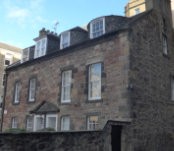
25 Thistle Court (1768), Thistle Lane, comprising two facing pairs of small houses, is reputedly the first to have been built in the New Town. It is rubble-constructed, that is with masonry of wholly or partly rough stones of varying shape and size, built 16 of local pink and yellow sandstones. Sandstone dressings around the windows of Nos. 3–4 (now an electrical transformer station) have been recently replaced. The grounds are private but locally derived sandstones and occasional basalt can be closely examined in the rubble-constructed boundary wall in Thistle Lane. The lane itself is laid with setts (cobbles) of silver-grey granites from Aberdeenshire with local black basalt and dolerite.
26 Buildings on the north side of St Andrew Square
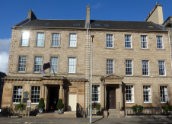
26 Buildings on the north side of St Andrew Square exhibit contrasting styles of walling methods from west to east. The walls of the upper floors of Nos. 21 and 22 (1775, John Young) are of coursed rubble, likely to be from Bearford’s Parks, once covered by stucco (render). These houses were built as main door flats with separate entrance and stair to other floors. The west gable of No. 21 is in droved ashlar. Between 1845–48 both houses were refaced at ground floor with ashlar of possibly
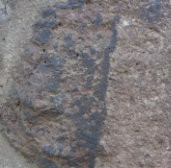
Some masonry blocks are massive, bedded with occasional rip-up clasts of mudstone (fragments derived from a pre-existing bed of mud). Wavy slump bedding is visible low down on the south-east corner. Good examples of cross-bedding are displayed on the north side in the street between this building and the Scottish National Portrait Gallery.
27 Former Scottish Equitable Assurance Building, Nos. 27–28 St Andrew Square
27 Former Scottish Equitable Assurance Building, Nos. 27–28 St Andrew Square (the original houses were replaced in 1899, J M Dick Peddie and George Washington Browne, with reconstruction in 1982 by Michael Laird), is of pink fine-grained sandstone from Doddington, Wooler.
28 Scottish National Portrait Gallery, Queen Street
28 Scottish National Portrait Gallery, Queen Street (1890, Sir Robert Rowand Anderson) is one of the earliest to use gaudy, red
29 Paton Building, Nos. 1–3 York Place and 15–19 North St Andrew Street
29 Paton Building, Nos. 1–3 York Place and 15–19 North St Andrew Street (1824, David Paton), was refaced with warm coloured
Location & facilities
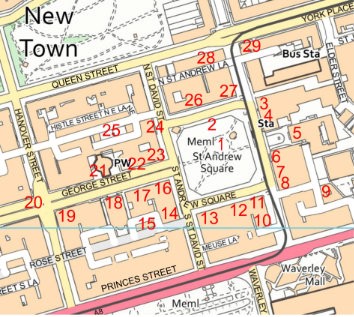
Dating back to 1770 and designed by James Craig as an integral part of his New Town Plan, St Andrew Square is in the heart of the New Town of the City of Edinburgh. On-street car parking is very limited. There are many local bus routes in Princes Street to the south of the square and in George Street to the west. Edinburgh Trams operate through Princes Street and the east side of St Andrew Square. The nearest public toilets are situated within Edinburgh Bus Station and Waverley Railway Station.
Safety
The walk described in this leaflet follows pavements and paths that may be uneven in places and busy through much of the year. The itinerary necessitates crossing a few busy city streets. The statue (Locality 20) is best viewed from surrounding pavements. Do not attempt to cross over to the roundabout.
Access and conservation
The itinerary falls entirely within the UNESCO Edinburgh World Heritage Site. For further information about Edinburgh World Heritage and the city’s history and culture visit https://ewh.org.uk/. Maps and trails are available from this website as free downloads. Details of Listed Buildings and Monuments in St Andrew Square and George Street are available on the Canmore website https://canmore.org.uk/ and the British Listed Buildings website https://britishlistedbuildings.co.uk/. St Andrew Square Garden is a privately owned Garden that had previously only been accessible to its owners (surrounding residents and businesses). The gardens were made open to the public in 2008 and are managed by Essential Edinburgh (https://www.essentialedinburgh.co.uk/). There are no geological exposures. Although the itinerary follows a normally accessible route, reference to buildings, property or land does not imply any public right of access.
Find out more about Edinburgh’s geology
This booklet is one of more than 20 geology and landscape publications about local sites available from Lothian and Borders GeoConservation as free downloads from https://www.edinburghgeolsoc.org/publications/geoconservation-leaflets/https://www.edinburghgeolsoc.org/publications/geoconservation-leaflets/.
Books including Lothian Geology and Building Stones of Edinburgh give more detail and are available from the Edinburgh Geological Society at https://www.edinburghgeolsoc.org/publications/.
Acknowledgements
Written by Andrew McMillan and members of Lothian and Borders GeoConservation. Images: Andrew McMillan, Mike Browne. Designed by Barry Tymon. We are grateful to the late Professor Gordon Walkden, University of Aberdeen, for information on the sources of granite used in several of the buildings. Produced by Lothian and Borders GeoConservaton, a commitee of the Edinburgh Geological Society, a charity registered in Scotland Charity No: SC008011.
©2025 Lothian and Borders GeoConservation