Skiddaw
J. Boardman
Introduction
Two aspects of the geomorphology of the Skiddaw massif are of interest, in the context of both periglacial processes and landforms. These are the existence of currently active patterned ground, and the evidence for a more severe periglacial climate in the past in the form of snow-bed features and protalus ramparts.
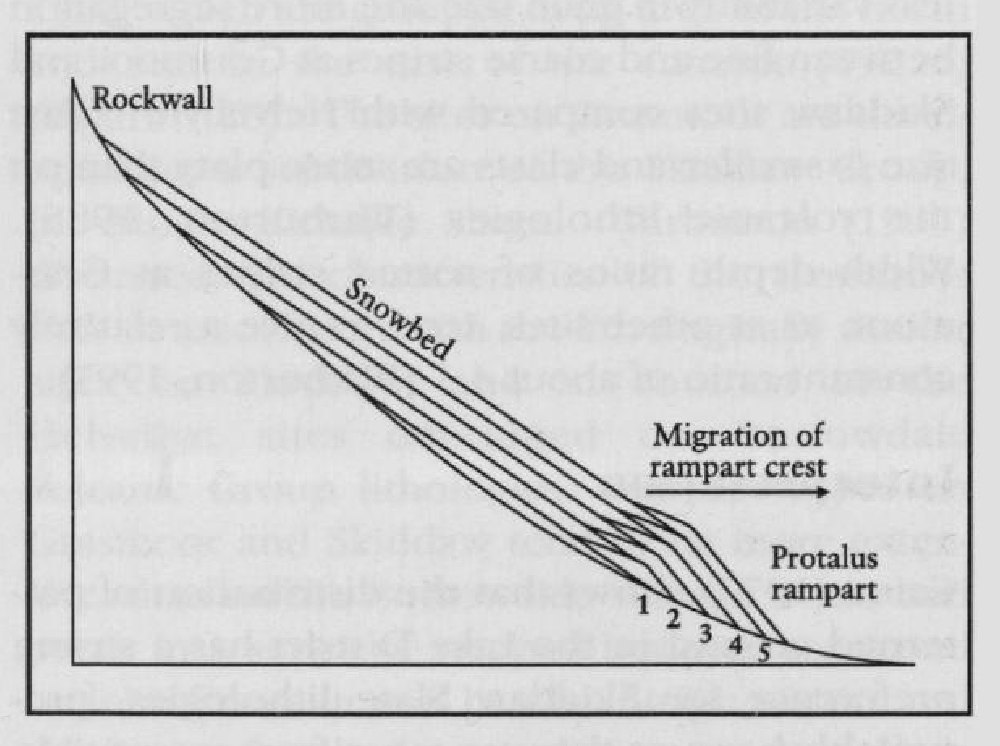
Patterned ground of the type generally associated with current or past periglacial conditions can be found on the high flat summits of Skiddaw, and Caine's (1972) survey of the central Lake District recorded the distribution of sorted, patterned ground comprising polygons and stripes. Snow-bed features and protalus ramparts are of importance because they point to the former existence of perennial snow beds, and therefore a climatic regime cooler and/or wetter than the present. 'Protalus ramparts' are curving ridges of coarse debris that accumulate at the foot of steep cliffs by sliding and rolling across a snow patch (Ballantyne and Kirkbride, 1987b)
Description
Warburton (1985) recorded patterned ground at six sites on Skiddaw and he described them in association with the lithologically similar sites on Grasmoor and in contrast to the Helvellyn sites, which are developed on
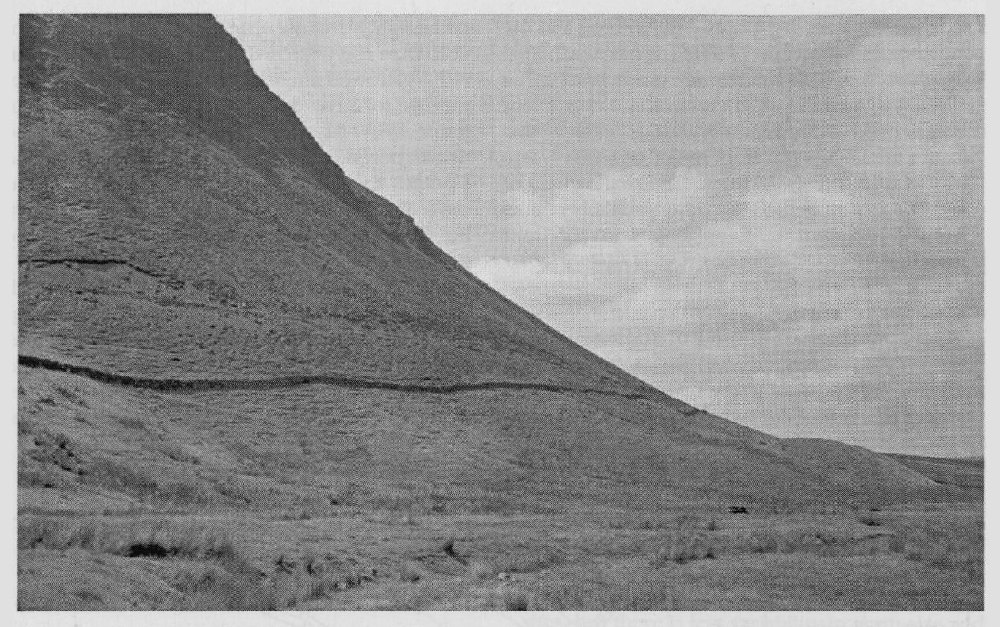
The snow-bed features at Dead Crags are shown in
Interpretation
Caine (1972) demonstrated that the distribution of patterned ground in the Lake District shows a strong preference for Skiddaw Slate lithologies, presumably because they are more frost susceptible than the Borrowdale Volcanics. Warburton (1997) showed a tendency for sites at higher elevations to have deeper sorting as a result of more frost days, and therefore greater frost heave potential at higher elevation. For the Skiddaw sites the relationship is rather poor and other factors seem to be operative, particularly the presence of frost-susceptible material at the site.
The protalus rampart was produced by rock clasts – released by frost action from an outcrop above a sheltered snow patch – sliding and rolling down the surface of the snow patch and accumulating as an arcuate ridge at its lower limit. In this respect, it is a typical example of these features and its existence attests to the severity of the climate, in terms of frost weathering, and the presence of a regional snowline. The feature is likely to have been developed during the Loch Lomond Stadial episode.
Conclusions
The periglacial patterned ground and snow bed and protalus rampart features of the Skiddaw area confirm the importance of periglacial processes, immediately following the Late Devensian deglaciation, during the Loch Lomond Stadial episode and, at high altitude, during the Holocene Epoch, to the development of the Lake District landscape.